ChatGPT Ads Hit a $1B Run Rate. OpenAI Is Building an Intent Marketplace

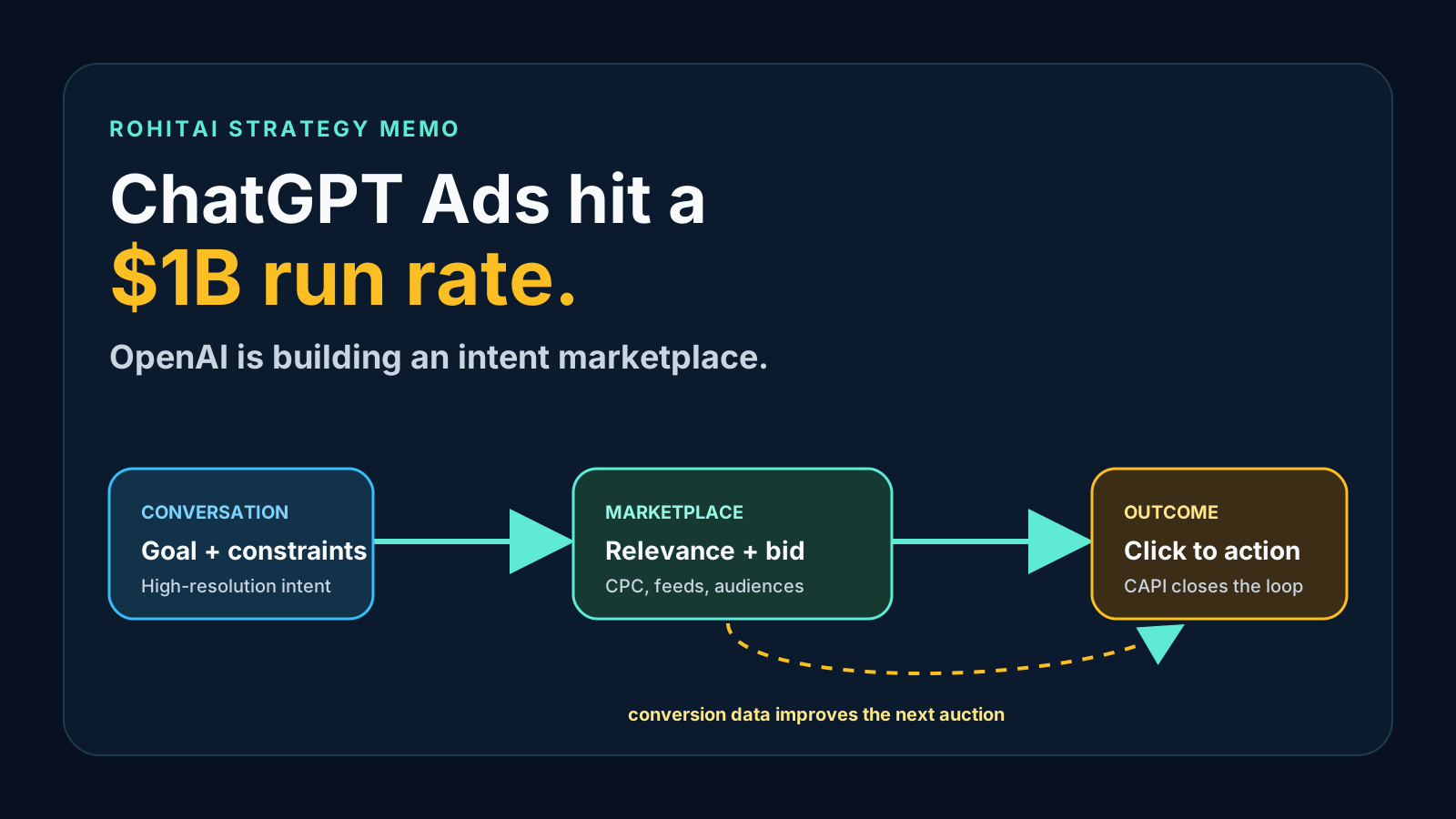
ChatGPT Ads reached a billion-dollar annualized pace in less than 200 days. The easy interpretation is that OpenAI found another way to monetize more than one billion weekly users. The more useful interpretation is that it now controls a new kind of commercial inventory: the moment when a person has explained a goal, narrowed the constraints, and is close to choosing what to do next.
On August 31, OpenAI said ChatGPT Ads had reached a $1 billion annualized revenue run rate. That is a snapshot, not $1 billion already earned. Digiday reports that OpenAI annualized its current monthly ad revenue, which works out to roughly $83.3 million per month if that pace holds. The same announcement says self-service Ads Manager access is expanding across India, Europe, the Middle East, and North Africa.
The headline proves advertisers are interested. The product underneath it is the bigger story.
OpenAI has already assembled semantic matching, relevance-weighted auctions, CPC and outcome-optimized bidding, product feeds, geographic targeting, custom audiences, Pixel measurement, a server-side Conversions API, and a programmatic Advertiser API. This is no longer a sponsored card attached to a chatbot. It is the commercial operating system around an intent-rich decision surface.
That distinction matters for builders. Search advertising starts with a query. Social advertising infers interest from behavior. ChatGPT can see the goal, budget, objections, tradeoffs, and decision criteria inside one conversation. If OpenAI can connect that live task state to a reliable outcome loop without breaking user trust, it owns an acquisition channel that neither search nor social perfectly reproduces.
OpenAI launched its U.S. ads test on February 9. By late March, it said the pilot had exceeded a $100 million annualized run rate in under six weeks. Five months later, the stated pace is ten times larger.
That is fast. It is also easy to exaggerate.
An annualized run rate takes a recent revenue pace and projects it across 12 months. It does not reveal actual 2026 year-to-date revenue, seasonality, credits, gross margin, advertiser retention, or how much spend came from launch incentives. OpenAI has not published platform-wide CTR, CPA, ROAS, invalid-click rates, repeat spend, or incrementality distributions.
The roughest scale check is revealing. Divide the $1 billion pace by OpenAI's stated one billion-plus weekly active users and you get less than $1 of annualized ad revenue per weekly user. That is not ARPU—the denominator includes paid, ad-free, under-18, Temporary Chat, and non-commercial usage—but it shows why the number can be both impressive and early. OpenAI has demonstrated demand without approaching incumbent ad-platform monetization density.
There is also a same-day rollout caveat. OpenAI's launch post says self-service starts later on August 31 across India, Europe, the Middle East, and North Africa. At publication time, its country availability page still marked India and 31 European countries as “Coming Soon” and did not enumerate MENA markets. The fair description is announced global expansion with a documentation lag, not every market instantly live.
Advertising platforms need an inventory unit. Search has the query. Social has the impression inside a feed. Retail media has the shopper near a product or checkout.
ChatGPT's native unit is different: an eligible conversation that has accumulated enough decision state to make a paid option useful.
Consider the difference between these two signals:
search query: "best project management software"

conversation state:
- 35-person remote product team
- migrating from spreadsheets
- needs EU data residency and SSO
- budget under $12 per seat
- rejected two tools because reporting is weak
- wants deployment before next quarter
The second signal contains a problem definition, buyer profile, constraints, objections, timing, and a likely next action. OpenAI says its ad system uses the current conversation's context and intent alongside ad and landing-page content, advertiser-provided context hints, targeting, and—where enabled—selected signals from the broader ChatGPT experience. Context hints are semantic guidance, not exact-match keywords.
That lets OpenAI protect the conversation from the advertiser while still monetizing what it understands about the task. OpenAI says advertisers do not receive private chats; they receive aggregated, non-identifying performance reporting. The platform keeps the most valuable matching context inside its own boundary.
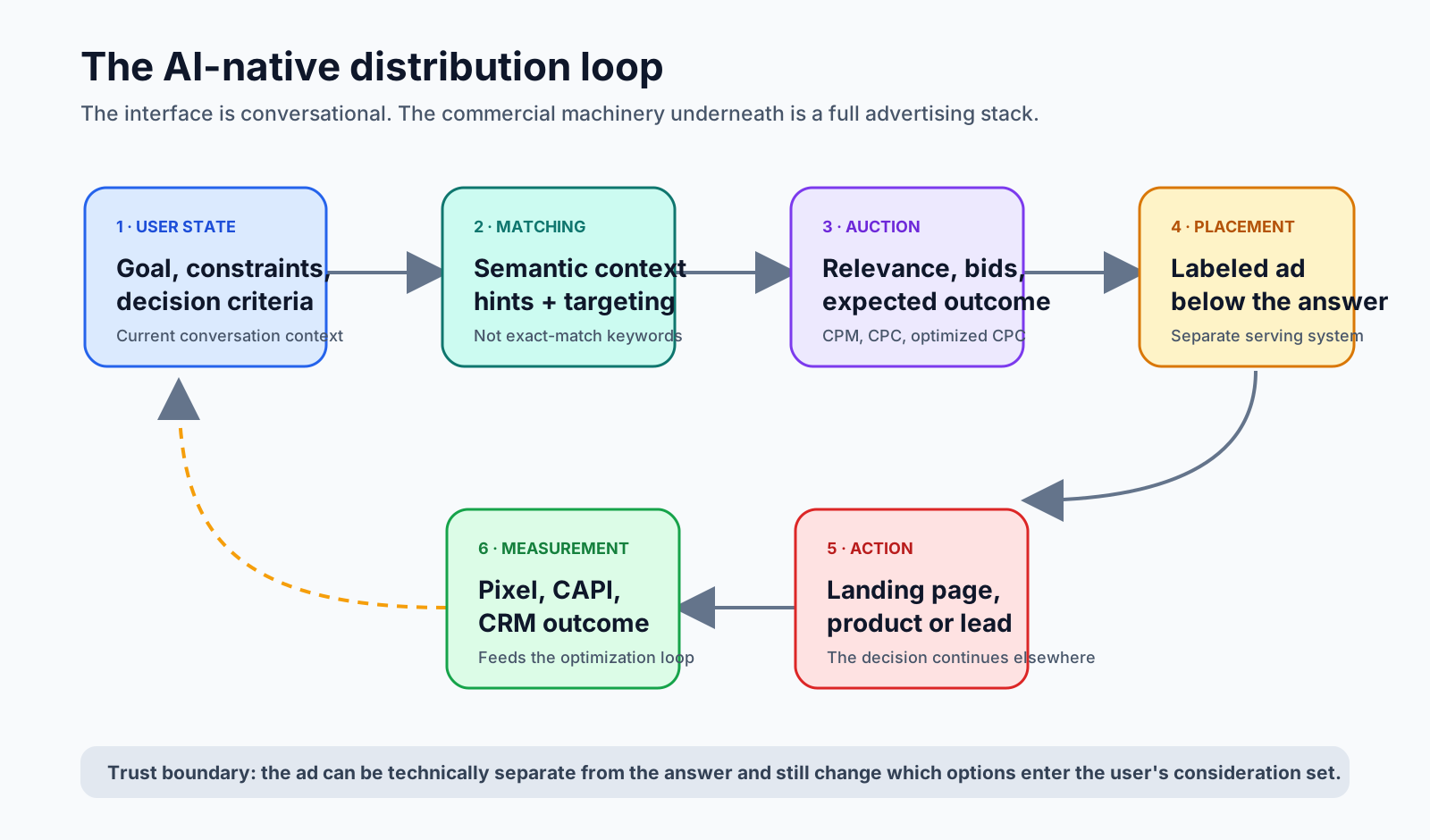
The interface begins with a conversation, but the business compounds through auction and outcome data.
This information asymmetry may become both the moat and the audit problem. OpenAI knows why the conversation matched. Advertisers know what they supplied and which conversions came back. Users see a labeled sponsored unit. Independent researchers see only the exposed output unless OpenAI provides deeper transparency.
The platform therefore has more privacy than handing a transcript to an advertiser, but less external legibility than keyword advertising. The matching logic is semantically rich and mostly invisible.
The “AI-native” part is the demand signal. Most of the commercial stack is recognizable.
OpenAI's advertiser documentation describes CPM and CPC buying in a relevance-weighted second-price auction. It recommends an initial maximum CPC bid of $3 to $5, but that is setup guidance—not an observed market average. Conversion-optimized CPC is in open beta, optimizes toward one selected standard event, and still bills per valid click rather than per conversion.
The company also supports product feeds, first-party custom audiences, geographic targeting, Pixel measurement, server-to-server conversion events, and an API for campaigns, ads, audiences, feeds, conversions, and reporting.
| Layer | What OpenAI provides | What is actually new | Builder risk |
|---|---|---|---|
| Intent | Current-conversation context, semantic hints, optional broader signals | Task state can be richer than a keyword or inferred interest | Opaque matching and hard-to-audit exposure |
| Auction | CPM, CPC, optimized CPC, relevance-weighted second price | New inventory surface, familiar auction mechanics | Limited public pricing and performance benchmarks |
| Creative and catalog | Ads, landing pages, context hints, product feeds | Dynamic product selection against a live conversation | Stale price or availability becomes acquisition failure |
| Measurement | Pixel, Conversions API, click and optional view-through reporting | Connects an AI decision surface to downstream outcomes | Consent, deduplication, attribution, and identifier governance |
| Activation | Custom audiences, geography, campaign API, partner ecosystem | Programmatic operation at global scale | Long-tail fraud, policy evasion, and regional restrictions |
This matters because the moat is unlikely to be “we put an ad under a chatbot answer.” That can be copied. The harder asset is the loop: intent quality, auction liquidity, conversion feedback, fraud defense, catalog freshness, consent handling, and policy enforcement.
Product feeds make the point clearly. They let OpenAI choose an eligible item at serving time using structured title, price, availability, image, and destination data. During beta, those feed products are for paid ads; they do not automatically become organic recommendations. For merchants, catalog truth becomes acquisition infrastructure. Better copy cannot rescue a stale price, out-of-stock product, or broken destination.
OpenAI says ads run on systems separate from the chat model, appear as labeled sponsored units below responses, and cannot shape, rank, or alter ChatGPT's answer. Those are meaningful product boundaries.
They do not settle the whole trust question.
A sponsored option can leave every word of the answer untouched and still change the user's consideration set. Placement affects salience. Repetition affects familiarity. A product shown immediately after a detailed comparison can receive attention that an equally relevant unpaid option does not.
The right trust dashboard therefore needs more than answer-difference tests. It should include exposure rates, repeat exposure, advertiser concentration, option-set inclusion, sensitive-context adjacency, demographic distribution, downstream actions, hide/report rates, and organic-versus-paid confusion.
An August preprint offers a useful but limited early baseline. Researchers ran 91 U.S. synthetic accounts through 127,801 conversations and observed 3,602 ads from 191 advertisers. During the March 8–31 collection window, 5.61% of interactions produced an ad. Among exposed accounts, the median account saw ads on 24% of prompts after first exposure. Ads were clearly separated from answers, and excluded sensitive topics had near-zero delivery.
The same audit found lower-income ZIP-code profiles were somewhat more likely to receive any ads. That is a correlation from a short, U.S.-only sock-puppet study with structured prompts and likely automation-detection effects. It is not evidence that OpenAI intentionally targets lower-income users. It is a reason to keep auditing as the system expands across languages, regions, and self-service advertisers.
The European rollout creates an unusually useful experiment.
OpenAI says personalized ads are not initially available in the European Economic Area or Switzerland, and its custom-audience documentation applies the same initial restriction there. Current-thread contextual matching can still work.
That produces two materially different environments:
EEA / Switzerland
current conversation context
no initial past-chat personalization
no initial custom audiences

other eligible markets
current conversation context
optional broader ChatGPT signals
first-party custom audiences where supported
If contextual-only European campaigns perform close to personalized markets, ChatGPT's distinctive value comes from the live task itself. If they lag badly after accounting for market mix, the platform may depend more heavily on conventional behavioral profiling than the AI-native story suggests.
That comparison will not be perfectly clean—markets, consent rates, advertisers, languages, and product mix differ—but it is more informative than another company-selected ROAS anecdote.
The regulatory timing is equally striking. On August 31, the European Commission designated ChatGPT a Very Large Online Search Engine under the Digital Services Act after it declared at least 45 million average monthly EU users. The designation gives ChatGPT four months to comply with additional systemic-risk duties. It was not caused by the ads announcement, but it means the self-service expansion arrives as transparency, risk assessment, ad-repository, and researcher-access expectations become more consequential.
Self-service is therefore both the revenue unlock and the integrity stress test. Managed sales can screen a limited group of large advertisers. A long-tail platform must verify many more businesses, review more landing pages, detect evasive creative, handle appeals, police restricted categories, and keep ads away from sensitive contexts in many languages.
OpenAI now has two complementary economic loops.
On one side, consumers, enterprises, and API customers pay to use intelligence. On the other, advertisers pay to enter the decision flow around that intelligence. The earlier RohitAI analysis of OpenAI's enterprise rate card showed how work becomes metered model consumption. ChatGPT Ads turns consumer decision state into a second monetizable surface.
That changes the strategic value of owning distribution. Supplying a strong model through someone else's interface earns model revenue but gives up the user relationship, auction, and conversion data. RohitAI's piece on OpenAI's planned Cursor cutoff framed model access as a platform dependency. ChatGPT Ads shows the opposite position: owning the interface lets OpenAI control demand creation and monetization end to end.
Three implications follow.
OpenAI says it does not optimize for time spent. It does not need to copy a feed's infinite-scroll economics if it can monetize fewer, higher-value moments. A ten-message buying conversation may create more commercial information than 30 minutes of passive browsing.
The metric to watch is not ads per weekly user. It is qualified sponsored opportunities per eligible decision journey.
A person who clicks after discussing constraints with ChatGPT should not land on a generic brand page that restarts discovery. The best destination should resume at proof, configuration, comparison, booking, or checkout.
Advertisers do not receive the private chat, so they cannot reconstruct every constraint. They can still design destinations for a high-intent visitor: show transparent pricing, concrete compatibility details, short configuration paths, and strong evidence above the fold.
OpenAI already supports product catalogs, purchases, subscriptions, trials, appointments, app installs, app opens, conversion optimization, and API-managed campaigns. That is more infrastructure than static display cards require.
The likely destination is an action marketplace: sponsored products that can be configured, leads that can be qualified, reservations that can be booked, apps that can be installed, or business agents that can handle a scoped handoff. OpenAI says it will explore more native ways for businesses to interact with consumers in ChatGPT. The current measurement stack is the foundation for that move.
Test when customers already compare specifications, pricing, compatibility, or vendors and you can measure a valuable downstream event.
Start with clean feeds, one reliable conversion goal, a controlled budget, and destinations designed to continue a decision.
Hold off when returns are thin, conversion quality is unknown, consent is unresolved, or your attribution stack cannot prove incrementality.
OpenAI highlights an ecommerce advertiser with 3x ROAS over 28 days and a partner saying more than 80% of ad-driven ChatGPT traffic came from new customers. Its named Newegg case study reports 3x ROAS across campaigns and 7x during a two-week sale.
Those examples show possibility, not expected performance. They lack disclosed spend, attribution design, control groups, and platform-wide distributions.
The right response is a controlled experiment.
Start with Pixel and the Conversions API, not optimized bidding. Confirm that the same purchase is not counted twice, that failed server batches are retried safely, and that CRM outcomes reconcile with Ads Manager. OpenAI's API currently accepts batches of up to 1,000 events; if one event in a batch fails, the entire batch can fail. That makes validation and idempotent retry behavior part of campaign quality.
Then test two kinds of demand capture. One campaign should use need-state context hints: what the user is trying to achieve, under what constraints, and at what decision stage. A second can use a product feed where assortment and availability matter. Keep a holdout geography or audience without ChatGPT spend where feasible.
Budget pacing needs its own guardrail. OpenAI defines a daily budget as a seven-day average: a campaign may spend up to twice the nominal daily budget on one day, while staying within seven times that budget across the applicable seven-day period. Small teams should set alerting and cash limits around the real pacing rule, not the label in the UI.
Finally, do not enable outcome optimization until the event stream is trustworthy. Conversion-optimized CPC can make a clean signal more useful. It can also make a broken signal scale faster.
The next phase is unlikely to be “more cards under more answers.” Four shifts look more plausible.
First, OpenAI will add action-oriented formats. Product checkout, reservations, lead capture, app installs, and sponsored business-agent handoffs fit the current event taxonomy and campaign infrastructure.
Second, Europe will become the most useful public signal of whether conversational intent can substitute for longitudinal profiling. OpenAI should publish performance ranges by contextual versus personalized inventory without exposing user data.
Third, transparency will become a product feature. The early academic audit had to simulate users to observe delivery. A mature marketplace needs a searchable ad repository, researcher access, clearer advertiser concentration reporting, and exposure metrics that go beyond clicks.
Fourth, business model will become part of assistant positioning. Anthropic has explicitly committed to keep Claude ad-free, arguing that assistant advertising creates incentives that conflict with working unambiguously for the user. OpenAI is making the opposing bet: separate the answer from the ad, give users controls, and use advertising to subsidize broader access.
Neither position is resolved by a slogan. OpenAI has to prove separation, relevance, and restraint at global self-service scale. Anthropic has to fund broad access without the same subsidy. Users will learn that “which assistant is best?” includes a business-model question alongside model quality, price, privacy, and tools.
Not from this announcement. OpenAI reported a $1 billion annualized revenue run rate, which annualizes a current revenue pace. Independent reporting says that pace is based on current monthly ad revenue multiplied by 12. It is not the same as $1 billion already booked or recognized.
OpenAI says no. Advertisers receive aggregate, non-identifying performance data rather than private chats, memories, or personal details. Advertisers can separately send conversion data—including permitted identifiers and downstream actions—under OpenAI's Conversion Terms, which creates its own consent and governance obligations.
No. OpenAI says ads can still use the context of the current chat thread. Turning personalization off prevents other chat threads, ad history, and topics from informing selection. Temporary Chats do not show ads.
OpenAI says ads are selected and served by systems separate from the chat model, clearly labeled, and displayed below responses. Advertisers cannot shape or rank the model's answer. A paid placement can still influence which options a user notices after reading that answer.
No. OpenAI announced self-service expansion across India, Europe, the Middle East, and North Africa beginning later on August 31, but its country table was still catching up at publication time and did not list every MENA market. Account creation and country availability are separate.
No broad migration is justified by the public evidence. Start with a measured pilot, preserve a holdout, test decision-continuation landing pages, separate paid and organic ChatGPT traffic, and scale only if incremental customer quality beats the existing mix.
The $1 billion pace is the first proof that advertisers will pay to enter ChatGPT's decision flow. It is not proof that the channel has durable returns, neutral exposure, or mature enforcement.
The durable asset is larger than the ad unit. OpenAI owns the conversation where intent becomes explicit, the auction that selects a paid option, the measurement stack that observes the outcome, and the interface that can eventually complete the action.
That is why this expansion matters to builders who never plan to buy an ad. Model capability can be rented through an API. Decision state, distribution, and outcome data compound inside the product that owns the user relationship.
ChatGPT is becoming an intent marketplace. The hard part now is proving that the marketplace deserves the trust already placed in the assistant.