Health in ChatGPT Moves the Safety Boundary Into Ordinary Conversations

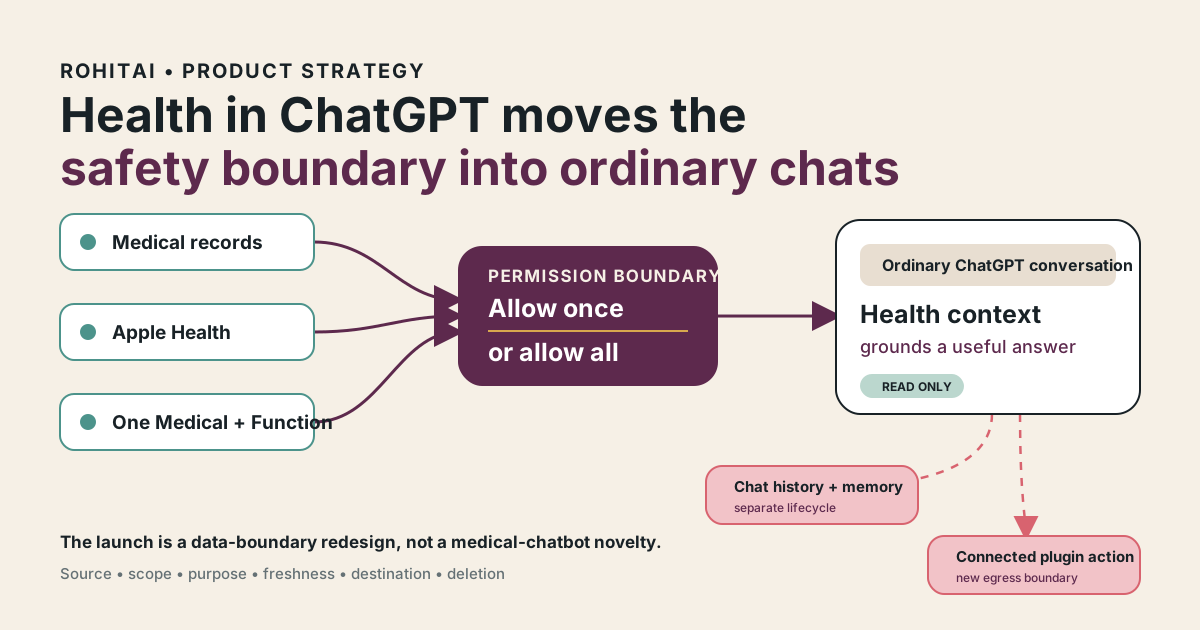
In January, OpenAI's answer to connected health context was a room. Medical records, Apple Health data, and Health-space memory did not flow into ordinary ChatGPT conversations.
On July 23, OpenAI replaced that wall with doors.
Connected health information can now inform an ordinary ChatGPT conversation: a restaurant search that accounts for an allergy, an exercise plan shaped by a recent injury, or a question about whether a lab result has changed. By default, ChatGPT asks before using that context. The user can approve that request once or choose to always allow access, which turns off future permission prompts.
That is the product change worth studying. Safety no longer depends mainly on where a conversation happens. It depends on whether a health fact may cross into it, what evidence travels with that fact, what the model infers from it, and which copies remain afterward.
OpenAI says more than 70% of health-related conversations among early users happened outside the old Health space. The company has not published the sample or methodology, but the product lesson is believable: people do not keep life neatly separated into app-defined modes. A food question can be a health question. A calendar plan can become a recovery question. Context is useful precisely because it follows the user.
It is also dangerous precisely because it follows the user.
Health in ChatGPT is a mass-market test of sensitive-data agent design. Medical records and wearables supply the context; permission, provenance, memory, deletion, and plugin egress determine whether that context remains governable.
The January Health launch kept sensitive information inside a dedicated experience. Health memory did not flow back into general ChatGPT. That was easy to explain: the place itself was the boundary.
The July launch keeps Health as the home for connecting accounts, browsing records, and reviewing trends, but lets connected context travel into other conversations with permission. Users can also invoke it explicitly with @Health.
The rollout is gradual, not universal on day one. OpenAI's current support page lists logged-in U.S. users aged 18 or older on Free, Go, Plus, and Pro. Web and iOS are supported; Apple Health requires an iPhone. The documented sources are supported U.S. provider portals, Apple Health, One Medical, and Function Health. Availability varies by provider and app, and OpenAI does not publish a complete provider list or field-level coverage map.
The connected sources are read-only. Health cannot write back to a provider record or Apple Health. Connected Health data is not currently available in Voice mode, and Health is not supported in Codex.
Those limits matter, but the architectural move matters more. OpenAI observed that a separate destination added friction, so it moved the boundary from location to authorization.
That resembles the direction I described in ChatGPT Work: ChatGPT is becoming a router for context that lives elsewhere. Health is the high-sensitivity consumer version of that idea. When the context is a medication list rather than a project file, invisible routing becomes a safety problem.
Take a simple fact: a provider record lists a penicillin allergy.
Conceptually, it begins in a source system. After provider sign-in and consent, the record syncs to Health. When that information becomes relevant in an ordinary conversation, ChatGPT by default asks whether connected Health information may be used. If allowed, ChatGPT may draw on the synced information and produce derivative text in chat history. If Memory is on, a conversational statement can influence future chats. If another connected plugin is asked to act, Health-derived information may approach a new destination. OpenAI has not disclosed its identity-matching, normalization, or retrieval implementation.
That is not one permission event. It is a journey:
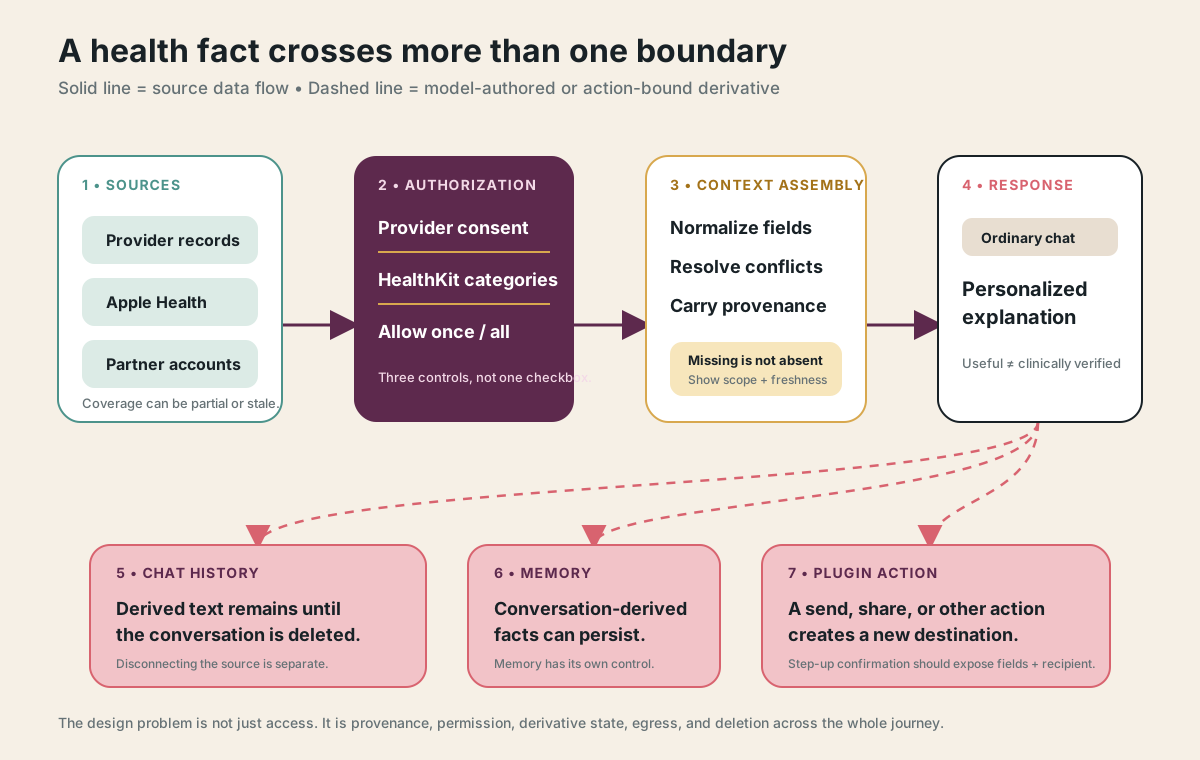
This conceptual flow is not a diagram of OpenAI's undisclosed internal architecture. Solid paths represent source data; dashed paths represent model-authored or action-bound derivatives with potentially different permission and deletion rules.
The useful distinction is between source objects and derived objects.
Disconnecting a provider account stops future syncing and schedules the synced source data for deletion from OpenAI's systems within 30 days. It does not remove information already incorporated into chat history; that remains until those chats are deleted. A memory created from that conversation is another object. A message sent through another plugin is another copy in another system.
This is why a binary “connected” badge is too weak. A trustworthy interface needs a permission receipt: source, fields used, time range, freshness, purpose, model version, destination, grant duration, and any downstream action. Without that receipt, users can authorize data movement without being able to reconstruct it.
Connected context sounds like more evidence. Sometimes it is. But medical data is not a clean personal truth database.
A medication list can be stale after a prescription stops. A diagnosis can be copied forward. Two portals can disagree. One hospital may be connected while another is missing. A wearable may write heart rate into Apple Health but keep its proprietary recovery score inside its own app.
Apple adds a subtler failure mode. HealthKit authorization is fine-grained: apps request access by data type, and for sample types users can grant a recent window rather than their full history. Apple also says an app cannot tell whether read permission was denied; a denied query can appear as though no matching samples exist.
For a model, that creates an epistemic trap:
no authorized data returned
        is not the same as
no measurement, medication, diagnosis, or event exists
Coverage metadata is therefore part of answer correctness. A safe response should say which sources and periods were checked, what was unavailable, and when each source last refreshed. “I found no result” is responsible only if the system also explains what it was able to search.
The risk is asymmetric: personalization may increase persuasion faster than truth. An answer that references a medication, recent lab, and sleep pattern can feel better grounded even when one of those inputs is stale.
Health in ChatGPT sits on top of a deliberate U.S. policy choice: patients should be able to move their records into an app they choose.
That portability is what makes longitudinal consumer health AI possible. It also creates a privacy handoff that many users will not expect.
HHS guidance says that when a HIPAA-covered provider sends electronic health information at a person's direction to an independent app that is neither a covered entity nor a business associate, the downstream copy is no longer governed by HIPAA. The provider's original record remains protected; HIPAA simply does not follow every user-directed copy into a consumer app.
OpenAI is explicit that consumer Health is not intended for covered-entity clinical use and does not come with a business associate agreement. It offers separate products for healthcare organizations and clinicians.
That does not mean the downstream copy enters a legal vacuum. The FTC enforces privacy promises and an amended Health Breach Notification Rule that reaches many non-HIPAA health apps and connected-device ecosystems. Unauthorized disclosure can matter, not only a hacker breaking into a database. State laws, including consumer-health statutes, add other duties.
I would not state that the FTC has formally classified ChatGPT Health under that rule; no such public determination was found. The narrower point is enough: portability can move data from a familiar medical-law regime into a consumer product governed by a different patchwork of promises, rules, and enforcement.
OpenAI says eligible paid Health users can receive GPT-5.6 Sol, while Free users have GPT-5.5 Instant available. The GPT-5.6 system card reports a length-adjusted HealthBench Professional score of 60.5 for Sol versus 51.8 for GPT-5.5, an 8.7-point gain. OpenAI's separate GPT-5.6 launch page lists GPT-5.5 at 49.5 with the same Sol score. OpenAI does not explain the discrepancy, so this article uses the internally consistent system-card pair and its stated 8.7-point delta.
That is an 8.7-point benchmark gain. It does not validate Health in ChatGPT end to end.
| Evidence | Result | Layer measured | What it does not establish |
|---|---|---|---|
| GPT-5.6 system card | Length-adjusted: Sol 60.5 vs GPT-5.5 51.8 | Model response quality on a physician-oriented rubric | Connector completeness, identity matching, retrieval, memory, or user outcomes |
| HealthBench Professional | 525 tasks; hard cases enriched about 3.5× | Difficult clinician chats | EHR-integrated workflows or institution-specific constraints, which the paper excludes |
| Nature Medicine triage test | 33 of 64 clear emergency cases were undertriaged | Structured January stress test on GPT-5-mini thinking | July models, real records, natural conversations, or a population error rate |
| Oxford randomized study | 1,298 UK adults, ten written scenarios; LLM help did not improve condition identification or next-step decisions | Human use of earlier general-purpose models | Current ChatGPT Health or connected-record performance |
The HealthBench Professional paper warns against treating absolute scores as a proxy for real-world performance. Because the paper excludes EHR-integrated workflows, it does not evaluate much of the shipped connector path: source authorization, record normalization, deduplication, freshness, retrieval, or provenance.
Independent evidence needs equally careful labels. A peer-reviewed Nature Medicine study tested the January product with GPT-5-mini thinking, synthetic vignettes, and a forced four-level triage format. In its clear emergency cases, 33 of 64 responses were undertriaged. A later non-peer-reviewed preprint argued that more natural prompting reduced some failures. Neither paper measures the July system.
The Oxford human-use study is useful for a different reason: 1,298 UK adults worked through ten written scenarios using earlier models in 2024, and the study found a two-way communication breakdown. Users omitted facts the model needed and struggled to separate good advice from bad. Connected records may recover some omitted context, but they can also make imperfect advice feel more authoritative.
OpenAI's controls are more specific than the blanket claim that connected health data simply trains the model.
The company says connected medical records, Apple Health data, and conversations that use them are not used to train foundation models or target ads, regardless of the user's ordinary training setting. Chats are encrypted at rest and in transit, and connected Health information receives additional encryption protections. OpenAI does not claim end-to-end encryption.
The Health Privacy Notice adds important detail: limited authorized personnel and trusted service providers might access Health data for model-safety work unless the user opts out, and the data can be processed for support, fraud prevention, security, legal duties, and specified service-provider operations.
Deletion is object-specific. Disconnecting a source stops future syncing and schedules its synced data for deletion from OpenAI's systems within 30 days. Information already written into chat history remains until those conversations are deleted. Health conversations can create ordinary ChatGPT memories when Memory is enabled, even though synced records do not directly create memories. Legacy Health chats remain in a separate Health Project.
That makes deletion a lineage operation:
revoke source authorization
delete synced source cache
delete derived chat text
delete relevant memories
review legacy Health Project
review downstream plugin copies
As I argued about standing authority in agent automations, revoking the original grant is not the same as undoing everything done under it. Sensitive agents need a data map, not merely a disconnect button.
The useful builder lesson is not “add a medical disclaimer.” It is to make the data journey inspectable.
A response should carry source organization, source record ID, clinical event date, last refresh, permission scope, and transformation history. If two sources conflict, show the conflict. If authorization is partial, say so. If the system cannot distinguish denial from absence, never silently turn an empty query into a negative medical fact.
Persistent grants deserve special care. “Allow all” reduces prompt fatigue, but it also becomes standing authority for sensitive context. The interface should make persistent access easy to inspect and should show exactly which sources and purposes it covers. OpenAI does not document grant expiry, so the interface should show duration explicitly and make expiration or revocation easy.
Actions need a new boundary. Read-only ingestion is a meaningful safety choice, but a model can still pass health-derived text to another connected plugin. OpenAI says additional safeguards check such sharing and that some sensitive actions may trigger confirmation, but it does not define the complete action set. A step-up confirmation should preview the recipient, exact fields, purpose, and destination before anything leaves.
The metric set should change too. Model accuracy is one line item. Teams should also track connector success, record freshness, conflicting-source rate, permission comprehension, provenance visibility, urgent escalation, correction rate, downstream disclosure, and deletion completion.
That is less glamorous than a leaderboard. It is closer to product safety.
Connected health data is becoming a category, not a unique connector trick. Microsoft's Copilot Health preview also connects Apple Health and records from a company-reported network of more than 50,000 U.S. provider organizations. Its current design keeps Health in a dedicated space. OpenAI's July choice is different: broad consumer-plan distribution and permissioned use inside ordinary chat.
Google's company-authored, non-peer-reviewed SymptomAI research points to another competitive axis. The study randomized 13,917 consenting participants across five Gemini 2.0 Flash interview strategies. Accuracy comparisons used the 1,228 participants who later reported a clinician-provided diagnosis, with 517 cases receiving clinician review. Google reports that all four agent-led strategies significantly outperformed its user-led Base condition. It was exploratory research, not a diagnostic product, but the product lesson is useful: eliciting missing context can matter as much as retrieving more context.
Connected records are already becoming a category feature. The defensible layer will be whether users can see why the system knows something, whether they understand the scope of a grant, whether missing data stays visibly missing, and whether deletion reaches every derivative.
Medical records, Apple Health, labs, and wearable feeds will become expected inputs across major assistants. Source count alone will not hold a moat.
Provenance, freshness, permission receipts, conflict handling, and derivative deletion will distinguish systems people can safely rely on.
Read-only ingestion will expand faster than write-back or autonomous clinical action. Interpretation is risky; acting on it raises the stakes again.
My prediction is that sensitive-data assistants will add a receipt view within 12 to 18 months. It will show which sources were read, what was missing, which grant authorized the use, which model answered, whether memory changed, and where any derivative was sent.
I also expect OpenAI to broaden provider coverage and eventually add Android, while keeping record write-back and autonomous clinical action restricted. Expanding availability is a different class of change from authorizing actions. Reversible, attributable action is much harder.
The larger signal is that privacy UX is becoming agent infrastructure. OAuth says the app can connect. The next interface has to explain what the agent actually did with the connection.
OpenAI is gradually rolling it out to eligible logged-in U.S. users aged 18 or older on Free, Go, Plus, and Pro. It works on web and iOS; Apple Health requires an iPhone. OpenAI says rollout may take a few weeks, so eligible accounts may not see it immediately.
OpenAI currently documents Apple Health, supported U.S. provider portals, One Medical, and Function Health. Provider and app availability varies. Wearable data can arrive through Apple Health when another app writes compatible data there, but proprietary scores may not transfer.
No. OpenAI says consumer Health is not intended for clinical or covered-entity use and does not offer a business associate agreement. ChatGPT for Healthcare and ChatGPT for Clinicians are separate organizational products.
OpenAI says connected medical records, Apple Health information, and conversations that use them are not used to train foundation models or target ads. That promise should not be broadened into “nobody can ever access the data”; the Health Privacy Notice describes limited safety, support, security, legal, and service-provider processing.
Future syncing stops, and OpenAI says synced data from that source is deleted from its systems within 30 days. Text already incorporated into chats remains until those chats are deleted. OpenAI's support page does not say disconnecting automatically deletes memories, legacy Health Projects, upstream provider or HealthKit authorizations, or downstream copies; those should be reviewed separately where applicable.
Health is read-only and cannot change provider records or Apple Health. Connected Health data is not currently supported in Voice mode, and Health is not supported in Codex.
Health in ChatGPT is a bet that deeply personal context can become ambient without becoming invisible.
The launch will be judged on medical usefulness, but the more important test is architectural: can OpenAI let a sensitive fact follow the user while preserving source, scope, freshness, purpose, and deletion at every step?
If it can, Health becomes a template for financial, legal, identity, and other sensitive-data agents. If it cannot, the permission prompt will have moved the wall without replacing the protection the wall provided.