OpenAI’s Enterprise Rate Card Turns Every Agent Run Into a Cost Graph

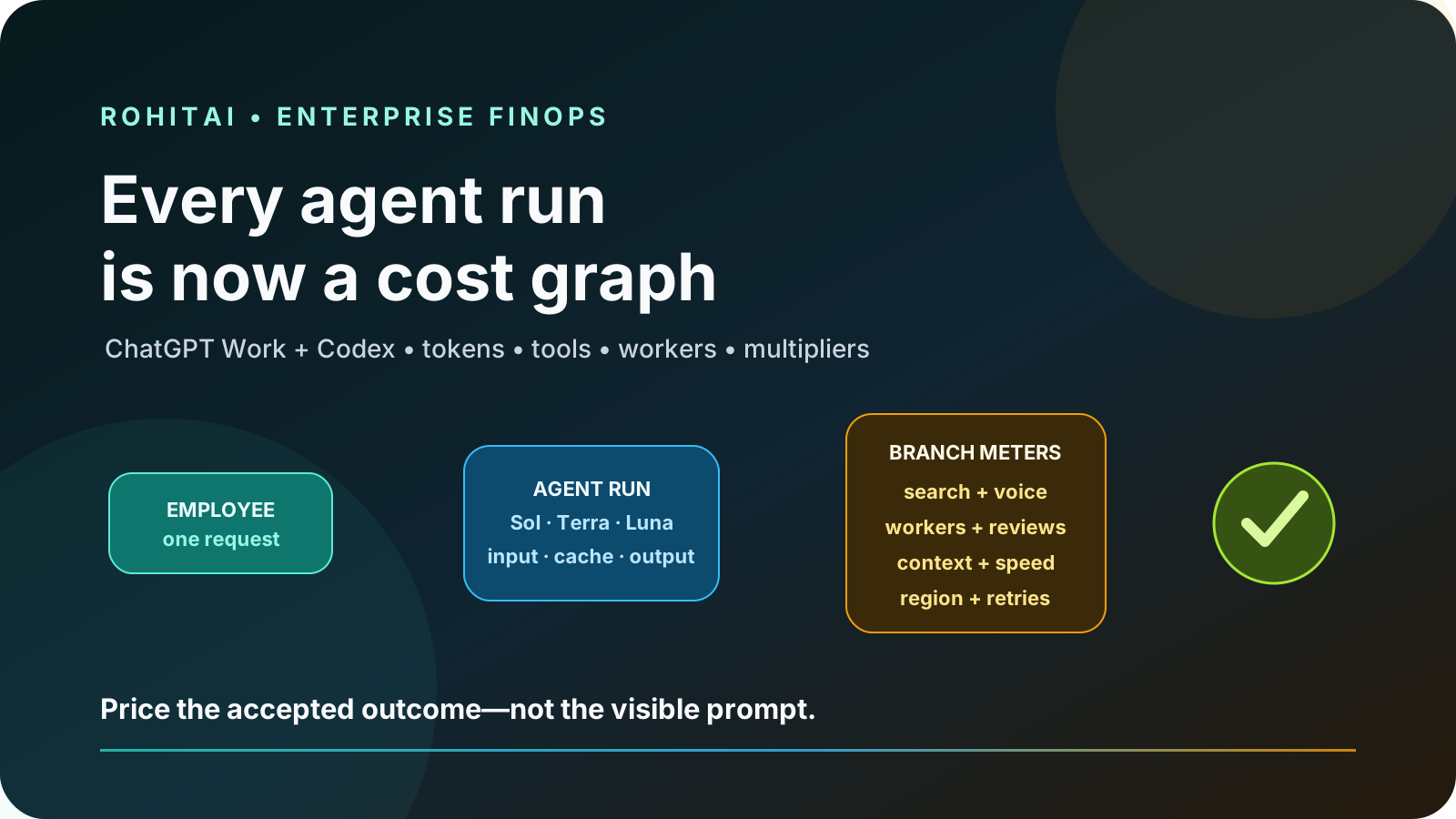
An employee asks ChatGPT Work to research a market, update a spreadsheet, and prepare a slide deck. It sounds like one request. The bill can be a small network: model input, cached context, output, web-search runs, search-result tokens, delegated workers, long-context premiums, Fast mode, and regional processing.
OpenAI has now put public dollar rates around that network for a specific class of customers. Its new Enterprise token-based rate card covers Chat, ChatGPT Work, Codex, Voice, search, images, office tools, Workspace Agents, reviews, automations, and delegated workers. That breadth matters more than the headline prices.
One caveat belongs at the top: this card applies only to new ChatGPT Enterprise customers whose agreements specify usage-based billing in US dollars. Existing Enterprise and Edu plans, new Edu plans, and ChatGPT Business still use separate credit-based cards unless their contracts say otherwise. This is not an overnight repricing of every Enterprise workspace.
It is still a meaningful commercial shift. In April, OpenAI moved Codex from approximate per-message credits to credits tied to input, cached-input, and output tokens. The August card removes that credit abstraction for covered agreements and exposes direct USD rates across a much larger workplace product graph.
The operating consequence is blunt: a seat is no longer a useful unit for forecasting agent work. Neither is a message. Enterprises now need the same cost attribution, routing policy, cache design, and budget enforcement inside ChatGPT that engineering teams already use around APIs.
OpenAI now has three economically different descriptions in circulation.
The new card charges covered Enterprise agreements directly in USD per million tokens. The existing Codex rate card maps those token categories into credits for Plus, Pro, Business, and most Enterprise-family workspaces. A small subset of Enterprise customers remains on a legacy message-based Codex card.
That chronology matters. Token metering did not begin this week. OpenAI changed Codex pricing on April 2 for Plus, Pro, Business, and new Enterprise plans, then extended it to most existing Enterprise-family plans on April 23. What changes here is the commercial interface and the surface area: direct dollars, more products, and a detailed list of feature meters.
Before building a calculator, procurement should record the agreement’s seat or platform fee, committed spend, included usage, discount, overage terms, region, taxes, and renewal mechanics. OpenAI explicitly says the signed agreement controls. The public card is a list-price map, not a replica of every customer invoice.
For ChatGPT Work and Codex, the published GPT-5.6 rates are unusually clean. Every tier has a cached-input rate equal to one tenth of fresh input, and an output rate equal to six times fresh input.
| Work/Codex model | Input / 1M | Cached input / 1M | Output / 1M |
|---|---|---|---|
| GPT-5.6 Sol | $5.00 | $0.50 | $30.00 |
| GPT-5.6 Terra | $2.00 | $0.20 | $12.00 |
| GPT-5.6 Luna | $0.20 | $0.02 | $1.20 |
Rates observed on OpenAI’s Enterprise token card on August 7, 2026. Contract discounts may differ.
Consider an illustrative task with one million fresh input tokens and 100,000 output tokens. It costs $8 on Sol, $3.20 on Terra, and $0.32 on Luna. This is not a typical-task estimate; it simply holds the token mix constant so the routing effect is visible.
The obvious response is to shorten every prompt. That is useful, but it misses the largest lever. Moving a bounded task from Sol to Luna changes unit cost by 25×. Trimming ten percent of the prompt changes one part of the bill by ten percent.
The better architecture is to use Sol where ambiguity or risk is high, then hand well-specified execution to Terra or Luna. Sol can plan a migration, resolve conflicting requirements, or review a consequential result. A cheaper tier can classify files, run repetitive checks, format artifacts, or execute a narrow plan.
Use for classification, extraction, repetitive transformations, test summarization, and tightly specified background steps that pass your evals.
Use for everyday coding and knowledge work where the task needs judgment but does not justify frontier-tier spend.
Reserve for architecture, difficult debugging, ambiguous research, high-value synthesis, and final review where a better decision can repay the premium.
The most useful sentence in OpenAI’s card is easy to skim past: a single request may include both model-token charges and separate feature charges.
That makes the invoice unit a graph, not a prompt.
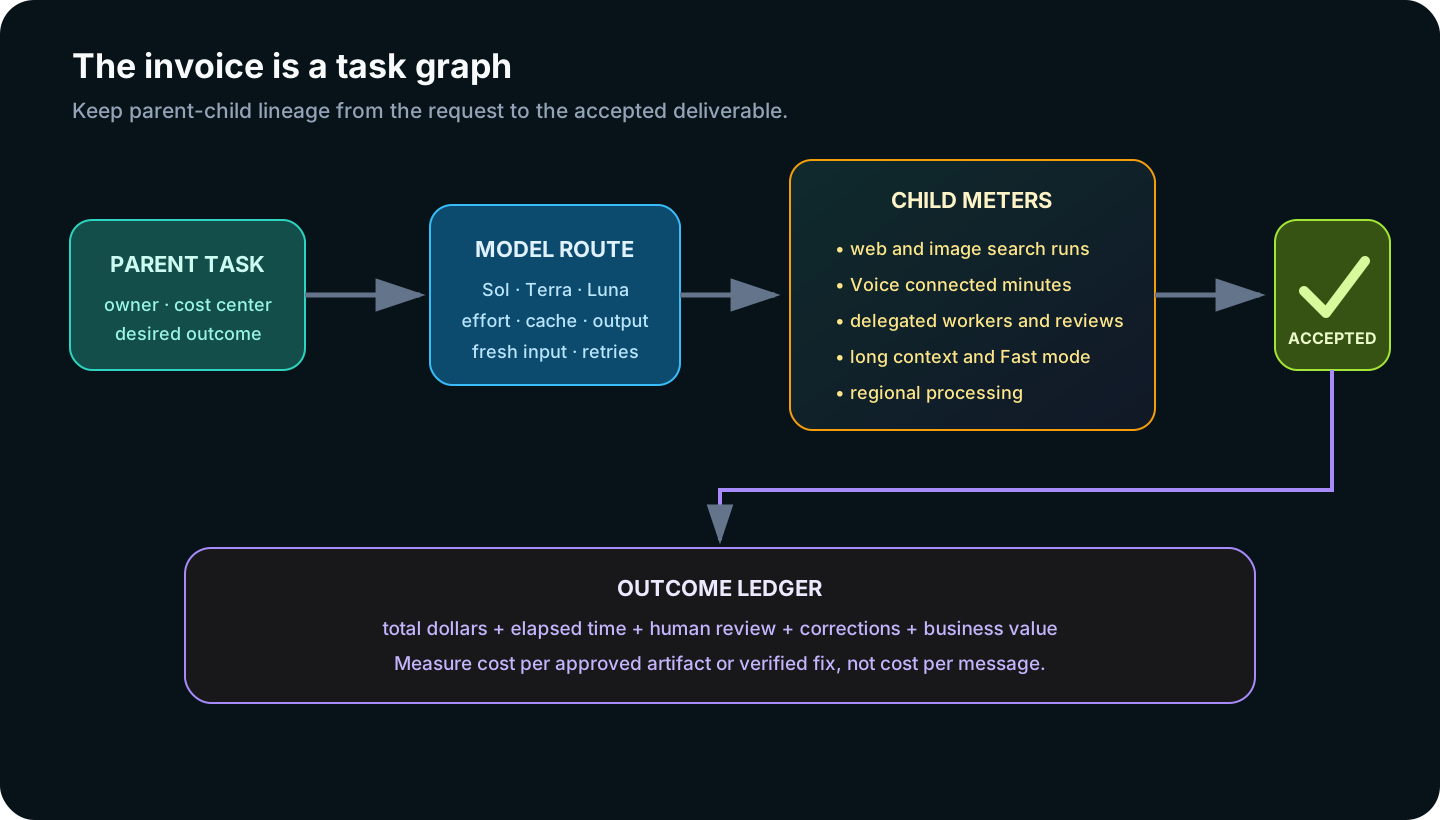
The useful attribution path preserves every child step and reconnects spend to an accepted business outcome.
A Voice session in Chat costs $0.12 per connected minute plus GPT-5.5 backend tokens. In Work and Codex, the same minute rate can be joined by GPT-5.6 Terra backend tokens and delegated-worker tokens. Sixty connected minutes therefore begin at $7.20 before model work.
Web Search and Image Web Search each cost $10 per 1,000 runs, or one cent per run, with search-content tokens billed separately at the selected model’s rate. A research agent that searches, opens results, asks two workers to investigate, and then writes a long report has crossed several meters before a human sees the answer.
Long context introduces another step. Above 272,000 input tokens, supported GPT-5.6, GPT-5.5, and GPT-5.4 Work/Codex tasks are charged at 2× for input and cached input and 1.5× for output. The illustrative Sol task above rises from $8 to $14 under the long-context rates, before Fast mode or residency.
OpenAI does not publish a worked example showing how every multiplier combines. Teams should validate stacking and rounding against their Cost API data and invoices rather than assuming that Fast mode, long context, and regional processing always compound in a particular order.
The pricing ratios reveal two engineering priorities.
First, stable context should be deliberately cache-friendly. Put durable instructions, schemas, and reference material in a consistent prefix. Narrow file and date ranges. Compact stale history. Avoid loading every connector description or a huge repository instruction file when the task uses only a small slice.
On Sol, one million cached input tokens plus 100,000 output tokens cost $3.50, compared with $8 for the same fresh-input mix. The cache does not make the output cheaper, but it changes repeated context from a nuisance optimization into a material budget control.
Second, output is the expensive edge. Across Sol, Terra, and Luna, an output token costs six times a fresh input token. Teams should ask for bounded artifacts, structured findings, concise intermediate handoffs, and evidence that someone will actually review. Letting every worker narrate a long chain of work is not transparency if nobody consumes it.
Higher reasoning levels have the same listed per-token rate for a given model, but that does not mean the same task cost. More effort can produce more tokens, and OpenAI’s credit card says Ultra may run additional agents for eligible users. “Same rate” describes the unit; it does not promise the same quantity.
This extends a point from RohitAI’s earlier analysis of GitHub Code Quality’s three-meter review loop: the visible action is often the wrong place to attach cost. For agents, the bill follows the execution path.
OpenAI launched unified ChatGPT and Codex usage analytics on June 18, seven weeks before this card appeared. The Global Admin Console can break credit usage down by user, product, and model, expose the same data through a Cost API, and apply workspace, group, and user limits.
That sequence looks deliberate. Consumption pricing for workplace agents is difficult to sell without a way to explain and constrain consumption. The analytics layer is not finance polish added after launch; it is part of the product architecture that makes metered agents deployable.
The current public description still leaves an attribution gap. User/product/model breakdowns are useful, but the new card composes feature runs, workers, reviews, Voice minutes, context tiers, speed tiers, and regional uplifts. Enterprises will want those meters joined under a parent run and then connected to a ticket, pull request, approved spreadsheet, presentation, or decision.
That is also where FinOps and safety meet. A runaway agent can waste money and take too many actions at the same time. RohitAI’s long-horizon agent monitoring framework treats money, tokens, attempts, tools, and wall-clock time as cumulative budgets. The rate card makes the dollar portion explicit, but a safe ceiling still needs all of them.
OpenAI cut Luna’s API price by 80% and Terra’s by 20% on July 30, then passed lower consumption rates into Work and Codex, according to its price-performance update. That should reduce the cost of a fixed workload.
Agent workloads do not stay fixed.
OpenAI-affiliated research on the shift to agentic AI reports that more than 10% of Codex users managed three or more concurrent agents at least once a week, while the share submitting at least one task estimated at more than eight hours of human work rose nearly tenfold in the first half of 2026. Among selected OpenAI roles, median monthly output-token volume grew 13× for legal staff and more than 50× for researchers between November 2025 and June 2026.
Those figures come from OpenAI data and should not be mistaken for an independent customer billing audit. They do expose the likely direction: lower unit costs invite more agents, longer tasks, and more automation. Total consumption can rise faster than price falls.
The effect will spread outside engineering. Work can operate across files and apps, while the card puts Excel/Sheets, PowerPoint, and Workspace Agents on GPT-5.6 Sol token rates. OpenAI’s separate Signals analysis says workplace usage is more than twice as likely to involve doing or creating than non-work usage, although that dataset explicitly excludes organization-managed accounts. It is directional context, not Enterprise ROI evidence.
When finance, research, sales, and operations adopt agents, chargeback cannot stop at “AI platform.” Each workflow needs a business owner who can say whether the artifact was useful.
OpenAI is not alone in separating access from consumption. Anthropic’s Enterprise billing documentation describes a seat fee with Claude, Claude Code, and Cowork tokens billed separately at standard API rates, alongside organization and individual limits.
The market is converging on an access-and-control-plane fee plus metered inference and feature use. That changes vendor evaluation. Headline seat price matters less; cost per verified deliverable, cache economics, feature meters, regional uplifts, trace portability, and the quality of spend controls matter more.
Three predictions follow.
The adjacent technical shift is already visible. As RohitAI argued when Codex moved its agent boundary beyond the terminal, connectors, remote execution, plugins, and delegated workers turn an assistant into a runtime. Runtimes need traces and quotas.
No. The public page covers new Enterprise customers whose agreements explicitly use USD usage-based billing. It does not disclose the full contract, platform fee, minimum commitment, included usage, discounts, or true-up terms.
The card lists the same token rate across supported reasoning levels for a model. Actual task cost can still rise if a higher effort level consumes more tokens or invokes additional workers.
Only when measured latency has business value. Compare Standard and Fast on completion time, accepted-output rate, human wait time, and total dollars. OpenAI says Sol Fast mode can reach up to 2.5× Standard speed, but a speed claim is not an ROI calculation.
Route the task to the cheapest model that meets an eval-backed quality threshold. Then improve cache reuse, bound output, gate long context, and cap fan-out. Prompt trimming alone will not capture the 25× model spread.
OpenAI’s new rate card gives enterprises something they have been asking for: clearer mapping from workplace AI activity to dollars. It also removes the comfort of pretending that an agent is a message inside a seat.
For covered contracts, every important design choice can now reach the bill: which model plans, which model executes, how much context is fresh, how long workers talk, how many searches run, whether the job crosses 272K tokens, whether latency earns a premium, and whether the final artifact is accepted.
That is healthy pressure. It rewards teams that treat agents as production systems with routing, observability, budgets, and outcome ownership.
The rate card is not merely a price list. It is a diagram of the system enterprises now have to operate.