DeepSeek V4 Flash Vision Is Open. The API Is Still Harder to Beat

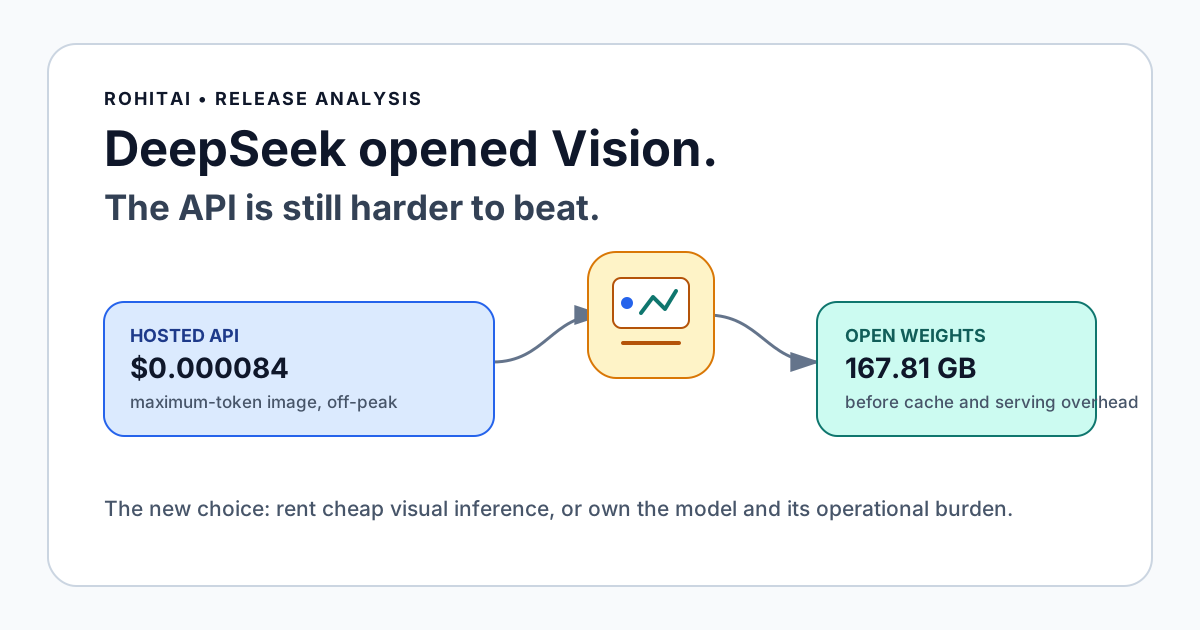
DeepSeek made V4 Flash Vision downloadable on August 31, ten days after putting the experimental multimodal model behind its API. The obvious headline is that another large vision model now has open weights. The useful headline is less comfortable: owning the checkpoint is finally possible, but renting the model remains absurdly cheap.
The MIT-licensed Hugging Face release is a 167.81 GB checkpoint with a readable prompt encoder and reference PyTorch inference. It gives teams something the August 21 API launch did not: a model revision they can pin, inspect, adapt, place behind their own data boundary, and serve through competing infrastructure.
Yet DeepSeek's hosted economics attack the case for operating it. At prices checked on August 31, an image consuming the maximum 384 vision tokens costs about $0.000084 off-peak before text and output. The checkpoint, meanwhile, needs server-class memory before you budget a byte for KV cache, activations, image processing, kernels, or redundancy.
That is why this release matters. DeepSeek has turned multimodal agents into an infrastructure choice. You can buy visual inference at commodity-like rates, own the stack when control justifies the burden, or route between both. The model's sight is interesting. The bargaining power created by a downloadable checkpoint is the larger change.
DeepSeek first launched deepseek-v4-flash-vision-exp as a hosted model on August 21. It accepted images through OpenAI-compatible Chat Completions and Responses formats, plus an Anthropic-compatible Messages endpoint. It also arrived with a Files API and support in DeepSeek Harness.
The August 31 repository changes the ownership boundary.
The public artifact includes the tokenizer, OpenAI-style message encoding for text, images and tool calls, model configuration, 48 safetensor shards, and reference code covering the vision encoder and aligner, DFlash attention, mixture-of-experts layers, Hyper-Connections, and the DSpark path. The repository was created at 06:16 UTC and changed several times during its first three hours. Teams should pin the evaluated revision—86f746b36186f0e567729a5c06a8c918caba82a9 at research time—instead of treating main as an immutable product.
This is an update to the limitation in our V4 Flash public-beta analysis: the earlier downloadable Flash model was an unusually cheap, cluster-shaped text agent. Vision-Exp preserves that agent backbone and adds a visual route. It also adds a new routing axis to the Flash-versus-Pro decision: the question is no longer only how hard the task is, but whether the task contains pixels worth paying attention to.
There are now three sensible ways to use Vision-Exp: rent DeepSeek's hosted route, absorb the self-hosting work, or keep an owned route as a fallback while sending ordinary traffic to the cheap API.
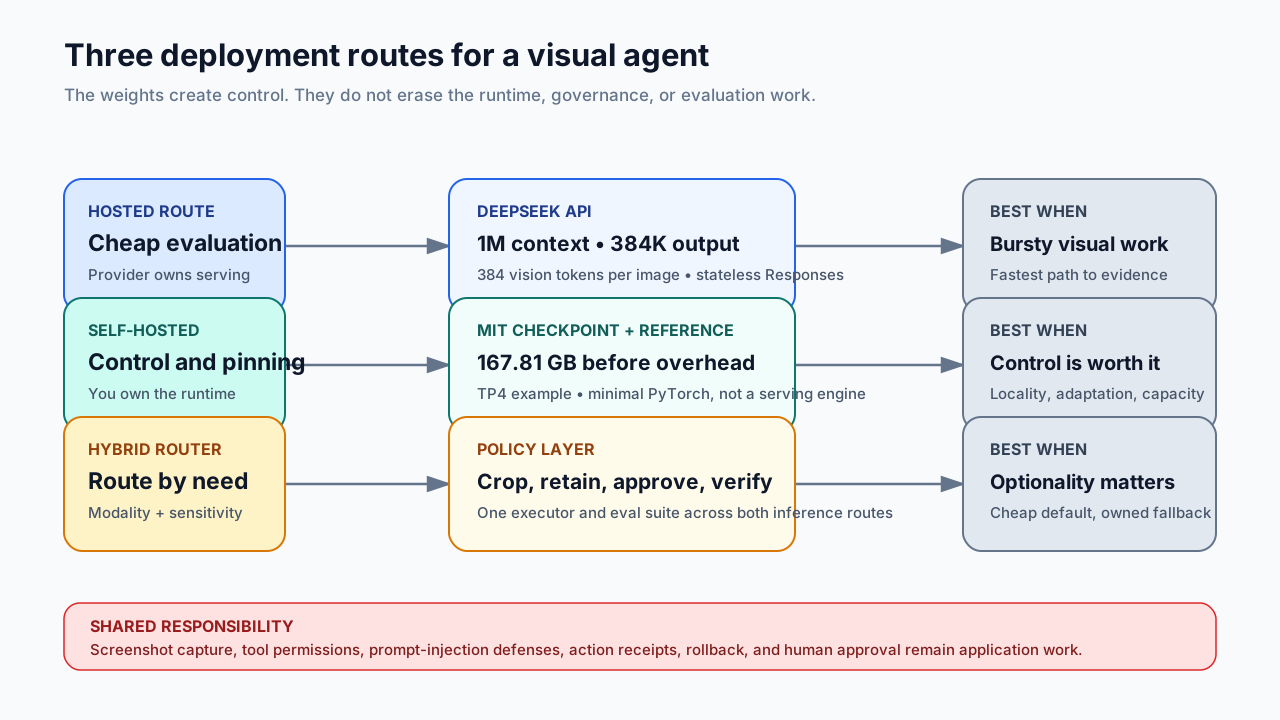
The weights create optionality. Screenshot capture, tool permissions, evaluation, approvals, and rollback remain application responsibilities on every route.
Best for evaluation, bursty workloads, prototypes, and teams without a mature multi-GPU serving platform. DeepSeek owns availability and kernels; you keep the agent loop.
Best when data locality, checkpoint pinning, adaptation, predictable reserved capacity, or provider independence is worth more than the infrastructure bill.
Keep text Flash for ordinary text and FIM, use hosted Vision for most pixels, and reserve an evaluated self-hosted route for sensitive or continuity-critical work.
This is the same lesson we drew from Tencent's 770B Hy4 Preview: downloadable control and economical self-hosting are different claims. An MIT license removes a legal barrier. It does not remove memory, networking, runtime integration, observability, or on-call work.
The official safetensor index reports 167,811,372,792 bytes, or 167.81 GB decimal. Hugging Face's artifact scanner counts 304,646,824,126 serialized entries across I8, FP8, BF16, F32, and metadata-related types.
Neither number should be flattened into a casual “305B model” procurement claim.
DeepSeek's model card does not publish a definitive architectural total or activated-parameter count for Vision-Exp. Third-party catalogs carry forward the base V4 Flash label of 284B total and 13B active. The Hugging Face figure is a count of serialized tensor elements in a checkpoint that includes packed FP4 experts and quantization metadata. Those figures describe different things.
The configuration is more operationally useful. It shows a 43-layer language backbone with hidden size 4,096, 256 routed experts plus one shared expert, six routed experts selected per token, and a maximum position setting of 1,048,576. The vision stack has 32 layers, dimension 1,024, 16 heads, 14-pixel patches, 3× downsampling, and a maximum of 384 visual tokens per image.
Log the checkpoint hash, precision, processor, and serving topology. A single “B” number does not tell you whether the model fits, how fast it runs, or whether two providers are serving equivalent artifacts.
| Decision factor | DeepSeek hosted API | Open checkpoint |
|---|---|---|
| Starting cost | Usage-based; no model-serving fleet | 167.81 GB checkpoint before runtime overhead |
| Control | Provider alias and provider operations | Pin revision, modify stack, choose serving location |
| Production readiness | Managed endpoint with 2,500 listed concurrency | Minimal PyTorch reference; production recipe is your work |
| Data boundary | Images and prompts cross the provider boundary | Can remain inside your controlled environment |
| Best reason to choose | Fast evidence and difficult-to-beat unit economics | Locality, adaptation, reproducibility, or exit leverage |
DeepSeek's current pricing page lists the Vision experimental model at the same tariff as V4 Flash: per million tokens, cache-miss input is $0.22 off-peak or $0.44 peak, and output is $0.66 or $1.32. Cache-hit input is $0.007 or $0.014. Peak windows are 01:00–04:00 and 06:00–10:00 UTC on weekdays.
Every image is capped at 384 input tokens. At the cache-miss rate, the arithmetic is:
1 maximum-token image, off-peak = 384 / 1,000,000 × $0.22 = $0.00008448
1 maximum-token image, peak     = 384 / 1,000,000 × $0.44 = $0.00016896
600 such images, off-peak       = $0.050688
Those figures exclude text, reasoning, output, tool calls, retries, and human review. They still make one point clearly: image-token price is unlikely to be the bottleneck.
The constraint hides inside the same 384-token rule. DeepSeek's vision guide says small images are scaled toward roughly 384×384 pixels and large images toward roughly 800×800 total pixels. A 2,000×2,000 image and a 5,000×5,000 image therefore converge on the same billed visual budget. The Responses parameter detail="original" can preserve the source through the client boundary, but it does not repeal later model-side normalization.
For photographs and coarse UI state, that bargain may be excellent. For a dense Grafana dashboard, tiny browser error, financial chart, architecture drawing, long web page, or 4K screenshot, it can erase the evidence your agent needs.
The right preprocessing stack will usually preserve a whole-image overview, detect dense or actionable regions, crop small controls and text, then send critical regions as separate images. This makes visual density a routing signal. A simple product screenshot may go directly to Vision-Exp; a long document might first go through layout detection; a local edge model may identify regions before the large agent reasons over them.
That is also why Vision-Exp does not replace compact models such as LFM2.5-VL-3B. A 3B-class edge model can make “where should I look?” cheap and private. DeepSeek can handle “what should the agent do about it?” The two can belong in the same system.
DeepSeek's Responses documentation contains the primitive visual agents need: function_call_output and custom_tool_call_output items can return input_image parts. A browser tool can capture a screenshot, your application can feed it back, and Vision-Exp can reason over the new state.
That is sight inside a tool loop. It is not a computer-use product.
The same compatibility page says the API is stateless. It does not support previous_response_id, conversations, storage, or background mode. Built-in computer_use, MCP, code interpreter, and file search tool types are ignored. Function tools and server-side web search are supported; apply_patch is the only supported named custom tool.
This produces a clean responsibility split:
model:      interpret pixels, plan, choose a function, inspect the result
executor:   open browser, click, type, download, mutate, capture evidence
policy:     restrict domains/actions, require approvals, redact secrets
state:      persist task history, tool receipts, screenshots, and checkpoints
verifier:   decide whether the intended state actually changed
Silent compatibility is the sharp edge. DeepSeek says unsupported Responses parameters can be ignored rather than rejected. A 200 OK does not prove that computer use, MCP, storage, or another assumed capability ran. Capability negotiation and contract tests matter more than API-shape familiarity.
DeepSeek's model card places Vision-Exp close to Opus 4.8 on four multimodal-agent benchmarks. These are vendor-reported results, not independent reproduction of the August 31 checkpoint.
The first footnote is about evidence: launch-day research found no reputable independent suite reproducing these scores or testing the downloadable artifact. DeepSeek used its own Harness setup for the text-agent rows, with maximum reasoning effort, temperature 1.0, and top-p 0.95.
The second is about the baseline. On ApexBench and Agents' Last Exam, text-only V4 Flash ignored multimodal elements. Part of the uplift therefore measures the difference between seeing and not seeing, not a controlled quality gain between two vision-capable models. Chartography and ZeroBench do not include base-Flash results at all.
The useful conclusion is modest: DeepSeek has published credible evidence that Vision-Exp belongs in a serious evaluation alongside expensive frontier models. It has not established that the model is a universal Opus replacement. A limited 49-prompt commercial test found competitive webpage and layout work alongside failures in comic sequencing, geometry, complex visual reasoning, and code detail. That jaggedness is exactly what a 384-token visual bottleneck would lead us to test.
DeepSeek is unusually clear about the included runtime: it is a readable reference implementation rather than a production serving engine. The documented conversion example creates a tensor-parallel-4 checkpoint, and torchrun can extend across nodes. That proves an intended execution path. It is not a throughput guarantee or hardware bill of materials.
Raw weights are only the first memory allocation. Production serving also needs room for the image processor, activations, KV cache, quantization scales, runtime kernels, request batching, long-context behavior, and failure tolerance. A high-availability service adds replicas or a recovery plan. The one-million-token configuration makes cache planning a product decision, not an edge case.
At launch, we found no model-specific public vLLM or SGLang production recipe to cite. Support will likely arrive quickly because the base V4 family already attracts runtime work, but “supported” will still need a matrix: checkpoint revision, processor version, quantization, attention and MoE kernels, tensor/expert parallel layout, driver, accelerator, image batch, and context length.
Our vLLM 0.27 analysis described this as one serving contract. Vision adds another failure surface to that contract. A local response that looks plausible is not parity evidence. Compare the pinned checkpoint with the hosted alias on fixed prompts, fixed images, tool-call parsing, multi-turn replay, and long-context cases before shifting traffic.
Vision-Exp costs the same as text Flash, performs better on six of seven vendor-reported text-agent rows, and accepts the familiar APIs. That makes a global alias swap tempting. Resist it.
The vision model is experimental and does not support FIM completion. The hosted alias can change independently of the open checkpoint. Text regressions remain possible because DeepSeek says the model underwent continued training. Use a separate route and earn the migration with evidence.
The hosted Files API is free and convenient for reusing screenshots. It accepts images up to 64 MiB, stores up to 25 GiB and 10,000 files per user, and allows an expiry between one hour and 30 days.
The dangerous detail is the default: according to DeepSeek's Files API guide, omitting the expiry fields keeps the upload permanently unless you delete it.
That turns a cheap vision feature into a data-lifecycle decision. Browser screenshots can contain customer records, authentication state, internal dashboards, source code, personal messages, or secrets that happened to be visible. A team that adds “visual memory” without explicit expiration can retain far more than the product owner intended.
Set expiry on upload. Delete aggressively. Record the file identifier in the task trace. Include screenshot storage in the threat model. If the data cannot cross the provider boundary at all, that is one of the clearest reasons to accept self-hosting cost.
Three second-order effects matter more than today's score table.
First, open weights change vendor negotiations before they change deployment. A team does not need to operate Vision-Exp to benefit from the MIT checkpoint. Competing hosts can optimize it. Enterprises can price an exit. Regulated buyers can ask whether a local route is feasible. The hosted API stops being the only implementation of DeepSeek's visual capability.
Second, visual density becomes a first-class router feature. “Contains an image” is too crude. A product photo, a tiny error toast, a 40-row spreadsheet screenshot, and a long page have radically different information density under the same 384-token cap. Routers will classify not only task difficulty and price, but whether the image needs crops, OCR, a specialist document model, or local preprocessing.
Third, open checkpoints are getting ahead of portable serving. DeepSeek has published enough to inspect and run the model, but not a turnkey fleet target. The gap between model availability and reliable runtime support will become a competitive layer. Providers that can reproduce prompt encoding, visual preprocessing, tool parsing, long-context behavior, and stable throughput will add more practical value than a page that merely says “supports DeepSeek V4.”
My near-term prediction is a three-route stack: text Flash for ordinary agent work and FIM, hosted Vision-Exp for cheap image-bearing turns, and an open-weight route for sensitive or continuity-critical workloads. If DeepSeek follows its recent release pattern, the experimental alias will eventually become a dated checkpoint or fold into stable Flash. Until then, pin everything and assume the alias can move.
The weights, repository code, tokenizer, encoder, and reference inference are released under MIT. “Open weights” is the more precise label because DeepSeek has not published the full training data, training mixture, or complete training recipe.
Not as the published checkpoint in any ordinary sense. The safetensor index alone is 167.81 GB, before runtime overhead. DeepSeek's reference path demonstrates tensor-parallel-4 conversion and supports multi-node torchrun, but the company does not publish a complete production hardware specification.
No. Vision-Exp adds images and shares the Flash tariff, but it is experimental and does not support FIM. Treat it as a modality-specific route until your text and agent regressions say otherwise.
No. Vision-Exp can inspect images returned by function or custom-tool outputs, but DeepSeek's compatibility page says built-in computer use, MCP, code interpreter, and file search are ignored. Your application must supply the executor, permissions, state, and verification.
No. They are DeepSeek's published benchmark results. They are useful launch evidence, but the downloadable checkpoint had not been independently reproduced at research time, and two base-Flash rows compare against a text model that ignored the images.
DeepSeek did not merely add a vision encoder to an open model catalog. It put two competing infrastructure offers on the table.
The API offer says visual tokens should be cheap enough that builders stop rationing screenshots. The open-weight offer says teams should be able to pin, inspect, adapt, relocate, and competitively serve the model when control matters more than convenience.
Neither offer builds the agent for you. The hard work moves outward: crop policy, visual evals, executor security, state, retention, tool receipts, and verification. That is a healthy shift. Model access becomes less scarce, while system quality becomes easier to measure honestly.
Start with the API. Make the model earn its place on your own screenshots and charts. Keep the open checkpoint as leverage—and operate it only when the reason is stronger than its 167.81 GB starting line.