Broadcom’s AgentMinder Turns Every AI Agent Tool Call Into a Policy Decision

An enterprise AI agent can authenticate correctly and still do the wrong thing.
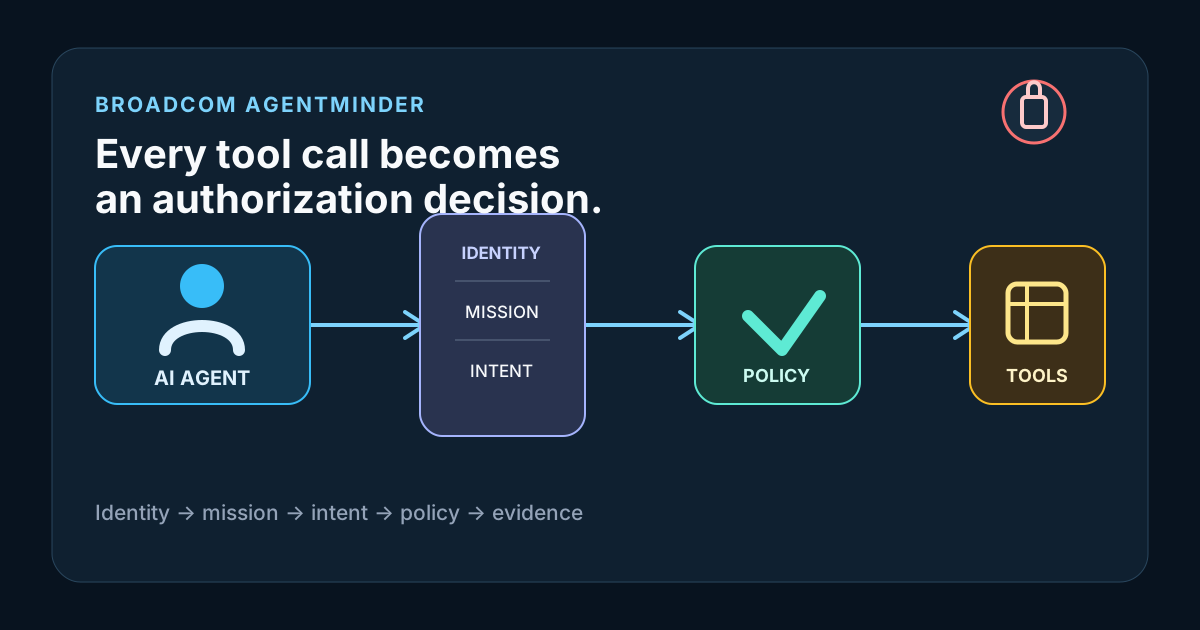
That is the problem Broadcom is trying to solve with AgentMinder, a new runtime control plane announced at VMware Explore on August 31. Instead of granting an agent a durable bundle of permissions and hoping its prompt keeps it within bounds, AgentMinder checks each tool call against the agent’s identity, declared business intent, delegated mission, current policy, and approved resources. The request is forwarded only after authorization; the decision and action are then tied together in an audit trail.
The obvious reading is that Broadcom has added “AI governance” to VMware’s private-cloud portfolio. That misses the useful part. The stronger idea is that agent governance is moving out of policy documents and into the request path. Identity proves which agent is calling. A mission limits why it is acting and for whom. Runtime authorization decides whether this specific tool call can proceed. Telemetry records what happened. Revocation stops the next action.
There is also an important catch. Broadcom presented AgentMinder beside VMware AI Factory, Tanzu sandboxes, vDefend discovery, Avi inspection, and several gateways. Those controls do not share one release date. AgentMinder 4.1 is generally available. Some model-sharing features are available. Several execution, network, and application defenses are scheduled for fall 2026 or described only as forthcoming.
So this is not one finished “AI factory” with a universal kill switch. It is a set of control planes arriving on different clocks. Buyers need to evaluate the joins between them as carefully as the products themselves.
Broadcom’s AgentMinder announcement says the product is generally available now. The official release notes identify the shipped build as AgentMinder 4.1.0+1578, packaged with separate Helm charts for the platform, Layer7 AI Gateway, infrastructure, and observability.
The architecture has three main planes:
The gateway can run inside the AgentMinder cluster or externally beside a workload. That matters. An enterprise can keep its policy enforcement point close to agents running on VMware, Google Cloud, or another Kubernetes platform instead of sending every call through a Broadcom-hosted SaaS gateway.
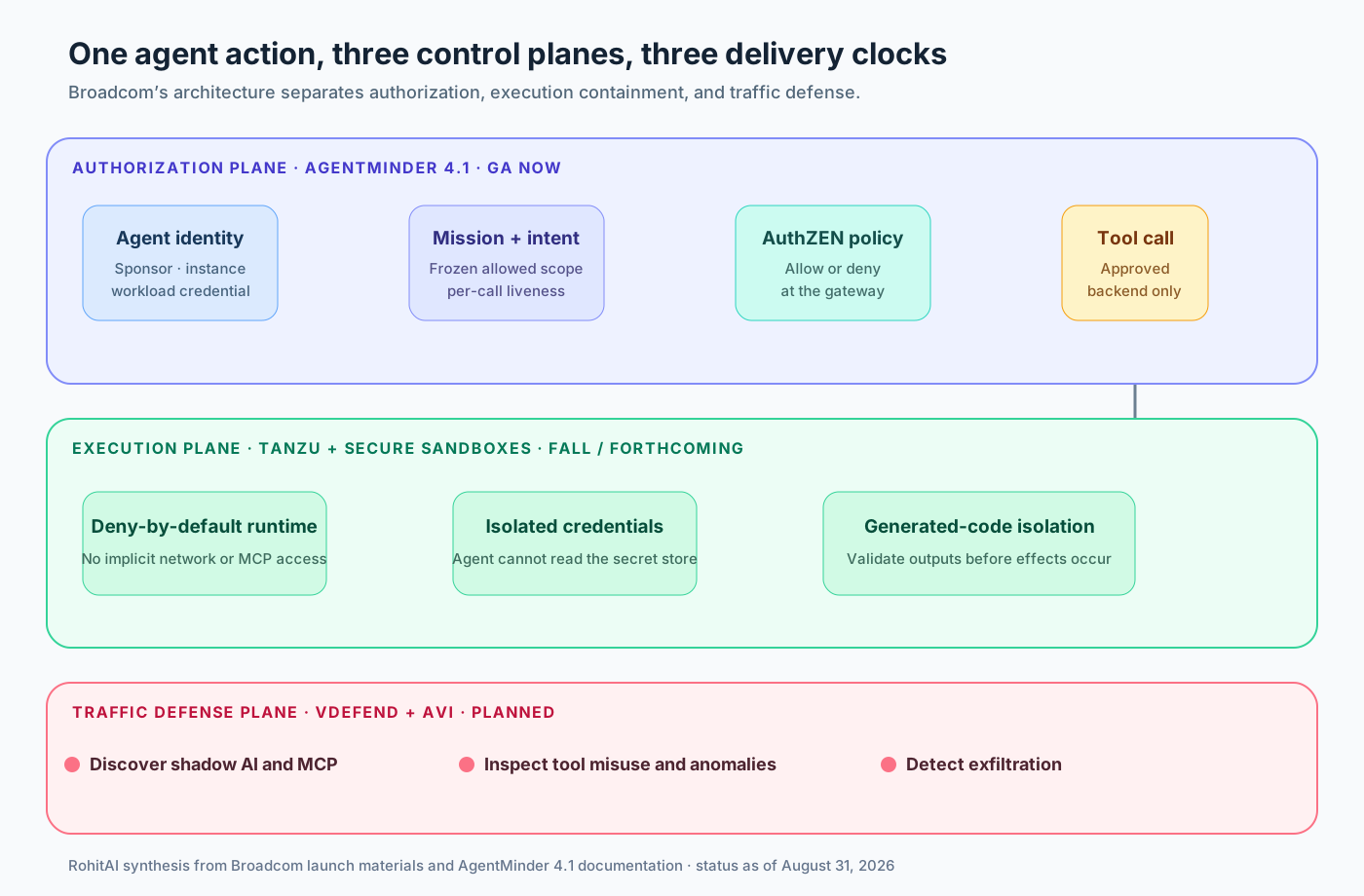
The important boundary is time: AgentMinder’s request-path control is GA; execution containment and network inspection arrive through separate products and release schedules.
Here is the launch without the blended marketing language:
| Layer | What it controls | Availability | Important boundary |
|---|---|---|---|
| AgentMinder 4.1 | Agent identity, mission, intent, per-tool authorization, audit | GA now | Human approval and several response and circuit controls remain roadmap items |
| VCF Model Runtime | Shared private model serving with isolated namespaces | Available now | Namespace isolation is not proof of KV-cache, adapter, telemetry, or side-channel isolation |
| VCF AI Gateway | Model routing, token limits, usage controls, application authorization | Forthcoming | Broadcom has not published a universal GA date in the launch material |
| Tanzu agent runtime | Deny-by-default sandboxes, isolated credentials, explicit service connections | Targeted for fall 2026 | Announced capabilities should not be counted as deployed containment today |
| vDefend and Avi | Shadow-AI discovery, traffic inspection, misuse and exfiltration defense | Planned | They are separately licensed Advanced Services in VCF documentation |
This status matrix is not a minor procurement detail. If a risky workflow depends on a future sandbox or inspection feature, AgentMinder being GA does not close that gap.
AgentMinder’s most useful contribution is a more precise authorization chain. In the documented request flow, the gateway authenticates the caller, resolves a tool to a business intent, validates any delegated mission, asks a policy decision point for a decision through AuthZEN, applies supported directives, forwards the call, and emits telemetry.
The mental model looks like this:
Who is calling?
    ↓
Which tool maps to which business intent?
    ↓
Does the signed mission permit that intent for this subject?
    ↓
Does current policy allow this action in this context?
    ↓
Forward to the approved backend and emit correlated evidence
AgentMinder 4.1 fails closed for an unbound tool, invalid or expired mission credential, subject mismatch, intent outside mission scope, inactive mission, or policy denial. That is a meaningful improvement over placing a broad API key in an agent container and trusting the model to use it politely.
The delegated-mission design is particularly interesting. A mission can be represented by a signed JWT or X.509 certificate containing the delegating user, expiry, allowed intents, and scope. Its authority is the intersection of what policy grants and what the mission type allows. That intersection is frozen when the mission is issued.
This creates a deliberate asymmetry:
new deny   → constrains the next call
new grant  → does not widen an active mission
more scope → revoke and issue a new mission
That is good capability security. Emergency restriction can take effect quickly, while privilege expansion requires a new credential and lifecycle event. A mutable long-lived token would make it much easier for authority to grow invisibly.
Broadcom says an agent must declare what it is trying to do, not only who it is. The phrasing is catchy, but “intent” needs careful interpretation.
AgentMinder does not inspect a model’s hidden motives. It maps a tool to an organization-defined business intent, then checks whether the agent and mission are allowed to invoke that intent. That is useful because it gives policy authors a stable vocabulary such as read_customer_record, prepare_refund, or deploy_to_staging instead of forcing them to reason directly about prompts.
But a permitted tool can still receive dangerous parameters. An agent authorized to prepare a refund might choose the wrong customer, amount, destination, or currency. An agent allowed to query payroll could request every employee instead of one team. Tool-level authorization narrows the door; it does not prove the effect is safe.
AgentMinder’s shipped-versus-roadmap appendix says enforcement of response constraints, human approval, gateway-side circuit breaking, and several body, throttle, audit, circuit, and cache handlers are not shipped in 4.1. Builders still need typed tool schemas, parameter ranges, resource scoping, transaction limits, effect previews, idempotency keys, and target-side postcondition checks.
Broadcom documents a clean mission-revocation path. An administrator can complete or revoke a mission through the admin API, and the next tool call fails its liveness check with MISSION_NOT_ACTIVE.
That is a real kill switch at a request boundary. It is also narrower than the phrase “kill switch” often implies.
Suppose an agent starts a 40-minute data export, submits a cloud deployment, launches a payment batch, or hands work to another queue. Revoking the mission can block the next gateway call. The public documentation does not establish that it cancels the backend operation already in progress, withdraws credentials copied outside the gateway, quarantines compute, or reverses a partial side effect.
Serious systems therefore need two stop paths:
This distinction connects directly to our analysis of how 1,200 nominal sandboxes became one system during the OpenAI–Hugging Face incident. A control can be locally correct and still fail at system level when agents share writable state, credentials, networks, or stop authority.
AgentMinder did not appear from a blank repository this summer. A Broadcom white paper from March described an agent-governance plane built from Symantec Identity Security Platform, Privileged Access Management, and Layer7 API Gateway. The 4.1 topology names IDSP and Layer7 components directly.
That lineage cuts both ways.
On the positive side, identity lifecycle, OAuth and OIDC, policy decision points, API gateways, high availability, and enterprise audit are mature operating problems for Broadcom. An agent-control product built on those systems may be more credible than a startup gateway that discovered identity management after building a prompt filter.
On the other side, the product boundary matters. Buyers need to know which AgentMinder capabilities are native, which depend on existing IDSP, PAM, or Layer7 deployments, how upgrades are coordinated, and which licenses are required. Broadcom disclosed no public AgentMinder price at launch.
This is one of the article’s less obvious conclusions: AgentMinder’s technical maturity and its commercial complexity probably come from the same place. Reusing established products can shorten the path to production, while also importing their packaging, administration, and upgrade seams.
Broadcom’s use of OpenID AuthZEN may be the launch’s most strategically important choice. AuthZEN standardizes how a policy enforcement point asks a policy decision point for an authorization decision. In practice, AgentMinder can sit beside a workload while an enterprise keeps its existing policy engine authoritative.
That reduces two forms of lock-in. Tool traffic does not have to cross a central SaaS chokepoint, and policy decisions do not have to be rewritten into a proprietary gateway language merely to enter the request path.
What AuthZEN does not provide is equally important. The 1.0 specification leaves policy language, architecture, state management, and API authentication outside its scope. It does not give every organization the same agent identity model, mission vocabulary, delegation semantics, or conflict-resolution rules. Parameter-level MCP authorization work is still developing.
The standard makes the wire portable. The organization still has to define the meaning.
That mirrors the point we made about portable agent plugins: tools can travel while trust does not. A packaged tool can describe how to call an API. It cannot carry the right to use that API against a particular customer’s systems.
AgentMinder’s observability story is stronger than simply printing “built on OpenTelemetry” on a launch slide. The 4.1 observability documentation describes W3C trace propagation across SDK, gateway, policy decision point, and backend, with correlation fields including clientTxnId, agentClientId, missionId, missionType, and intentScope. It also documents structured audit events, allowed and denied call metrics, policy latency, active sessions, and signed audit receipts.
That gives an operator a chance to answer a difficult question: which human sponsor, agent instance, delegated mission, policy decision, tool call, and backend effect belong to the same chain?
It does not automatically make the evidence compliance-grade. The hard questions move downstream:
OpenTelemetry’s GenAI semantic conventions continue to evolve, and sensitive content fields are often opt-in. A signed receipt is valuable only if the verifier, key lifecycle, storage, and gap detection sit outside the agent’s write authority.
The launch numbers show that Broadcom can operate identity infrastructure at enterprise volume. They do not show how AgentMinder behaves under a burst of autonomous tool calls with complex policy, cross-region failover, high denial rates, and a degraded audit pipeline. Procurement teams need a policy benchmark, not an identity-count headline.
The VMware AI Factory announcement covers the infrastructure around the agent-control plane: bare-metal automation, GPU pooling, model serving, a model gallery, RAG workflows, Day 2 operations, and observability for token throughput, latency, compute, and memory.
Broadcom says VCF customers can run more than 150 open-source and commercial models. It also claims VCF automation can shrink the path from bare metal to a served model from weeks to hours. Those are vendor claims; the announcement does not publish the full model catalog, test matrix, baseline, latency distribution, hardware count, or validation criteria.
Current model sharing is more concrete. Model Runtime can expose one deployment to multiple tenants using isolated namespaces. That could reduce duplicate GPU allocation, but teams should test KV-cache isolation, adapters, batching, telemetry, rate limits, update behavior, and noisy-neighbor effects rather than equating namespaces with complete inference isolation.
Network World reports that AI Factory is not a separate product and adds no charge beyond VCF, citing Broadcom’s VCF marketing chief. The useful procurement question is therefore not “What does AI Factory cost?” It is “Which VCF subscription, hardware, accelerators, support, and add-on products reproduce the architecture in the slide?”
The VCF 9.1 FAQ includes Private AI Services in the subscription scope, while Avi Load Balancer and vDefend Firewall are separately licensed Advanced Services. AgentMinder pricing and bundling remain undisclosed.
Broadcom’s depth is attractive because it can place controls at several points: agent-to-tool, application-to-model, workload-to-network, and transaction-to-backend. Defense in depth is sensible. Uncoordinated defense in depth is a production incident waiting to happen.
Imagine AgentMinder allows a call, a model gateway rate-limits the retry, Tanzu denies the network connection, Avi redacts the response, and vDefend raises an alert under a different trace identifier. Each product may be working as designed while the operator sees contradictory policy, duplicated logs, retry amplification, and no obvious owner.
The full VMware stack therefore needs one policy hierarchy and one trace contract. Each layer should have a named responsibility, an authoritative decision source, and a documented failure mode. Otherwise, buying more control planes can reduce explainability.
Evaluate AgentMinder if agents run across VCF, GCP, or other Kubernetes platforms and you want customer-adjacent enforcement tied to an existing policy decision point.
The stack is most compelling when shared model serving, private data, Tanzu operations, network controls, and VMware lifecycle management are already part of the platform plan.
Finance, HR, infrastructure, and customer-data actions need external approval, parameter controls, target-side limits, and in-flight cancellation beyond AgentMinder 4.1’s shipped boundary.
There is also a competitive reality. Microsoft’s Entra Agent ID already covers agent blueprints, instance identities, owners and sponsors, lifecycle governance, Conditional Access, and risk controls. AWS publishes consumption pricing for AgentCore controls, including $0.000025 per policy authorization request—$25 per million decisions before runtime, model, network, telemetry, and other charges.
Broadcom’s distinction is not that it invented agent identity. It is the combination of customer-adjacent, per-tool-call enforcement with signed mission scope, existing enterprise policy engines, and a path into the VMware private-cloud stack.
Do not start with a polished demo agent. Start with the failure paths that will decide whether the control plane earns trust.
The economic metric should change too. Token price is only one slice of an agent workflow. The more useful unit is cost per accepted business effect:
model inference
+ policy decisions
+ tool execution
+ retries
+ human review
+ observability
+ rollback and cleanup
--------------------------------
= cost per accepted outcome
AWS already prices authorization per request. Broadcom ties identity, mission, telemetry, and wider cost management into its platform. Whether or not AgentMinder adopts per-decision pricing, enterprises will eventually allocate agent cost by authorized action and successful outcome, not merely tokens consumed.
Within a year, serious platform reviews will ask for a per-feature GA matrix and a map of every route around the enforcement point. A gateway cannot govern a credential copied into an SDK, an unobserved queue consumer, or a direct service call. Coverage will matter more than the presence of a governance product.
Enterprises will increasingly require agent gateways to speak AuthZEN or an equivalent open decision protocol. But they will still own the subject-action-resource-context schema, mission lifecycle, intent catalog, parameter classifications, and approval obligations. Interoperable requests will not eliminate policy engineering.
AgentMinder can run on GCP and standards-based Kubernetes, which makes it a plausible entry product outside a VMware-only estate. The richer economics—shared GPUs, governed model services, Tanzu, Avi, and vDefend—compound inside VCF. Broadcom can be neutral at the enforcement edge while pulling more of the operating model toward its vertical stack.
Yes. Broadcom said AgentMinder was generally available on August 31, 2026, and its documentation identifies the shipped 4.1.0+1578 build. That status does not apply to every AI Factory, Tanzu, vDefend, or Avi capability announced beside it.
No. It evaluates an organization-defined intent mapped to a tool, along with identity, mission, context, policy, and resource scope. It does not read the model’s internal motives, and tool authorization alone does not constrain every parameter or downstream business effect.
It stops the next governed tool call after the mission liveness check. Public documentation does not show that it interrupts an operation already running behind the gateway. Builders still need job cancellation, token revocation, compute isolation, and compensating actions.
Broadcom told Network World that AI Factory is not a separate product and adds no charge beyond VMware Cloud Foundation. That is not the same as a free stack. VCF, hardware, accelerators, support, AgentMinder, Tanzu, observability, and separately licensed services such as Avi and vDefend can shape the total cost.
It overlaps with both, but the product boundaries differ. Entra Agent ID emphasizes identity inventory and lifecycle within Microsoft’s control plane. AWS AgentCore offers managed runtime, identity, policy, gateway, and observability services with public consumption pricing. AgentMinder emphasizes customer-adjacent, per-tool enforcement and integration with existing policy systems, with a deeper private-cloud story through VMware.
Broadcom did not launch a smarter model. It launched an argument about where enterprise trust belongs.
Prompts are too soft to carry authority. Static service accounts are too broad. Human IAM assumptions do not fit software that can plan, delegate, retry, and act while its sponsor is offline. The authorization decision has to move closer to the action, and the evidence has to survive outside the agent.
AgentMinder 4.1 makes that argument concrete. Its signed missions, frozen authority, per-call checks, customer-adjacent gateway, AuthZEN interface, correlated traces, and request-boundary revocation are thoughtful controls. Its limits are equally concrete: semantic effects extend beyond intent labels, human approval and several response controls are not shipped, the kill switch does not promise in-flight cancellation, and public performance and pricing evidence is thin.
VMware AI Factory widens the frame from one authorization gateway to the infrastructure, models, sandboxes, networks, and applications around it. That breadth could become Broadcom’s advantage. It could also create a maze of partially overlapping gates.
The winners in enterprise agent infrastructure will not be the vendors with the longest control list. They will be the ones that can prove, for every consequential action: who acted, under whose authority, for which declared purpose, against which resource, under which policy, with what recorded effect—and exactly how the system stops.