OpenAI’s Planned Cursor Cutoff Makes Model Access an M&A Risk

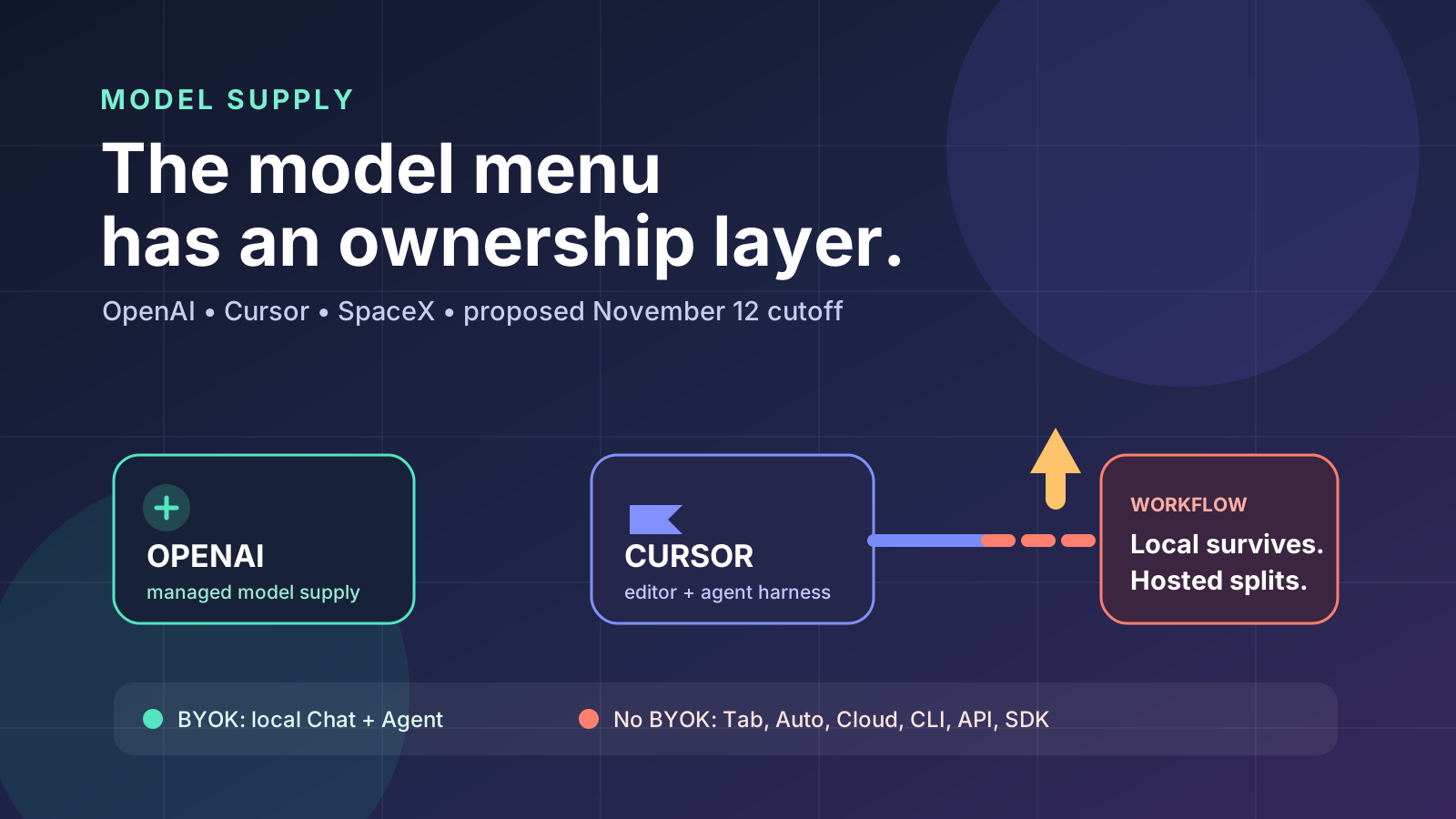
OpenAI’s plan to stop supplying models to Cursor looks small if you start with the number Cursor co-founder Michael Truell offered: OpenAI models account for about 5% of Cursor user traffic.
That is the wrong denominator.
The important number is how much of a team’s critical workflow can survive when a model supplier decides the owner of its coding platform is no longer an acceptable counterparty. On that measure, the impact is not 5%. A user can bring an OpenAI API key into local Cursor Chat and Agent, but that key does not restore OpenAI models to Tab, Auto, Cloud or Background Agents, Automations, CLI, API, or SDK. The model remains available; the integrated workflow does not.
OpenAI said on August 28 that it intends to wind down its custom Cursor contract after SpaceX acquired the company. It proposed November 12, 2026 as the shutoff date and said future models, including Astra, will not be provided through the managed relationship. The date is not final. OpenAI’s transition guidance says Cursor may end access sooner and that both companies still need to confirm the official termination date.
This is bigger than a model disappearing from a dropdown. It is the first clean warning that an AI coding tool’s model menu is a negotiated supply chain. Ownership, contract language, training boundaries, safety controls, routing economics, and supplier relationships decide what appears in the interface. Builders need to architect—and buy—accordingly.
There are four facts to keep separate.
First, OpenAI has notified SpaceX of its intent to end the contract that provides OpenAI models through Cursor’s managed product. This is an official company decision, not a rumor.
Second, November 12 is a proposed transition endpoint, not a settled date. Current access is expected to continue during the proposed period, but Cursor can choose an earlier end and the companies are still talking.
Third, OpenAI says it will not add future models to the managed Cursor relationship. It specifically names Astra, the upcoming model that OpenAI has said may approach unusually consequential cyber capabilities. That exclusion matters more strategically than the retirement date for today’s catalog.
Fourth, users have partial continuity routes. OpenAI documents three: an OpenAI API key inside Cursor, a compatible gateway, or the separate Codex IDE extension. Each preserves a different product, billing path, and set of features. None turns the old managed relationship back on.
The migration guidance exposes three layers that are usually collapsed into the phrase “model access.”
BYOK mostly answers the first question. It preserves a portion of the second. It does not guarantee the third.
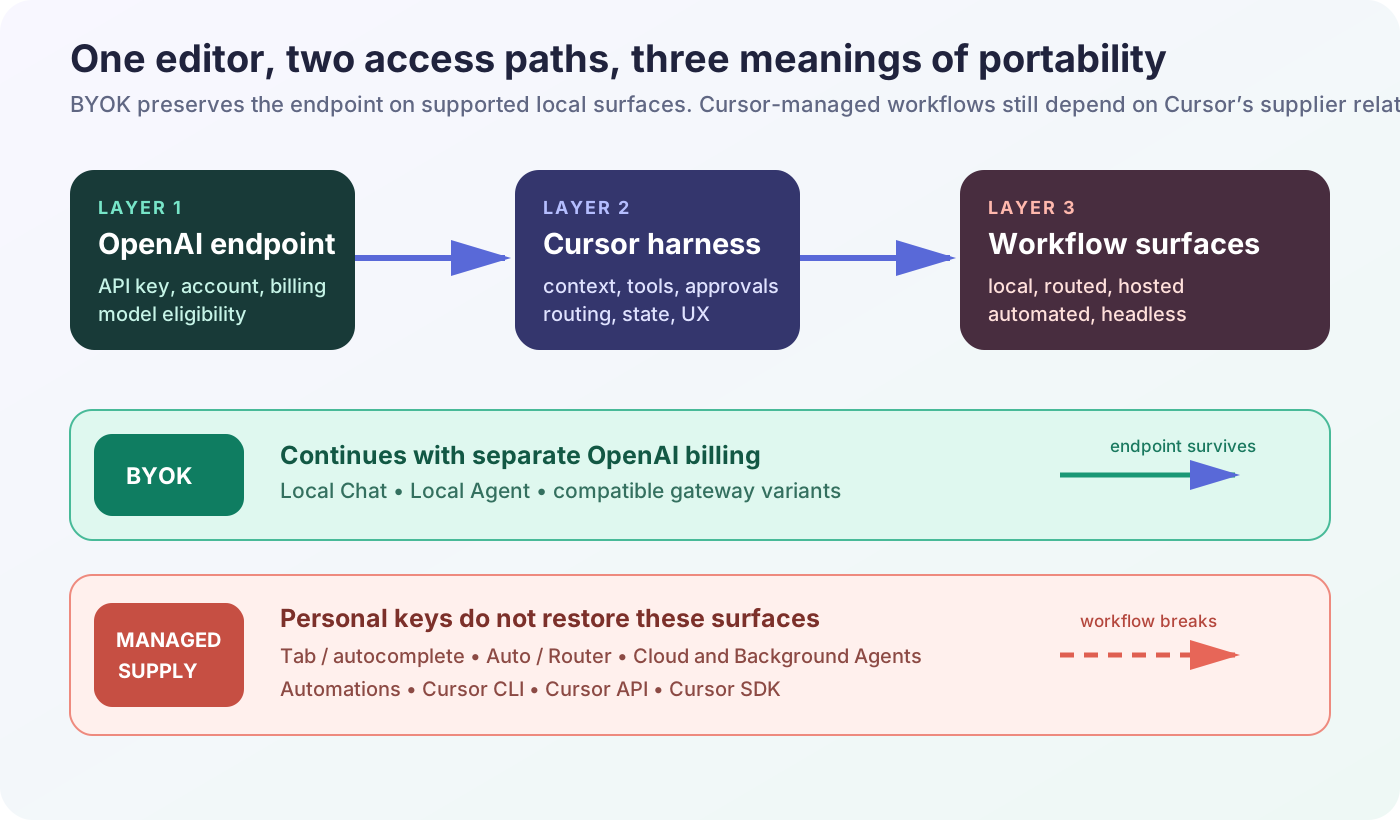
The useful boundary is not “inside Cursor” versus “outside Cursor.” It is local, user-keyed execution versus Cursor-supplied or Cursor-routed execution.
The distinction is concrete. OpenAI’s help page says a personal API key or gateway can be selected in supported local Chat and Agent sessions. But Cursor Tab and autocomplete do not use it. Auto does not use it. Cloud and Background Agents do not use it. Neither do Automations, Cursor CLI, Cursor API, or Cursor SDK.
The separate Codex extension is a stronger continuity option if the goal is “use an OpenAI coding agent in the same editor window.” It has its own authentication and agent experience, however. It does not change what Cursor Chat, Agent, Tab, Auto, or Cloud Agents use. Same shell, different product.
| Cursor surface | OpenAI BYOK or gateway | What continuity actually means | Migration risk |
|---|---|---|---|
| Local Chat | Supported | Direct model calls can continue with separate OpenAI billing | Low to medium |
| Local Agent | Supported | Tool behavior still depends on Cursor’s local harness and provider compatibility | Medium |
| Tab / autocomplete | Not supported | Uses Cursor-supplied models; choose a different route | Medium |
| Auto / Cursor Router | Not supported | The router selects from Cursor’s changing managed pool | High if model identity matters |
| Cloud or Background Agents | Not supported | Hosted execution needs a Cursor-provided model path | High |
| Automations, CLI, API, SDK | Not supported | Headless and productized workflows need replacement models or another runtime | Highest |
| Codex IDE extension | Separate route | OpenAI’s agent runs beside Cursor rather than through its model picker | Low for Codex-specific work |
That table is the migration plan in miniature. A team that only tests a prompt in local Chat can conclude everything is fine while its scheduled agents, CI jobs, SDK integrations, and routed enterprise requests are still exposed.
Truell’s estimate is useful as a directional signal: this is not a sudden removal of Cursor’s dominant model supplier. It is not useful as a measure of business importance.
“Traffic” is undefined. It could mean requests, sessions, tokens, active users, or an internal routing measure. It says nothing about revenue, spend, completion rate, or where those calls sit in a workflow.
Cursor’s pricing design also pushes traffic toward its own models before this cutoff happens. Its current model and pricing documentation puts Grok and Composer in a “Cursor Models” pool with significantly more included use. OpenAI, Anthropic, and Google models sit in the separate “Other Models” pool. Teams and Enterprise customers pay an additional $0.25 per million token Cursor Token Rate on third-party requests, including BYOK, while first-party Grok and Composer calls are exempt.
That structure makes a low third-party share unsurprising. It also creates a tail-risk problem: the rare calls to GPT-5.6 Sol may be the architecture review, cross-repository debugging pass, or difficult migration that a cheaper route could not finish. Volume-weighted dashboards routinely hide this concentration.
The right audit is not “what percentage of our prompts use OpenAI?” It is:
This is not a routine deprecation. OpenAI says its custom Cursor agreement contains a limited cancellation window after a change of control and that it is giving the maximum notice the contract allows.
SpaceX’s regulatory filing says the acquisition became effective on August 14 and made Cursor a wholly owned subsidiary at an implied equity value of $60 billion. A separate filed acquisition note describes an April compute arrangement, improving existing models including Grok, and potentially developing models and model-specific products together.
That turns an ownership event into a runtime event. The product did not have to fail. The API did not have to be deprecated. The customer did not have to choose a different model. A contract clause changed the set of suppliers willing to serve the same integration.
This deserves a line item in AI M&A diligence:
Change of control
        ↓
supplier cancellation window
        ↓
future-model eligibility changes
        ↓
different behavior by product surface
        ↓
customer migration and revalidation
Ordinary uptime SLAs do not cover that chain. Neither does a generic promise of “multi-model support.” Buyers need notice periods, termination assistance, model-substitution rights, trace and state export, committed-capacity treatment, and remedies when access is withdrawn for reasons unrelated to service availability.
OpenAI says it cannot be confident SpaceX will use its technology within OpenAI’s terms. The public record explains why the risk is legible.
SpaceX disclosures describe Cursor contributing personnel, data and datasets, technical know-how, workflows, prompts, specifications, and software code to work that can improve Grok or produce jointly developed models. OpenAI’s public business terms generally prohibit using OpenAI output to build competing AI models, subject to limited exceptions. OpenAI also points to reporting about Musk’s testimony that xAI had partly used OpenAI technology in training.
But one boundary matters: there is no public evidence that Cursor passed OpenAI outputs into the SpaceXAI or Grok training pipeline. The filings establish adjacency between Cursor’s product data and joint-model work; they do not establish that OpenAI-derived data crossed that boundary. OpenAI’s decision is a counterparty-risk judgment, not proof of a Cursor breach.
That distinction should not soften the engineering lesson. After an acquisition, previously separate stores of prompts, traces, proprietary code, eval results, and training corpora can become organizationally adjacent overnight. Providers and enterprise customers will increasingly demand provenance controls that can show which data entered which model-development path, under what rights, and with whose approval.
Withholding existing GPT access is a transition problem. Withholding Astra is a market signal.
OpenAI has said preliminary Astra evaluations show major advances in agentic coding and cybersecurity and that it cannot yet rule out a Critical cyber capability threshold. It has not classified Astra as Critical, but it has described stronger isolation, network restrictions, monitoring, weight protection, and selective pauses while testing continues. Our earlier analysis, OpenAI Astra Puts the Research Cluster Inside the Safety Boundary, explains why that matters.
OpenAI is therefore not merely declining a resale channel for another commodity API. It is deciding that an aggregator’s ownership, purpose, controls, and counterparty history affect eligibility for an unusually capable future model.
That points toward a new frontier-access stack:
price and capacity
+ identity and ownership
+ allowed purpose
+ monitoring and provenance
+ contractual remedies
= actual model eligibility
The model card and rate limit will still matter. They will no longer be the whole gate.
Anthropic responded in the opposite direction. Co-founder Tom Brown said the company would continue increasing compute to support Claude models in Cursor, according to Reuters reporting. No public volume, duration, model list, price protection, or service-level commitment accompanied that statement, so it should not be mistaken for a continuity guarantee.
Still, the posture is revealing. Anthropic buys all capacity at SpaceX’s Colossus 1 data center—more than 300 MW across over 220,000 NVIDIA GPUs, according to the company. OpenAI is exiting a model-supply relationship over trust and terms. Anthropic is staying inside a reciprocal compute relationship.
The lesson is not that every lab will close access to rival-owned tools. It is that access will follow a web of negotiated interdependence. Compute, distribution, training partnerships, cloud commitments, safety posture, and competitive boundaries will shape the catalog.
That makes “provider-neutral” an increasingly demanding claim. A product may support many model IDs while its pricing, included-use pools, router defaults, supplier contracts, and owner’s training strategy all tilt toward a first-party model.
Cursor’s Grok 4.6 page shows the vertical path clearly: the model was jointly trained with SpaceXAI, is available across desktop, web, iOS, CLI, and SDK, and is priced at $2 per million input tokens and $6 per million output tokens for standard service. Cursor reports strong coding results, but the same page shows mixed outcomes across benchmarks, so Grok is not a proven drop-in replacement for every OpenAI workflow. Our Grok 4.6 analysis goes deeper on that tradeoff.
There is no universal migration choice. The right response depends on whether a team values product integration, provider diversity, or runtime independence most.
Move most work to Grok, Composer, and Cursor-managed Auto. This keeps the broadest surface coverage and included-use economics, but increases exposure to Cursor’s routing decisions and first-party model strategy.
Re-evaluate Claude, Gemini, Grok, and Composer per workflow while using OpenAI BYOK for supported local tasks. This preserves choice but still leaves hosted and headless surfaces dependent on Cursor’s supplier catalog.
Use Codex or a direct OpenAI API path for critical OpenAI work, with prompts, tools, evals, and policies versioned outside the editor. This costs more operationally but survives a model-picker change.
For many serious teams, the answer will be a mix: Cursor’s integrated first-party route for high-volume work, multiple third-party models for independent quality checks, and a separate runtime for tasks that genuinely depend on OpenAI.
List local Chat, local Agent, Tab, Auto, Cloud or Background Agents, Automations, CLI, API, and SDK separately. Mark the requested model, actual provider, credentials, billing owner, tool path, and replacement option for each.
Build a 30–50 task eval set from real failures and high-value work. Include repository-scale changes, architecture decisions, terminal recovery, review, long-context tasks, and tool-heavy agent runs. Compare accepted outcomes, retries, latency, token cost, and human review time across GPT-5.6 Sol, Terra, and Luna; Claude; Grok; Composer; and any Gemini route you actually use.
Cursor Router documentation says the pool can change over time and that users do not hand-pick the underlying model for each Auto request. For consequential runs, log the requested route, actual model if exposed, effort level, surface, provider, context size, tool schema, region, cache policy, timestamp, and result.
An OpenAI API key is billed separately from Cursor and ChatGPT subscriptions. Add gateway fees where applicable, Cursor’s Teams or Enterprise third-party token rate, lost included usage, retries, and reviewer time. Our enterprise agent cost analysis explains why seat price is rarely the useful unit.
Ask for change-of-control notice, future-family eligibility, termination assistance, model substitution, trace and state export, deletion obligations, data provenance, and remedies. Make it possible to prove that provider outputs and customer code do not enter competing-model training without explicit rights.
Three consequences are easy to miss in the immediate coverage.
First, AI product architecture now inherits ownership risk. A coding tool can be technically multi-model and commercially single-point-of-failure on each supplier agreement. Change-of-control clauses belong beside API limits and disaster recovery in architecture reviews.
Second, hosted agent surfaces are the lock-in layer. Text prompts and model endpoints are comparatively portable. Cloud execution, context assembly, routing, state, automations, approvals, identity, and billing are not. As coding tools become agent platforms, portability will get worse unless teams deliberately keep workflow assets and evals outside the host.
Third, frontier access will resemble strategic capacity more than SaaS inventory. Astra’s exclusion, Anthropic’s reciprocal SpaceX compute deal, and Cursor’s first-party Grok economics all point the same way. The catalog will be shaped by relationships and permitted use, not only benchmark rank.
My near-term expectation is that Cursor will put more default and promotional weight behind Grok 4.6 and Composer while publishing a clearer migration matrix for OpenAI users. Claude’s share of difficult coding traffic could also rise because Anthropic has publicly chosen to add capacity. The managed OpenAI relationship will probably still end, but the final date or transition mechanics may change because both sides describe ongoing discussions.
The broader prediction is firmer: enterprise AI contracts will start naming change-of-control, future-model eligibility, and per-surface continuity explicitly. This incident gives procurement teams the case study they needed.
OpenAI has definitely announced its intent to wind down the managed contract. November 12 is the proposed date, not the confirmed final date. Cursor can end access sooner, and OpenAI says it will publish the official date after both companies confirm it.
Yes, for supported local Cursor Chat and Agent requests. The API usage is billed to your OpenAI account. BYOK does not cover Cursor Tab, Auto, Cloud or Background Agents, Automations, CLI, API, or SDK.
It gives you a separate OpenAI coding-agent experience inside the Cursor editor. It does not restore OpenAI models to Cursor’s own Chat, Agent, Tab, Auto, Cloud Agents, or other managed services.
OpenAI says it lacks confidence that SpaceX will comply with its terms, but the public record does not prove Cursor passed OpenAI output into Grok training. Regulatory filings show close model-development collaboration and broad data contributions; they do not establish that specific data crossing.
Not safely as an assumption. They may be better for some tasks and worse for others. Cursor’s own benchmark page reports mixed comparative results, and model behavior depends on effort settings, context, tools, routing, and the host harness. Re-run real workflow evals.
November 12 may move. Do not let that delay the work.
Use the next two weeks as the real deadline to map every affected surface, export what is portable, build the eval set, and test at least one independent route. Then use the remaining transition window to migrate based on evidence instead of a rushed model swap.
OpenAI’s Cursor decision is not proof that multi-model products are failing. It is proof that “multi-model” describes a catalog, not a continuity guarantee.
The durable architecture is one where a supplier can disappear, the team can see exactly which workflows break, and the hardest work still has somewhere trustworthy to run.