OpenAI Skills Turns Agent Workflows Into a Cross-Product Standard

For most of the generative-AI era, a repeatable workflow was a long prompt somebody kept in a document. If it worked, teammates copied it. If it stopped working, nobody knew which version had changed. If the workflow needed a script, a reference file, or a tool, the “prompt library” quickly became a folder of tribal knowledge.
OpenAI is now giving that workflow a real deployment unit.
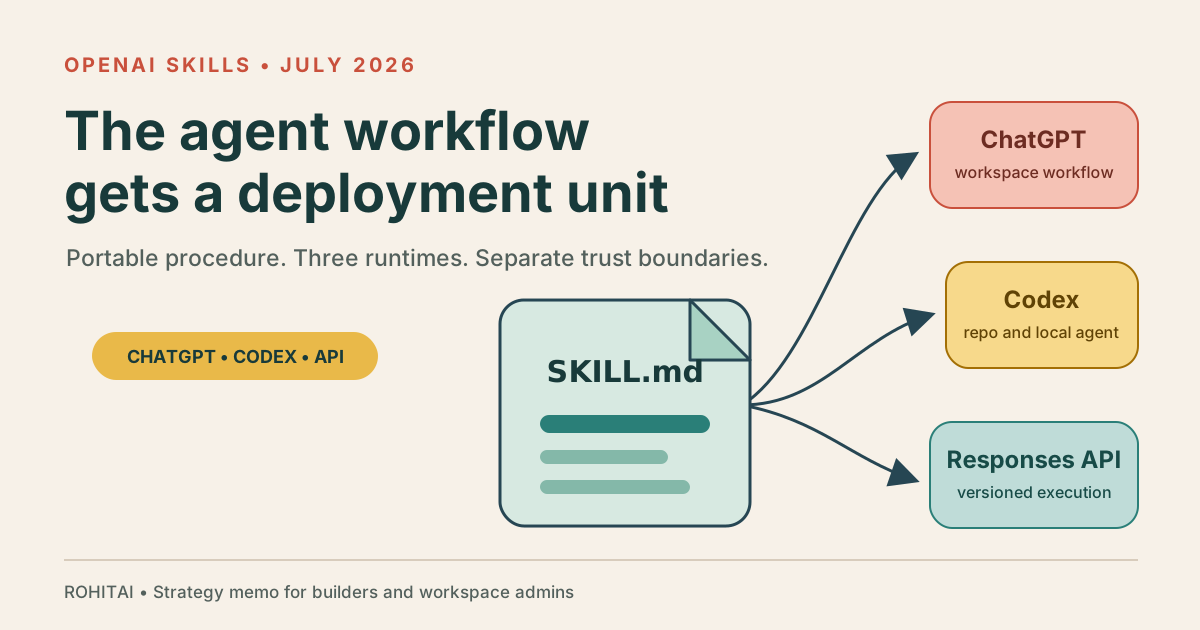
Personal Skills are generally available for ChatGPT Business, Enterprise, Healthcare, and Edu. The same Agent Skills format is supported in Codex and through the Responses API. A skill can package instructions, examples, reference material, assets, and executable code around a SKILL.md manifest. OpenAI follows the open Agent Skills standard, so the bundle can be downloaded from one surface and installed in another.
That is the big change. The procedure is becoming portable across chat, coding, and application runtimes.
But the tempting conclusion—“write once, run everywhere”—is only half true. ChatGPT sharing does not become Codex filesystem policy. A Codex skill does not carry its sandbox or network permissions into an API container. An API version pin does not create a workspace approval record in ChatGPT. The files travel; the trust boundary does not.
OpenAI has standardized the artifact before it has unified the control plane. That makes Skills immediately useful, and it creates a new engineering discipline: teams now have to operate agent procedures like software.
The useful way to understand a skill is as a small repository for one job.
At minimum, it contains a SKILL.md file with a name, a description, and instructions. It can also include scripts, references, templates, examples, and assets. In Codex, the description helps the agent decide when a skill applies; the full instructions are loaded only when the skill is selected. OpenAI calls this progressive disclosure: the agent sees enough metadata to route the task without stuffing every installed procedure into the prompt.
customer-renewal-review/
├── SKILL.md
├── scripts/
│   └── calculate-risk.py
├── references/
│   ├── scoring-rubric.md
│   └── escalation-policy.md
└── assets/
    └── account-brief-template.md
That structure fixes several problems at once.
The workflow becomes reviewable. The operating instructions live beside the code and reference material they depend on. A team can export the package, inspect it, test it, update it, and install it elsewhere. The agent can discover the procedure by its description instead of relying on a user to remember the right incantation.
It also changes what “customization” means. Custom instructions shape an assistant broadly. An AGENTS.md file gives Codex durable context for a repository or directory. A skill is narrower: it is a named capability for a repeatable job, invoked explicitly or selected when the request matches.
Our earlier Codex remote-work guide treated AGENTS.md as the persistent operating manual around a codebase. Skills complement that layer. AGENTS.md says how this environment works; a skill says how to perform this particular procedure.
OpenAI's cross-product story is real, but each surface adapts the package differently.
| Surface | How it arrives | How it runs | Control that stays local |
|---|---|---|---|
| ChatGPT | Create, upload, install, share, or publish to a workspace | ChatGPT can select an installed skill when relevant | Owner, access, workspace roles, sharing, install policy, compliance events |
| Codex | Repository, user, admin, system, or plugin-installed filesystem scope | Explicit $skill / /skills use or implicit description matching | Sandbox, approvals, network, tools, local config, repository trust |
| Responses API | Project-scoped upload, versioned bundle, curated ID, inline ZIP, or local path | Hosted container_auto or developer-managed local shell | API auth, version pin, container lifecycle, tool policy, application approvals |
ChatGPT is the lowest-friction surface. Eligible users get a Skills area with views for installed, self-created, shared, and workspace-published skills. They can create a skill through chat, edit it directly, upload one, or install one that a colleague has shared. OpenAI includes a skill-creator skill for eligible accounts, making the authoring loop itself a reusable workflow.
This is where Skills will reach non-developers. A finance team can package its variance-review procedure. Sales operations can distribute a deal-inspection rubric. A research team can capture how it verifies sources and formats a memo. The interface makes those procedures feel closer to an internal app than a text snippet.
There is an important rough edge: Personal Skills do not automatically sync between the ChatGPT desktop app and web/mobile. A user adds them separately. The format is portable, but today there is no single personal registry transparently following the user across every surface.
That distinction will confuse people because “same standard” sounds like “same installed state.” It is not.
Codex reads skills from filesystem scopes. A team can check a procedure into .agents/skills with the code it governs, keep personal skills under $HOME/.agents/skills, or deploy organization-wide defaults under /etc/codex/skills. Plugins provide a distribution wrapper when a workflow should ship with apps, MCP connections, configuration, or multiple skills.
Codex can invoke a skill explicitly, or match it implicitly from its description. Authors can disable implicit selection with allow_implicit_invocation: false, which is useful for expensive, sensitive, or rarely appropriate workflows.
The model is elegant because it is close to normal software practice. A repository-scoped release checklist can be versioned with the repository. A migrations skill can include the exact scripts and reference docs that its instructions cite. A security review can be present without bloating every turn because Codex loads the full manifest only when it needs the skill.
The tradeoff is equally software-like: a script inside a skill is code. If Codex has permission to run it, the package may read files, transform data, invoke tools, or make changes within the effective sandbox. “It's only instructions” is no longer a safe assumption.
The OpenAI API Skills guide adds the machinery product teams need: project-scoped uploads, immutable versions, a default-version pointer, hosted container execution, and explicit version selection.
A hosted skill can be attached to the shell environment in a Responses API call:
const response = await openai.responses.create({
  model: 'gpt-5.6',
  input: 'Use the renewal-review skill for this account packet.',
  tools: [{
    type: 'shell',
    environment: {
      type: 'container_auto',
      skills: [{
        type: 'skill_reference',
        skill_id: 'skill_abc123',
        version: 4,
      }],
    },
  }],
});
The version number is the quiet star. A chat user can say “use our renewal skill”; an application can say “use version 4 of this approved bundle.” That is the difference between convenient reuse and reproducible production behavior.
OpenAI's current limits also make the object concrete: a ZIP can be up to 50 MB, contain up to 500 files per version, and include individual uncompressed files up to 25 MB. This is enough room for a substantial workflow package, not a reason to stuff an undocumented application into a skill.
The standard gives teams one source format. It does not create one security model.
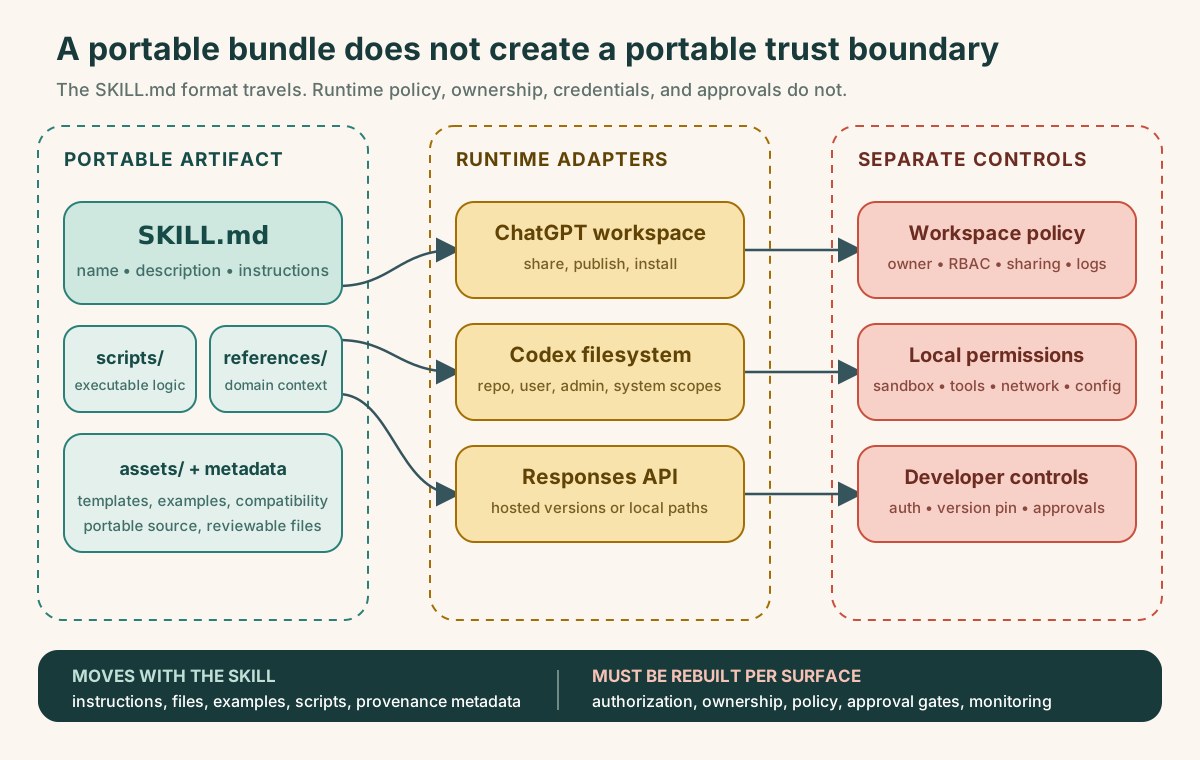
The bundle can travel; authorization, ownership, runtime policy, and monitoring must be established again on each surface.
Imagine a workspace publishes a skill that prepares a customer renewal memo using an approved CRM app. A developer downloads the same bundle and installs it in Codex. The procedure moved. The CRM OAuth grant did not. The workspace's role-based access did not. The app approval policy did not. The ChatGPT compliance record did not turn into a local shell audit trail.
Move that skill again into an API project and another boundary appears. The developer chooses a hosted or local shell environment, attaches a version, supplies credentials through the application architecture, and decides which external actions require approval. The manifest may be identical while the blast radius is completely different.
This is RohitAI's first non-obvious read: Agent Skills standardizes workflow source, not workflow authority.
That is the correct design. A portable ZIP should not silently carry a user's credentials or inherit permissions from a different product. But teams need to model the gap explicitly. Otherwise, they will assume that an approved workflow remains approved everywhere it can be installed.
OpenAI says Skills are currently off by default for ChatGPT Enterprise and Edu. Beginning July 23, 2026, it plans to turn Skills on by default for Enterprise workspaces that have not opted out.
The wording matters.
This is an Enterprise default change, not a statement that every Edu workspace will flip on the same day. It is also not the first day Skills exist: OpenAI introduced the Enterprise and Edu beta in March, and Codex has supported reusable skills since the Codex app launch period. The current news is the GA status for Personal Skills on managed plans, the explicit cross-surface portability story, and the near-term Enterprise default.
Admins can separately govern whether members may create and use skills, upload skill files, share them, publish them to the workspace, or install them for other members. A separate admin inventory exposes owner, access, users, recent invocation counts, and timestamps. Skills can also appear in Compliance Logs, and conversations used with them follow workspace data-residency settings.
Those are meaningful controls. They still apply to workspace-managed ChatGPT Skills. OpenAI explicitly warns that Skills in other products, including Codex, may be governed separately.
So the July 23 decision is not simply “on or off.” An enterprise should answer:
Who may author?
Who may upload external bundles?
Who may publish to the workspace?
Who may install for other people?
Which skills may use apps with write actions?
Who owns abandoned skills when an employee leaves?
How do Codex and API deployments enter the same inventory?
If the answers do not exist, default-on turns a productivity feature into an unowned software catalog.
This is the second non-obvious consequence: the enterprise prompt library is becoming a software supply chain.
Once a skill can contain code, references, and tool instructions, its risks look familiar:
ChatGPT scans uploaded skills and may mark them Available, Needs Review, or Blocked. OpenAI correctly says that scanning does not replace a team's own review or policy. The API documentation is even more direct: treat skills as privileged code and instructions, vet their contents, bound their workflows, and add approval before high-impact actions.
The operating model should borrow from package management and CI/CD:
Record source, author, owner, reviewers, dependencies, and the exact bundle hash.
Test correct triggering, wrong-trigger resistance, expected outputs, tool use, and adversarial inputs.
Pin a tested version, approve permissions per runtime, canary usage, then promote the default.
Know where the bundle is installed, who can still use it, and how to disable or delete it quickly.
This is why versioning matters more than it seems. In the API, creating a new version and changing the default version are separate operations. A careful team can upload version 5, run an eval and a canary against it, then move the default pointer only after approval. High-stakes applications can keep requesting version 4 until the new release clears their checks.
ChatGPT's sharing experience makes adoption easier; the API's version model makes behavior more reproducible. Enterprises will eventually want those strengths combined in one organization-wide inventory.
OpenAI now has the pieces of a workflow ecosystem, but they are not yet one lifecycle.
This is the third non-obvious read: the next valuable enterprise layer is not another skill marketplace. It is a control plane that can answer where a workflow exists and what it can do.
A mature inventory would map one logical skill across:
source repository and bundle hash
ChatGPT workspace publication
desktop and web/mobile installations
Codex repo, user, admin, and plugin copies
API project IDs and pinned versions
tool and app dependencies
data classes touched
approval requirements
invocations, outcomes, incidents, and owners
OpenAI already exposes parts of this picture. ChatGPT admins can see ownership, access, users, and 30-day invocation counts. API developers get project-scoped IDs and versions. Codex has explicit filesystem locations and configuration. What is missing is the cross-surface join.
Without that join, a company can revoke a ChatGPT workspace skill while an exported copy remains in a repository, on a developer machine, inside a plugin, or attached to an API project. That is not an argument against portability. It is the normal cost of portable artifacts—containers, packages, and documents behave the same way. It is an argument for provenance and deployment tracking from day one.
Our ChatGPT Work analysis described OpenAI's move from assistant to work layer. Skills fill in the procedural layer: apps supply authority and data, models provide reasoning, and skills encode how the work should be done. The GPT-5.6 agent credit-pool analysis adds the economic layer. A production team will eventually attribute spend and outcomes by skill, version, surface, and business process, not only by model or user.
The wrong first skill is a vague “company assistant” stuffed with every policy and tool. It will be hard to trigger, hard to test, and dangerous to authorize.
Start with a bounded procedure that has a stable input, a checkable output, and clear failure conditions.
Package work such as release-note preparation, incident-summary formatting, account-review rubrics, test-failure triage, or document QA. The inputs are known and a human can verify the result quickly.
Add workflows that read approved sources or prepare a change, then require a person to approve the write, send, merge, or external action.
Avoid an all-purpose skill with unrestricted shell, network, customer-data, and write access. Decompose it until permissions and success criteria are understandable.
A useful skill has a contract:
trigger: when this procedure should and should not run
inputs: required files, fields, and source systems
steps: deterministic stages and tool boundaries
outputs: schema, template, or artifact expected
checks: how the agent and reviewer know it succeeded
approvals: actions that require a person
failure: when to stop, escalate, or refuse
owner: team accountable for the workflow
That contract is more important than a clever prompt. The instructions can evolve. The contract gives you an eval target.
OpenAI's July 23 Enterprise change leaves enough time to establish a lightweight process. It does not require a six-month governance program.
For developers, the quickest win is to turn one repeated, irritating procedure into a repo-scoped skill. Keep it narrow, add a small eval set, and verify that implicit invocation does not trigger on neighboring tasks.
For API teams, upload a bundle as a non-default version, pin it in a staging call, and test the actual hosted environment. Pay attention to which files the skill can access, which tools it can call, how containers expire, and what application state your Responses usage retains under your account settings.
For workspace admins, inspect the permission granularity before choosing a blanket setting. Letting members use approved skills is different from letting them upload arbitrary external ZIPs or install a workflow automatically for other people.
Not literally—there is no universal registry or dependency solver today—but the analogy explains the direction. Teams will search for workflows, inspect metadata, install versions, fork packages, report vulnerabilities, and argue about trusted publishers. The distribution layer we predicted in our look at AI-agent social networks and skill.md is moving into mainstream products.
The healthy version of this market will value provenance, small scopes, reproducible evals, and transparent dependencies. The unhealthy version will be a pile of “productivity skills” that quietly contain broad scripts and stale policy.
If a workflow package describes the job, supplies references, and defines checks, a team can test it across model versions and surfaces. The model still matters enormously, but the durable organizational asset becomes the procedure plus its evaluation set.
That shifts bargaining power. A company with well-specified skills can compare models on completion rate, cost, latency, and risk without rebuilding every workflow from zero. The moat moves from prompt tricks toward proprietary operating knowledge encoded in testable packages.
The first dashboards will count invocations. The useful dashboards will show:
accepted outcomes per skill version
human corrections per run
tool approvals and denials
cost per completed process
wrong-trigger rate
time saved versus baseline
incidents and revocations
An invocation is not value. A skill that runs 10,000 times and creates 2,000 cleanup tasks is worse than one used 500 times with a 95% acceptance rate.
Enterprises will ask whether one policy can follow a workflow from ChatGPT to Codex to the API. They will want signed packages, organization-approved publishers, dependency scanning, centralized revocation, version promotion, and evidence that the same logical skill is operating within different runtime permissions.
OpenAI has a head start because it owns all three surfaces. The hard part is no longer demonstrating that the format travels. It is making the governance map travel without letting authority leak.
Skills encode a reusable procedure. Plugins distribute a larger product bundle that can include skills, apps, MCP connections, and configuration. Teams will author and test a skill locally, then package it as a plugin when installation, dependencies, and workspace distribution need a product wrapper.
That boundary is healthier than forcing every workflow to become a mini-platform.
Skills are reusable workflow packages built around a SKILL.md manifest. They can include instructions, examples, reference files, assets, and scripts. OpenAI documents support across ChatGPT, Codex, and the Responses API.
OpenAI says Personal Skills are generally available for ChatGPT Business, Enterprise, Healthcare, and Edu users. Its current pricing comparison separately lists “Skills beta” for Free, Go, Plus, and Pro. Treat managed-plan GA and consumer-plan beta as different availability states, not one universal launch.
Not automatically. OpenAI says Personal Skills must be added separately on desktop and on web/mobile. Users can export and reinstall a standards-compatible package, but installed state is not one synchronized personal registry today.
They share the Agent Skills package format, but they are installed, authorized, executed, versioned, and monitored differently. Portability of files does not mean portability of permissions or ownership.
OpenAI plans to enable Skills by default beginning July 23, 2026, for Enterprise workspaces that have not opted out. Its wording does not announce the same default-on change for Edu workspaces.
Yes. A skill can include scripts, and Codex or an API shell environment may execute code within the permissions of that runtime. Review third-party skills as privileged code and instructions, even when the top-level description sounds harmless.
The Skills API maintains immutable versions and a separate default-version pointer. Applications can request a specific integer version or use the default/latest behavior described in the current API docs. Pin a tested version for production when reproducibility matters.
No. A skill can direct an agent to use tools that are already available, but it does not create a new OAuth grant or override workspace and application permissions. Tool authority must be configured separately.
OpenAI Skills looks modest if you see it as a place to save prompts. It looks much larger when you see what has been standardized: a reviewable package for agent procedures that can move between end-user chat, local coding, and hosted application execution.
That package could become the most durable layer in the agent stack.
Models will change. Apps and APIs will change. Tool protocols will change. A company's hard-won procedure for reviewing a renewal, resolving an incident, migrating a service, or checking a financial model can survive those changes if it is encoded as a portable workflow with clear inputs, checks, and ownership.
The catch is that portability multiplies deployments. Every new surface adds a runtime, a permission model, a version, and an audit path. Treating a skill like a harmless prompt will create avoidable failures. Treating it like software—small, versioned, tested, attributable, and revocable—turns it into infrastructure.
OpenAI has made agent workflows portable. The teams that benefit most will be the ones disciplined enough to keep their trust boundaries visible.