WeatherNext 2 Turns Cyclone Forecasts Into Programmable Risk Infrastructure
 Rohit Ramachandran
Aug 07, 2026Updated Aug 07, 2026
 Rohit Ramachandran
Google DeepMind has released the code and pretrained weights behind WeatherNext 2, WeatherNext Cyclones, and a smaller Mini model. The accompanying Nature paper reports a striking result: across tropical cyclones from 2023 through 2025, WeatherNext Cyclones delivered an average lead-time advantage of at least a day for track, intensity, and wind-radii predictions over leading operational baselines.
That is the scientific headline. It is not the whole product story.
The more consequential shift is that cyclone uncertainty is becoming a programmable distribution. DeepMind says its operational system can now generate 1,000 plausible 15-day scenarios. The public WeatherNext 2 feed exposes 64 ensemble members through BigQuery, Earth Engine, and Zarr. Builders can stop treating a forecast as one line on a map and start asking operational questions: How many scenarios cross this shipping corridor? What fraction puts hurricane-force winds near these substations? At what lead time does the expected cost of closing a port fall below the expected loss of staying open?
Open weights make forecast generation easier to inspect and reproduce. They do not make those decisions automatic. The hard work moves downstream into calibration, local observations, impact models, legal terms, alert policy, and human escalation.
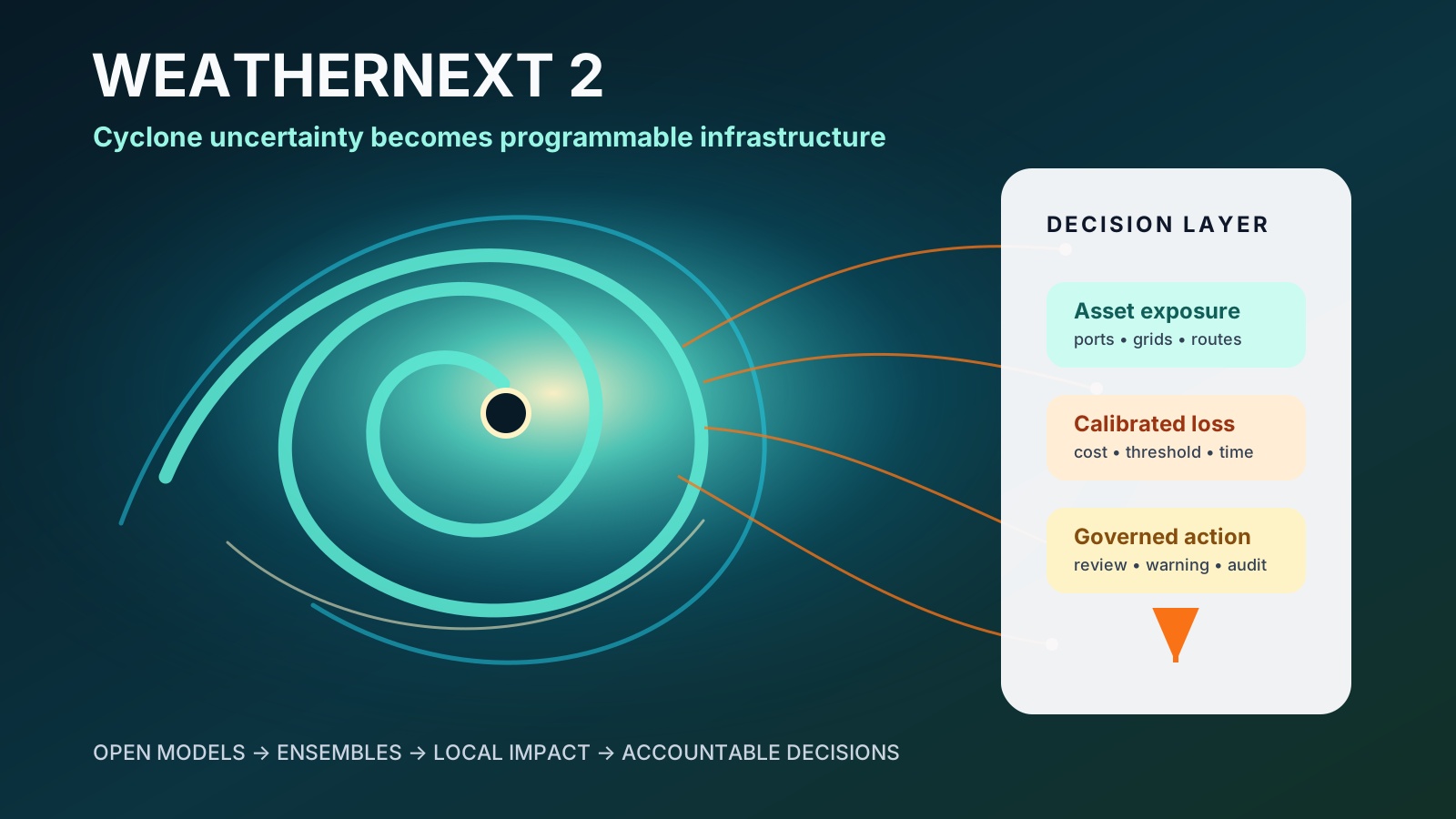
WeatherNext is therefore best read as a transfer of value. The atmospheric model is opening; the defensible product becomes the decision layer built above it.
The August 6 release bundles several things that are easy to collapse into one name.
WeatherNext Cyclones is the cyclone-specialized family evaluated in the new peer-reviewed paper. It combines global atmospheric analysis with expert-curated cyclone records, including track, intensity, size, and wind-radii information. DeepMind describes nearly 20 TB of atmospheric data and almost 5,000 storms spanning roughly 45 years. The model used live during the 2025 Atlantic season was called FNV3; the National Hurricane Center's postprocessed guidance was called GDMI.
WeatherNext 2 is a later, independently trained general-weather model using the same cyclone-forecasting algorithm. It also predicts 100-metre wind. Its weights are not interchangeable with the WeatherNext Cyclones checkpoints, so the cyclone paper's scores should not simply be pasted onto every WeatherNext 2 output.
WeatherNext 2-mini runs at 1-degree resolution and is designed to lower the experimentation barrier. Google says it can run on a free Colab TPU or a P100-class GPU, while warning that it should not match the full models.
The GitHub repository includes pretrained weights, sample data, rollout and tracker code, loss and gradient examples, and year-frozen checkpoints trained only through the year before an evaluation period. Code is under Apache 2.0; other released materials are under CC BY 4.0. ERA5, HRES, real-time forecast data, and other third-party inputs can carry separate terms.
Evidence map
Nature-evaluated family; FNV3/GDMI lineage; specialized cyclone targets; frozen 2023, 2024, and 2025 checkpoints.
Independent training run; general operational weather feed; adds 100-metre wind; 64 public ensemble members.
The algorithm connects the branches. Benchmarks, weights, data terms, and deployment claims still need branch-specific attribution.
The peer-reviewed paper says WeatherNext Cyclones was evaluated worldwide on 2023-2025 storms and achieved a day or more of average lead-time advantage across track, intensity, and wind-radii prediction. It also reports that adding the model to a weighted consensus improved forecast skill.
An earlier and more concrete result covered a narrower slice. In the 2023-2024 North Atlantic and East Pacific evaluation, DeepMind reported that its five-day track forecast was about 140 km closer to the observed storm location than ECMWF ENS, roughly matching ENS at 3.5 days. That is a useful number, but it should not be generalized to every basin or to the entire three-year paper.
The intensity result is the more surprising break with the previous AI-weather generation. An independent CIRA/NHC-affiliated study of earlier open AI weather models found competitive track guidance but severe low bias in storm intensity. WeatherNext Cyclones attacks that weakness by training the global model against curated storm attributes, rather than expecting a generic coarse-grid model and a tracker to recover intensity on their own.
One more caveat is essential. The full model consumes fields at roughly 0.25-degree resolution, about 28 km at the equator. That is much coarser than a regional model resolving the inner core. DeepMind's result does not prove that eyewall physics, terrain, coastal geometry, or convection stopped mattering. It shows that a model trained directly on storm attributes can infer useful track, intensity, and wind-structure guidance from large-scale context.
That is target engineering, not the abolition of small-scale physics.
"WeatherNext is open source" is true and incomplete. A builder choosing an integration route faces three products with different economics, terms, and operating burdens.
| Route | What you get | Operational tradeoff | Best first use |
|---|---|---|---|
| Public forecast feed | 64 members, four daily initializations, global 0.25-degree fields, 15-day horizon | Experimental data, request-based access, fixed operational configuration, separate real-time terms | Asset joins, geospatial analysis, research, and product validation |
| Open repository | Code, weights, Mini, frozen checkpoints, training and tracker utilities | TPU-first full model or H100-class GPU, data dependencies, no support or API-stability promise | Reproduction, localization research, custom postprocessing, and model inspection |
| Vertex AI EAP | Custom ensemble size and horizon, selected hourly variables, Zarr output, dedicated GPUs | Allowlist, billing and quota, single-tenant A100/H100 capacity, contractual restrictions | Teams needing managed custom forecasts or historical backtesting from 2024 onward |
The public-data guide points builders to BigQuery for SQL-heavy analysis, Earth Engine for raster workflows, and Zarr on Cloud Storage for direct array and ML pipelines. Google says requests are reviewed weekly and typically take five to seven business days.
The licensing boundary also moves with time. The Earth Engine dataset card treats historical forecast data older than 48 hours as CC BY 4.0 with required attribution, while the freshest 48 hours use separate, revocable real-time terms that limit redistribution and raw-data proxying. A weather product needs a layer-by-layer legal review, not one repository-license check.
The Vertex route is not a cheap shared endpoint. It provisions dedicated single-tenant A100 or H100 GPUs through an early-access program. Google's guide also says users must not use the model or its forecasts to develop a similar competing service, among other restrictions. That makes the managed route materially different from self-hosting the permissively licensed repository.
Start here when the product needs probability fields, not custom model initialization. It removes model operations and makes validation the first job.
Choose this for reproducibility, tracker experiments, postprocessing, or localized research—and budget for accelerator memory, data access, and model qualification.
Consider it when custom horizons, ensemble sizes, or backfills justify dedicated capacity. Review commercial restrictions before architecture work begins.
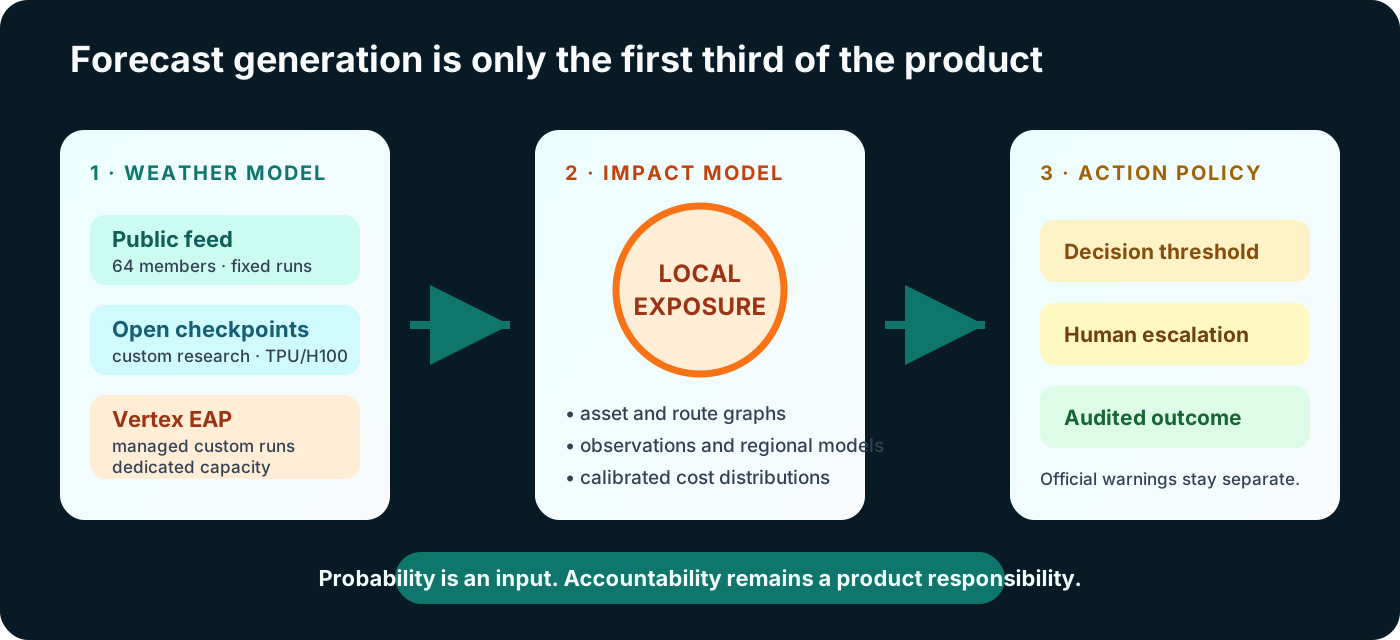
The forecast becomes useful only after a product joins it to local exposure, calibrated consequences, and an action policy.
A 50-member ensemble can express event frequency in rough two-percentage-point steps. A 1,000-member ensemble lowers that nominal step to one-tenth of a percentage point. For rare events such as rapid intensification, that creates a much richer product surface.
But 1,000 correlated model runs are not 1,000 independent observations. WeatherNext's underlying Functional Generative Network uses four independently trained model seeds and learned noise to produce coherent variability. Every member still shares architecture, much of the training data, and the same broad modeling assumptions.
The FGN technical report is candid enough to document mesh-frequency artifacts and an unstable training seed that had to be removed and retrained. That disclosure is valuable. It also explains why ensemble count alone is a weak reliability claim. A large ensemble can sample its own error very precisely.
This leads to the first non-obvious implication: the operational unit is not a checkpoint; it is a versioned forecast assembly. Model seed, initialization source, tracker, calibration window, ensemble size, temporal resolution, postprocessor, and alert threshold all belong in the release identifier. A tracker change can alter the customer-facing product even when the weights do not move.
The second implication is that consensus membership matters more than standalone dominance. NOAA says the 2025 season was the first time NHC incorporated these new AI weather systems into real-time guidance. NHC's 2026 definition of the TVCN track consensus includes GDMI among its eligible components. A model does not need to win every storm if it contributes a useful, different error pattern to a governed consensus.
That is a more credible adoption path than replacing forecasters. In NOAA's own Q&A, NHC says its official human-produced forecast remains more skillful and consistent than any individual model. It notes that AI guidance was valuable for Hurricane Melissa, while traditional models performed better in other cases.
The third implication is commercial: open sourcing pushes the moat out of the weather map. Once anyone can query 64 scenarios or run Mini, another animated wind layer is not much of a business. The valuable product knows which warehouse floods, which route has a tolerable delay cost, which turbine cluster needs inspection, or when a claims team should pre-position adjusters. It owns local exposure data, calibrated loss functions, action thresholds, and an audit trail.
This is the same systems lesson I drew from NVIDIA Cosmos 3 Edge: headline model speed has to be decomposed into the clocks of the full decision loop. And as with JoyAI-Video-Edit's open weights, downloadable files do not erase the runtime, data, and validation stack. WeatherNext raises the stakes because a mistaken product claim can influence life-safety behavior.
Suppose a logistics team wants to reroute vessels when hurricane-force winds could cross a corridor. The wrong first milestone is a beautiful globe. The right one is a backtestable decision contract.
Define the action and its cost. Specify the wind threshold, corridor geometry, lead-time window, false-alarm cost, missed-event cost, and who can override the system. Then ingest the 64-member feed and calculate the fraction of members crossing the condition. Calibrate that fraction against historical outcomes by basin and lead time. Compare it with climatology and the organization's current guidance. Only then should a product expose an alert.
Use a pipeline like this:
initial conditions + WeatherNext ensemble
                  ↓
asset / route / facility graph
                  ↓
local observations + hazard postprocessor
                  ↓
calibrated loss distribution
                  ↓
action threshold + human review
                  ↓
audited recommendation

official meteorological warnings ─────────────► separate, always visible
The official-warning channel is deliberately outside the learned decision pipeline. A commercial application can provide additional planning guidance without presenting itself as the source of public safety authority.
First, independent basin-level reliability work. The paper's global average is important, but operators need to know where tail probabilities are calibrated, where rapid intensification produces false alarms, and how performance changes with observation quality.
Second, the gap between the 64-member public feed and the 1,000-member operational cyclone system. More scenarios are useful only if users can access the relevant attributes, understand effective ensemble size, and validate the tails. Google has not published an end-to-end cost or latency figure for the full thousand-member decision pipeline.
Third, hybrid consensus products. NHC has decades of institutional machinery for evaluating models, combining guidance, and communicating one coherent risk message. That favors AI entering as another governed family beside physics-based systems, not as a standalone oracle.
Fourth, localized postprocessors built on Mini and the frozen checkpoints. The low-cost model should make research and teaching easier. It may also produce basin-specific tools. But moving from a notebook to official or commercial operations will still require seasonal verification, data licensing, and warning governance.
Finally, managed access. Vertex currently looks like capacity procurement, not a weather-model API: allowlist, quota, notebook-driven runs, dedicated GPUs, and large Zarr artifacts. If demand grows, Google will probably package a simpler service. Until then, most builders should begin with the public feed.
One operational number deserves more attention than the accelerator benchmark: the public dataset's documented schedule is roughly 7.5 hours after each initialization, normally within about 15 minutes of that target but sometimes more than an hour late. For applications, freshness begins when observations and initial conditions arrive—not when the neural network starts its forward pass.
WeatherNext Cyclones is a serious scientific advance because it closes a gap that earlier AI weather models left open: useful intensity and wind-structure guidance alongside track, from one global probabilistic system. The open release is equally important because it gives researchers frozen checkpoints, code, weights, and a path to inspect the machinery rather than consume only a corporate chart.
The launch also draws a clean line around what the model does not provide. It does not turn a 15-day horizon into a 15-day warning. It does not turn a 28 km grid into neighborhood physics. It does not make 1,000 related samples independent. It does not make an unsupported repository an operational service. And it does not replace the official forecast.
For builders, that is not a disappointment. It is the market map.
The atmospheric forecast is becoming faster, broader, and more accessible. The scarce work is converting probability into a decision that is locally calibrated, economically defensible, legally usable, reversible when possible, and accountable when wrong.
That is where WeatherNext stops being a model release and starts becoming infrastructure.
Google released code and pretrained weights in the WeatherNext repository. The code and notebooks use Apache 2.0, while other released materials use CC BY 4.0. Inputs and forecast surfaces such as ERA5, HRES, real-time WeatherNext data, Earth Engine, and Vertex AI can have separate terms, so "open source" does not describe the whole deployment stack.
It generates global weather and cyclone scenarios out to 15 days. That is a model horizon, not a promise that every 15-day cyclone prediction is decision-grade. Skill and calibration vary by hazard, basin, storm, and lead time.
No. Google's current WeatherNext 2 data documentation describes a 64-member public ensemble. The 1,000-member figure refers to DeepMind's expanded operational cyclone system.
No. Google warns against using the research release as a replacement for official alerts, and NOAA says the official human-produced NHC forecast remains more skillful and consistent than any single model. WeatherNext is guidance within a wider expert process.
For most applications, start with the 64-member public feed through BigQuery, Earth Engine, or Zarr. Self-host the full model only when custom research or control justifies TPU/H100 operations. Evaluate Vertex EAP when managed custom ensemble size, horizon, or backtesting is worth dedicated capacity and its contractual terms fit the product.