JoyAI-Video-Edit Hits 30 FPS. The Stream Still Runs on Five Clocks.

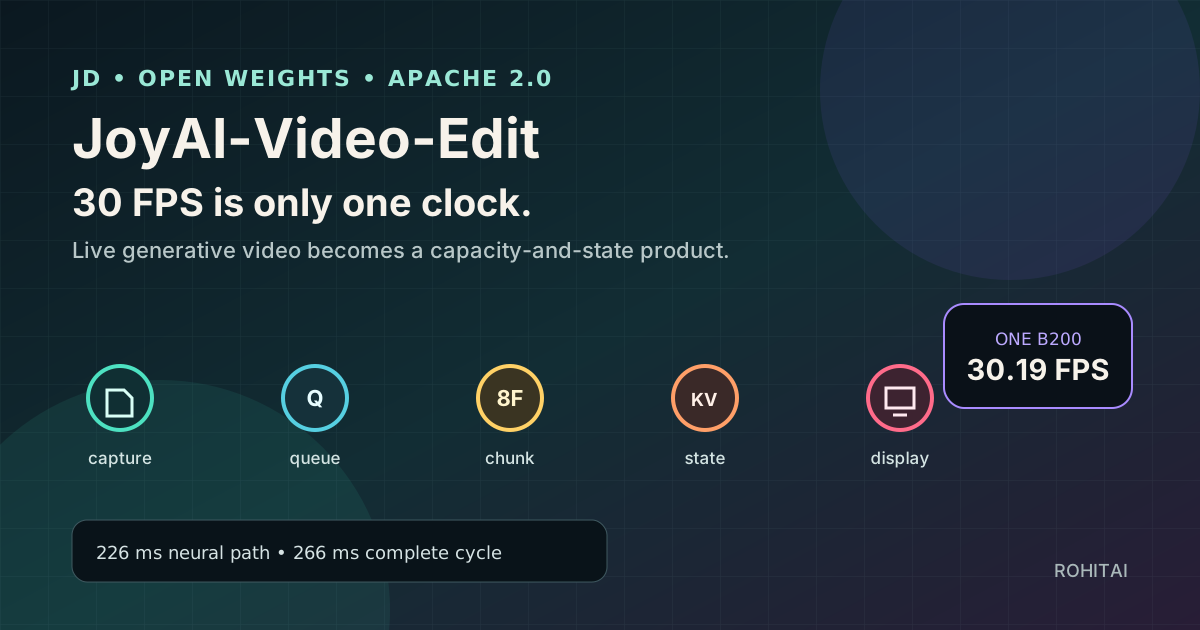
A live video editor can process 30 frames every second and still feel late.
JD's JoyAI-Video-Edit is the clearest open-weight demonstration yet of that distinction. Its 16B multimodal diffusion transformer edits a camera feed or uploaded video as frames arrive, working alongside a causal VAE and an external condition encoder. JD has released the checkpoints, deployment code, an online demo, and a technical report under Apache 2.0. Its headline result is 30.19 frames per second at 720p on one Nvidia B200.
That number matters. It means an open-weight diffusion pipeline can, on JD's reported setup, keep pace with a live stream instead of rendering a short clip long after the source has ended. But 30.19 FPS does not mean an edited frame appears 33 milliseconds after capture. The paper describes eight-frame chunks, 226 milliseconds of request-to-response compute, and a 266-millisecond complete cycle. The reference server can add queueing, prompt enhancement, startup gates, encoding, network transit, and browser decode.
The useful conclusion is therefore bigger than “open video editing is now real time.” Live generative video has become a capacity-and-state product. Builders need to budget a GPU session, measure several different latency clocks, decide what the model is allowed to forget, and preserve provenance around a system that can replace people, backgrounds, objects, and styles continuously.
JoyAI-Video-Edit is important because it makes that product category tangible. It is also early enough that the engineering contract matters more than the victory lap.
The public repository describes a causal video-to-video system: it consumes source frames and a natural-language instruction without waiting for the complete video or looking ahead to future frames. The technical report combines a multimodal condition encoder, a causal video VAE, and a 16B multimodal diffusion transformer. Distillation reduces generation to two denoising steps.
The artifact is substantial. Hugging Face exposes roughly 34.06 GB of JoyAI DiT and VAE weights before external dependencies. The repository is public, ungated, and labeled Apache 2.0. This is more than a paper promise or a hosted demo: a capable team can inspect and run the released inference path.
It is not a self-contained research stack. The deployment guide requires Xiaomi's MiMo-VL-7B-RL-2508 as the condition encoder and can use separate YuNet and YOLOv8n detector files. JD lists an exact tested environment around CUDA 12.8, PyTorch 2.9.1, Flash Attention 4 beta, Triton 3.5.1, CUTLASS, and one B200. No lower-memory configuration or VRAM measurement is published.
The README's unchecked tasks are equally informative: RTX 5090 support, a stronger reference-guided model, and release of the training and data-generation pipelines. “Open weights” is accurate. “Fully reproducible open-source training stack” would overstate the release.
JD's 30.19 FPS result is best read as steady-state capacity: the complete pipeline can process frames at roughly the rate a 30 FPS source produces them. It does not collapse every delay between camera and screen into 33 milliseconds.
The paper says the causal VAE compresses eight source frames into one latent frame. For each eight-frame chunk, it reports 22 ms for VAE encoding, 185 ms for DiT denoising, and 19 ms for VAE decoding. That is 226 ms from request to generated response. Add 31 ms for KV-cache construction and 9 ms for pseudo encoding, and the complete cycle reaches 266 ms. Eight frames divided by that cycle is about 30.1 FPS.
The same report measures an 81-frame sequence at batch size one. It takes 2.68 seconds end to end. That is consistent with 30.19 FPS, but it is not first-frame latency.
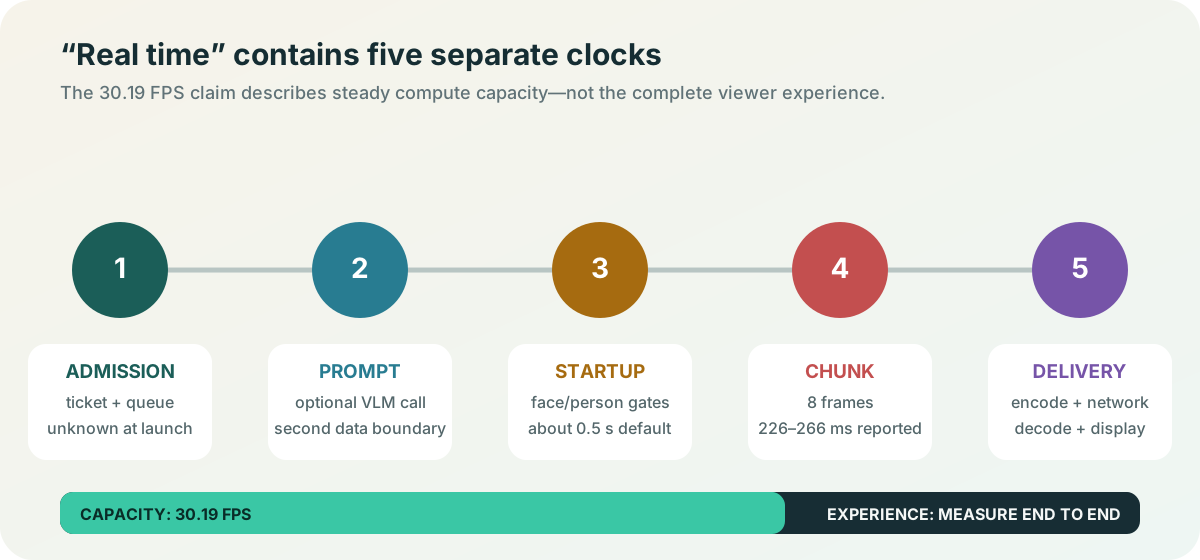
A stream can keep up over time while the viewer still experiences a quarter-second or more of lag. Measure every clock separately.
For a product, there are at least five clocks:
The reference app's default face gate waits for 12 stable frames before editing. At its 24 FPS assumption, that is about half a second. The prompt enhancer has a much larger timeout ceiling, although it falls back to the raw instruction on failure. A polished application can still feel responsive, but only if the team stops using FPS as a synonym for latency.
The same discipline applies beyond video editing. Our Cosmos 3 Edge analysis separated reasoning, action-chunk, and generated-video clocks because one “real-time” label could not describe three workloads. JoyAI needs the same treatment inside a single live session.
The most useful number in JD's paper is easy to miss. In its own deployment comparison, SANA-Streaming's transformer runs faster than JoyAI's: 54.36 versus 37.21 FPS. JoyAI's VAE, however, is reported at 200 FPS, compared with 27.12 FPS for the SANA deployment JD tested. The complete systems reverse the transformer ranking: 30.19 FPS for JoyAI and 14.51 FPS for SANA.
| System in JD's comparison | DiT throughput | VAE throughput | End-to-end throughput | Builder lesson |
|---|---|---|---|---|
| JoyAI-Video-Edit | 37.21 FPS | 200 FPS | 30.19 FPS | A balanced causal codec and deployment path preserve transformer throughput. |
| SANA-Streaming deployment | 54.36 FPS | 27.12 FPS | 14.51 FPS | A faster DiT cannot rescue a slower media stage. |
These are JD-reported measurements of the deployments used in its paper. SANA-Streaming's own paper reports 24 end-to-end FPS at 1280×704 on an RTX 5090 and 58 DiT FPS. Hardware, precision, resolution, and implementations differ, so JD's 2.08× headline is not an apples-to-apples comparison with SANA's optimized result.
This changes the optimization target. Streaming video teams should profile the causal codec, frame movement, attention cache, compilation, quantization, memory reuse, output encoder, network path, and browser decoder as one product. A benchmark that reports only DiT speed is like benchmarking a video call using only the microphone codec.
There is a broader model-design lesson here too. As denoising steps fall, “supporting” modules stop looking like overhead and start setting the ceiling. The next large speed gain may come from a better VAE or serving scheduler rather than a smarter transformer.
JoyAI can accept a source stream without a predefined duration because its compute does not grow with every past frame. That is good engineering. It is not infinite memory.
The released configuration uses a three-chunk local attention window with a persistent first-chunk sink. The selection code makes the mature window the initial anchor, at most one recent historical chunk, and the active chunk. Intermediate history is discarded. The reference server also defaults to recreating its session every 1,080 accepted post-gate source frames—about 45 seconds at 24 FPS or 36 seconds at 30 FPS—although the reset can be disabled.
This is the bargain behind “open-ended”: bounded cost in exchange for an explicit forgetting policy.
For a five-second style effect, that policy may be invisible. For a 45-minute broadcast, it becomes a product behavior. Does a jacket remain the same shade after a scene cut? Does a replaced presenter retain identity after leaving and returning? Does text on a sign drift? Does the first-chunk anchor help when the camera moves into a different room, or does it pull the stream toward stale context?
Those questions are not answered by a one-minute average score. They require long-session evals around scene cuts, subject exits, occlusion, lighting changes, multiple people, rapid motion, and resets.
Use JoyAI for reversible camera filters, event visuals, creator previews, and supervised production effects where a brief reset or continuity error can be detected and corrected.
Test re-entry, occlusion, scene changes, face gates, consent, and reset behavior before relying on a persistent edited identity in customer meetings, education, support, or live commerce.
Generated video may help simulation or an operator view, but it should not silently replace the source-of-truth camera path used for safety decisions, audit, or incident review.
A provider can package the B200 stack, warm sessions, admission control, provenance, and evals—but first it must prove multi-session economics the reference server does not establish.
The serving code reveals the commercial bottleneck more clearly than the model card. In the public FastAPI and WebSocket server, clients receive queue tickets. Only the head ticket holds the model session, and inference is protected by a process-wide lock. The paper benchmark is batch size one.
That does not prove one B200 can never serve multiple streams. Better batching, model replicas, partitioning, lower resolutions, or future kernels may change the curve. It does mean the shipped reference path demonstrates one active live session per process—not a high-concurrency service.
Capacity planning should start with cost per accepted stream-hour, not cost per generated frame. A persistent session reserves expensive hardware whether the visual change is dramatic or barely visible. Products need admission control, honest queue UX, warm spare capacity, preemption policy, session timeouts, and a decision about what happens when a GPU fails halfway through a broadcast.
This splits the video-model market into two distinct infrastructures. A hosted generator such as the one examined in our MiniMax H3 render-queue analysis sells asynchronous jobs and output seconds. JoyAI-like services are more likely to sell reserved concurrent streams or GPU-session time. One queue produces assets. The other holds an interactive stateful channel open.
That distinction also separates JoyAI from xAI's Grok Imagine Video API surface. Multiple generation modes behind one model ID expand modality breadth. Continuous editing of an incoming feed changes the infrastructure contract.
JoyAI's optional prompt enhancement deserves more attention than it will receive in launch summaries. When an OpenAI-compatible endpoint and key are configured, the enhancer code sends the raw instruction and a downscaled source frame to a vision-language endpoint, then uses the rewritten prompt. If the call fails or times out, the server falls back to the original instruction.
This can improve instruction quality. It also creates a second video-data boundary. An ambient OpenAI API key can activate the SDK's default endpoint even without a separately declared enhancer URL, so private deployments should disable prompt enhancement explicitly or pin it to a controlled service.
An enterprise may self-host JoyAI because a telepresence or retail camera feed cannot leave its environment, then accidentally forward a representative frame to an external endpoint during prompt rewriting. The right answer is not “never enhance prompts.” It is to make the route explicit: disable it, self-host it, or document and approve the provider, retention, region, and data handling.
The model also supports person replacement, object addition and removal, background changes, and reference-guided identity edits. The current materials do not document watermarking, C2PA credentials, a model-specific abuse evaluation, or an acceptable-use policy. Apache licensing answers who may run the weights. It does not answer how a product should prove what happened to a frame.
In the paper's evaluation tables, JD reports an overall 3.60 out of 5 on OpenVE-Bench using a Gemini multimodal judge. That beats the streaming systems in its table and stays close to strong offline or proprietary editors. It does not lead every category: SANA-Streaming scores higher on background change, and the offline open-source Bernini-R is slightly higher overall at 3.72.
JD also introduces LongV2VBench, 229 one-minute tasks across background change, style, local addition, modification, and removal. JoyAI scores 3.30 overall, compared with 1.71 for the strongest listed baseline, XMax-X2.0. The benchmark targets exactly the drift problem short video tests miss.
The caveats are material. LongV2VBench was created by the JoyAI authors and was not present as a downloadable package in the public repository at the research cutoff. The automatic judge details are incomplete. The visible human evaluation uses clips shorter than ten seconds and does not state evaluator count, comparison count, demographics, or agreement statistics. No independent reproduction of quality, throughput, memory use, or long-session stability was available on launch day.
So the correct launch-day language is “JD reports,” not “JoyAI proves.” The open files make independent testing possible. Now the project needs it.
Three consequences are likely to matter after the demo excitement fades.
JoyAI's own comparison shows that transformer speed can lose to codec speed at the system boundary. Model teams will invest more heavily in causal VAEs, compilation portability, frame pipelines, and hardware-specific media paths. The glamour stays with the 16B transformer; the usable latency may be won elsewhere.
Today the attention sink, recent-window length, face gates, and periodic reset are hidden implementation choices. They directly affect what users see. Mature products will expose concepts such as re-anchor subject, preserve source motion, reset style state, hold identity, and show original. State policy will become part of the creative interface rather than an invisible server default.
JoyAI targets a 16B model on a data-center B200. SANA-Streaming targets a 2B model and reports a 24 FPS path on an RTX 5090. That is not a simple winner-and-loser story. It looks like market segmentation: higher-fidelity, versatile effects on reserved data-center capacity; cheaper, private, lower-footprint editing on consumer hardware. JD's first TODO—5090 support—shows it understands the pressure.
There is a fourth implication for platform companies. If concurrency remains close to one process per active stream, the moat will not be access to Apache-licensed files. It will be packing efficiency, warm-start reliability, regional GPU capacity, long-stream evals, provenance, and failure recovery. Open weights lower the permission barrier while raising the quality of the serving competition.
The checklist is deliberately more operational than a normal model eval. A live editor does not fail only by producing an ugly frame. It can drift after ten minutes, black-hold when a person leaves, leak a frame through an enhancer, queue a customer behind another session, reset identity mid-broadcast, or preserve a beautiful edit while the original evidence is lost.
The highest-signal follow-ups are not another showcase reel.
First, look for an independent B200 reproduction that reports VRAM, power, cold-start compile time, tail latency, and the exact Git and weight revisions. Second, watch JD's RTX 5090 work: the quality and resolution sacrificed to fit a consumer card will show whether JoyAI can become a local product rather than a data-center appliance. Third, wait for public LongV2VBench assets and external submissions. Fourth, watch whether a serving team demonstrates safe multiplexing or whether commercial packaging settles on reserved streams.
I would also watch the training and data release closely. The paper lists billions of image and video samples across progressive stages, but it does not identify source datasets, licenses, geographic composition, creator consent, or opt-out mechanics. Shipping the promised pipeline without a usable data ledger would improve reproducibility while leaving the rights question unresolved.
The checkpoints and serving code are public and labeled Apache 2.0, so “open-weight with open deployment code” is a fair description. The release is not yet a complete reproducible research stack: MiMo-VL and detector assets are separate dependencies, while the training and data-generation pipeline remains a TODO.
No. JD's figure is mean end-to-end throughput for its benchmark. The paper separately reports 226 ms for the neural path and 266 ms for a complete eight-frame cycle. Application gates, queueing, encoding, networking, and display can add more delay.
JD lists RTX 5090 support as future work. The documented tested path uses one Nvidia B200 and a Blackwell-specific software stack. SANA-Streaming reports a separate 24 FPS consumer-GPU result, but that does not establish JoyAI compatibility.
Not at publication time. It is a same-day vendor-reported result in JD's technical paper and model materials. The public artifact makes reproduction possible, but no independent result was found during research.
Supervised, reversible live effects are the sensible starting point: creator tools, event visuals, preview filters, and production workflows that preserve the original feed. Identity-sensitive telepresence, evidence-bearing video, or safety-relevant perception needs a much stronger continuity, privacy, and provenance layer.
JoyAI-Video-Edit moves open-weight video editing across an important line. The source no longer has to end before generation begins, and the published system reportedly keeps pace with a 720p stream on one GPU. That is a credible new building block.
The line it crosses is not “instant video.” It is stateful video infrastructure.
Thirty FPS tells a team that compute may keep up. It says nothing by itself about first-frame delay, queueing, resets, privacy, concurrent users, or continuity after half an hour. Those are now the product.
JD has released enough for builders to test that product honestly. The next winner will not be the team that repeats the frame-rate number most loudly. It will be the one that can keep a live edit fast, coherent, private, attributable, and economically available when more than one person connects.