SGLang 0.5.17 Gives Agent Sessions a Vote in GPU Memory

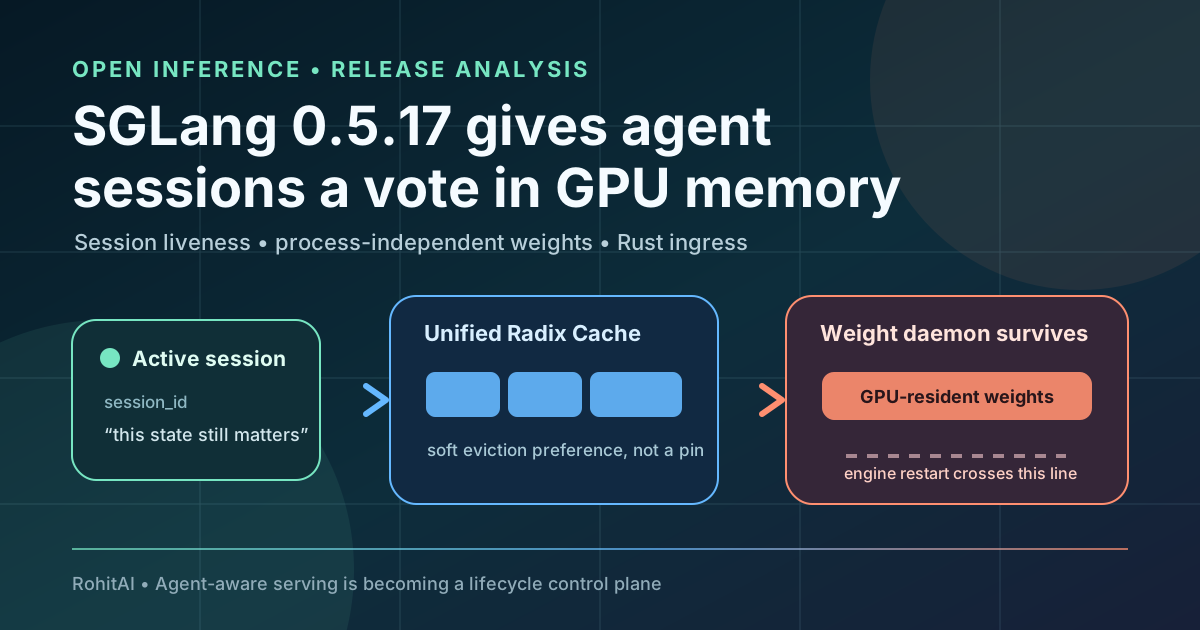
SGLang 0.5.17 makes one application field surprisingly consequential: session_id.
With the new opt-in session-aware cache, that ID tells the runtime that cached KV and recurrent state still belong to live work. Unreferenced state should be considered for eviction first. In the same release, a persistent weight daemon lets model weights outlive a crashed or restarted engine, while an opt-in Rust server begins moving HTTP, tokenization, and detokenization out of Python.
Those changes look unrelated in a long release note. They are better understood as a single shift: the open inference runtime is learning that different pieces of an agent system have different lifetimes.
The obvious headline is model support—Kimi K3, MiniMax H3, DeepSeek-V4—and some large, contributor-reported throughput gains. The more durable story is that serving is moving beyond “accept prompt, emit tokens.” The runtime is starting to decide which state should survive pressure, which state should survive a process, and which API path is safe to expose.
This extends RohitAI's analysis of vLLM 0.26. vLLM's release made where reusable KV can live an infrastructure contract. SGLang 0.5.17 starts answering a different question: does the application still care about that state? Locality plus liveness is the beginning of an agent-aware scheduler.
The caveats matter. A session reference is not a pin. Sub-second weight mapping is not sub-second endpoint recovery. The Rust path is not a full Rust rewrite, and its tagged implementation does not enforce a configured API key. Version 0.5.17 is important precisely because it exposes the next control surfaces—and how unfinished some of them still are.
SGLang v0.5.17 shipped on August 8 from commit 2948168. The maintainers count 582 pull requests from 194 contributors, only 14 days after v0.5.16. PyPI lists Apache-licensed Linux wheels for CPython 3.10 through 3.13 on x86-64 and Arm64.
That breadth makes a conventional changelog summary almost useless. There are new models, communication backends, kernels, parsers, defaults, error behaviors, dependencies, and known issues. The useful organizing question is simpler:
What is allowed to outlive what?
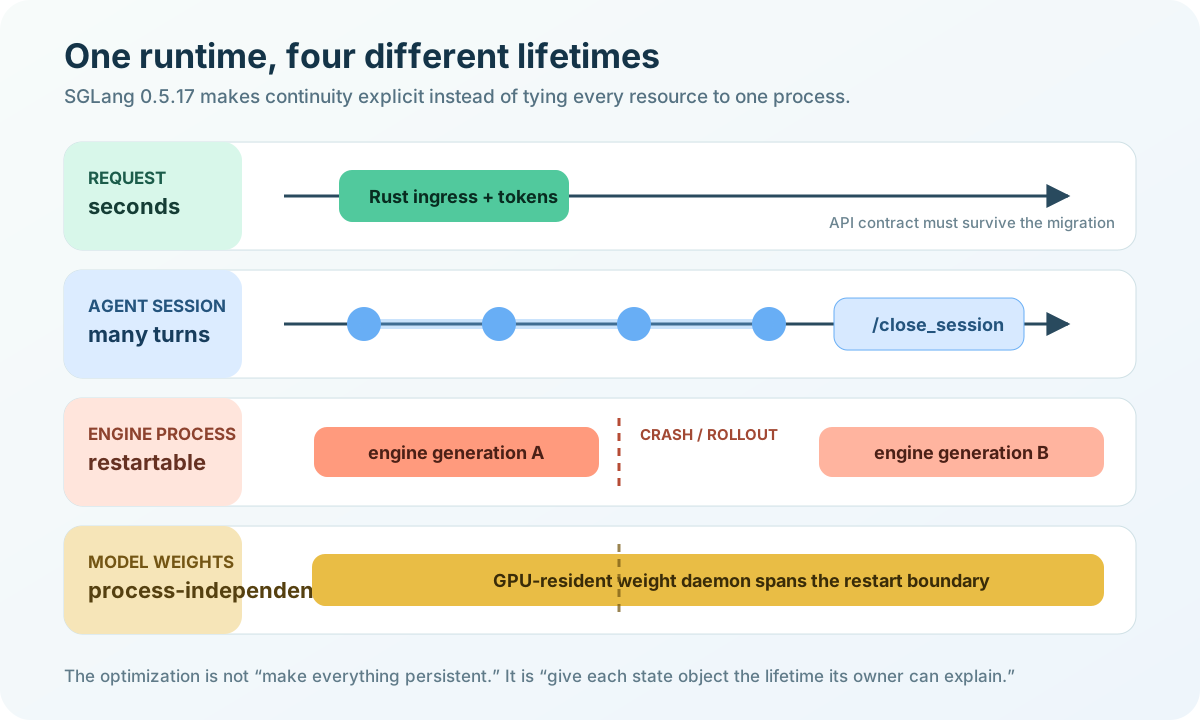
The release does not create one giant persistent runtime. It introduces separate lifetime boundaries, each with its own ownership and failure semantics.
A request may last seconds. An agent session may last hours. An engine process may restart during a rollout. Model weights may be expensive enough to remain resident across that restart. Treating those as the same lifecycle wastes memory in one place and recovery time in another.
This is why the release is more than a speed update. It is a first attempt to make continuity explicit.
SGLang has long been associated with radix-tree prefix reuse. Version 0.5.17 adds an application signal to that machinery.
The session-aware Unified Radix Cache change accepts a stable top-level session_id on requests. While that session remains referenced, its FULL-attention KV, sliding-window state, or Mamba state gets preferential treatment during eviction. The application calls /close_session when the work is finished.
The word preferential is doing real work. Referenced entries can still be evicted if unreferenced KV is insufficient. Closing a session removes the reference; it does not immediately delete the underlying cached state. The feature is opt-in through --enable-session-radix-cache, requires UnifiedRadixCache, and does not extend this lifecycle signal to storage-backed L3 cache in the shipped change.
That makes session_id neither a database key nor a guarantee of residency. It is a liveness hint with operational consequences.
This is the first non-obvious implication: application lifecycle has become performance policy.
A leaked session reference can make stale state look valuable. Reusing an ID across tenants can mix lifecycle policy even if request data remains logically separated. Closing too early can throw away the advantage between agent turns. Closing too late can pressure unrelated traffic. The platform needs open-session counts, age distributions, close failures, referenced bytes, and eviction outcomes—not just a global cache-hit percentage.
There is also a clean protocol lesson. RohitAI's MCP 2026-07-28 analysis argued that removing hidden transport sessions does not remove an agent's need for explicit state ownership. SGLang lands on the same principle from the opposite direction: the transport can be ordinary HTTP, but the application still needs to declare when a durable unit of work begins and ends.
Large-model restarts are slow partly because a new process normally reloads and post-processes weights that the GPU had moments earlier.
SGLang's weight-cache daemon separates those lifetimes. One persistent daemon per GPU holds the post-quantized tensor-parallel shard. A replacement engine maps the same physical GPU memory through CUDA IPC and coordinates over Unix-domain sockets.
The contributor's Qwen3-235B FP8 test on four GPUs shows why the idea matters—and why the headline needs restraint.
The sub-second number is real for the measured weight phase. It is not the delivered whole-engine recovery time. The RFC's targets of a sub-10-second cold restart and a sub-one-second warm standby are roadmap goals. The current implementation is single-node and tensor-parallel; multi-node plus data- and expert-parallel recovery remain later work.
That distinction suggests a better availability dashboard. Record at least four timestamps:
process_started
weights_mapped
graphs_ready
endpoint_accepted_and_completed_probe
Otherwise a fleet can report “recovered” while clients still wait more than a minute. Recovery is now a sequence of readiness claims, not one process-health bit.
The daemon also becomes a new dependency. Operators need to test socket permissions, daemon death, fingerprint mismatch, GPU-memory accounting, fallback-to-disk, and version skew. Moving state out of a disposable process improves recovery, but it creates a smaller stateful control plane that deserves its own health model.
SGLANG_RUST_SERVER is the easiest feature to oversell.
The tagged Python wrapper says the embedded server replaces the Python API server, TokenizerManager, and DetokenizerManager with Rust threads inside the scheduler process. The Python scheduler and GPU-worker framework remain. Kernels, attention backends, quantization, and KV internals have not suddenly become a Rust engine.
That is still strategically meaningful. HTTP handling, tokenization, detokenization, streaming state, and request shaping can become front-half bottlenecks at high concurrency. Moving them away from Python's GIL is a credible direction. But the release does not attach a public end-to-end speed result to the main OpenAI-compatible path.
Its operational boundary is narrower than the label suggests. The v0.5.17 route registry merges models, completions, and chat-completions. It does not mount a Responses API route. The wrapper refuses to start if --preferred-sampling-params is configured because that Python behavior has not been ported.
Most importantly, the tagged Rust server source contains an explicit warning: a configured api_key does not protect its routes because the authentication boundary has not been ported.
| Surface | Shipped scope in v0.5.17 | Boundary to test |
|---|---|---|
| Session-aware cache | Active-session references influence Unified Radix Cache eviction. | Soft preference, explicit close lifecycle, no storage-backed L3 coverage. |
| Weight cache | GPU-resident TP shards can outlive and remap into an engine process. | Single-node TP today; complete readiness remains far above the map time. |
| Rust server | HTTP plus tokenization/detokenization for models, completions, and chat. | No built-in API-key boundary in the tag; no Responses route. |
| DWDP | Peer-weight prefetch and local expert compute for MoE prefill. | Early development; result depends on model, fabric, traffic, and baseline. |
| Helix/DCP backends | New all-to-all choices and optional full-Q projection replication. | The merged PR's performance section was still marked in progress. |
The lesson is not “Rust is risky.” It is that a language migration can improve the hot path while temporarily reducing the maturity of surrounding controls. API parity, authentication, logging, error shapes, cancellation, and overload behavior belong in the benchmark.
SGLang 0.5.17 also ships topology-specific paths for the increasingly strange geometry of frontier MoE models.
Distributed Weight Data Parallelism changes prefill by fetching expert weights across NVLink and computing locally instead of dispatching tokens through the usual expert-parallel all-to-all path. In one four-B200, gpt-oss-120b prefill-only test, the contributor reported gains ranging from 1.16× to 1.92× depending on shape. At saturation for one 8K-input, concurrency-128 case, the reported result was 506,000 tokens/s versus 329,000 for the DEP4 baseline.
The underlying DWDP paper reports a much smaller 8.8% output-TPS-per-GPU gain for DeepSeek-R1 on a GB200 NVL72 system under a different traffic envelope. That is not necessarily a contradiction. It is evidence that “inference performance” has too many dimensions to survive as one number.
The DeepSeek-V4 FP8 MegaMoE path has the same caveat. Its merged benchmark reported 22.24% higher SLO-compliant total and output throughput in one TP8/EP8 test with 3,500 input and 1,500 output tokens. It is useful evidence for that configuration, not a fleet-wide multiplier.
Preserve the full benchmark tuple:
checkpoint + quantization + GPU + fabric + parallelism
+ input/output shape + concurrency + cache state + graph mode
+ latency SLO + software commit + baseline
Delete one field and the headline becomes harder to reproduce. This is not academic bookkeeping. A recent backend-divergence preprint found shifts of up to 16.6 percentage points across otherwise fixed evaluation setups when the inference backend changed. It is one preprint, not settled consensus, but it is enough reason to treat a runtime upgrade as a quality and reproducibility change—not just capacity work.
New-model support is still a major part of this release. It also demonstrates why a “supported” badge needs a versioned topology manifest.
Kimi K3 is a 2.8-trillion-parameter MoE with 104 billion active parameters and a 1,048,576-token context, according to Moonshot's model card. SGLang's day-zero serving report spans recipes using roughly 8 to 32 datacenter GPUs across NVIDIA and AMD families. SGLang itself has no usage fee under Apache-2.0; model licenses are separate, and that operating envelope is not free.
MiniMax H3 makes the point from another direction. SGLang's H3 cookbook includes a two-RTX-5090 route with layerwise offload and a roughly 384-GiB-class host. A five-second, 1344×768, 50-step output took 559.67 seconds in that published test. RohitAI's H3 launch analysis described the hosted product as a render queue; v0.5.17 now gives builders a self-hosted route, but not a lightweight one.
This is the third deeper implication: runtime support is becoming a procurement and certification product.
The useful artifact is no longer “Kimi K3 supported.” It is a manifest containing the exact checkpoint, GPU generation, memory floor, host RAM, quantization, tensor/expert/data parallelism, kernel flags, context shape, modality, parser, and measured SLO. SGLang's cookbooks already approximate that object manually. The next step is making it machine-readable and attaching it to every deployment.
Taken together, v0.5.17 points toward an inference scheduler with more than queue depth in its cost function.
Session references let the application say that a prefix or recurrent state still belongs to live work. Future routers can combine that signal with age, tenant policy, and expected reuse.
The weight daemon makes engine processes disposable before their most expensive resident state is disposable. Readiness must be measured across every remaining startup phase.
Rust ingress is only successful if routes, auth, errors, streaming, tool calls, parsers, and defaults preserve the contract the application actually uses.
My first prediction is that routers will score liveness plus locality. Queue depth alone cannot tell you whether one replica already holds an active agent's useful state. Cache location alone cannot tell you whether the application has abandoned it. The winning score will combine queue time, state location, session value, promotion cost, expiry, and tenant rules.
Second, recovery SLOs will split into named phases. “Pod ready” and “weights loaded” are too coarse for multi-minute initialization paths. Platforms will expose weight-ready, graph-ready, parser-ready, and end-to-end probe-ready timestamps, then route only after the last contract is satisfied.
Third, the open-serving competition will move away from a universal tokens-per-second crown. SGLang, vLLM, RTP-LLM, TensorRT-LLM, and specialized kernels can each win on selected tuples. Recovery time, state ownership, model operability, API semantics, and failure behavior will become the more defensible product surface.
Do not approve 0.5.17 because the model loads and a chat completion returns 200. The release changes three certification domains at once: API behavior, application-state lifecycle, and model-specific execution.
Sensible when 0.5.16 is stable and you do not need the new model or lifecycle paths. Track early issue reports and prepare the acceptance suite first.
Best default for teams that need fixes or model support. Run ordinary Python ingress first, compare quality and tail latency, then expand by hardware tuple.
Put session caching, the weight daemon, Rust ingress, DWDP, and MegaMoE behind separate flags and cohorts. Otherwise a regression will have too many plausible causes.
No. It is an opt-in path tied to Unified Radix Cache. Applications must send a stable session_id and close the session when its work ends. The reference changes eviction preference, not guaranteed residency.
No. The opt-in Rust path replaces the request front half—API serving, tokenization, and detokenization—while the existing Python scheduler and GPU-worker framework remain.
It made the measured cached weight-map phase 0.63 seconds. Complete readiness in the published Qwen3-235B FP8 test was still about 80 seconds. Sub-10-second cold restart and sub-one-second standby are goals, not the shipped end-to-end result.
Not without an external authenticated boundary. The v0.5.17 source explicitly says a configured API key does not protect its routes. It also lacks a Responses route and does not support every Python-side behavior.
Teams that need Kimi K3, MiniMax H3, DeepSeek-V4 paths, or the new lifecycle features have the clearest reason to canary. Everyone else can prioritize downstream issue reports and a complete acceptance matrix over release-day urgency.
SGLang 0.5.17 will be remembered for its model list and benchmark numbers. Those will age quickly.
The longer-lived idea is that an inference runtime needs explicit opinions about continuity. An active agent session should influence cache pressure. Model weights should not necessarily die with an engine process. A faster ingress path should preserve the API and security contract around it. A model-support claim should name the topology that makes it true.
That is a larger job than producing tokens quickly.
Open serving runtimes are becoming the layer that decides what survives, what moves, what restarts, and what the application is allowed to assume. Version 0.5.17 is not the finished control plane. It is a clear view of the control plane being assembled.