NVIDIA Cosmos 3 Edge Runs on Three Clocks

NVIDIA has put three very different clocks under one model name.
On a Jetson AGX Thor T5000, the Cosmos 3 Edge reasoner produces roughly 37 to 43 decoded tokens per second. A special policy configuration generates a 32-action chunk in a median 1.528 seconds. Yet a separate H100 image-to-video test reports only 6.71 generated frames per second for video intended to play at 24 fps.
Those are all NVIDIA-reported results for the same 4B-class release. They are not contradictory. They show why “real time” is the wrong label to attach to a model without naming the workload.
Cosmos 3 Edge, released publicly on July 20, is important because NVIDIA has compressed reasoning, world prediction, inverse dynamics, and action generation into a model small enough to place near a robot’s sensors. The obvious take is that world models have finally moved from the data center to the edge. The more useful take is narrower: NVIDIA has made edge-resident cognition plausible, not a universal real-time controller.
That distinction decides where the model belongs in a production robot. Cosmos 3 Edge can interpret a scene, forecast consequences, and propose chunks of action. Joint limits, collision checks, force limits, stale-command rejection, and emergency stops still need an independent, deterministic path. The release shrinks the learned stack. It does not repeal control engineering.
The public model card calls Cosmos 3 Edge a 4B model. Hugging Face’s repository metadata counts 3,858,999,728 BF16 parameters. That is compact by current world-model standards, but the number alone hides the architecture’s purpose.
The Cosmos 3 technical report describes a dense 2B transformer design with 28 layers, expanded into separate autoregressive and diffusion parameter streams. The autoregressive side handles vision-language understanding and text reasoning. The diffusion side generates continuous outputs such as images, video, and actions. Their parameters remain distinct; joint attention lets the diffusion stream use the shared context while the reasoner stays causal.
This is the release’s actual compression trick. NVIDIA did not merely make a video generator smaller. It put several physical-AI jobs behind one representation of state, consequence, and action.
NVIDIA had already described Cosmos Nano models as edge-oriented in its January 2025 Cosmos launch. Edge is therefore not the first Cosmos model pointed toward local inference. Its novelty is compressed convergence: a reasoner, forward and inverse dynamics, visual generation, and policy output can now live in one 4B-class package.
The performance evidence still belongs in separate lanes.
| Path | Published configuration | Vendor result | What it proves | What it does not prove |
|---|---|---|---|---|
| Reasoner | Raw Transformers on T5000; text, image, or video prompt | 37.3–42.6 decoded tokens per second | Local multimodal reasoning can be interactive on the top Thor module | Sustained live-video analysis, tail latency, thermal behavior, or Orin 8GB speed |
| Canonical DROID request | 16 future steps × 8 action values; vLLM-Omni on T5000 | 6.32 seconds end to end | The public policy has a concrete DROID action contract | That every documented policy configuration is real time |
| 15 Hz policy test | 32 × 8 chunk; four denoising steps; PyTorch; mapped processing bucket | 1.528-second median on T5000 | The chunk can arrive before 32 actions are consumed at 15 Hz | Fifteen model calls per second or equivalent results on other Thor modules |
| Image-to-video | Separate eager-mode test; 480p, 24-fps output, one H100 | 6.71 generated frames per second | Edge trades some reported quality for much higher throughput than Cosmos 3 Nano | Real-time 24-fps world generation on edge hardware |
The detailed Policy DROID card makes the 15 Hz wording especially important. Thirty-two actions consumed at 15 Hz span about 2.133 seconds. The model is “real time” when it finishes the next chunk before that horizon runs out. The controller still executes the individual commands between inferences.
Only the T5000 meets that 15 Hz deadline in the four-step test. T4000, an emulated T3000, and T2000 report 2.208, 2.632, and 5.195 seconds. All meet the 5 Hz chunk budget in that setup. In the separate 30-step vLLM-Omni test, T5000, T4000, and the emulated T3000 meet the 5 Hz budget; T2000 does not.
The launch is easiest to understand as a systems consolidation.
Older physical-AI stacks often pass state through separate perception, language, video-prediction, and policy models. Every boundary requires a schema, a conversion, memory movement, synchronization, and another place for calibration to drift. Cosmos 3 Edge gives reasoning and generation a common account of the scene, then supports several uses: describe what is happening, predict a likely future, infer the action that produced a change, or generate an action toward a goal.
That can remove meaningful orchestration work. It can also keep sensitive camera streams on the device and reduce dependence on an unreliable network. But it does not mean every output belongs in the same control loop.
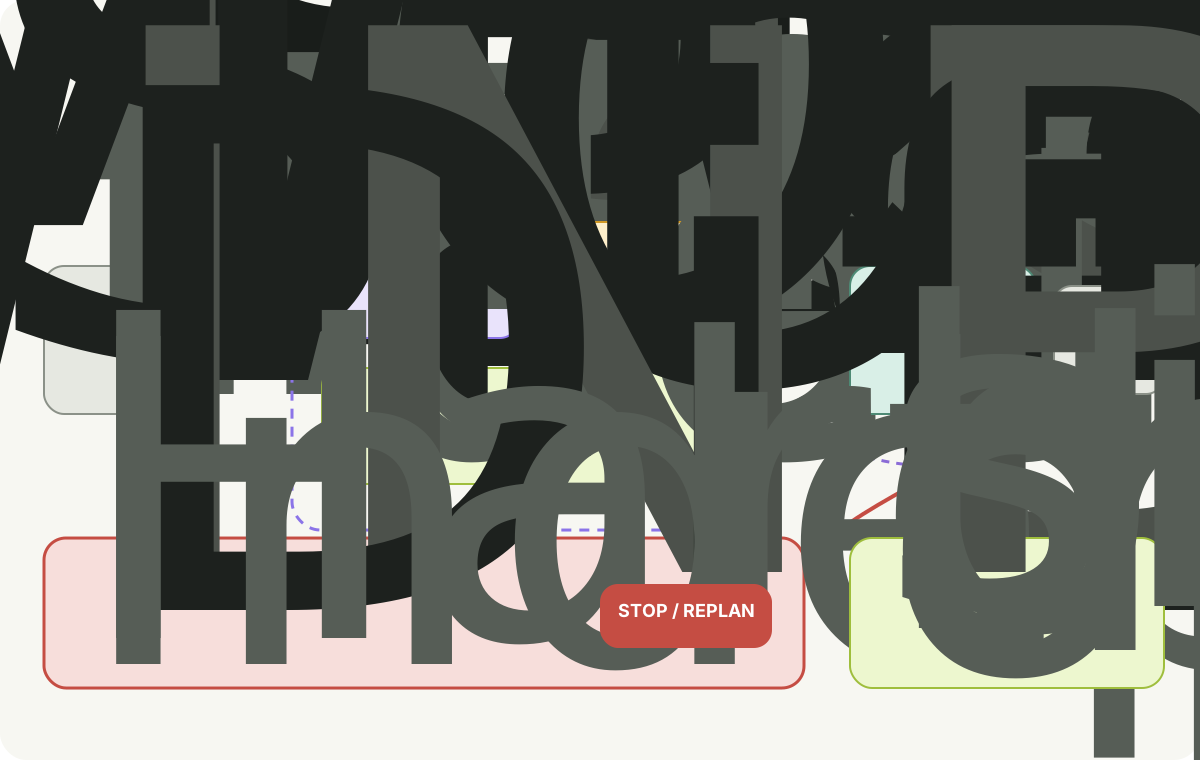
Cosmos can consolidate the learned cognition layer. The safety rail should remain independently observable and able to cancel motion.
The useful topology is not “camera directly to world model directly to motors.” It is closer to:
sensors → edge cognition → bounded action intent → deterministic controller → actuators
              ↑                         ↓
       independent monitor ← state, timing, limits → stop or replan
Use the model for semantic planning, prediction, and action chunks. Keep torque, force, joint, speed, collision, workspace, and emergency-stop enforcement outside it. NVIDIA’s own limitations section says the model is not an explicit physics simulator and should not be treated as physically accurate simulation, ground-truth reasoning, or safety-certified decision making.
Google makes a similar architectural recommendation for Gemini Robotics On-Device: pair learned behavior with low-level safety controllers. That is not timid engineering. It is the only sensible response to a model that can hallucinate a causal relationship and then act on it.
A shared world representation has an under-discussed failure mode.
Suppose an occluded camera view makes the model infer that a box has cleared the gripper. If reasoning, future prediction, and policy generation all consume the same mistaken representation, all three can agree. The textual explanation looks coherent. The forecast looks plausible. The action chunk follows logically. The entire learned stack can be consistently wrong.
This is the price of removing glue: fewer interfaces can also mean fewer independent checks.
An effective watchdog should therefore be diverse, not a second prompt to the same model. Use encoder signals from another sensor, deterministic geometry, force thresholds, a smaller failure detector, or rules with a different failure surface. The SAFE VLA research project shows why timely failure detection matters in both simulation and a real robot setup. An ICCV 2025 study of adversarial VLA vulnerabilities found that camera-side attacks could devastate task success in its tested suites.
The full 4B package gets the headline because it joins understanding, generation, and action. Many edge products will not need all of it.
Hugging Face’s Transformers integration exposes the reasoner surface: text, images, or sampled video in; text out. The diffusion generator, VAE, scheduler, and action-generation paths remain in Diffusers and the broader Cosmos Framework. NVIDIA also describes the reasoner as a separately usable 2B module.
That division is more than a packaging detail. A factory inspection camera may need local anomaly explanation and escalation, not continuous photorealistic future video. A warehouse robot may need scene grounding before an existing controller chooses a route. A traffic camera may need event classification with private footage kept on site. Those jobs can use the smaller surface and avoid loading a generator they do not need.
NVIDIA says the reasoner fits on an 8GB Jetson Orin, but the published Orin timing table uses AGX Orin 64GB. Treat the 8GB statement as a memory-fit claim until a reproducible latency, thermal, and sustained-load result is available.
Use the Transformers path for local scene description, anomaly triage, grounding, and high-level planning. It has the simplest runtime surface and is likely to fit the largest number of practical edge products.
Use the released policy as a starting point when the robot, observations, action semantics, and task data match DROID. Budget for embodiment-specific post-training, controller integration, and an independent safety layer.
Load the complete stack when forward dynamics, inverse dynamics, visual consequence prediction, or shared action-generation state removes enough system work to justify the extra memory, runtime, and validation burden.
This is my first prediction: reasoner-only deployments will outnumber full generator deployments on constrained edge systems. The full model is strategically important because it proves convergence. The smaller reasoner path will often be the economically sensible product.
The base repository is public and ungated. OpenMDW 1.1 permits commercial and noncommercial use, modification, and redistribution, and it places no restrictions on model outputs. Redistribution must preserve the license and applicable origin notices. The license also leaves third-party rights clearance with the user and contains litigation-triggered termination language.
That is meaningful access. It is not hardware neutrality.
NVIDIA documents Linux, BF16, and NVIDIA Ampere, Hopper, and Blackwell as the tested compatibility surface. FP16, FP8, and FP4 are not officially supported for the released Edge checkpoint, while FP8 and NVFP4 variants are marked as coming soon in the Cosmos repository. No release-day evidence establishes equivalent support on CPU-only systems, AMD GPUs, Apple silicon, Windows, or macOS.
The default generator path also pulls a separately gated Cosmos guardrail checkpoint, although the framework lets a developer disable that safety check. The current NIM support matrix exposes other Cosmos 3 sizes rather than Edge. In other words, “downloadable” and “turnkey” are different release states.
NVIDIA’s strategic product is larger than a free checkpoint. Cosmos spans data curation, synthetic data, simulation, post-training, evaluation, serving, and Jetson deployment. Open weights can therefore increase demand for NVIDIA’s compute stack. Model access and system portability are separate axes.
The base model documents action representations for cameras, autonomous vehicles, egocentric motion, single-arm and dual-arm robots, and an AgiBot humanoid format. That list describes representational breadth. It does not mean the downloadable policy can control all those machines.
The concrete policy release is Cosmos3-Edge-Policy-DROID. Its card specifies DROID visual observations and 8D action output. The canonical request uses a 16 × 8 chunk; the special timing tests use 32 × 8. Camera geometry, coordinate frames, action normalization, gripper semantics, task rate, workspace limits, recovery behavior, and the robot-side controller remain embodiment-specific.
There is also a recipe gap. The public action-policy fine-tuning directory currently provides a DROID policy script for Cosmos 3 Nano, not a matching Edge Policy-DROID reproduction script. Edge-specific vision and reasoner recipes exist, so this is a policy-product gap rather than a total absence of post-training support.
Our recent MiniCPM-Robot teardown of the closed-loop contract argued that the real deployment unit is model plus runtime plus hardware plus safety. Cosmos 3 Edge asks a different question: how much orchestration disappears when perception, prediction, and action share one substrate? The answer is “a meaningful amount,” but the actuator-side contract still does not disappear.
This is the second prediction: NVIDIA and its partners will release more embodiment-specific Edge policy checkpoints before “one policy for every robot” becomes credible. Foundation breadth creates a good initialization. Product breadth arrives through data, adapters, calibration, and field validation.
NVIDIA reports that Edge is much faster than Cosmos 3 Nano in its 480p image-to-video throughput test, while Nano scores higher on the same vendor’s image-to-video quality aggregates. The DROID policy comparison is mixed too: Edge narrowly beats pi0.5 under vague and specific instructions in RoboLab, but trails it materially under the default-instruction slice. “State of the art” flattens useful tradeoffs.
Cross-vendor comparisons are even weaker. SmolVLA is a 450M open VLA positioned for consumer hardware. OpenVLA is a 7B policy trained on 970,000 robot episodes. Gemini Robotics On-Device is a restricted-access product with its own tasks and hardware story. Their parameter counts, embodiments, observation stacks, action horizons, benchmark suites, and availability differ.
A Nature Machine Intelligence study spanning hundreds of VLA experiments found that backbone choice, policy design, and cross-embodiment decisions all materially change performance. That is a useful warning against buying a robot policy from one aggregate score.
Run a common task set on the same machine. Fix the cameras, controller, observation history, action rate, intervention rule, and success definition. Report failures and operator takeovers, not only successful episodes. Until then, launch tables are orientation maps, not purchase orders.
The practical question is not whether Cosmos 3 Edge can produce an impressive clip. It is whether a frozen system can survive stale data, timing variance, sensor shifts, and interrupted intent without unsafe motion.
Two launch claims deserve special skepticism during that process. NVIDIA says developers can adapt Edge to a target workload in about a day, but it does not attach a standard dataset size, hardware budget, task difficulty, or quality threshold. And the T3000 policy result is emulated without capped DRAM bandwidth, so shipping hardware may be slower.
NVIDIA introduced Edge alongside Japanese industrial collaborations involving Fujitsu, FANUC, Yaskawa, and Kawasaki Heavy Industries in its July 15 announcement. Those names make the release strategically credible. They do not establish production volumes.
Associated Press reporting says the first collaboration phase is expected later in 2026 and notes that no joint-venture decision or everyday-deployment timetable had been set. Advantech says commercial systems based on the lower-power T2000 and T3000 modules are expected in the first quarter of 2027.
That timing supports a third prediction: the second half of 2026 will be heavy on evaluation, post-training, and bounded pilots. Reasoner-only vision systems should move first. DROID-like manipulation pilots will follow where teams control the embodiment and safety shell. Broad fleets will wait for shipping hardware, better recipes, independent testing, and evidence that the deployment survives a factory shift rather than a benchmark run.
Yes. OpenMDW 1.1 allows commercial and noncommercial use, modification, and redistribution, and it does not restrict outputs. Preserve the required license and origin notices, review its termination terms, and clear third-party rights for datasets, dependencies, inputs, and downstream assets separately.
Selected paths do under specific conditions. The reasoner is interactive on the reported Thor systems. A four-step 32-action policy configuration meets a 15 Hz chunk budget on T5000, while other tested Thor tiers miss that tighter deadline. A separate 30-step configuration meets 5 Hz on several tiers. High-quality 480p video generation is slower than playback even in the reported H100 throughput test. Ask “which path, on which hardware, under which deadline?”
No such result has been published. The released checkpoint is a DROID-specific 8D policy. The base model’s broader action schemas are useful representations, not zero-shot deployment certificates. A new robot still needs data, action semantics, calibration, a controller adapter, safety constraints, and physical evaluation.
There is no defensible universal ranking from the launch evidence. Cosmos differentiates itself through a shared reasoner, predictive generator, and action substrate plus NVIDIA’s deployment stack. SmolVLA is much smaller and more hardware-accessible; OpenVLA has a different generalist-policy lineage; Gemini On-Device is not an open checkpoint. Compare them on the same embodiment and outcome protocol.
Cosmos 3 Edge is the most convincing evidence yet that a useful slice of world modeling can sit beside the machine it serves.
Its significance is not that every Cosmos workload suddenly runs in real time. It is that reasoning, prediction, and action no longer need data-center-sized models or separate conceptual stacks. A builder can choose the reasoner alone, specialize a policy, or pay the cost of the full generator when shared predictive state earns its place.
The release also makes the remaining work harder to ignore. “Edge” tells you where cognition runs. It does not tell you the control deadline, embodiment contract, safety architecture, thermal envelope, or fallback behavior. Those are the product.
NVIDIA has made onboard world modeling plausible. It has not made physics negotiable.