Meta’s Muse Code Bets Cheap Tokens Will Train a Better Agent

Meta entered the terminal-agent market with an awkward benchmark story and a much stronger business strategy.
The obvious comparison is Muse Code versus Claude Code or Codex. On Meta’s own launch charts, Muse Spark 1.2 plus Muse Code does not win the two headline coding evaluations. Claude Opus 5 plus Claude Code remains ahead on Terminal-Bench 2.1, while Claude and GPT-5.6 Terra lead on DeepSWE 1.1. That makes “Meta built the best coding agent” the wrong takeaway.
The useful takeaway is that Meta has assembled a feedback loop the incumbents must take seriously. Muse Code keeps durable local session state, coordinates background agents, isolates parallel work in git worktrees, and was co-trained with the model that powers it. Then Meta offers a contributor tier whose listed output price is more than 20 times lower than the standard tier in exchange for permission to use requests to improve its products.
That combination changes the contest. The model improves the harness. The harness collects the kinds of long, tool-heavy traces the next model needs. Aggressive pricing recruits more people to generate those traces. The Model API and OpenRouter give Meta distribution outside its own terminal.
Muse Code is still a beta, and several enterprise controls remain unspecified. But it turns coding agents from a pure model race into a workflow, telemetry, and distribution race. Meta does not need to take first place on day one for that strategy to work.
Meta released the Muse Code beta and Muse Spark 1.2 on August 5, 2026. Muse Code is a terminal product for macOS and Linux. It can inspect a repository, make a plan, edit files, run validation, and keep specialized agents working in the background. Muse Spark 1.2 is available through Muse Code, the Meta Model API, and OpenRouter.
Those details resemble the standard coding-agent checklist. The architecture underneath them is more interesting.
Muse Code records model calls, tool runs, approvals, edits, steering, and cancellation in a local append-only JSONL event log. Meta describes that log as the session’s source of truth: the product can replay it after a crash and reconstruct the work rather than starting over. Child agents get their own contexts and git worktrees under .muse/worktrees/, keeping their changes away from the user’s working copy until they are reviewed and integrated.
Meta’s worked example requested six child agents. Four ran concurrently on that machine and two queued. That is evidence of orchestration, not a universal four-agent limit. The more important design choice is that concurrency is treated as leased repository state, not six chat windows editing the same checkout.
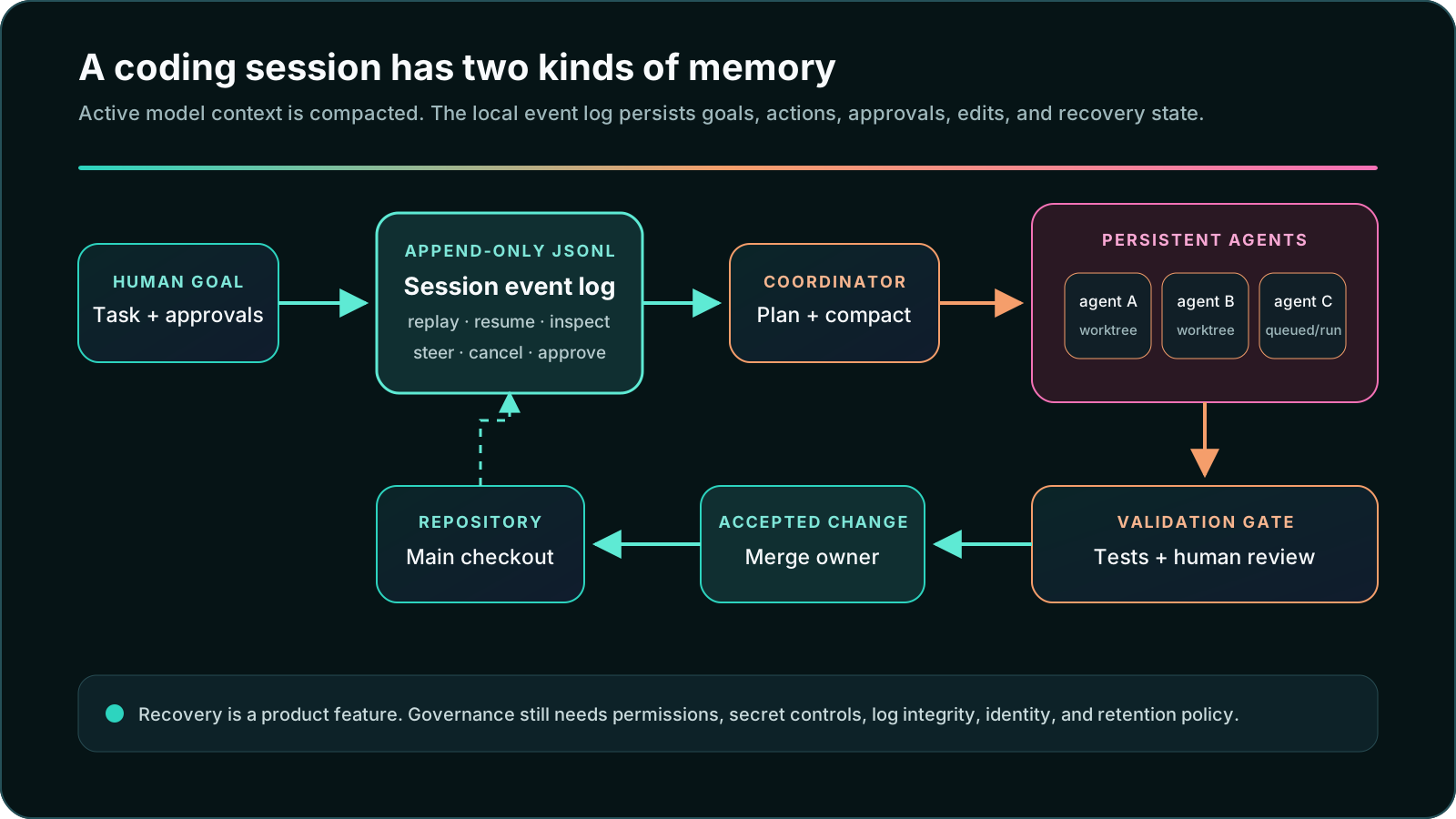
Muse Code separates durable session history from disposable model context. The event log can replay what happened; worktrees isolate proposed changes; tests decide what moves back into the repository.
This is the same broader transition RohitAI examined when VS Code moved coding agents behind an Agent Host: the durable session is becoming a product object. Models remain important, but the runtime increasingly decides whether a long task survives interruption, whether parallel work can be reviewed, and whether a human can understand what the agent actually did.
Meta says it co-trained Muse Spark 1.2 with Muse Code using rejection-sampled agent trajectories. The recipe emphasized goal conditioning, context compaction, subagent behavior, and the actual Muse Code toolset. Muse Spark 1.1 also helped generate and grade coding environments and instruction-following templates used to train its successor.
That is a vertical product decision. The agent does not merely send generic prompts to a provider. The model learns the conventions of the runtime: how work is decomposed, what tool results look like, when context is compacted, how child agents report, and what counts as completion.
We made a related argument in DeepSeek V4-Flash Makes the Harness Part of the Model. Muse Code is a cleaner commercial expression of it. A model can look ordinary in a neutral shell and much better in the environment whose trajectories shaped its training.
This creates a useful advantage and a real lock-in risk.
The advantage is behavioral fit. A co-trained stack can spend fewer tokens explaining its own tools, preserve plans through compaction, and learn failure patterns that only appear during multi-step repository work. Meta’s selected kernel-optimization case studies—runs of up to 24 hours and more than 1,000 tool calls on NVIDIA Hopper tasks—show the kind of horizon the team is targeting. They do not establish an ordinary-repository success rate, but they do show that the training target is sustained iteration, not autocomplete.
The risk is that the model’s best behavior may not travel. Use Muse Spark through another OpenAI-compatible shell and you may gain provider flexibility while losing some of the runtime conventions it learned. Use Muse Code with another model and the harness may no longer elicit that model’s strongest behavior. “Supports the API” and “performs like the native product” are no longer equivalent claims.
Meta’s evaluation choices are revealing. For Terminal-Bench 2.1 and DeepSWE 1.1, it paired several models with their native or selected agent products. That is more representative of what a buyer may use than placing every model inside a stripped-down common harness. It is also a poor way to isolate the base model.
All of these figures are Meta-published launch results; no independent launch-day reproduction was available in the reviewed sources. The evaluation methodology also says Meta’s third-party integrations were best effort and that its tools and system prompts may not be tuned for proprietary competitors.
That caveat belongs beside the scores, not in a footnote readers never see. Different products bring different prompts, tool schemas, retry policies, context strategies, and reasoning settings. The charts therefore support two conclusions:
The uneven gains matter too. Spark 1.2 improves by 6.7 percentage points on Terminal-Bench and 6.3 on DeepSWE versus the 1.1 pairings, but by only 2.3 points on Meta’s internal coding set and 2.2 on MCP Atlas. This looks like a targeted coding-and-workflow release, not a new general intelligence tier.
Meta’s standard rates are already aggressive: $1.25 per million input tokens, $0.15 per million cached input tokens, and $4.25 per million output tokens. Reasoning tokens are billed as output, which matters when an agent thinks, retries, validates, and delegates for hours.
The contributor tier changes the economics—and the data terms.
| Usage | Standard tier | Contributor tier | Listed discount | Important condition |
|---|---|---|---|---|
| Input / 1M tokens | $1.25 | $0.10 | 12.5× cheaper | Requests may be used to improve Meta products; access is limited by a rolling five-hour token allowance. |
| Cached input / 1M tokens | $0.15 | $0.002 | 75× cheaper | The exact rolling allowance and complete country list were not published in the reviewed materials. |
| Output / 1M tokens | $4.25 | $0.20 | 21.25× cheaper | Available only in selected countries; use with confidential code requires explicit review. |
Pricing and terms are from Meta’s Muse Code product page. Meta had not published the exact rolling token allowance or complete country list in the materials reviewed for this article.
Calling this a discount misses the exchange. Meta is offering dramatically cheaper inference for workloads it can use to improve its products. Coding-agent sessions are unusually valuable training material because they contain far more than prompts and answers: repository exploration, tool selections, rejected approaches, test failures, repairs, approvals, compaction boundaries, and evidence of whether a patch was accepted.
That maps directly onto Meta’s disclosed training method. If the next Muse model learns from harness trajectories, then contributor usage can supply more of the behavior the training loop is designed to consume. The low price reduces experimentation friction; more experiments create more traces; better traces can improve both the model and the harness.
This is an inference from the published pricing and training disclosures, not a claim that Meta has described the full contributor-data pipeline. But it is the clearest strategic reading of the tier.
For hobby projects, public repositories, and disposable prototypes, the trade may be attractive. For proprietary source code, customer data, secrets, security findings, or unreleased products, contributor should be an explicit legal and security decision—not the default selected because it is cheap.
Meta labels standard-tier requests as not used to improve its products. That is useful, but it is not the same as a complete retention policy or contractual zero-data-retention guarantee. Meta says it has begun accepting ZDR requests through sales; public details on eligibility, regions, activation timing, and contract terms remain limited.
Vertical co-training usually points toward a closed stack. Meta is also distributing Muse Spark 1.2 through its Model API and OpenRouter, with OpenAI-compatible recipes in its cookbook. That gives the company three routes into a developer workflow.
Best place to test the co-trained behavior: persistent agents, event replay, worktree isolation, approvals, and the runtime conventions Muse Spark 1.2 was trained around.
Better for existing agent shells, routing layers, and controlled model comparisons. Expect some native-harness advantage to disappear when the runtime changes.
Lowest listed token cost for experiments where product-improvement data use is acceptable. A poor default for confidential code or regulated workloads.
This is a smart wedge. Meta does not have to convince every Claude Code or Codex user to replace their terminal on day one. It can win API traffic inside model-agnostic tools, learn which workflows travel, and reserve the strongest behavioral fit for Muse Code.
That horizontal route also puts pressure on incumbents. Once a model is “good enough” for a large class of repository tasks, the market can shift toward availability, integration, and verified task economics. A small benchmark gap may matter less than a 10× or 20× budget difference—provided the cheaper system’s retries and review burden do not erase it.
The append-only local log is one of Muse Code’s best ideas. It gives crashes and cancellations a history, makes steering observable, and can show which tools and edits produced the current state. For beta debugging, that is far better than treating a coding session as an opaque chat transcript.
But “append-only” and “local” do not automatically mean secure, tamper-evident, or enterprise-auditable.
The launch materials reviewed here do not establish centralized retention, role-based access control, cryptographic integrity, organization-wide policy, secret isolation, or third-party audit. A local JSONL file can help an engineer answer “what happened?” while still being inadequate for a security team asking “who could alter the record, who can read it, and which policy prevented the action?”
The same caution applies to worktrees. Isolating child-agent branches reduces accidental collisions with the working copy. It does not resolve semantic conflicts when two agents change the same behavior through different files. Nor does it decide which patch should win. Parallel work still needs a merge owner, acceptance tests, and a clear rule for discarding weak branches.
RohitAI’s earlier analysis of long-horizon agent failures is relevant here: visibility into a trajectory is necessary, but the safety boundary also needs permissions, isolation, independent monitoring, and controls that survive the agent’s own mistakes.
Do not start with a coding trivia set. Give the product complete repository tasks whose acceptance conditions can be checked automatically. Include a migration, a bug with a misleading symptom, a cross-file refactor, a flaky test, and a task that should be refused or escalated.
Then run two separate comparisons.
First, hold the harness constant and swap models. This estimates base-model value in your environment. Second, compare native products—Muse Code, Claude Code, Codex, and any internal agent—as complete systems. This measures the thing developers will actually operate. Publishing one number for both questions guarantees confusion.
The primary economic metric should be:
cost per accepted change =
  model charges
  + human review time
  + retry cost
  + cleanup from failed branches
  + expected cost of escaped defects
Token price is an input to that equation, not the answer. A cheap agent that starts four child loops, reasons heavily at output-token rates, and needs repeated repair can lose its apparent advantage. A more expensive agent can be cheaper if it closes the task with less supervision. Only your repository and review process can settle that.
Common-harness tests answer “which model is strongest under controlled conditions?” Native-product tests answer “which stack completes the task best?” Meta’s launch demonstrates why both views are necessary. Expect serious evaluations to publish them side by side instead of pretending product-pair scores are clean model rankings.
Model weights can improve quickly and API syntax can be copied. A mature schema for goals, approvals, tool evidence, compaction, child-agent leases, failed tests, and accepted patches compounds more quietly. It improves recovery today and produces better training trajectories tomorrow. Meta’s event log is an early visible piece of that moat.
Meta can subsidize inference because adoption, API share, and permitted contributor traces have strategic value beyond immediate margin. Competitors will respond with bundles, credits, caching discounts, or task-priced plans. Builders should resist the marketing arithmetic and demand cost per verified outcome.
There is a fourth dependency: enterprise adoption. Local replayability is a strong beta feature, but larger organizations will want central policy, tamper evidence, identity, retention controls, and clearer ZDR terms. If Meta builds those quickly, Muse Code can move from an individual terminal tool into a governed engineering system. If it does not, the Model API may travel farther than the native agent.
Muse Code does not reset the coding leaderboard. It changes what the leaderboard needs to measure.
The launch ties together a coding-focused model, a stateful terminal runtime, parallel isolated agents, a training recipe built from agent trajectories, and pricing that can recruit far more of those trajectories. Each part reinforces the others. That is the flywheel.
The day-one limitations are equally clear. Muse Code is a macOS-and-Linux beta with no published GA date. Meta’s best benchmark results are vendor-reported and confounded by different harnesses. The standard data terms are not a complete ZDR story. The local event log improves recovery without yet proving enterprise governance.
None of that makes the launch minor. It tells builders where to focus.
Test the native product as a system. Test the model separately. Put data terms beside price. Treat context and durable state as different layers. Measure accepted changes, not generated code. And watch whether Meta can turn cheap access into enough high-quality agent experience to close the remaining capability gap.
If it can, Muse Code will not have won by being the best terminal agent on launch day. It will have won by making the market train it.
Muse Code is Meta’s terminal-based coding agent for macOS and Linux, currently in beta. It uses Muse Spark 1.2 to plan repository-scale changes, edit code, run validation, and coordinate persistent background agents.
Meta’s launch data does not establish that. Muse Spark 1.2 plus Muse Code is competitive, but trails Claude Opus 5 plus Claude Code on Terminal-Bench 2.1 and trails Claude and GPT-5.6 Terra product pairings on DeepSWE 1.1. Because the harnesses and reasoning settings differ, those are product comparisons rather than clean base-model rankings.
They should not do so by default. Contributor requests may be used to improve Meta products, and public materials leave some retention and processing details unspecified. Confidential workloads should use an approved standard-tier or negotiated ZDR path after legal and security review.
Because context capacity is not durable memory. Long tasks still need to preserve goals, summarize completed work, bound active context, and recover from interruption. Muse Code’s compaction and event log solve different parts of that problem.