vLLM 0.27.0 Expands the Runtime—and the Blast Radius

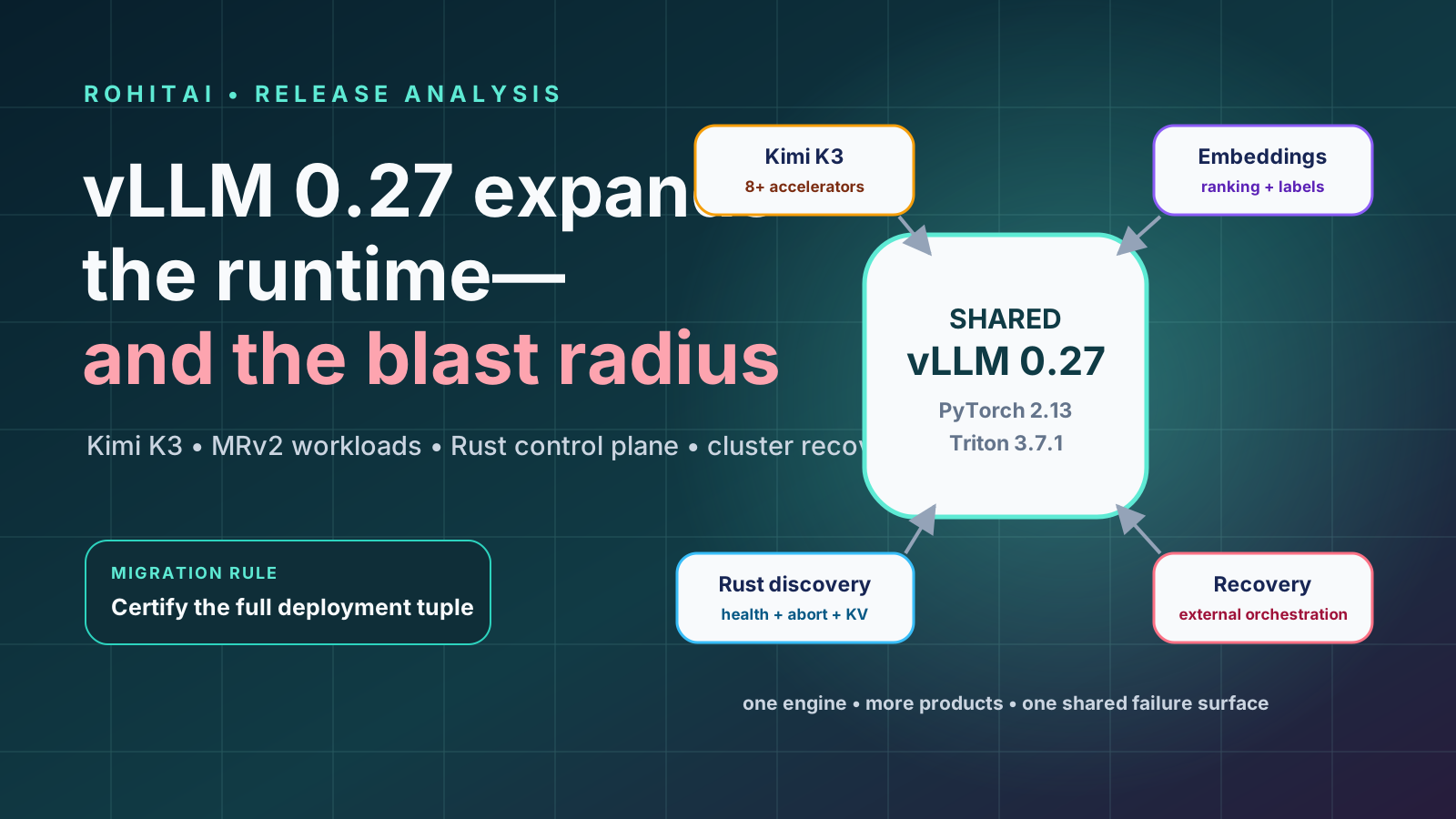
vLLM 0.27.0 is easy to file under “more models, faster kernels.” That reading misses the costly part.
The August 10 release lands full-stack Kimi K3 support, Qwen3.5 dense and MoE models, K-EXAONE 2.0, Jina Embeddings v5, more DeepSeek-V4 optimizations, and early Rubin and AMD gfx1250 work. Those additions alone would make it a large serving release.
But vLLM also widened what one runtime can own. Model Runner V2 now reaches embeddings, reranking, sequence classification, token classification, and token embeddings. The experimental Rust frontend gained health, abort, model discovery, and KV-event discovery over gRPC. A first fault-tolerance framework can pull a damaged expert-parallel deployment out of a permanent hang. Underneath all of it, the base environment jumps to PyTorch 2.13 and Triton 3.7.1.
That combination changes the upgrade question. A vLLM fleet can now sit under generation, retrieval, ranking, moderation, and cluster routing at the same time. Consolidation may reduce duplicated infrastructure, but it concentrates failure. One bad image, ABI mismatch, runner regression, or readiness mistake can cross product boundaries that used to fail separately.
So 0.27.0 should not be treated as a package bump. It is an infrastructure migration with a larger reward and a larger blast radius. The useful unit to certify is no longer “vLLM supports this model.” It is the exact model, checkpoint format, parser, runner, kernels, driver, network topology, and recovery controller that will serve real traffic.
The scale of the release is visible in its contributor count, but the more useful signal is the number of contracts it changes at once.
Our vLLM 0.26 analysis argued that KV tiering turned inference state into an infrastructure contract. Version 0.27 advances the same story in a different direction. State placement is still there, but the runtime now exposes more workload types and more machine-readable cluster state while changing the compiled foundation beneath them.
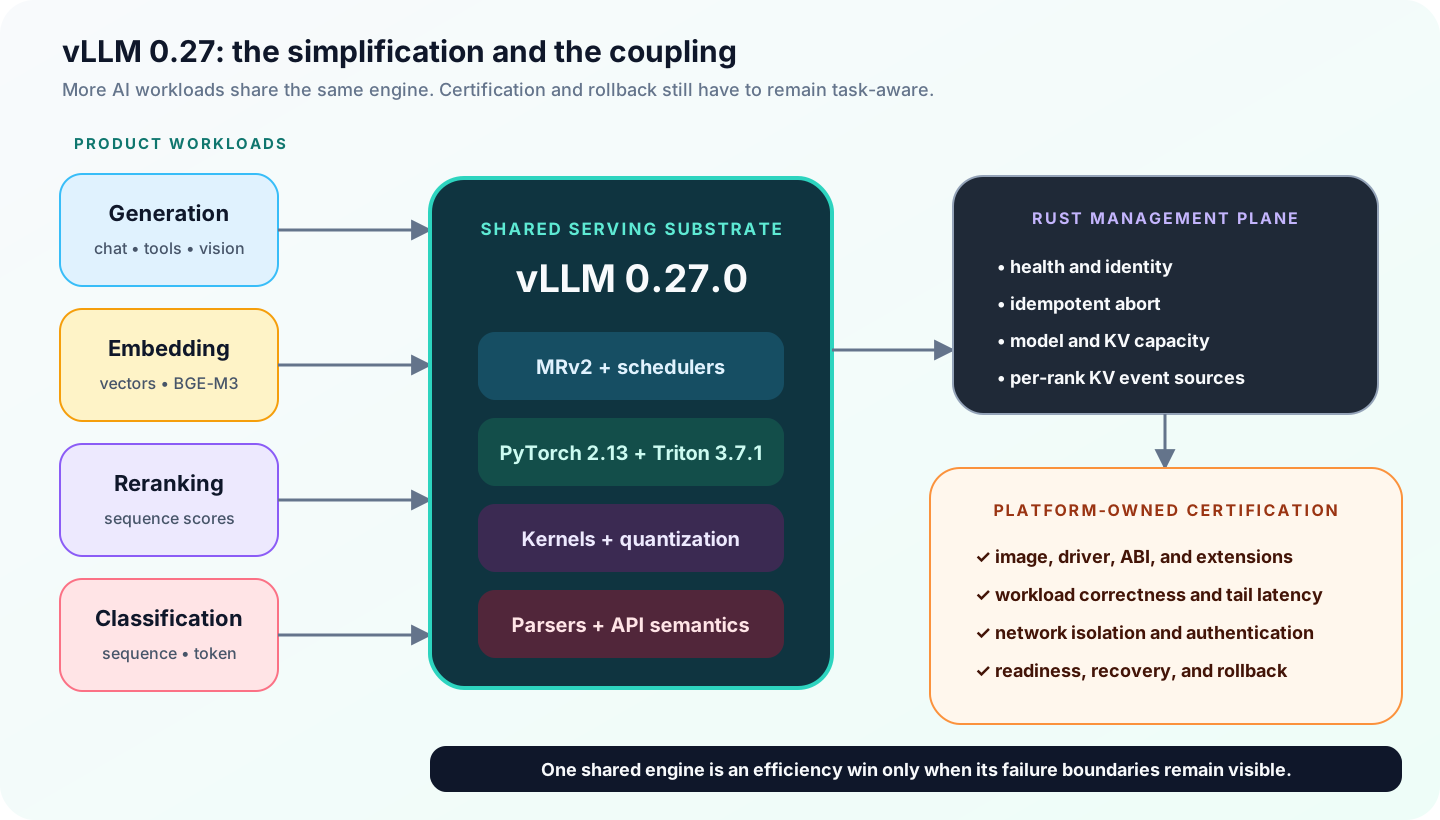
The simplification is real: more AI tasks can share one engine. So is the coupling: the image, runner, kernels, and control plane become common dependencies.
The sourced facts are the release contents. RohitAI's interpretation is that vLLM has crossed from a fast generation engine into a shared inference substrate. That promotion creates four contracts:
A successful pip install answers none of them.
Kimi K3 is the release's headline and its best stress test.
Moonshot's official model card describes a native vision-and-text mixture-of-experts model with 2.8 trillion total parameters, 104 billion active parameters, 93 layers, 896 routed experts, and a 1,048,576-token context window. vLLM calls its support “full stack” because it spans model code, kernels, Python and Rust frontends, attention residuals, DeepGEMM, compressed-tensors checkpoints, DSpark fusion, and optional shared-expert sharding.
That is substantial engineering. It is also evidence that model support is no longer a registry entry.
The official vLLM recipe currently points NVIDIA users to a Kimi-specific CUDA 13 image, says that image needs an R580-or-newer driver, and offers no CUDA 12.9 tag. It recommends at least eight GB300 GPUs; AMD users start at eight MI355X or MI350X GPUs. Serious production traffic is described as multi-node. DeepGEMM MegaMoE is recommended for cross-node NVLink but is incompatible with cross-node RDMA. Model Runner V2 and the Rust frontend are supported behind opt-in environment flags.
The recipe also warns that K3 can occasionally emit a tool-call format its own parser does not expect. An application is expected to validate the schema and retry.
Those are not footnotes around support. They are the support contract.
| Layer | What 0.27 supplies | What the operator still has to prove |
|---|---|---|
| Model and format | K3 architecture, compressed-tensors integration, AttnRes, and specialized MoE paths | Exact checkpoint revision, quantization, output quality, memory headroom, and license approval |
| Compiled runtime | A tagged vLLM path on PyTorch 2.13 and Triton 3.7.1 | Image digest, CUDA or ROCm version, driver, collectives, custom extensions, and ABI compatibility |
| Cluster topology | TP, EP, shared-expert sharding, and supported communication backends | Whether NVLink, RDMA, NIC layout, failure domains, and backend choices work together |
| API behavior | OpenAI-compatible serving plus K3 reasoning and tool parsing | Tool-schema validity, retry bounds, thinking-turn continuity, streaming, and client compatibility |
| Production behavior | Warmup, health, discovery, and initial recovery primitives | Readiness, tail latency, observability, rollback, request loss, and recovery-time objective |
The same caution appears in smaller model integrations. vLLM 0.27 adds K-EXAONE-2.0-750B-A37B, following the cluster-scale model story in our K-EXAONE 2.0 analysis. Its Inkling path supports dynamic per-token FP8, while the merged integration explicitly left out block FP8 because the model's interleaved gate/up layout does not align with the required 128-by-128 scale blocks. “Inkling supported” does not mean “every Inkling quantization supported.”
That distinction will become normal. A compatibility badge tells you where to start an evaluation, not whether you may end it.
Model Runner V2's non-generative expansion may be more strategically important than any one model.
Version 0.27 adds encoder-only attention, sequence pooling for embeddings and classification, token classification, token embedding, BGE-M3 pooling, CPU multimodal support, and multi-layer MTP. A team that currently operates separate generation, embedding, reranking, and classification servers can start consolidating those workloads on vLLM.
There is evidence that correctness received attention. In one merged pooling test, contributors reproduced an NFCorpus reranking score of 0.3288 against 0.32898 for the SentenceTransformers reference. The Jina Embeddings v5 integration reports cosine similarity of at least 0.99999 against a Hugging Face reference in three H100 tests. These are useful, narrow validation results—not independent throughput benchmarks and not guarantees for another model, device, or dataset.
Capability also differs from default selection. At the time of publication, the pull request to enable MRv2 for pooling models by default remains open. Operators need to inspect the runner their deployed model actually selected instead of assuming the new path is universal.
The upside of consolidation is straightforward: one image family, one operational vocabulary, shared telemetry, and potentially better capacity pooling.
The hidden cost is correlated failure. An upgrade that distorts an embedding by a small amount may change retrieval recall. A token-classification regression can damage a safety or redaction path. A scheduler change can alter chat latency. A Triton or driver mismatch can remove all three services together.
This produces a counterintuitive rule: shared infrastructure requires less shared testing. Each task needs an independent canary, acceptance dataset, latency objective, and rollback switch even when every task uses the same executable.
The release-note phrase “Rust frontend” invites the wrong debate. This is not a completed rewrite of vLLM's execution engine.
The tagged Rust README still calls the frontend experimental and not feature-complete. Rust owns the northbound serving layer while talking to the core Python engine process over ZeroMQ. It can also run as a standalone frontend in front of external engines.
The important 0.27 additions are control-plane verbs and facts:
SERVING or NOT_SERVINGThat is enough information for an external router or orchestrator to stop treating every worker as an opaque IP address. It can begin routing by capability and state, not just queue depth.
The connection to vLLM 0.26 is direct. Version 0.26 made KV residency more explicit. Version 0.27 gives control-plane clients a way to discover where KV events come from. The likely destination is a router that can ask both “which replica is free?” and “which replica can reach the useful prefix state?”
The security warning is broader than gRPC. vLLM says inter-node channels are unencrypted by default, and its HTTP API-key protection applies to selected prefixes rather than every operational route. Cluster discovery is valuable because it exposes more truth. It is sensitive for the same reason.
The first fault-tolerance framework addresses a nasty failure mode in data-parallel plus expert-parallel deployments: one dead rank can leave surviving ranks blocked forever in an expert all-to-all operation.
The merged design detects the failure, aborts in-flight requests, resets communication state, and lets an external orchestrator trigger coordinated recovery. That is materially better than an indefinite cluster hang. It is not transparent failover.
The current framework targets external-load-balancer deployments and selected fault-tolerant all-to-all backends such as nixl_ep and deepep_low_latency. The orchestrator still owns unhealthy-cluster detection, admission control, the decision to drain or abort, cluster-wide coordination, retry policy, and the recovery-time objective.
vLLM now supplies more of the middle. The platform still owns the beginning, the end, and what happens to interrupted requests.
One contributor validation used Qwen3-30B-A3B with 128 experts at DP4/EP4 and recovered after injected failures. A recorded episode took roughly 125 seconds from the rank failure to normal operation. That proves eventual recovery in one setup. It does not establish lossless or instant failover.
This is the second non-obvious shift in 0.27: reliability improves by making the external contract clearer. The engine does not become self-healing; it becomes more governable by a platform that knows how to coordinate it.
The dependency change should decide the rollout shape even for teams that do not care about Kimi K3.
vLLM 0.27 moves the base to PyTorch 2.13.0, torchvision 0.28.0, and Triton 3.7.1. The dependency pull request also moved the CUDA base from 13.0.2 to 13.0.3 and recorded a prebuilt NIXL expert-parallel extension failing to load because of an ABI mismatch. That failure was found during the project's own integration work. Every out-of-tree CUDA or ROCm extension deserves the same suspicion.
The release also removes the Plamo2 and Ouro implementations plus the max_num_partial_prefills and max_long_partial_prefills flags. A primary model can load perfectly while an old manifest, side pool, or scheduler assumption still breaks.
Warmup deserves separate treatment. A runner-owned Triton warmup change reduced live-inference JIT compilations from four to one in one tested MRv2 configuration, and to zero with Eagle3, without changing generated outputs in the contributor's checks. That is useful. It moves compilation work earlier; it does not erase it.
If Kubernetes marks a pod ready when the socket opens, the first user can still pay for preparation the platform failed to include in readiness. Measure three clocks:
process start → socket open
socket open → representative warmup complete
warmup complete → first successful production-shaped response
Cold-start performance is a deployment property. A kernel optimization cannot fix a readiness probe with the wrong definition.
The obvious benefit of 0.27 is coverage. The more important consequence is coupling.
Three conclusions follow.
Kimi K3 required coordinated changes across model code, frontends, kernels, quantization, expert layout, topology, and parsing. A late DeepGEMM fix addressed an assertion reproduced at the model's maximum 1,048,576-token context. The support boundary can move with one kernel or image revision.
Teams will need deployment manifests that are closer to a lockfile than a wiki page. The manifest should name every meaningful coordinate and link to the eval result that certified it.
Generation, retrieval, reranking, and classification can share vLLM without sharing one release switch. Mature platforms will keep separate pools or at least separate canary and rollback controls for each task. Otherwise, the operational simplicity of one engine becomes the organizational complexity of one outage affecting every AI path.
Health, abort, model capability, KV capacity, and event-source discovery are not glamorous throughput features. They are the facts an autoscaler, cache-aware router, and recovery controller need to make safe decisions. The Rust frontend may remain opt-in while these contracts become strategically central.
There is a cadence lesson too. vLLM says its release candidates clear CI, performance, and model-accuracy suites, and it builds across CUDA, CPU, Arm, and ROCm. That is a strong upstream process. A recent empirical preprint found vLLM to be the most visible serving framework in the sampled open-source repositories while multi-framework adoption remained limited. The study is not a definitive census, but the combination suggests sticky engine choices and a concentrated downstream blast radius.
A biweekly release cadence is an advantage only for consumers that automate certification.
SGLang 0.5.17 shipped two days earlier with day-zero Kimi K3 support, an initial Rust frontend, cache-routing work, and fault-tolerance changes. The projects are converging on the same problems while keeping different dependency baselines: SGLang 0.5.17 remained on PyTorch 2.11; vLLM 0.27 moved to PyTorch 2.13.
That difference may matter more than a small microbenchmark win. An engine has to fit the drivers, compiled extensions, cache fabric, network topology, failure model, and release process an organization already operates.
Use this path when Kimi K3, K-EXAONE 2.0, new MRv2 workloads, or the control-plane primitives have immediate value. Pin the complete environment and move traffic by task after independent gates pass.
Sensible when the current model and runtime tuple is meeting its SLO and none of the new support is urgent. Rebuild extensions and acceptance coverage before changing the shared foundation.
Worth the cost for high-value workloads that need bargaining power, independent failure domains, or a fallback during runtime regressions. Portability requires real replay tests, not an unused container image.
Benchmark the decision on production-shaped prompts, prefix reuse, tool traces, parser behavior, hardware images, and injected failures. The release notes report several DeepSeek-V4 gains, including a 1.88× kernel improvement, separate 3.4% and 3.9% end-to-end TTFT improvements, and 448 MiB of memory savings. Those figures come from different changes and configurations. They are not additive, and they do not predict Kimi K3 or embedding performance.
Moonshot's hosted platform listed Kimi K3 at research time at $0.30 per million cache-hit input tokens, $3 per million uncached input tokens, and $15 per million output tokens. The self-hosting recipe starts at eight top-end accelerators and points serious traffic toward multi-node deployments.
Those numbers describe different economic regimes.
A stable, heavily utilized cluster can amortize hardware, networking, spare capacity, and platform engineering across enough traffic to make self-hosting attractive. Bursty agent workloads may leave expensive GPUs idle and make the hosted API cheaper even when its marginal token rate looks high. A one-million-token context window also makes cache-hit distribution and output/input mix decisive.
The comparison needs more than token price:
self-hosted cost per accepted outcome =
  accelerators + idle capacity + network + storage + engineering
  + failed requests + recovery reserve + depreciation
  divided by validated completed work
API price and an eight-GPU minimum are inputs to that model. Neither is the answer.
Treat the first deployment as a new fleet, even if the Kubernetes manifest looks familiar.
The release deserves urgency where it unlocks a required model or workload. It does not deserve an in-place production upgrade.
The first signal is whether the gRPC discovery schema stabilizes into a contract that external routers and autoscalers can depend on. Server identity, parallelism, scheduler limits, model capability, KV capacity, and per-rank event sources are already most of the raw material for capability- and locality-aware routing.
The second is fault recovery. Expect movement from retry-and-reset primitives toward faster rank replacement, more explicit orchestrator APIs, and clearer request-loss semantics. The current work establishes the state machine, not its final recovery time.
The third is MRv2 defaulting. When pooling workloads move onto the newer runner by default, consolidation becomes the normal path rather than an opt-in experiment. That will make task-specific release gates more important, not less.
Finally, watch how vLLM and SGLang package frontier models. If both engines support the same checkpoint but require materially different PyTorch, driver, cache, and network baselines, “which is faster?” will keep losing ground to “which one can this platform certify and recover?”
No. PyTorch 2.13 and Triton 3.7.1 make it a compiled-environment migration, and the release removes models and scheduler flags. Use a parallel fleet, rebuild extensions, and replay workload-specific tests.
It supplies a broad full-stack implementation. Production readiness still depends on the exact checkpoint, quantization, image, driver, accelerator count, backend, network topology, parser behavior, latency target, and failure plan.
Not yet. The tagged README calls it experimental and not feature-complete. Rust owns an expanding northbound and control-plane layer while the core engine remains Python, connected over ZeroMQ.
No. It can prevent an expert-parallel cluster from hanging indefinitely and coordinate a reset, but it aborts in-flight requests and needs an external load balancer and orchestrator. Recovery time depends on the deployment.
They can share the serving substrate, but they should not share one undifferentiated acceptance gate or failure domain. Separate pools are still sensible when retrieval or safety paths need independent rollout and rollback.
vLLM 0.27.0 makes open-model serving broader, more observable, and more recoverable. It also makes the runtime a common dependency for more of the AI product.
Kimi K3 demonstrates how much machinery now sits behind a model name. MRv2 shows how many task types can converge on that machinery. Rust discovery gives external systems a clearer view of it. Fault tolerance gives those systems a recovery hook. PyTorch 2.13 reminds everyone that the foundation can still move under the whole stack.
The release is worth adopting. The package-bump mindset is not.
The teams that get the most from 0.27 will be the ones that treat inference support as a versioned deployment profile, preserve task-level failure boundaries, and make certification as automated as the release cadence.