vLLM 0.26.0 Makes KV Tiering an Infrastructure Contract

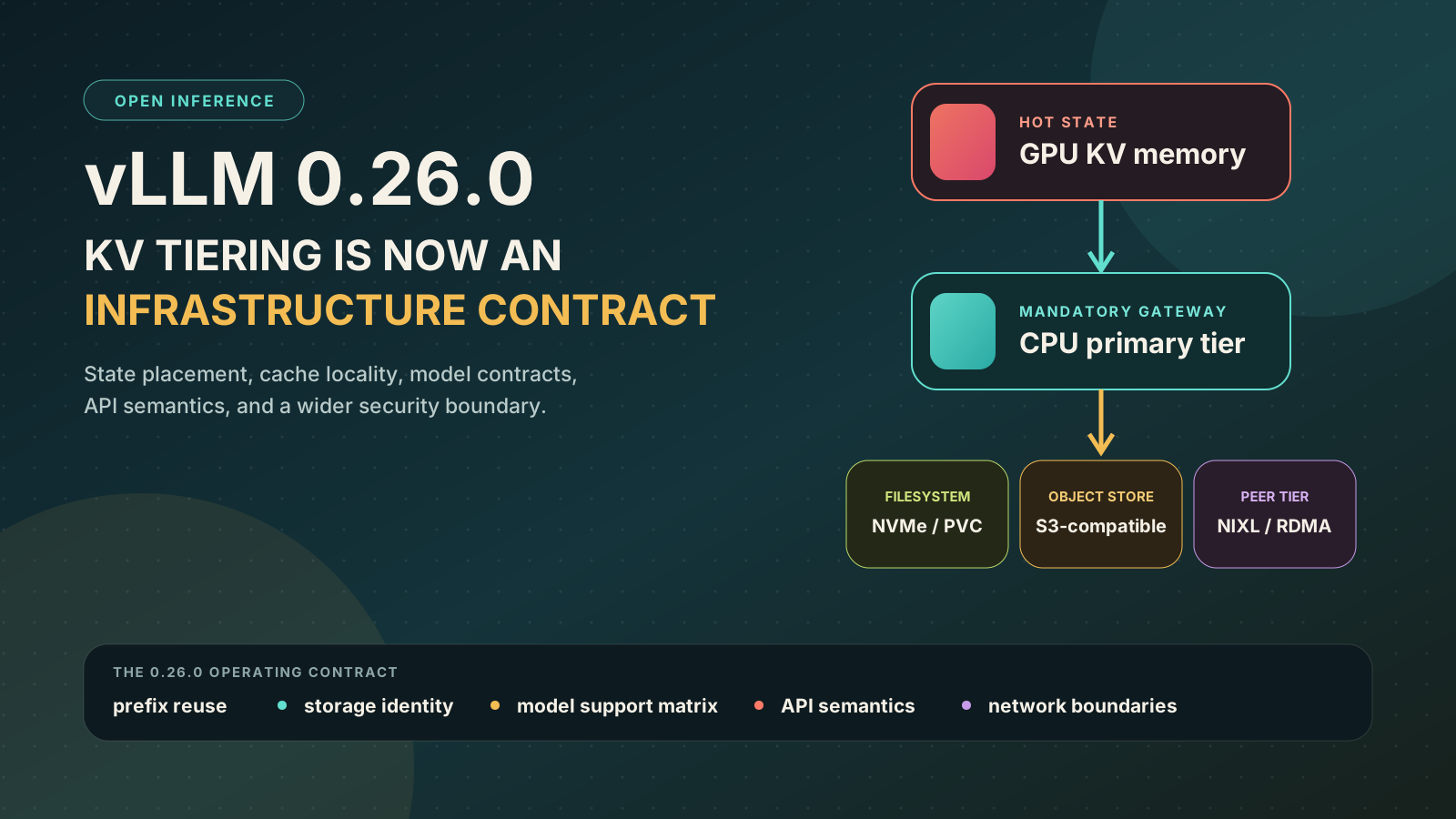
The least glamorous part of vLLM 0.26.0 may be the part that changes open-model serving most. Reusable prompt state can now outlive the GPU that created it: KV blocks can be named in storage, fetched through service credentials, evicted across tiers, and reused by another worker.
vLLM did not invent this tiering stack in 0.26. Version 0.22 introduced the multi-tier framework and a filesystem backend; 0.23 added object storage. Version 0.26 is the maturity release: workload identity, cache metrics, tier-owned events, replica-aware behavior, and a cleaner configuration boundary make the existing architecture look much more like production infrastructure.
When operators opt into the OffloadingConnector, completed prompt blocks can be copied from GPU memory into a CPU tier and then offloaded to a filesystem, an S3-compatible object store, or another peer. Elsewhere, the runtime can choose attention backends by KV-cache group, expose or suppress reasoning fields, load explicitly approved endpoint plugins, and put limits around network-facing work.
Inkling support and DeepSeek-V4 optimizations will attract most of the release-day attention. They deserve it. But both point to a larger shift: an inference engine is no longer judged only by how quickly it produces tokens. It is becoming responsible for where reusable state lives, which model-specific execution path is valid, what the API means, and which surfaces are safe to expose.
That makes vLLM 0.26.0 less like a routine runtime upgrade and more like a promotion in responsibility. Teams evaluating it should look past a successful model load. A shared 30,000-token system or RAG root may repay offloading quickly; a unique million-token agent history may only add I/O, write churn, and retention risk. The useful questions are now about cache reuse, tail latency, storage identity, semantic compatibility, downstream certification, and failure boundaries.
vLLM 0.26.0 shipped on July 25, 2026 from commit f265493. The maintainers count 411 commits from 212 contributors, including 61 first-time contributors. It arrived 14 days after vLLM 0.25.0, which made Model Runner V2 the dense-model default and removed the legacy PagedAttention implementation.
That sequence is more revealing than either changelog alone.
PagedAttention did not disappear as an idea. Paging, block management, and prefix caching became baseline machinery. The new differentiation is moving upward: cache placement, state movement, storage credentials, model-specific kernels, parser behavior, route protection, and observability.
The sourced fact layer is straightforward: model coverage expanded, DeepSeek paths improved, KV tiering matured, the Rust frontend gained multimodal features, the OpenAI-shaped API grew, and several attack surfaces were bounded.
RohitAI's interpretation is that these changes converge on one product category: vLLM is becoming a control plane for inference state.
The strategic center is the KV offloading and tiering design.
Offloading is opt-in through --kv-transfer-config. Once the OffloadingConnector is configured, its default CPUOffloadingSpec adds a pinned host-memory tier. Selecting the multi-tier TieringOffloadingSpec keeps CPU as the primary tier and can attach filesystem, object-store, or NIXL peer-to-peer tiers beneath it. The connector supports CUDA, ROCm, and XPU.
The topology is deliberately asymmetric:
GPU KV memory
      ↕
CPU primary tier
      ↕
filesystem | S3-compatible object store | peer
Only the CPU tier talks directly to GPU memory. A block coming from object storage does not jump into HBM; it passes through host memory first. That is why “KV in S3” should not be translated into “cheap cloud VRAM.”
It is better understood as a recomputation trade:
reuse a stored prefix when:

retrieval + CPU staging + promotion
is cheaper than
recomputing the prefix on the accelerator
That inequality changes by workload. CPU bandwidth, NUMA placement, block size, I/O concurrency, hit distribution, object-store latency, and eviction behavior all matter. The older vLLM CPU-offloading study reported large gains in favorable H100 workloads, but those were self-published, hardware-specific results that predated the 0.26 object tier. They are evidence that reuse can pay, not a promise that remote storage will improve every deployment.
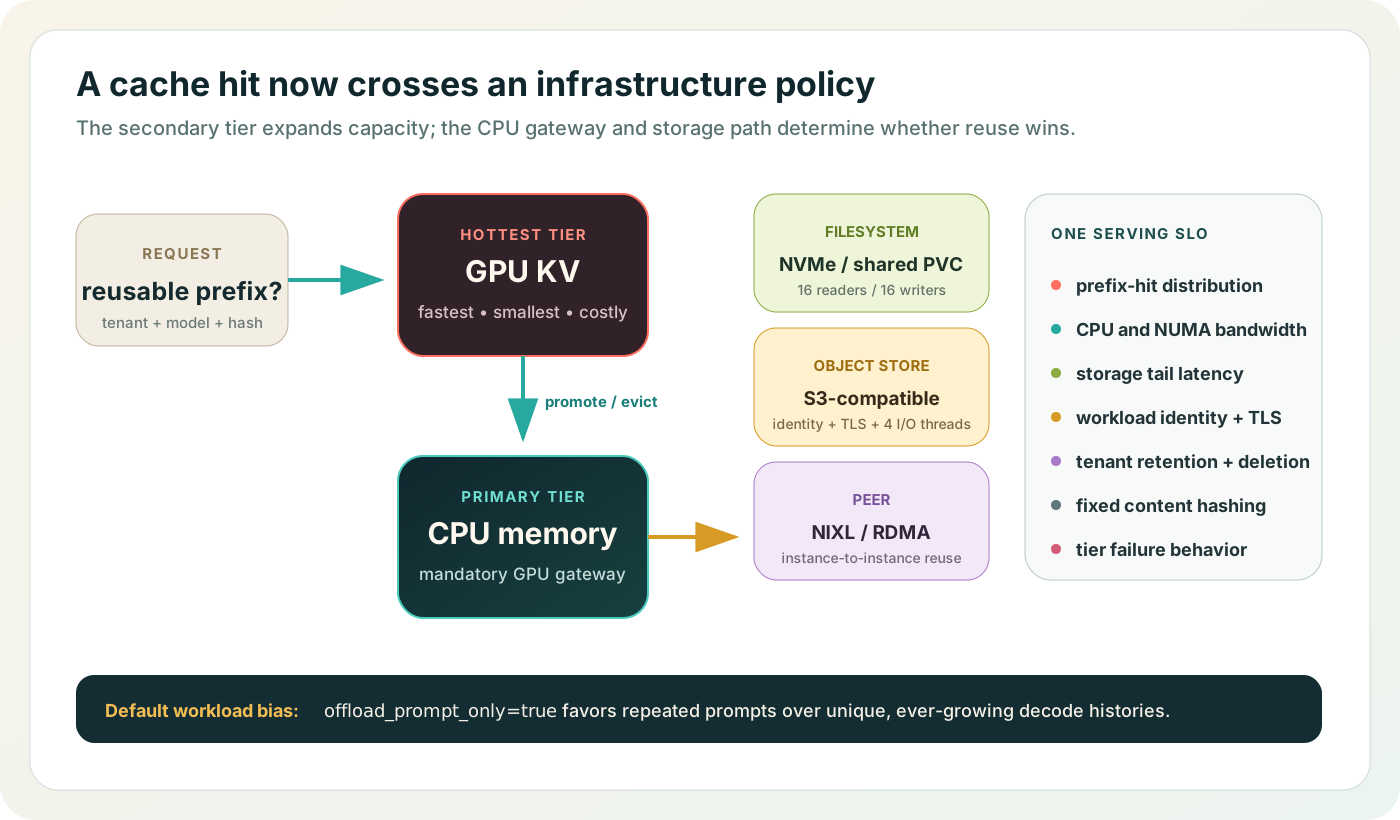
The secondary tiers expand reusable capacity. They also pull host bandwidth, storage latency, identity, and retention into the inference service-level objective.
The defaults reveal the intended workload. offload_prompt_only=true, so prompt or prefill blocks are offloaded while decode blocks are skipped. Filesystem I/O defaults to 16 reader and 16 writer threads; the object tier defaults to four I/O threads. LRU is the default primary-tier eviction policy, with ARC available.
The object tier uses an S3-compatible NIXL backend. It can use the AWS credential-provider chain and workload identity, fails startup when the configured bucket cannot be reached, and defaults its URL scheme to plain HTTP unless the operator chooses HTTPS and certificate handling. Shared filesystem or bucket-backed caches also require the same fixed PYTHONHASHSEED across workers so identical content maps to identical object names. Together, these defaults make host and storage topology part of the serving SLO.
There is a subtle failure-domain decision in the object backend: the tiering guide says vLLM probes the configured bucket during startup and refuses to start when it cannot connect.
Fail-fast validation is sensible. It prevents a server from advertising a cache topology it does not actually have. But it also means a tier introduced to save prefill compute can decide whether fresh inference capacity joins the fleet at all. That is a different role from a best-effort local cache.
Operators should classify the object tier before rollout. If it is required for the service's capacity or latency target, make bucket health part of admission, readiness, and incident ownership. If it is opportunistic, keep a tested deployment path or separate pool that can start without the tier. Do not assume the server will silently degrade to CPU-only offload when the configured bucket is unavailable.
This is the broader pattern in 0.26: cache configuration is becoming service architecture. The bucket is not merely where old tensors go. It can sit on the boot path, carry production identity, and change how much healthy capacity the router can see.
Long context is a capacity property. Cache value is a traffic property.
A one-million-token agent history can be a poor offload candidate if every trajectory is unique and continually growing. A 30,000-token policy, schema, or RAG prefix reused by ten thousand requests can be an excellent candidate. The first workload creates write churn and weak reuse. The second turns one expensive prefill into shared state.
That distinction suggests a better capacity-planning input:
Maximum context tells you how large one request may become. Reuse distribution tells you whether stored KV will avoid enough prefill work to justify its memory, storage, and governance cost.
The next implication is less obvious: KV residency becomes scheduler currency.
Suppose Replica A has an empty queue but none of a customer's 80,000-token shared prefix. Replica B has one request ahead of it and the prefix already warm in a reachable tier. Queue depth alone can select the slower destination.
The separate vLLM Router already offers a cache_aware policy built on an approximate per-worker radix tree of request prefixes. That is useful affinity, but it is not routing from exact tier-residency events. The tagged tiering guide notes event limitations, including placeholder behavior for some cache groups, and says locality metadata does not route a request by itself. Version 0.26 makes more of the state visible; it does not close the loop automatically.
The same direction appears elsewhere. SGLang HiCache documents GPU, host, and shared distributed cache levels. TensorRT-LLM exposes cache reuse, offload, eviction priority, and related scheduling machinery. LMCache emphasizes persistent sharing and lifecycle controls such as lookup, move, pin, and compress.
My prediction: production routers will increasingly score a replica by the state it can reach, not only by free accelerator memory and queue length.
Native vLLM tiering also raises the bar for cache middleware. Basic GPU-to-host offload is becoming an engine feature. Independent layers will need to justify their complexity through cross-engine reuse, centralized lifecycle policy, non-prefix reuse, movement, pinning, compression, or stronger multi-tenant controls. That is a market prediction, not a claim that vLLM has made LMCache or another layer obsolete.
Inference dashboards often reduce cache performance to one number: hit rate. Tiered storage makes that number dangerously incomplete.
A 90% hit rate on tiny prefixes can save less accelerator work than a 20% hit rate on very long, expensive prefixes. A remote hit can also look successful while making first-token latency worse than recomputation because storage or CPU promotion is slow. Meanwhile, aggressive offload writes can consume host bandwidth needed by requests that never hit the cache.
Track avoided prefill work per byte moved, not hit rate alone.
For each tier, I would track the prefix tokens reused, prefill milliseconds avoided, bytes read and written, CPU time, storage cost, and change in warm TTFT. Then compare those results by tenant and request class. A RAG service, a batch summarizer, and a long-running coding agent can have radically different reuse curves even when their average context lengths look similar.
Run the experiment with a control path that recomputes the same prefixes. Without that control, “cache hit” only proves that a block was found. It does not prove that finding it helped.
This is where tiering becomes a product decision rather than a feature toggle. Keep hot shared roots close. Let weak-reuse traffic recompute. Promote only when the observed savings beat the movement cost, and revisit the policy as model kernels or storage latency change.
Once prompt-derived KV blocks land in a filesystem or object store, “temporary accelerator state” stops being an adequate security classification.
The tensors are not plain-text transcripts, and reconstructing a prompt from them is not a routine query. They are still derived from customer input, can survive process restarts, and may be shared across workers. Peer-reviewed research has demonstrated timing-based prompt leakage under defined multi-tenant KV-sharing conditions. That paper does not establish a remotely exploitable vLLM 0.26 vulnerability. It does establish that cache state deserves a threat model.
The operational consequences are familiar:
The unfamiliar part is where those controls now sit. They are no longer only database-team concerns. The inference platform owns a storage boundary.
The release describes Inkling as having a full support stack. That is fair as a description of feature coverage: base modeling, relative attention, piecewise CUDA graphs, MTP speculative decoding, LoRA, and ModelOpt NVFP4 all landed.
The phrase becomes misleading only when “full stack” is heard as “every combination is production-certified.”
Thinking Machines' Inkling model card describes a 975-billion-parameter mixture-of-experts model with 41 billion active parameters, 256 routed experts plus two shared experts, text/image/audio input, and up to a one-million-token context. Our earlier Inkling analysis covers the model's customization thesis and institution-scale hardware floor. vLLM 0.26 supplies a much more credible self-hosting route, but the implementation records show why runtime support is multi-dimensional.
The base support PR included the tokenizer, renderer, reasoning and tool parsers, and image/audio preprocessing. It used a public checkpoint snapshot of roughly 551 GiB and launched with max_model_len=513000; that setting was not a 513,000-token performance benchmark.
The CUDA-graph work passed 51 of 51 piecewise and 51 of 51 full-graph cases on four GB200 GPUs at a tested maximum model length of 8,192. The test reduced gpu-memory-utilization from 0.9 to 0.8 because the checkpoint otherwise left too little KV headroom on that host.
The MTP path supports exactly one speculative token and rejects two. The LoRA PR requires INKLING_MULTIMEM_AR=0 and landed without a public real adapter for a complete end-to-end evaluation. The Hopper FlashAttention-4 path was tested by its author on GB200 rather than through a local H200 run.
None of that diminishes the engineering. It defines the acceptance surface:
checkpoint
× quantization
× attention and MoE kernels
× graph mode
× parser and chat template
× speculative decoder
× adapter
× hardware generation
× modality
× context shape
× runtime version
“Supported by vLLM” is now a category label. Production readiness is one tested coordinate in that matrix.
The DeepSeek-V4 work is important, but the benchmark scale needs discipline.
| Change | Reported result | Measured shape | What it does not establish |
|---|---|---|---|
| Specialized routing kernel | 2.94% lower mean TPOT | TP4 + EP, FP8 KV, 16 prompts, 2 input and 1,024 output tokens | Universal throughput or long-context performance |
| Remove repeat/copy work | 1.8% lower mean TPOT | Separate DP4 + EP run with the same short-input, long-output shape | An additive gain on top of 2.94% |
fused_topk_bias | About 1.5–2× | Contributor microbenchmark across 128 to 8,192 tokens | 1.5–2× end-to-end serving speed |
| ROCm sparse prefill | 6.7–10.5% lower TTFT; 1.6–7.3% higher throughput | DeepSeek-V4 Pro on eight MI355 GPUs, 8,192 input and 1,024 output tokens | A normalized NVIDIA/AMD comparison |
The 2.94% figure comes from PR #48660, the 1.8% figure from a separate configuration in PR #48137, the kernel result from PR #47463, and the MI355 numbers from PR #48519. The first two tests used two input tokens and 1,024 generated tokens. None validates a one-million-token prompt.
Read these results as evidence of model-specific specialization, not a universal 2× gain. Modern sparse-MoE serving depends on continuous work across routing, copies, communication patterns, sparse attention, compressors, quantization, and vendor-specific kernels.
Open weights make the checkpoint available. They do not make the optimized execution path generic.
vLLM 0.26 extends include_reasoning to non-Harmony models. According to the tagged reasoning documentation, setting it to false suppresses reasoning content, reasoning deltas, logprobs, and token IDs from Chat Completions and Responses output. The model still generates the reasoning tokens.
That makes include_reasoning=false a disclosure and payload control. It is not a compute budget.
The larger OpenAI-compatible server covers familiar completions, chat, Responses, embeddings, transcription, and translation surfaces. Compatibility is still not identity. Chat needs a usable template. Tool behavior depends on the model and parser. The user field is ignored. A checkpoint's generation_config.json can replace sampling defaults unless the operator explicitly chooses vLLM defaults.
Endpoint names therefore make a weak conformance suite. A production client should replay tools, streaming, reasoning fields, logprobs, sampling, errors, templates, and parser output against every runtime upgrade.
The Rust frontend is another direction signal that needs precise wording. Video, audio, Seed-OSS parsing, and a native vllm-bench port landed. The tagged Rust README still calls the frontend experimental and not feature-complete, and VLLM_USE_RUST_FRONTEND remains false by default. Rust improved its parity; it did not replace the default Python serving path.
The new endpoint-plugin framework also gets the boundary right by requiring explicit VLLM_PLUGINS allowlisting. A plugin route under a protected prefix inherits that prefix's API-key protection. A route outside those prefixes needs its own control or a proxy rule. Plugins can also shadow existing routes, so route inventory belongs in deployment review.
The release replaces diskcache in the Outlines structured-output backend with SQLite and native Rust serialization. The merged change removes exposure to a pickle-deserialization class associated with CVE-2025-69872. Maintainers also state that vLLM was not practically vulnerable under defaults because the disk cache was opt-in and expected to use a trusted directory. Calling it a confirmed default vLLM remote-code-execution fix would overstate the evidence.
The v0.26 release notes group several other hardening changes that are less dramatic and more instructive:
Those changes show where production inference breaks: parsing, fanout, serialization, validation, and concurrent state, not only CUDA kernels.
The v0.26 security guide also draws a blunt perimeter. --api-key protects the /v1, /v2, and /inference prefixes, not every route. Depending on configuration, operational controls for pause, resume, abort, scaling, or weight updates can remain outside that check. Optional gRPC provides no built-in authentication, authorization, or encryption. Inter-node communication is insecure by default.
An API key is not the network boundary. Put public inference routes behind an allowlisting reverse proxy or service mesh, isolate internal ports, and protect cache-transfer and distributed traffic at the network layer.
There is no universal “upgrade immediately” answer. Version 0.26.0 adds security hardening and important model support, but serving-runtime changes deserve a canary and a downstream acceptance matrix.
Sensible when the current checkpoint and hardware tuple is stable and you do not need Inkling, DeepSeek-V4 paths, native tiering, or the new fixes immediately. Track patches, then move through a normal canary.
Best when one vLLM stack owns a workload with strong repeated prefixes. You reduce moving parts, while accepting responsibility for CPU sizing, storage latency, identity, retention, and tier failure.
Worth testing when cross-engine reuse, centralized lifecycle controls, movement, pinning, compression, or non-prefix reuse justifies another system in the serving path.
Whichever posture you choose, test a request lifecycle rather than importing a peak tokens-per-second figure.
Two upgrade details are easy to miss. The new offloading configuration boundary means out-of-tree experimental OffloadingSpec implementations loaded through spec_module_path now receive one OffloadingConfig. Packaging also remains asymmetric: the 0.26.0 PyPI page supplies Linux x86-64 and aarch64 wheels, while the installation guide introduces stable XPU containers without a prebuilt XPU Python wheel.
Feature presence and deployable artifact availability are separate checks.
Predictions are only useful when there is a visible test. Three signals would show that this release's direction has become normal production practice.
Watch for mainstream routers to accept cache hashes, tier locality, or estimated promotion cost as first-class scheduling inputs. A warm prefix can matter more than a slightly shorter queue, but vLLM 0.26 does not yet assemble its events into that complete routing loop.
The proof will be a versioned manifest—checkpoint, quantization, kernels, parser, modalities, adapters, hardware, and validated context shapes—that a release pipeline can evaluate automatically. Inkling makes a binary “supported” badge too weak for the job.
Look for explicit TTLs, tenant namespaces, deletion APIs, retention logs, and cache-store ownership in enterprise inference products and security questionnaires. Durable prompt-derived state will have crossed the line from runtime implementation detail to governed data product.
No. It is a slower, larger secondary tier for reusable KV blocks. Transfers between a secondary tier and GPU stage through the CPU primary tier. The economic question is whether retrieval beats recomputation for the workload's actual prefix distribution.
include_reasoning=false reduce reasoning cost?Not by itself. It suppresses reasoning and related metadata from the response while the model still generates reasoning tokens. Treat it as disclosure control, then use supported generation or thinking budgets for compute control.
No. Its multimodal coverage improved, but it remains experimental, not feature-complete, and opt-in.
Not without a canary. Treat 0.26 as a new certification event for the exact checkpoint, quantization, hardware, parser, context shape, and traffic mix you run. Move faster when you need its model support or security fixes, but keep rollback and compare correctness plus tail latency before widening the fleet.
vLLM 0.26.0 expands open-source inference in two directions at once.
It goes downward into specialized model execution: Inkling graphs and parsers, DeepSeek routing kernels, quantization, speculative decoding, and hardware-specific paths.
It goes outward into production infrastructure: CPU and storage tiers, credentials, cache events, reasoning semantics, plugin routes, resource bounds, and network controls.
The second direction will matter longer.
Peak throughput remains important, but the harder operating question is now whether a team can explain where reusable state lives, who may read it, which execution contract produced the response, and what happens when a tier or route fails.
That is the standard vLLM 0.26.0 is beginning to set.