xAI Grok Build Workflows Make Orchestration the Product

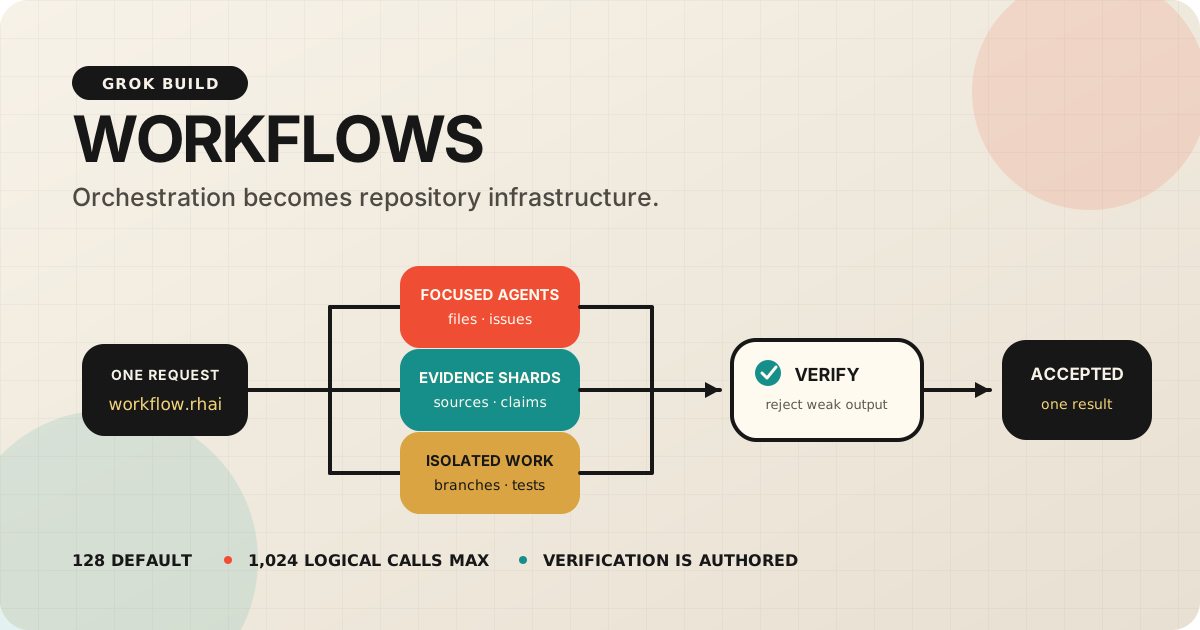
xAI put 1,024 agents in the headline. That is the easiest part of Grok Build Workflows to repeat—and the least useful part for deciding whether to trust one with a repository.
The consequential change is that Grok Build can now turn a large task into an executable orchestration program, run it in the background, show its phases and agent-level token use, then save the program under .grok/workflows/ as a reusable team command. The unit of agent work is moving beyond a chat session. It is becoming versioned source that decides how work is split, which tools workers receive, what counts as evidence, when a finding is rejected, and how one result is assembled.
That makes this a control-plane release, not a swarm demo.
The implementation also makes the headline smaller than it sounds. In the public Grok Build source snapshot, 1,024 is a cumulative allowance for logical child-agent calls. It is not a promise of 1,024 simultaneous workers, a token budget, or a dollar limit. A session can have four active workflow runs, workflows cannot recursively launch other workflows, and pause/resume survives only inside the same process.
xAI is not first here. Anthropic launched a strikingly similar Dynamic Workflows layer for Claude Code on May 28. The important signal from xAI's July 23 release is therefore convergence: coding-agent vendors now expect orchestration itself to be written, inspected, saved, shared, and rerun.
This is a follow-up to RohitAI's teardown of the open-sourced Grok Build harness. The harness exposed the agent loop. Workflows add the programmable layer above it.
xAI's announcement describes a simple interaction: ask Grok Build for a workflow to review a pull request, triage issues, audit routes, or research a topic. Grok writes a small program with named phases, smoke-checks it, launches it in the background, and returns control to the main session.
The /workflows view exposes progress by phase, individual agent status, results, and per-agent token counts. A successful run can be saved to .grok/workflows/ for a project or the personal Grok workflow directory for use across projects. That file becomes a parameterized slash command.
This is more durable than asking one root agent to improvise delegation on every run. The orchestration can be diffed. A team can review it. The same topology can run against pull request 5137 after it ran against pull request 4821. Failures can be traced back to a specific workflow revision instead of a fuzzy conversation history.
The dashboard tells the useful story. Grok Build has a large ceiling, but xAI's own reference design is small, staged, and selective.
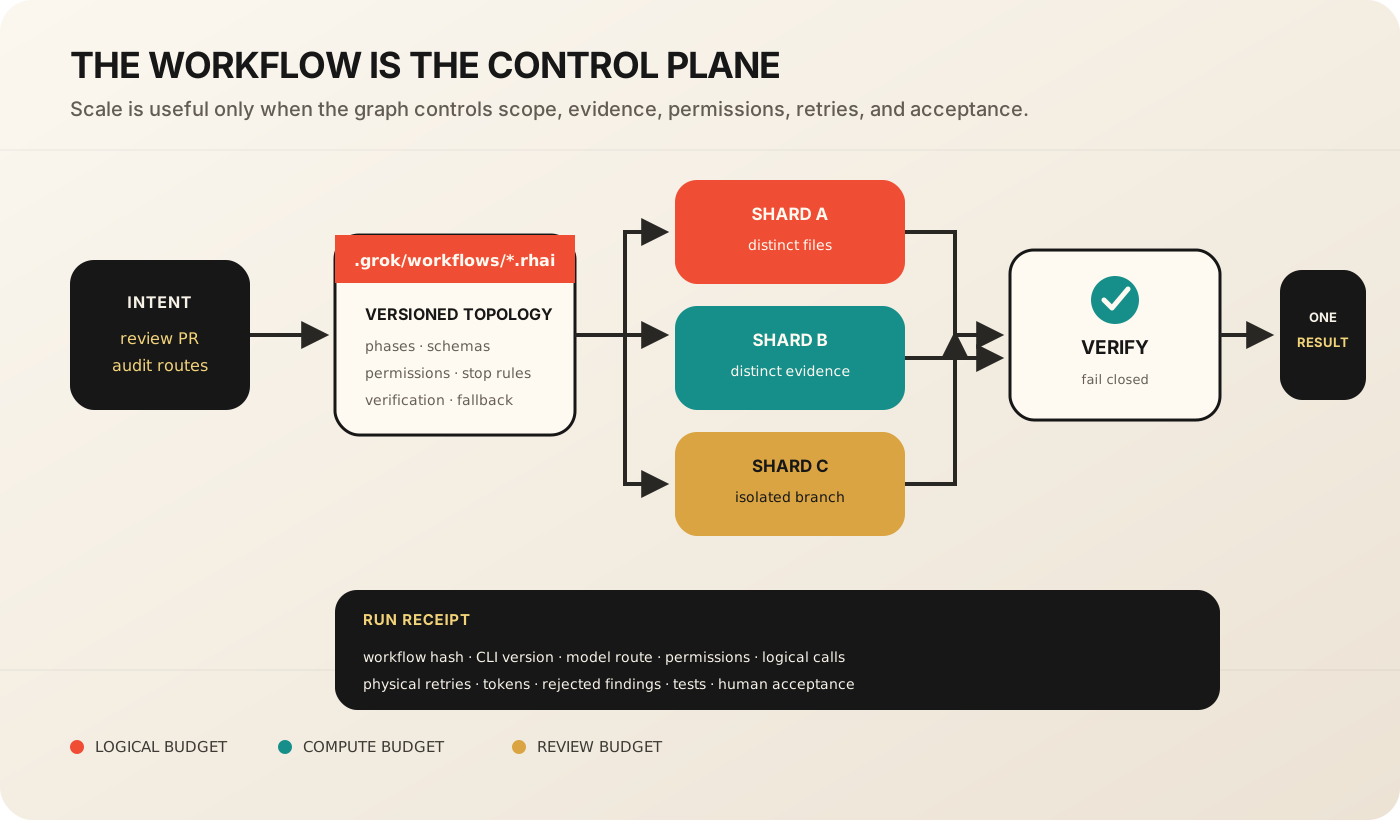
The workflow file holds the topology. Agent count is only one input; permissions, evidence rules, retries, and acceptance criteria decide whether the run is useful.
The word agent collapses three different quantities:
Grok Build's agent_budget caps the first quantity. The workflow tool implementation accepts a budget from 1 through 1,024, with 128 as the default. Each agent() call and each item sent through parallel() consumes a logical slot.
The host service adds two important details. A parallel panel that would cross the remaining budget is rejected before any child in that panel launches. That is a clean failure boundary. But a structured-output repair retry can create another physical child run without consuming a second logical slot.
So even the logical ceiling does not perfectly bound model calls. And xAI does not publish a comparable simultaneous-worker limit, scheduler policy, or queueing guarantee. “Up to 1,024” cannot be converted into a throughput claim.
| Control surface | What the inspected build does | Production reading |
|---|---|---|
| Agent budget | 128 by default; 1–1,024 accepted | Cumulative logical calls, not simultaneous workers |
| Parallel panel | Rejected atomically if it would cross the remaining budget | No half-launched panel on budget failure |
| Structured-output retry | May run another physical child without another logical slot | Logical budget does not equal invocation count |
| Run-level concurrency | Four active workflows per top-level session | Plan capacity at the run level as well as the child level |
| Nested workflows | Workflow children and subagents cannot launch another workflow | The graph has one top-level orchestration boundary |
| Resume | Journal replay inside the same process | A CLI restart is not durable cloud continuation |
| Verification | Programmed explicitly by the workflow author | The engine provides primitives, not truth |
The built-in deep_research.rhai is more revealing than the launch demo.
Its default breadth cap is four, adjustable from two through six. The planner may choose fewer questions. The workflow moves through four phases: Plan, Research, Verify, and Report. A successful run at the default breadth uses four to eight logical calls; the full-breadth path looks like this:
1 planner
4 focused researchers
up to 2 verifier shards
1 report synthesizer
The researchers are read-only. Each can return at most six claims, and the candidate pool is capped at 24. Verification is not a loose vote. Claims are split across one or two verifier shards, so each claim is checked by one verifier—not both. A malformed verifier shard causes the claims assigned to that shard to be excluded. Retained claims need a supported verdict plus non-empty verifier-supplied evidence metadata; the code does not enforce a distinct second source.
That topology encodes a useful opinion: bounded diversity beats indiscriminate scale.
The planner creates non-overlapping questions. Researchers collect structured evidence. Verifiers act as a rejection layer. The final writer sees a filtered set. More workers would not automatically improve this design; they could produce more duplicate claims, correlated errors, and synthesis pressure.
This is the first non-obvious lesson from the release. The platform ceiling is marketing-compatible. The bundled workflow is production-shaped.
If I were evaluating Grok Workflows, I would begin closer to eight agents than 128. Scale only after measuring which additional shard creates new accepted evidence, faster completion, or broader file coverage.
Anthropic introduced Dynamic Workflows for Claude Code on May 28, exactly eight weeks before xAI's announcement. Its current workflow documentation describes the same broad product shape: model-authored orchestration scripts, background execution, reusable project and personal folders, slash commands, a /workflows dashboard, explicit verification stages, pause/resume within a session, and built-in deep research.
Claude uses JavaScript where Grok uses Rhai. Claude documents up to 16 concurrent agents and 1,000 total agents per run. It also shows an advisory warning above 25 agents or 1.5 million projected tokens. Grok documents 1,024 logical calls but not a simultaneous-concurrency number or equivalent projected-token threshold.
The 24-call difference between 1,000 and 1,024 is strategically meaningless. The meaningful differences are:
Grok's strongest answer today is inspectability. The Apache-licensed repository exposes the runtime and bundled workflow source. That lets builders audit semantics that xAI's launch post leaves vague. The caveat is that xAI calls the repository a periodic snapshot of an internal monorepo, so source-to-production parity remains something teams must verify.
xAI's launch examples are not random. Pull-request review, issue triage, authentication audits, and deep research are mostly read-heavy tasks that can be split by file, issue range, route, evidence source, or hypothesis. They look like map-reduce:
partition -> inspect independently -> reject weak outputs -> deduplicate -> synthesize
That is the sweet spot.
Strict migrations, incident response, and multi-file editing are different. If worker B depends on worker A's result, parallelism fragments the reasoning chain. If several workers touch shared state, coordination becomes the task. If all verifiers use the same model, source set, and premise, their agreement may be one repeated mistake.
The latest revision of Google Research's agent-scaling preprint is not a Grok benchmark, but it gives a useful prior. Across 260 configurations and six benchmarks, relative performance ranged from +80.8% on decomposable financial reasoning to -70.0% on sequential planning. The authors also found that architectures without centralized verification tended to propagate errors more than centrally coordinated ones. This is pre-peer-review evidence, not a universal scaling law, but the workload-shape result is hard to ignore.
A separate June preprint, Do More Agents Help?, matched multi-agent systems against single-agent baselines. Only one of six systems was numerically ahead, by 1.44 points within the authors' one-run uncertainty guidance; the other five trailed. Its separate Claude-Code-style runtime workflow performed strongly on GAIA, an important counterweight. The paper's useful conclusion is not “multi-agent systems fail.” It is that topology and harness design matter more than worker count.
Partition by changed file or risk class, keep workers read-heavy, then deduplicate and adversarially verify findings before one ranked report.
Assign distinct source families or competing hypotheses, require structured claims, and reject anything that lacks independent support.
Isolate work by disjoint file sets or worktrees. Keep dependency ordering and final integration under one coordinator.
Many agents touching the same files, schema, environment, or deployment can create merge pressure faster than useful work.
The acceptance metric should be cost per accepted result, not agents launched. For review, count distinct valid defects found per dollar and reviewer-hour. For migration, count cleanly merged files that pass tests. For research, count claims that survive independent verification.
.rhai file is executable team policyA saved project workflow looks modest: a file under .grok/workflows/, committed beside the code it operates on. But it can define far more than a prompt.
It decides:
That makes the workflow a new supply-chain surface.
The inspected registry has sensible local protections. Project discovery requires folder trust. Symlinks and non-regular files are rejected. Built-in names resolve before project definitions, which resolve before personal definitions, so a project cannot silently shadow /deep-research with a file of the same name. Workflow filenames and metadata follow constrained naming rules.
Those controls reduce accidental ambiguity. They do not answer provenance.
Who reviewed the generated workflow? Which revision ran? Has its permission set expanded since the last good result? Which model wrote it? Which CLI binary executed it? Can the organization revoke a compromised workflow? Is there an evaluation history showing that its verifier catches seeded defects?
This is the second non-obvious lesson: prompt libraries are becoming execution libraries. RohitAI made a similar argument when OpenAI Skills pushed reusable agent instructions toward a cross-product artifact. Grok's Rhai format is product-specific, but the governance need is the same.
xAI says completed work is not redone when a workflow is paused and resumed. The source shows the boundary of that promise.
The journal implementation replays completed, result-bearing host calls against the original immutable script and arguments. That is deterministic and valuable inside one running process.
It is not a durable cloud queue. In the inspected build, a CLI process restart makes an interrupted run terminal. The user guide also warns that an external side effect can run again if the effect happened but its result was not committed to the journal.
For read-only research, duplicate work is annoying. For writes, it can be dangerous.
Any workflow that comments on issues, changes remote state, triggers deployments, sends notifications, or writes to external systems needs idempotency keys, conditional updates, explicit commit markers, and compensating actions. “Resume” should never be translated into “exactly once.”
This is the third lesson: the journal boundary becomes the side-effect boundary.
Production teams need to distinguish:
logical budget  = how many child work items the graph may request
compute budget  = model calls, retries, tokens, tools, and long-context multipliers
review budget   = how much human attention is needed to accept the output
agent_budget addresses the first. Per-agent token visibility helps observe the second after a run starts. Nothing in the launch material establishes an enforceable workflow-level token or dollar cap.
xAI's consumer documentation says Grok products, including Build, draw from a shared weekly usage pool and that longer coding work uses more compute. It does not publish a workflow debit formula. The public Grok 4.5 API rate card is useful context, but it should not be treated as the price of a subscription workflow.
That gap will matter quickly. Claude now warns when a workflow projects past 1.5 million tokens. Cursor's separate Cloud Agents product requires a spend limit. GitHub's /fleet documentation explicitly warns that more subagent interactions consume more AI credits and that sequential work may gain nothing.
My read: xAI will need a projected-token warning, an enforceable credit ceiling, or both. Large logical limits create demand for financial controls even when most good workflows stay small.
The review budget is easier to miss. A 128-agent audit that returns 600 plausible findings may be operationally worse than an eight-agent run that returns 12 well-supported ones. Synthesis does not remove review; it can hide its size.
Parallelism does not create a new permission model. It multiplies the consequences of the existing one.
Teams should know which files every worker can read, what repository content is transmitted, whether web or MCP access is inherited, where traces are retained, and whether isolated copies are used for edits. xAI's workflow announcement does not provide a complete workflow-specific specification for permission inheritance, network egress, retention, or filesystem visibility.
There is relevant history. An earlier Grok Build version was at the center of a repository-upload dispute covered by RohitAI; Axios reported a test in which 5.1 GiB was uploaded for a narrowly scoped task said to require 192 KiB. That report is not evidence that the July 23 workflow implementation repeats the behavior. It is a reason to verify the installed binary and effective data path before multiplying repository access across a large fan-out.
Open source improves the audit surface. It does not, by itself, prove production routing, retention, or source parity.
Do not begin by asking whether 128 agents can run. Begin by asking whether eight produce a result worth accepting.
A useful execution receipt would include the workflow hash, installed binary version, model route, starting repository commit, effective permissions, logical budget, physical retry count, per-agent tokens, rejected findings, test outcomes, and the human acceptance decision.
That receipt does not appear in the headline, but it is what makes background work auditable.
The obvious competitive question is whether Grok can coordinate more agents than Claude. The durable question is who owns the workflow source.
Grok saves Rhai. Claude saves JavaScript. Other tools use skills, agent definitions, YAML, TOML, or product-specific APIs. These artifacts encode the expensive part of adoption: decomposition learned through failures, verifier prompts tuned to a codebase, permission choices, stop conditions, and the tests that distinguish a trustworthy result from a polished one.
Once a team has 50 reviewed workflows, switching agents is no longer a model-selector change. It is an orchestration migration.
That creates three likely product moves:
Grok has one meaningful advantage in that contest: the runtime is inspectable today. xAI can turn that into trust if it pairs open code with source-to-binary provenance, durable execution receipts, hard cost controls, and an explicit permission contract.
xAI advertises a maximum workflow budget of 1,024 agents, but the inspected implementation uses that number as a cumulative cap on logical child calls. xAI does not document 1,024-way simultaneous concurrency. Physical model calls can also exceed logical slots when a structured-output repair retry occurs.
It is a Rhai orchestration program that defines phases, launches focused child agents, combines results, and can explicitly add verification or fallback logic. Grok can generate the program from a plain-language request. Project workflows live under .grok/workflows/ and become reusable slash commands.
No. The runtime provides primitives for schemas, branching, agents, and parallel fan-out, but the workflow author must program the verifier prompts, evidence fields, acceptance rules, and failure behavior. The bundled deep-research workflow contains a strong fail-closed verification design; that does not automatically apply to every generated workflow.
Not in the inspected public source. Completed host-call results can be replayed when a paused run resumes in the same process. Restarting the CLI does not provide cloud-job continuation, and an external side effect can repeat if it completed before its result reached the journal.
No. Anthropic announced Claude Code Dynamic Workflows on May 28, 2026, before xAI's July 23 launch. The products differ in implementation and controls, but both signal that executable, reusable orchestration is becoming a standard coding-agent layer.
Measure wall time, tokens, retries, duplicate work, verifier precision, test results, reviewer effort, and cost per accepted result. Begin with a small, independently partitioned workload. Increase the logical budget only when the next shard adds measurable coverage or reduces completion time without increasing error and review costs.
Grok Build Workflows move xAI's coding agent from improvised delegation toward programmable operations.
That is a meaningful release. A repository can now carry not only instructions for an agent, but the graph that decides how dozens of agents work, verify, fail, resume, and report. Teams can share the graph and improve it over time.
The public source also keeps the product honest. The 1,024 ceiling counts logical calls, not guaranteed simultaneous workers. The built-in flagship workflow uses four to eight calls on a successful default-breadth path. Resume is same-process replay. Verification is authored, not automatic. Cost and review remain outside the hard agent budget.
Those are not reasons to dismiss Workflows. They are the reasons to evaluate the product at the right layer.
The future of coding agents will not be won by the largest swarm screenshot. It will be won by the system that turns a difficult task into a small, inspectable graph—and can prove that the graph produced an accepted result at a cost and risk a team understands.