xAI's Grok Bot Gives Your AI Team One Computer—and One Blast Radius

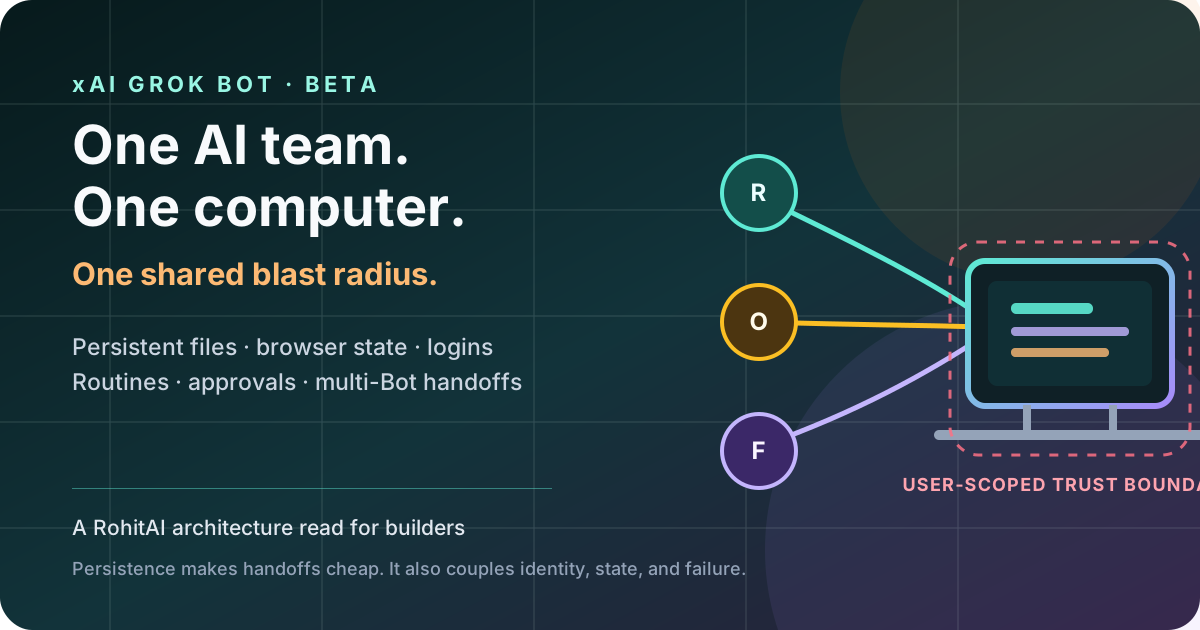
xAI wants Grok Bot to feel like hiring a small team. You create named specialists, put them in shared threads, teach them recurring jobs, and let them keep working after your laptop closes.
The metaphor is useful. The architecture underneath it is more useful.
According to xAI's Grok Bot FAQ, all of one user's Bots share one persistent cloud computer: the same files, browser state, and logins. The isolation boundary is the user, not the Bot. That choice explains why handoffs can feel natural. A research Bot can leave a file for a writing Bot; an operations Bot can inherit an authenticated browser session; nobody needs to rebuild context for every task.
It also means the “team” does not arrive with separate desks, credentials, or blast radii. A compromised session, poisoned webpage, unsafe routine, or state collision can affect more than one named specialist. Multi-Bot coordination may increase organizational clarity without adding compute isolation or measurable throughput.
That is the useful way to read the August 11 beta launch. Grok Bot is xAI's attempt to turn a user-scoped cloud workstation into the control plane for delegated labor. The launch is significant because it bundles persistence, computer use, learned routines, approvals, memory, schedules, and social coordination into one product. Its success will depend less on how convincingly the Bots chat and more on whether xAI can make shared state observable, permissioned, budgetable, and recoverable.
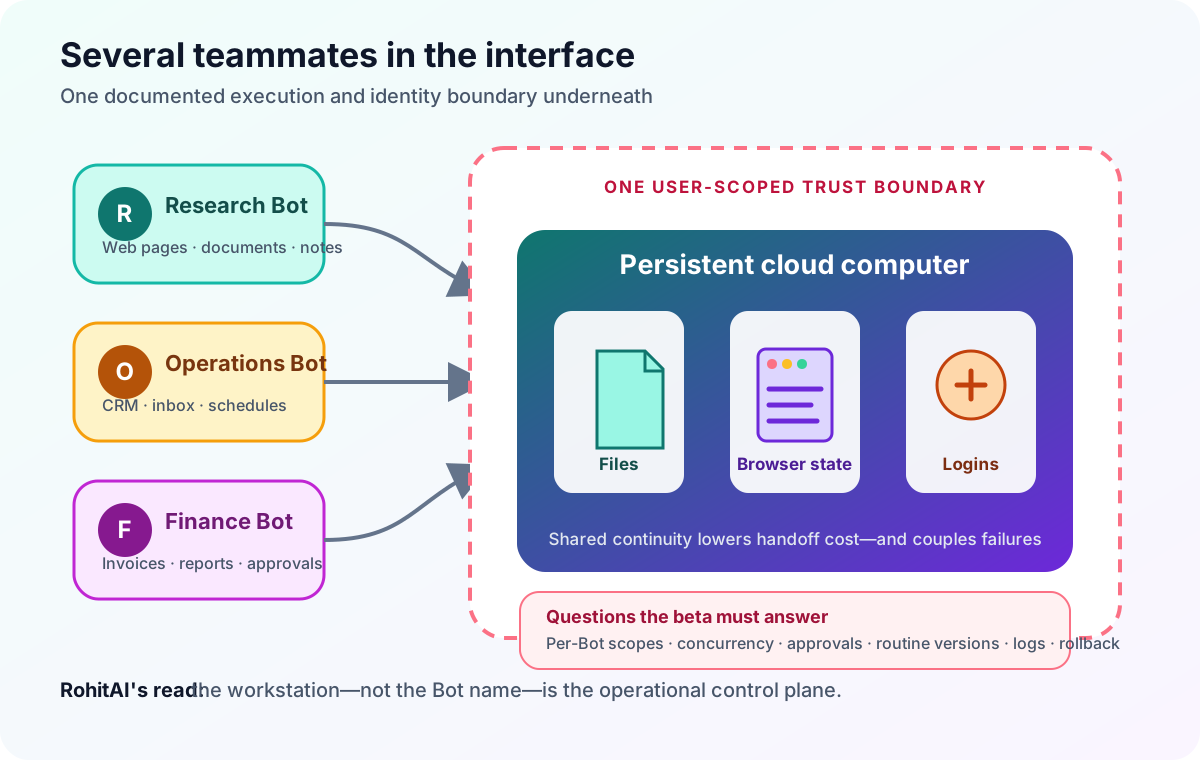
The product presents several teammates; the documented trust boundary is one user-scoped workstation.
Grok Bot is available in beta to SuperGrok Heavy, Cursor Ultra, and Cursor Premium Teams subscribers. xAI lists desktop clients for macOS, Windows, and Debian/Ubuntu Linux, plus iPhone and iPad apps; Android is marked as coming soon. Enterprise access remains a waitlist or near-term promise rather than general availability.
The product has five connected ideas:
xAI's use-case catalog lists 56 jobs across nine categories, from sales and marketing to finance, recruiting, product, engineering, and personal administration. The launch post says xAI used prototypes for CRM updates, invoice processing, marketing campaigns, bug fixes, office operations, and UI reproduction.
Those examples establish intended scope, not reliability. xAI does not publish an end-to-end success rate, side-effect error rate, median runtime, intervention rate, retry rate, or cost per completed workflow. One internal testimonial claims a 2–3x efficiency gain, but the launch includes no methodology, baseline, sample, or independent validation. Treat it as a customer quote, not a benchmark.
| Surface | Documented in beta | Still unspecified publicly |
|---|---|---|
| Execution | 24/7 cloud continuation; apps, browsers, and sites | Machine size, browser count, idle policy, queueing, concurrency |
| Identity | Cursor SSO and privacy mode; shared user logins | Per-Bot credentials, roles, profiles, or separation of duties |
| Routines | Learn by demonstration, correction, repetition, and schedule | Source format, versions, tests, ownership, export, rollback |
| Safety | Encryption, training opt-out, approval requests, Auto Review | Mandatory-action taxonomy, false-negative testing, audit contract |
| Economics | Subscription access, weekly usage, token-billed overage | Included pool, model route, Bot rate card, retry and tool billing |
Most agent products pay a context tax. Every new run has to rediscover the files, reauthenticate, rebuild browser state, and reconstruct what happened before. Grok Bot reduces that tax by keeping the workplace alive.
That can make a multi-Bot handoff pleasantly boring. One Bot gathers prospects and writes a CSV. Another opens the CRM and updates records. A third drafts follow-ups using the same browser identity. Shared state is the connective tissue.
But the same design couples tasks that the interface presents as separate roles.
Suppose a recruiting Bot opens a résumé containing hidden prompt-injection text. The same user's finance Bot later reuses the browser, filesystem, or authenticated session. Without per-Bot browser profiles, credential scopes, filesystem namespaces, and network rules, “Recruiter” and “Finance” are labels on a common environment—not security compartments.
The issue is larger than malicious content. Ordinary race conditions matter too. Two Bots might navigate the same browser, overwrite a shared download, refresh a session, submit duplicate forms, or act on a page whose state changed during an approval wait. xAI says Bots run in parallel, but it also says they share one computer. Until it publishes simultaneous-action limits and scheduling semantics, parallelism is a coordination promise rather than a throughput guarantee.
This produces the first non-obvious conclusion: the multi-Bot product may scale managerial clarity before it scales execution capacity. Naming specialists can help people route work even if those specialists queue behind one browser or contend for the same application. That is still useful. It should not be mistaken for a rack of independent cloud workers.
Teaching by demonstration is probably Grok Bot's best onboarding idea. “Watch me do this once” is far more approachable than asking an operations manager to define selectors, APIs, schemas, retries, and exception branches.
The convenience also hides an artifact problem.
In July, xAI launched Grok Build Workflows, which save orchestration scripts under .grok/workflows/, show named phases, expose per-agent token counts, and allow teams to reuse a reviewed program. RohitAI's earlier Grok Build Workflows teardown argued that these files are executable team policy: they deserve owners, review, tests, least privilege, and rollback.
Grok Bot moves in the opposite direction. The behavior is learned by watching, but xAI has not described an editable routine source, version history, diff, test harness, signer, export format, or rollback operation. The routine may feel like memory. Operationally, it is automation with permission to touch live interfaces.
That difference matters after the tenth correction. A Bot may learn that one exception is normal, carry a stale preference into a redesigned application, or reconcile contradictory instructions from another Bot. Evaluation becomes temporal:
task quality today
+ accumulated corrections
+ changed website state
+ refreshed credentials
+ cross-Bot messages
= next week's behavior
A demo can prove that a routine works once. A production test has to prove that it remains bounded after state and memory change.
xAI says Grok Bot returns when “something needs your approval” and can place sensitive actions through Auto Review. The missing word is which.
The launch examples span a wide side-effect range: drafting an email, sending outreach, updating CRM records, changing ad allocations, processing invoices, booking travel, and reproducing a bug. A useful approval system needs more than a pause button. It needs a mandatory-action policy, approver roles, expiry behavior, evidence shown at review time, and revalidation if the underlying state changes while the task waits.
Microsoft's current Copilot Studio computer-use documentation shows what a more explicit control surface looks like: stored credentials, website and application allowlists, human supervision, session screenshots, activity logs, and per-step billing. Microsoft's supervision guide also says the model may fail to request review when expected and warns that supervision is not a fail-safe.
OpenAI established an earlier consumer precedent with its 2025 ChatGPT agent launch: virtual-computer work, persistent cookies, recurring tasks, takeover for logins, and confirmation around consequential actions. Its current help page says that product has since been retired in favor of newer work and cloud-browser surfaces, so it is historical context rather than a like-for-like product available today.
Grok Bot's novelty is therefore not the invention of computer use or scheduled agents. Its bet is that people will manage persistent delegated work socially—as a set of colleagues in conversations—rather than as flows, tools, or one task-specific agent at a time.
The social interface can make delegation easier. It can also make authority feel softer than it is. A friendly name and avatar do not narrow a credential.
The Grok Bot page lists Cursor Ultra at $200 per month and Cursor Premium Teams at $120 per seat per month. SuperGrok Heavy subscribers also receive access, though the Bot page does not show a Heavy price.
xAI says subscriptions include weekly usage and that additional usage is billed according to token cost. It does not publish the Bot-specific included quantity, runtime model, token rates, concurrency, retry accounting, or whether cloud-computer time and third-party actions are metered separately.
That makes the seat price a poor proxy for operating cost. A scheduled routine can retry while nobody watches. Two Bots can duplicate work. A browser loop can consume tokens without producing an accepted result. A $200 plan can be cheap for one high-value workflow or expensive for a fleet of plausible-looking failures.
The right metric is:
total cost per accepted recurring outcome
= subscription allocation
+ overage
+ paid external actions
+ human review time
+ retries and recovery
This is the second non-obvious conclusion: always-on execution turns consumer-plan metering into infrastructure economics. Builders will need task budgets, hard stops, projected-cost warnings, and anomaly alerts even if the product is purchased like a subscription.
xAI says the cloud computer is encrypted in transit and at rest, supports training opt-out, and uses Cursor SSO, authentication, and privacy mode. It also describes enterprise DLP, certificates, proxies, and boot-time network controls. Those are meaningful vendor commitments.
They do not answer what one material run did.
For an invoice action, CRM write, production change, or outbound send, a team should be able to retrieve an execution receipt: Bot identity, routine revision, model route, initial state, websites and applications touched, credentials used, approvals requested and granted, screenshots or logs, tokens, retries, final side effects, and recovery status.
That evidence matters because product data paths can surprise users. In July, Axios reported that a tested Grok Build version uploaded 5.1 GB from a repository for a task that required about 192 KB. SpaceXAI said previously uploaded user data would be deleted. This was a separate coding product, and it is not evidence that Grok Bot repeats the behavior. It is a concrete reason to verify Bot egress, retention, and file access instead of inferring them from the chat interface.
The right pilot is small, reversible, and deliberately adversarial. Do not begin with the founder's browser profile or a finance administrator's account.
Start with one recurring, read-heavy job: collect a weekly market update, reconcile a non-sensitive dashboard, or draft a report from a bounded source set. Add one approval-protected write only after the read path is stable. Scale the permission surface more slowly than the Bot count.
The beta leaves obvious gaps, but its architecture points toward the next releases.
Finance, recruiting, sales, and engineering cannot safely share one undifferentiated credential plane. Expect separate browser profiles, service identities, filesystem scopes, or isolated workspaces before broad enterprise adoption.
Learned behavior will become a named artifact with an owner, diff, test run, approval policy, export path, and rollback. Grok Build already demonstrates that xAI understands the value of inspectable orchestration.
Group chat works for three Bots. It breaks when twenty routines create blocked approvals, duplicate work, cost anomalies, stale tasks, and incidents. Expect an operations console with hard spend limits and intervention queues.
There is also a strategic layer. Cursor said in April that it would use SpaceXAI's Colossus infrastructure for model training. Grok Bot now uses Cursor plans, Cursor team billing, Cursor SSO, and Cursor privacy controls. The partnership has moved from compute into distribution and identity.
That suggests the durable product is not one Grok model. It is a combined stack: compute, model routing, persistent workstation, team identity, billing, marketplace distribution, and operations. Grok Bot is where those layers become visible to a non-coding team.
Grok Bot is most compelling for a small team with repetitive, browser-heavy work that lacks clean APIs and can tolerate supervision. A founder, operations lead, growth team, or support manager may get value quickly from bounded research, drafting, reconciliation, and preparation tasks.
It is a weaker fit today for regulated workflows, strict separation-of-duties environments, high-value financial actions, production administration, or any job where the organization cannot accept an underspecified audit and routine-lifecycle surface.
The dividing line is not whether the task is impressive. It is whether a failure is visible and reversible.
If the worst outcome is a bad draft, the beta may be worth exploring. If the worst outcome is an unauthorized send, duplicate payment, exposed credential, incorrect access change, or untraceable customer-data movement, wait for narrower identities and stronger evidence—or supply those controls outside the product.
No. xAI describes a persistent cloud computer, named Bots, cross-Bot messages, shared threads, memory, routines learned by demonstration, schedules, and approval gates. The important addition is persistent execution state across tools, not scheduling alone.
No. xAI's FAQ says all Bots for one user share one persistent computer, including files, browser state, and logins. The public documentation says users are isolated from one another; it does not establish comparable isolation between a user's Bots.
xAI says they can work in parallel, but it does not publish simultaneous-action, browser-session, machine-capacity, or queueing limits. Test actual contention before converting Bot count into a throughput assumption.
xAI does not identify the Bot runtime or model-routing policy on the public launch and product pages. Grok 4.5 is relevant company context, but its API model ID and price should not be presented as Grok Bot's confirmed runtime or rate card.
The product page lists Cursor Ultra at $200 per month and Cursor Premium Teams at $120 per seat per month, with access also included for SuperGrok Heavy. Weekly usage is included and overage is token-billed, but xAI does not publish the Bot-specific included quantity or overage rate.
That depends on the task and the controls around it. xAI documents encryption, training opt-out, Auto Review, and planned enterprise controls. The beta's public material does not yet define per-Bot isolation, mandatory approvals, complete audit logs, routine versioning, or recovery semantics. Use least privilege, reversible tasks, external logs, and explicit human review.
Grok Bot makes a strong product argument: delegated work becomes more useful when the workplace persists. Files remain where a Bot left them. Browser sessions survive. Routines repeat. Specialists coordinate without the user copying context from one chat to another.
The same architecture makes the governance question impossible to postpone. One persistent computer concentrates identity, memory, credentials, state, cost, and side effects. The user gets continuity; the organization inherits a shared failure domain.
That trade is not automatically bad. It is simply the center of the product.
xAI has built an approachable interface for persistent AI labor. Now it has to expose the less approachable machinery that makes labor trustworthy: compartments, routine versions, approval policy, execution receipts, hard budgets, contention semantics, and rollback.
The companies that win always-on agents will not be the ones whose Bots seem busiest. They will be the ones that can show, at any moment, who acted, under which authority, on what state, at what cost, and how the action can be reversed.