Claude Code’s New Weekly Limit Has an 83.3% Warning Line

Claude Code teams have spent most of the summer living on borrowed headroom.
On August 29, Anthropic’s official Claude developer account said the standard weekly limit for Claude Code will become permanently 25% higher than the old baseline on September 14. The change covers Pro, Max, Team, and seat-based Enterprise plans. Until then, the temporary 50% uplift stays in place.
Both numbers are accurate. Neither tells a team what to do on Monday morning.
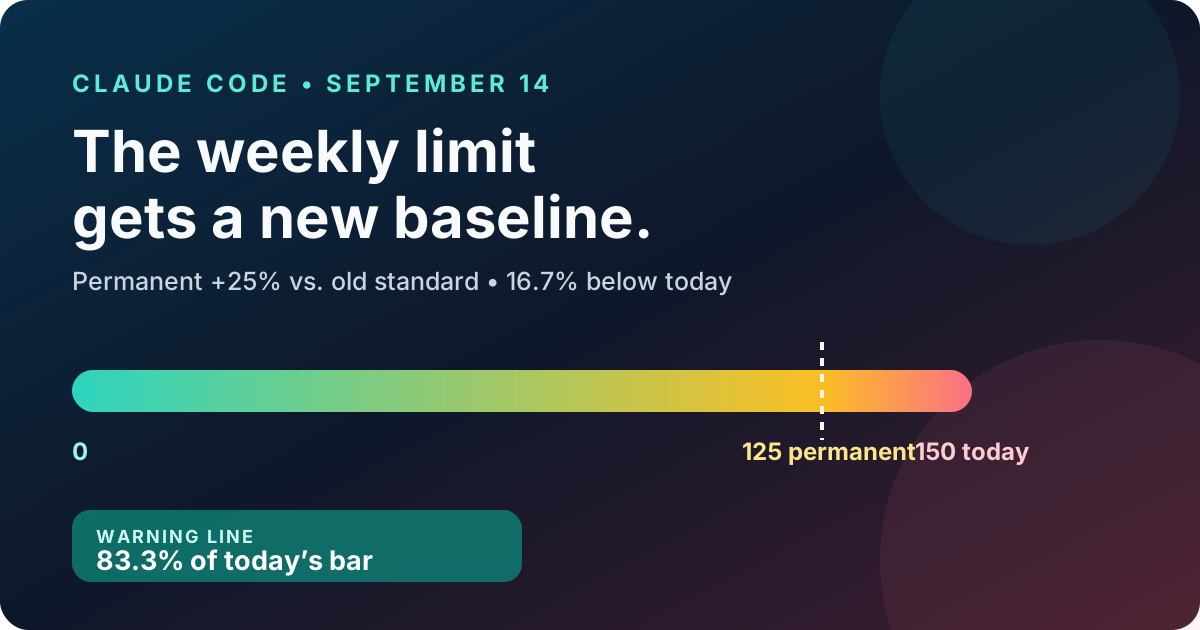
The useful number is 83.3%. The permanent allowance will be 125 units for every 150 units available during the promotion. If a workflow currently consumes more than five-sixths of its weekly bar, it will not fit after September 14 without changing its model mix, concurrency, schedule, or billing route.
This is why the announcement should be treated as a capacity cutover, not a celebratory limit increase and not a conventional price hike. Anthropic is leaving the subscription price alone, preserving more capacity than users had before May, and removing one-sixth of the capacity they have now. It still does not publish the underlying weekly entitlement in tokens, agent-hours, messages, or completed tasks.
Permanence settles the calendar. It does not solve capacity planning. Teams using Claude Code for parallel agents, background jobs, and long-context engineering work now have two weeks to build the missing unit of account themselves.
“Up 25%” compares September 14 with the pre-promotion standard. “Down 17%” compares September 14 with the allowance users have today. The arithmetic is simple:
| Capacity state | Old baseline | Compared with today | Operational meaning |
|---|---|---|---|
| Pre-promotion standard | 100% | 33.3% below today | The reference point Anthropic uses for the permanent increase. |
| Current promotion | 150% | Current state | The allowance teams have been normalizing their workflows around. |
| From September 14 | 125% | 16.7% below today | A permanent improvement over the old standard and a smaller runway than the promotion. |
| Warning line | 125 of 150 units | 83.3% of today’s bar | Current usage above this line needs mitigation or paid overflow. |
Anthropic reportedly described the step-down as roughly 17% in a follow-up. That rounding is fine. Calling it a 25% cut would be wrong because the new 125-unit allowance is not 25% below 150. Calling it only a 25% increase would hide the decision-facing comparison for anyone already using the promotion.
The announcement confirms four things: the September 14 date, the permanent 25% uplift over the old standard, the affected paid plans, and the continuation of the current 50% promotion until the change.
The surrounding documentation narrows the scope. Anthropic’s promotion FAQ says the temporary uplift applies only to Claude Code across the CLI, IDE extensions, desktop, and web. It does not raise five-hour limits, and it does not change Claude chat or Cowork limits. Free users and current consumption-based Enterprise seats are outside the promotion.
That FAQ is also stale. As of August 29 it still says the promotion ends August 31 at 11:59 PM Pacific and that limits then return to standard levels. The newer official post says the 50% uplift remains until September 14 and a permanent 25% uplift follows. The newer announcement should govern the date, but Anthropic has not reconciled the page.
Several important details remain undisclosed:
Those gaps are not reasons to dismiss the announcement. They are reasons to avoid fake precision. Nobody outside Anthropic can honestly convert “25% permanent” into a guaranteed number of pull requests or tokens.
The weekly story sits on top of a separate capacity expansion.
On May 6, Anthropic doubled Claude Code’s five-hour limits for Pro, Max, Team, and seat-based Enterprise plans. It also removed peak-hour reductions for Pro and Max. Anthropic connected those changes to new compute, including a SpaceX agreement it said would provide more than 300 megawatts and more than 220,000 NVIDIA GPUs within a month.
A week later, the company added the temporary 50% weekly promotion. Anthropic extended it several times through the summer. That matters because a promotion lasting four months stops feeling promotional in day-to-day engineering. Teams raise concurrency, keep more agents running, move more work into long sessions, and schedule sprints around the observed ceiling.
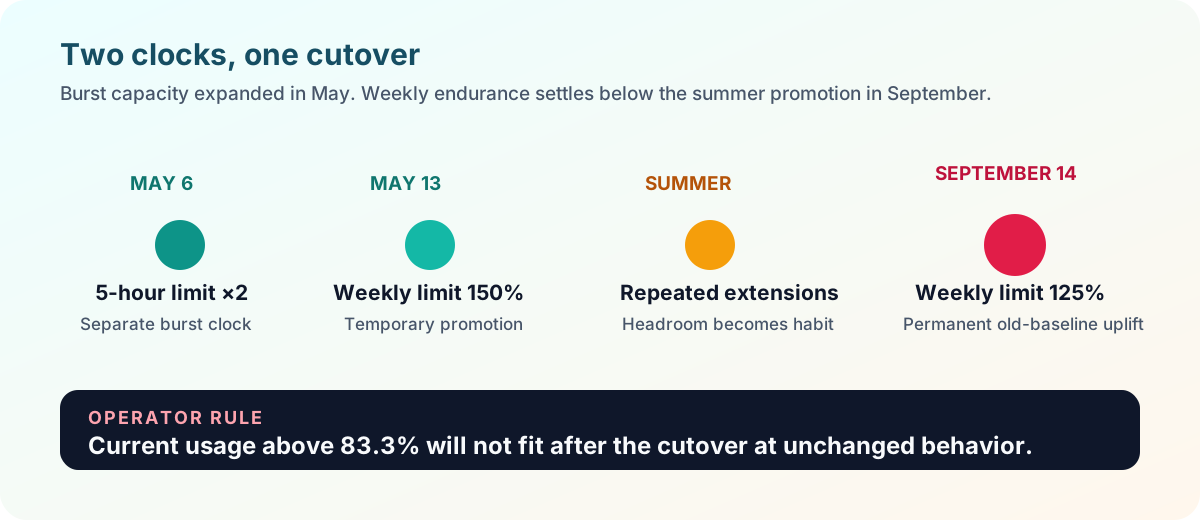
The five-hour burst allowance and the weekly endurance allowance are separate clocks. September changes the second one.
The scheduled step-down is therefore less like removing a coupon and more like resizing a production dependency after users have tuned around it. The old standard may be the contractual baseline in Anthropic’s framing. The promoted standard is the behavioral baseline inside many teams.
That distinction is the first non-obvious lesson: temporary capacity can create permanent workflow demand. Once autonomous work expands into available headroom, a later reduction forces an operating change even if the resulting limit remains better than the historical one.
Claude Code has a five-hour session limit and weekly limits. Anthropic’s usage guidance exposes both bars in Settings → Usage, with weekly reset times for Opus and other models.
The May change made burst work roomier. The September change leaves that five-hour improvement intact while settling weekly endurance below the summer promotion.
That combination matters for agentic coding. A developer can run a productive, high-concurrency session without touching the five-hour wall, then discover on Thursday that the weekly budget is gone. The local experience says “capacity is healthy” while the longer clock is draining faster.
Think of the two limits as different schedulers:
Parallelism widens the gap. Anthropic’s own Claude Code cost guide says every active agent teammate carries a separate context window and token use scales roughly with team size. The guide currently warns that agent teams in plan mode can use about seven times the tokens of a standard session. Long context, retries, verbose test output, loaded instructions, and idle teammates add more drain.
This reinforces RohitAI’s earlier argument that agent swarms need leases, backpressure, stop conditions, and retry budgets. A weekly limit is no longer a chat allowance. It is an admission-control budget for autonomous workers.
The same point applies to Anthropic’s newer self-hosted Claude Code runners. Your infrastructure decides how many jobs can execute. Anthropic’s quota decides how long those jobs can keep asking the model for work. Monitoring only one scheduler gives a false sense of capacity.
Permanence is useful. Teams no longer have to wonder whether the next extension lasts one week or one month. But a percentage applied to an unpublished base is not procurement-grade capacity.
Anthropic says usage varies with model choice, conversation length, request complexity, features, and effort. Its plan pages publish relative multipliers, reset behavior, and usage bars—not a fixed weekly number of tokens or compute units.
This creates a measurement burden for buyers. A Team Premium seat may have a clear sticker price and a relative capacity label, but the weekly output of that seat still depends on workload shape. Team limits are per member, not pooled, so one heavy agent operator can stop while nearby seats retain unused capacity.
The practical unit must come from local outcomes:
This is the second non-obvious lesson: the quota’s opacity turns observability into part of the product contract. Anthropic can show a percentage. Only the customer can map that percentage to useful work.
The most valuable follow-up Anthropic could ship is not another small blanket increase. It is attribution: usage by model, repository, user, agent, background job, and retry chain, with alerts and controllable degradation before the weekly wall.
The September change does not alter list prices. That does not mean the economic result is neutral.
Pro and Max users can enable usage credits after exhausting included capacity. Continued work is then billed at standard API rates. Anthropic provides monthly caps, balance alerts, and auto-reload controls.
For Team and legacy seat-based Enterprise, owners can also enable metered overflow and set organization or user limits. Team credits are prepaid; seat-based Enterprise overage is billed from actual monthly use. Current consumption-based Enterprise already meters usage from the first token and does not have an included weekly allowance to exhaust.
This is the third non-obvious lesson: a capacity reduction can shift cost without changing subscription price. If a team insists on preserving summer throughput, the missing one-sixth moves from flat-fee headroom into separately metered consumption.
RohitAI covered the mechanics of this hybrid model in the earlier Fable 5 usage-credit cutoff. The broader pattern is now hard to miss. A subscription buys a bounded first layer. Credits protect continuity. The customer owns the marginal-cost risk.
Anthropic’s public pricing page currently lists standard API rates ranging from $1 input and $5 output per million tokens for Haiku 4.5 to $10 input and $50 output for Fable 5. Those are marginal references, not a way to infer the value of included plan usage. Anthropic’s cost guide says observed enterprise API deployments average about $13 per active developer-day and $150–$250 per developer-month, but it also warns that model, codebase, parallel instances, and automation can move those numbers sharply.
The correct decision is not “credits are expensive” or “credits solve the limit.” It is whether the task that crosses the line is worth buying at the marginal route.
Everything in this section is interpretation based on the sourced facts above.
First, September 14 is a workload migration date. Teams normally reserve migration language for APIs, databases, and model IDs. Capacity changes deserve the same discipline when an agent is part of the delivery path. The dependency still works after the cutover; it simply supports less of the workload that has accumulated around it.
Second, fixed-price agent plans are becoming admission-control products. The important product behavior is no longer unlimited access to a model. It is how the platform admits bursts, caps weekly endurance, exposes exhaustion, and moves overflow onto another meter.
Third, autonomous concurrency is the hidden scarce resource. Human prompts are a poor proxy for consumption. One short instruction can spawn several contexts, retries, tests, summaries, and background jobs. Quota governance therefore belongs in the orchestrator, not in developer folklore.
Fourth, stable opacity is still opacity. A permanent 125% is easier to schedule than a promotion with weekly extensions. It remains impossible to budget confidently without local measurement because the denominator is private and workload-dependent.
Fifth, the market will compete on graceful degradation. The winning coding plan will not simply advertise the largest multiplier. It will help teams route cheaper work, pause background jobs, preserve state, alert before exhaustion, and buy controlled overflow without losing cost lineage.
Best for cost-sensitive teams. Cap fan-out, shorten context, route routine work to cheaper models, and schedule heavy runs after reset. The tradeoff is less peak throughput.
Enable credits only for named users or critical workflows, with monthly and per-user caps. Continuity improves, but marginal work moves onto API-priced billing.
Preserve checkpoints and route resumable work to an API, cloud provider, or another coding agent when the weekly wall arrives. This adds integration and evaluation work but reduces vendor-quota concentration.
OpenAI’s more explicit enterprise token accounting offers a useful contrast. RohitAI’s analysis of its enterprise rate card showed that transparency does not remove the cost problem; it makes the graph visible. Anthropic offers more included-seat simplicity up front, then asks teams to discover the graph through usage bars and overflow.
Do not estimate the cutover from memory. Capture two representative weeks, including at least one heavy delivery period.
A simple way to normalize the current bar is to multiply observed promoted usage by 1.2. A workflow using 70% today maps to roughly 84% of the smaller permanent allowance. One using 85% maps to 102% and needs a change.
Then test mitigations in the order that preserves the most useful work:
The checkpoint step is easy to underestimate. If quota exhaustion destroys task state, the next session pays again to rediscover files, constraints, failed attempts, and test results. Resumability is both a reliability feature and a quota optimization.
Anthropic says more visibility and control changes are coming, but it has not specified them. Three signals matter more than another marketing multiplier.
The first is attribution. Can a team see which agents, models, repositories, and retries consumed the week?
The second is transition behavior. Does an in-progress weekly cycle rebase cleanly on September 14, and are model-specific bars affected equally?
The third is metering trust. Users sometimes attribute faster depletion to policy when model mix, context growth, tokenizer behavior, or a metering bug may be responsible. A credible incident record needs vendor notices and local attribution, not screenshots alone.
My high-confidence prediction is that weekly limits will bind more often than five-hour limits for sustained agent-heavy users. May expanded the burst clock; September reduces the endurance available relative to summer.
My medium-confidence prediction is that Anthropic ships better warnings, attribution, or controls before the end of 2026. The company has hinted at visibility improvements, and the hybrid subscription-plus-credit model works better when customers can see the handoff coming.
My high-confidence commercial prediction is that Anthropic keeps the hybrid model. Weekly caps bound heavy-tail usage; metered overflow protects continuity and revenue. Effectively unlimited background agents would put the most unpredictable demand back on the vendor.
Both comparisons are valid. The September 14 allowance is 25% above the standard that existed before the summer promotion and 16.7% below the temporary allowance available today.
Anthropic named Pro, Max, Team, and seat-based Enterprise plans. The promotion FAQ excludes Free users and current consumption-based Enterprise seats.
No. The announcement concerns weekly limits. Anthropic separately doubled five-hour Claude Code limits in May, and the promotion FAQ says the weekly uplift does not affect that clock.
Anthropic has not published an absolute entitlement. Consumption varies with the model, context, effort, tools, request complexity, and workflow. Use the account’s usage bars and local outcome telemetry.
Anthropic has not said. It also has not disclosed the exact cutover time or how a weekly cycle spanning the date will be recalculated.
Reduce waste and fan-out, route work by difficulty, make runs resumable, and decide whether critical overflow should use capped credits or a fallback route. At unchanged behavior, usage above 83.3% of today’s promoted bar will not fit inside the permanent allowance.
Anthropic found a compromise that is better than snapping Claude Code back to the pre-May standard and worse than making the full summer promotion permanent.
For casual users, the distinction may never matter. For teams that have turned Claude Code into an execution layer, it matters now. The promotion gave them more room to build agent-heavy habits. September 14 takes one-sixth of that room back while leaving the underlying unit unpublished.
The response should be operational, not theatrical. Measure the current bar. Mark 83.3%. Protect high-value work. Cap autonomous fan-out. Decide who can cross into metered spend. Preserve enough task state to change routes without starting over.
The permanent limit is not the end of Claude Code’s capacity story. It is the point where quota management becomes part of running the agent.