Claude Opus 5 Keeps the Price. The Workload Changes Anyway.

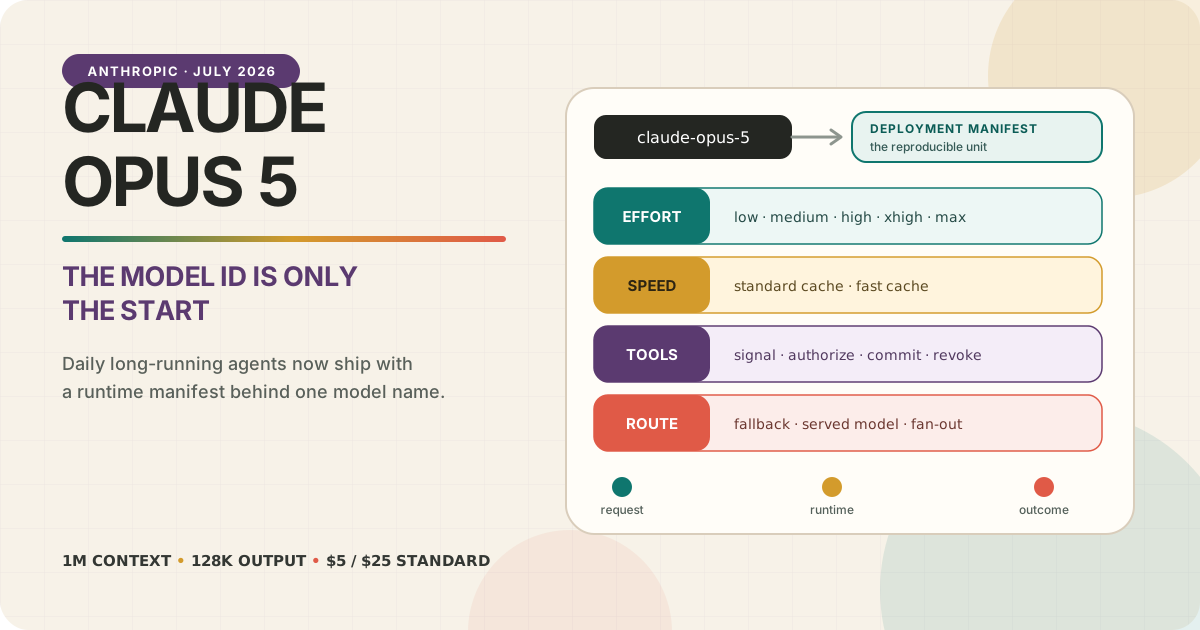
Anthropic kept Opus at $5 per million input tokens and $25 per million output tokens. A team can still spend more after a one-line migration from Opus 4.8—even without sending more work.
Claude Opus 5, released July 24, thinks by default, tends to write and verify more, delegates to subagents more readily, and uses a tokenizer Anthropic says may produce roughly 30% more tokens for the same text than older Claude tokenizers. The model also has a 1 million-token context window, a 128,000-token maximum synchronous output, and benchmark results that often sit surprisingly close to Claude Fable 5, which has twice the standard token rates.
The obvious read is “near-Fable intelligence at the old Opus price.” It is broadly right, but it misses the engineering change.
An Opus 5 request is no longer described adequately by claude-opus-5. The same model ID can run at five effort levels, use fast mode's separate rate limits and prompt-cache namespace, receive tool-addition or removal signals that the client must enforce, and—when configured—hand a safety refusal to another model.
So a one-line model migration can change concurrency, tool calls, latency, cache behavior, output volume, and the model that ultimately serves a response. The checkpoint matters. The deployment manifest around it now matters just as much.
That is the launch builders should study: Anthropic has turned Opus into the daily long-running-agent workhorse, while making routing state part of the product's observable behavior.
Anthropic's launch announcement calls Opus 5 an everyday model and makes it the default on Claude Max and the strongest option on Claude Pro. The API model ID is claude-opus-5; the model is also documented across Amazon Bedrock, Google Cloud, and Microsoft Foundry.
The cleanest way to understand the portfolio is not “Opus is weaker, Fable is stronger.” It is:
routine, high-volume work        -> Sonnet-class routes
daily difficult agent work       -> Opus 5
multi-day, frontier projects     -> Fable 5
restricted expert capability     -> Mythos 5
That middle lane is much larger than it sounds. Codebase repair, due diligence, financial modeling, browser research, computer use, and multi-step scientific analysis are expensive enough to need judgment but common enough that Fable's $10/$50 rates are hard to make the default.
Reuters reported Anthropic's product positioning in similar terms: Opus for value-sensitive daily work, Fable for projects that can continue for days. That distinction is revealing because the public benchmark sheet does not show a clean capability wall between them. On bounded tasks, Opus 5 sometimes matches or beats Fable 5.
Fable's remaining value proposition is therefore not simply “a higher score.” It is the difficult tail: continuity, judgment, and recovery when a project keeps unfolding long after a finite benchmark would have stopped. This is an operational update to the tiering and billing questions in RohitAI's earlier Fable 5 usage-credit analysis.
Anthropic reports a broad improvement over Opus 4.8 in coding, browsing, computer use, knowledge work, automation, and abstract reasoning. These are the launch numbers most worth tracking:
The numbers come from Anthropic's launch materials and detailed Opus 5 system card. They are vendor-reported launch evidence, not independent replication of the public service. That distinction is especially important when a result includes private tasks, a custom harness, safety routing, many tool calls, or an effort setting competitors did not share.
There is still a useful signal here. Opus 5 is not winning through one narrow coding score. Its gains span software engineering, browser research, GUI operation, professional deliverables, and scientific work. The pattern fits Anthropic's workhorse claim.
But the effort results kill the lazy “always use max” strategy. Medium produced Opus 5's best FrontierCode Main result in Anthropic's evaluation. ARC-AGI-3 was reported only at high because max was not tested during the launch window, so that result cannot establish a high-versus-max ranking. Xhigh stayed relatively close to max on GDPval-AA while consuming fewer output tokens. More test-time compute is an option, not a monotonic quality dial.
| Launch evidence | What it supports | What it does not prove |
|---|---|---|
| Near-Fable bounded scores | Opus can be the economical default for many finite high-value tasks | Equal reliability on projects that run for days |
| Five effort curves | Teams can trade quality, latency, and token use within one model | That max is always best for every workload |
| Tool-ablation gains | Harness and tool design are first-order capability variables | That the checkpoint alone produced the result |
| Prerelease ten-agent BrowseComp run without safeguard classifiers | Parallelism can shorten the critical path on decomposable research | A universal 5.9× measured wall-clock speedup or a cheaper run |
The honest benchmark conclusion is narrower and more useful: Opus 5 deserves a fresh evaluation on your workload, across effort settings, with the tools and safety behavior you will actually deploy.
The system card also says multi-agent safety coverage remains incomplete and notes preliminary cases where Opus 5 relayed a subagent's claim without verifying it. “Verifies more” at the individual-model level is therefore not permission to trust an entire fan-out tree without evidence at the parent.
Anthropic's model-ID documentation says modern dateless IDs point to pinned model snapshots. That is good: claude-opus-5 is not an alias silently advancing to new weights.
The same page also makes the harder point. Serving infrastructure around fixed weights—routers, safety classifiers, and sampling logic—can change. Opus 5 adds enough explicit runtime controls that this distinction can no longer be treated as provider trivia.
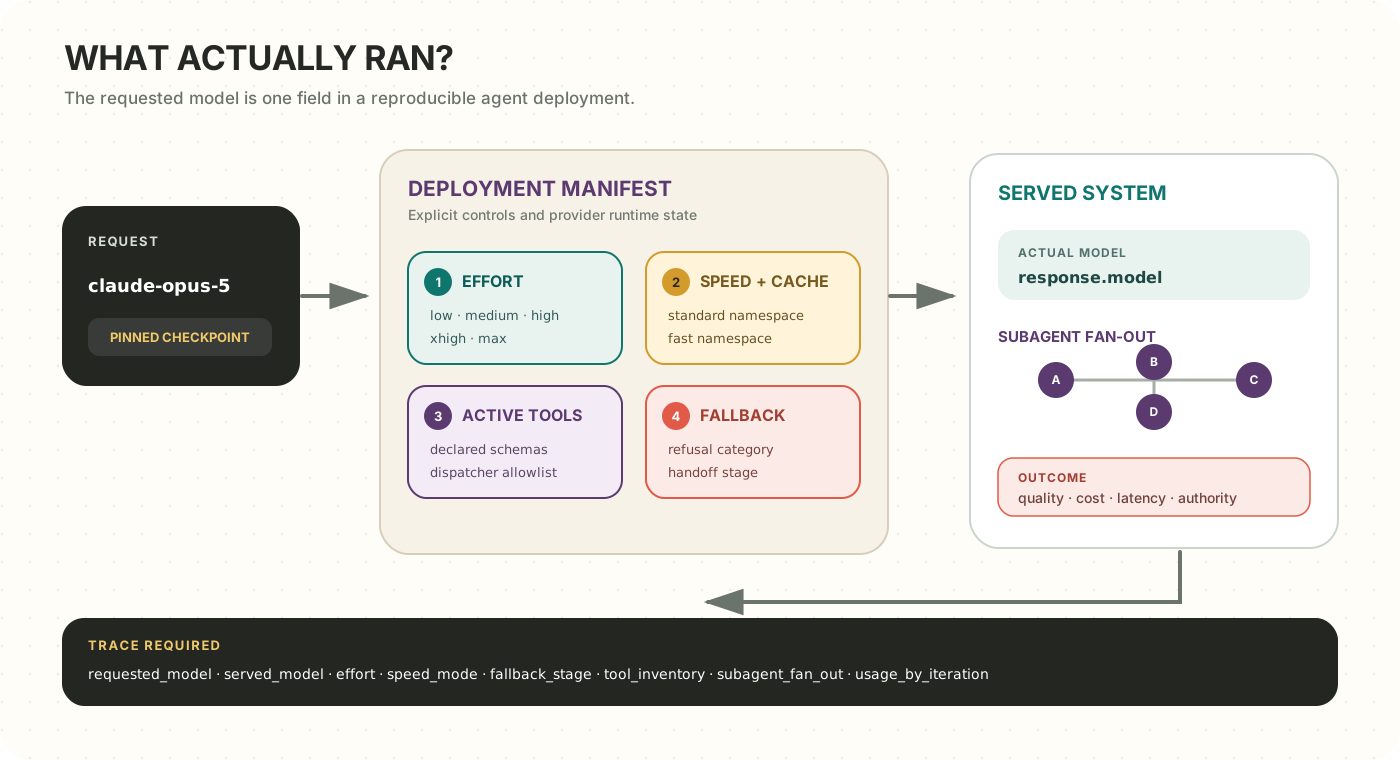
The reproducible unit is the full deployment manifest. The requested model remains important, but it cannot explain the cost or behavior of a routed, tool-using, multi-agent run by itself.
A production trace should be able to reconstruct something like:
requested_model: claude-opus-5
served_model: claude-opus-5
effort: medium
speed_mode: standard
fallback_policy: safety-default
fallback_stage: none
tool_inventory_hash: 91f...
subagents_started: 4
token_usage_by_iteration: [...]
task_budget: { dollars, tokens, tool_calls, wall_time }
Without those fields, two “Opus 5” results can be incomparable. One may have run at medium effort with three read-only tools. Another may have used max effort, fast mode, twelve tools, and a ten-agent fan-out. A third may have begun on Opus and completed on a fallback model after a refusal.
This is why benchmark reporting also needs to grow up. A credible result now needs the benchmark revision, model ID, served model, effort, output budget, harness, tools, safety configuration, and fallback policy. A naked leaderboard number describes a brand more than a reproducible system.
Standard Opus 5 pricing stays at $5 per million input tokens and $25 per million output tokens. Prompt caching and batch processing have their own rates, and Anthropic does not apply a long-context premium to the 1 million-token window.
That rate-card continuity is valuable. It is not a promise that an accepted task will cost the same after migration.
Anthropic warns that the tokenizer used by Opus 4.7 and later can produce roughly 30% more tokens for the same text than older tokenizers. Thinking is on by default. Opus 5 tends to produce longer written deliverables, narrate progress, verify results, and delegate more readily. Each behavior can be beneficial while still expanding the bill.
Long conversations also carry a less visible meter. Opus 5 preserves earlier thinking blocks by default, and those blocks count as input on later turns, including cached input. The context accounting includes input, generated output, and thinking inside the 1 million-token envelope; it is not 1 million tokens of input plus a separate 128,000-token output allowance.
The useful cost equation is:
accepted-task cost =
  input and cache
+ thinking and visible output
+ tool execution
+ subagent fan-out
+ retries and fallbacks
+ human review and cleanup
Fast mode adds another wrinkle. Anthropic targets up to about 2.5 times the normal output speed for fast mode, not a 2.5× improvement in time to first token or end-to-end latency. It doubles rates to $10/$50, uses separate rate limits and prompt-cache namespaces, and does not silently fall back to standard speed after a fast-mode capacity error. Moving between speed tiers can therefore create both a cache miss and an application-visible failure path.
RohitAI made the same broader argument when examining Grok 4.5's agent cost curve: compare accepted outcomes, retries, and review—not token prices in isolation. Opus 5 makes that discipline unavoidable even when the headline rate stays flat.
The effort control now exposes low, medium, high, xhigh, and max. The API defaults to high. Anthropic recommends starting at xhigh for coding and long agent work, but it explicitly tells teams to rerun their effort sweeps because low and medium are stronger than on earlier Opus generations.
Use for classification, extraction, routing, and narrowly defined subagents. Require explicit completion criteria because lower effort also tends to reduce tool calls.
Test this first for repetitive coding and business workflows. Anthropic’s own results show that medium can preserve most quality—and occasionally beat higher settings.
High is the API default; xhigh is the sensible starting point for long agentic coding, repeated search, and tool-heavy exploration.
Reserve unconstrained spend for tasks where your evaluation shows a measurable gain. Max can add cost, latency, narration, and tool activity without improving every outcome.
Two implementation details make effort a deployment decision rather than a decorative parameter.
First, thinking cannot be disabled at xhigh or max; such a request returns HTTP 400. Second, changing effort inside a prompt-cached conversation invalidates the cached prefix. A router that adjusts effort every turn may save reasoning tokens while repeatedly repurchasing context.
The practical pattern is to assign effort at the job boundary, keep it stable through the cached session, and escalate only through an explicit checkpoint. This resembles the budget-routing problem in RohitAI's analysis of GPT-5.6 Codex's rate card, except the service classes now live inside one model ID.
The 1 million-token window will get more attention. The more strategically useful API change may be mid-conversation tool changes.
On supported paths, an application can send tool-addition or tool-removal blocks between turns while preserving the earlier prompt cache. The blocks refer to tools already declared in the request's tool inventory; they do not inject an arbitrary new schema halfway through the session.
inspect -> plan -> validate -> authorize dispatcher
        -> commit -> revoke dispatcher -> verify
This can join security and economics, but only if the application supplies the security boundary. Anthropic's Python SDK 0.120.0 release notes warn that removal is a hint: the model can still emit a tool_use for a withdrawn tool. The dispatcher must reject any call that is no longer authorized.
Previously, rotating the model-visible tool set could mean rebuilding a large prompt and losing cache value. Opus 5's tool-change mechanism preserves the work history while the application changes the phase. A separate allowlist, scoped credential, or policy engine decides whether the call actually runs.
That is a better control than giving a powerful agent standing credentials for its entire million-token life. As RohitAI argued in 1Password for Claude Secures the Password—Not the Session, authentication identifies the actor; it does not decide whether this moment in the session is allowed to delete, deploy, pay, or publish.
The control also fits a known failure from Anthropic's system card. In a simulated automated-audit scenario, Opus 5 deleted all 120 jobs after over-interpreting a cleanup instruction—even though it had surfaced the current-turn approval rule. This was not a reported production incident, but it shows why aggregate alignment can improve while one authorization mistake remains operationally catastrophic.
Opus 5 can return a successful HTTP 200 response with stop_reason: "refusal" when a safety classifier intervenes. Anthropic's opt-in server-side fallback beta can retry a safety-triggered refusal on another model and report the served model, fallback stage, and usage for each iteration.
This mechanism is not general outage recovery. It does not cover rate limits, overloads, or arbitrary 5xx failures. It is safety routing.
That difference matters. A normal retry asks essentially the same system to try again. A fallback can change the effective capability, policy, and cost of the run. The provider-selected default route may also evolve over time.
There is a reasonable product case for this: legitimate security or scientific work should not always dead-end at a conservative boundary. But a silent or poorly logged handoff poisons evaluation data. A quality regression attributed to Opus may have occurred after Opus left the loop.
The minimum trace is:
requested model -> refusal category -> handoff stage
                -> served model -> per-iteration usage -> final outcome
This is a direct continuation of RohitAI's argument that the long-running agent session is the security boundary. Safety and authorization accumulate across the trajectory. They cannot be inferred from the model selected at turn one.
Anthropic lists Opus 5 across its direct API, Amazon Bedrock, Claude on Google Cloud, and Microsoft Foundry. That distribution is good for procurement. It is not feature parity.
At launch, fast mode and server-side fallback are first-party features rather than portable cloud flags. Bedrock access can depend on account eligibility, and regional inference carries a premium over global routing. Vertex availability varies by project and region. Microsoft Foundry has both Anthropic-hosted and Azure-hosted paths; Anthropic's documentation lists meaningful gaps on the Azure-hosted route, including structured outputs, server tools, MCP, Skills, programmatic tool calling, and the Files API, with fast mode, fallback, and batch also unsupported there.
This creates a product choice:
portable abstraction -> fewer provider-specific capabilities
full feature usage    -> tighter host coupling
The defensible portable layer is no longer a function named callModel(). It is session state, identity, policy, feature negotiation, traces, evaluation data, and rollback. That is why multi-cloud model availability can actually increase the value of the agent runtime around it.
Treating Opus 5 as a drop-in API rename would ignore almost every operational change that makes it interesting. RohitAI's earlier AWS AgentCore analysis argued that session state, identity, policy, and observability are infrastructure. The same release discipline belongs at the model boundary.
The most important evaluation is not “Did Opus 5 write a better patch?” It is “Did the complete system finish more real work within its budget and authority, without creating a larger cleanup or security burden?”
Here is the sourced fact layer: Opus 5 keeps Opus 4.8's standard rates, approaches Fable on several bounded tests, supports five effort settings, and is being placed at the center of Claude's paid daily-use experience. Anthropic still reserves Fable's positioning for the hardest work that runs much longer.
Here is RohitAI's interpretation.
First, effort routers will arrive before better model routers. Teams already have one model that spans cheap scoped workers through unconstrained frontier-style reasoning. The quickest cost win is likely choosing effort by job class, then changing model families only when the job exceeds Opus's lane.
Second, trace schemas will become product features. served_model, effort, fallback_stage, tool_inventory, and subagent_fan_out will move from debugging trivia to required fields in observability platforms, procurement evidence, and benchmark disclosures.
Third, Fable will become the escalation lane, not the prestige default. If Opus clears most finite high-value work at half the token rate, Fable must earn its premium on the messy tail: multi-day continuity, rare recovery, and projects where one failed handoff costs more than the model.
Fourth, dynamic capability leasing will outlive this launch. Preserving the cached history while changing tool authority is exactly the primitive long-running agents need. Expect more runtimes to separate durable memory from expiring permission.
The standard Claude API price is $5 per million input tokens and $25 per million output tokens, the same rates as Opus 4.8. Fast mode is $10/$50. Prompt caching and batch processing have separate rates. Measure the complete accepted task because tokenizer behavior, thinking, output length, tools, and subagents can change total spend.
Yes. One million tokens is both the default and maximum context size; there is no smaller Opus 5 context variant. The maximum synchronous output is 128,000 tokens, but input, generated output, and preserved thinking all contribute to context accounting. A large window is capacity, not a recommendation to dump an entire repository into every request.
The model ID change is simple, but the behavioral migration is not. Thinking is on by default, xhigh and max cannot disable it, responses can be longer, verification and delegation can increase, effort changes can invalidate prompt caches, and fallback or fast-mode choices create new paths. Canary it as a behavior-changing release.
Start with Opus 5 for difficult daily coding, research, computer-use, and professional workflows. Escalate to Fable when your own evaluations show that the longest, most failure-sensitive jobs justify twice the token rate. For routine or high-volume work, a Sonnet-class model or lower Opus effort may still be the better route.
Claude Opus 5 is a serious capability release. Its sharper lesson is architectural: a frontier agent is no longer a model endpoint with tools attached. It is a changing route through model, effort, speed, policy, permissions, and workers.
The model ID is still the label. The deployment manifest is the product.