xAI Open-Sources Grok Build: Audit the Path, Not the Badge

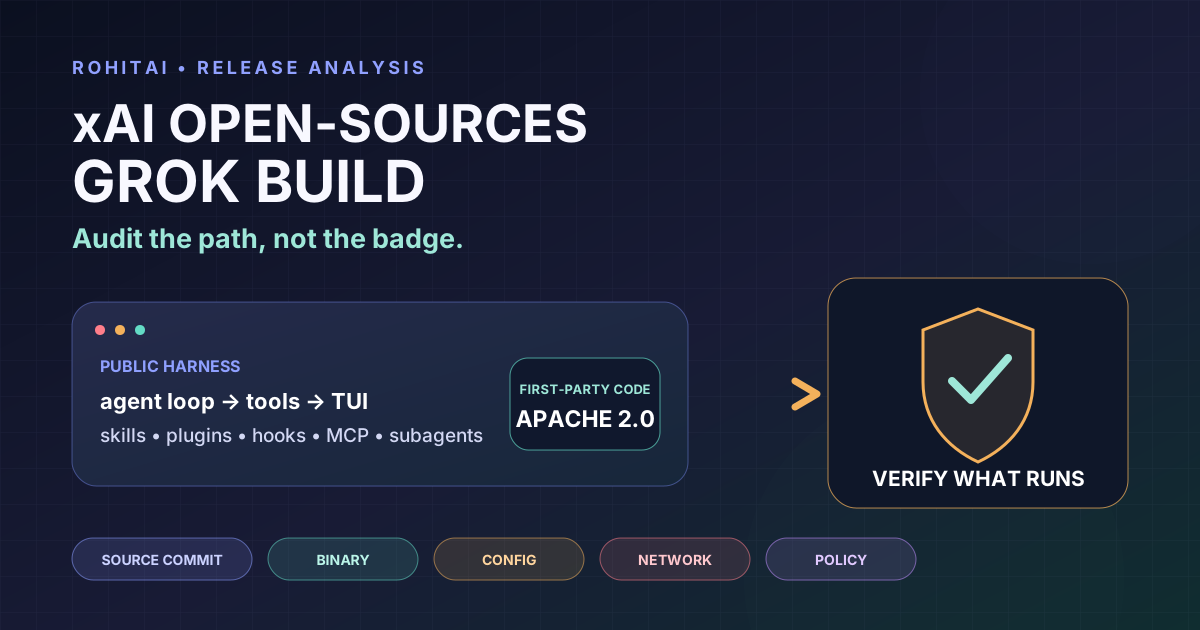
On July 15, xAI published the client code that decides how Grok Build sees a repository, calls a model, runs tools, edits files, and keeps an agent moving. That is a meaningful release. It is also an easy one to misunderstand.
The Grok Build repository is not a dump of Grok model weights. It is the Rust harness around the model: the agent loop, context assembly, response parsing, tool dispatch, terminal UI, workspace layer, skills, plugins, hooks, MCP servers, and subagents. xAI licenses its first-party code under Apache 2.0 and documents how to compile it or point it at local inference.
That improves trust because an important client-side control plane is now inspectable, modifiable, and forkable. A security team no longer has to infer every decision from a minified binary or network capture. A builder can trace a file read to a tool implementation, study how configuration wins, remove an unwanted path, and produce an internal build.
But an open repository is not a privacy certificate.
The official installer still downloads a separately distributed binary. The public tree is a periodic snapshot of an internal monorepo. Runtime settings can select a hosted model, a local server, telemetry, trace upload, remote model catalogs, web tools, MCP servers, HTTP hooks, and automatic updates. Service-side retention and policy remain outside the client repository. Even two binaries built from identical source can move different data when their configuration and network environment differ.
So the useful question is no longer, “Is Grok Build open source?” It is:
Which source commit produced the binary I am running,
which effective configuration controls it,
which endpoints can it reach,
and which policy governs the service on the other end?
This is the follow-up to RohitAI’s earlier wire-evidence report on Grok Build CLI repository uploads. The source release improves forward-looking auditability. It does not retroactively prove what an earlier binary did, or turn source visibility into automatic proof of privacy.
xAI’s July 15 announcement is short but specific. It says the published code covers context assembly, model-response parsing, tool-call dispatch, code reading and editing, command execution, the full-screen terminal interface, plan review, inline diffs, skills, plugins, hooks, MCP servers, and subagents. It also says developers can compile the harness, point it at local inference, and drive it from config.toml.
The repository README fills in the operating surfaces. Grok Build can run interactively in its TUI, headlessly for scripts and CI, or inside editors through the Agent Client Protocol. Its public crate map separates the composition root, TUI, agent runtime, tools, filesystem and VCS workspace, configuration, MCP, markdown, and sandbox layers.
That scope matters because the model is only one component of a coding agent. The harness decides:
These choices can make the same model look careful or reckless. A perfect patch in the model response is useless if the edit layer corrupts it. A good plan becomes dangerous if permission defaults encourage unreviewed execution. A local model does not create a local product if the harness still calls remote services around it.
The boundary is equally important. xAI did not publish Grok 4.5 weights, a self-hostable Grok inference stack, the private monorepo history, or the server code behind hosted inference, account settings, retention, and remote configuration. “Run local inference” means the harness can talk to a model server you control. It does not mean xAI’s current model became open-weight.
The README says the repository is periodically synced from the SpaceXAI monorepo. The root SOURCE_REV records the full internal commit represented by the public tree. On July 17, the public history showed two commits: the initial “Publish harness and TUI open-source” commit and a later “Synced from monorepo” update.
That design gives auditors real checkpoints. They can pin a public commit, inspect its dependency lockfile, compare later snapshots, and refer a finding to the internal revision recorded by SOURCE_REV. It is much better than a floating source archive with no origin marker.
It is not continuous visibility.
Changes can exist in the internal monorepo before the next sync. A shipped binary can come from a later internal revision than the public tree. A remote setting can change effective behavior without changing either source tree. The smaller the public history, the less evidence users have about normal sync delay, emergency disclosure cadence, and whether every production release will receive a corresponding snapshot.
This creates a new trust metric for xAI: snapshot lag.
For a normal UI fix, a short delay is unremarkable. For a security or privacy fix, the interval between internal change, binary release, public snapshot, and advisory becomes part of the product’s auditability. If xAI wants the repository to be the “definitive reference,” as its announcement says, users need to know how close that reference is to the thing they can install today.
The governance model is also deliberately one-way. CONTRIBUTING.md says external pull requests and unsolicited patches are not accepted. The code is open source under a recognized permissive license, but upstream development remains internal. Builders can fork; they cannot assume xAI will review or merge their fix.
That distinction produces six different kinds of evidence:
| Evidence layer | What the release gives you | What it still cannot prove |
|---|---|---|
| Source | Readable client logic, license rights, dependency graph, and diffable snapshots. | That an installed binary contains exactly this code. |
| Build recipe | Pinned Rust toolchain, Cargo lockfile, DotSlash-managed protoc, and documented commands. | Bit-for-bit reproducibility or parity with xAI’s release pipeline. |
| Artifact provenance | A source revision pointer and separately versioned official binary channel. | A cryptographic source-to-binary match without published attestations or reproducible hashes. |
| Runtime config | Documented model, telemetry, update, extension, and policy controls. | Which merged value actually won on another user’s machine. |
| Network observation | Code paths and endpoint configuration that guide a focused test. | That an enabled path sent nothing without measuring the process and its children. |
| Service policy | Client gates and account-state handling that can be reviewed. | Server retention, backups, deletion, human access, or policy enforcement. |
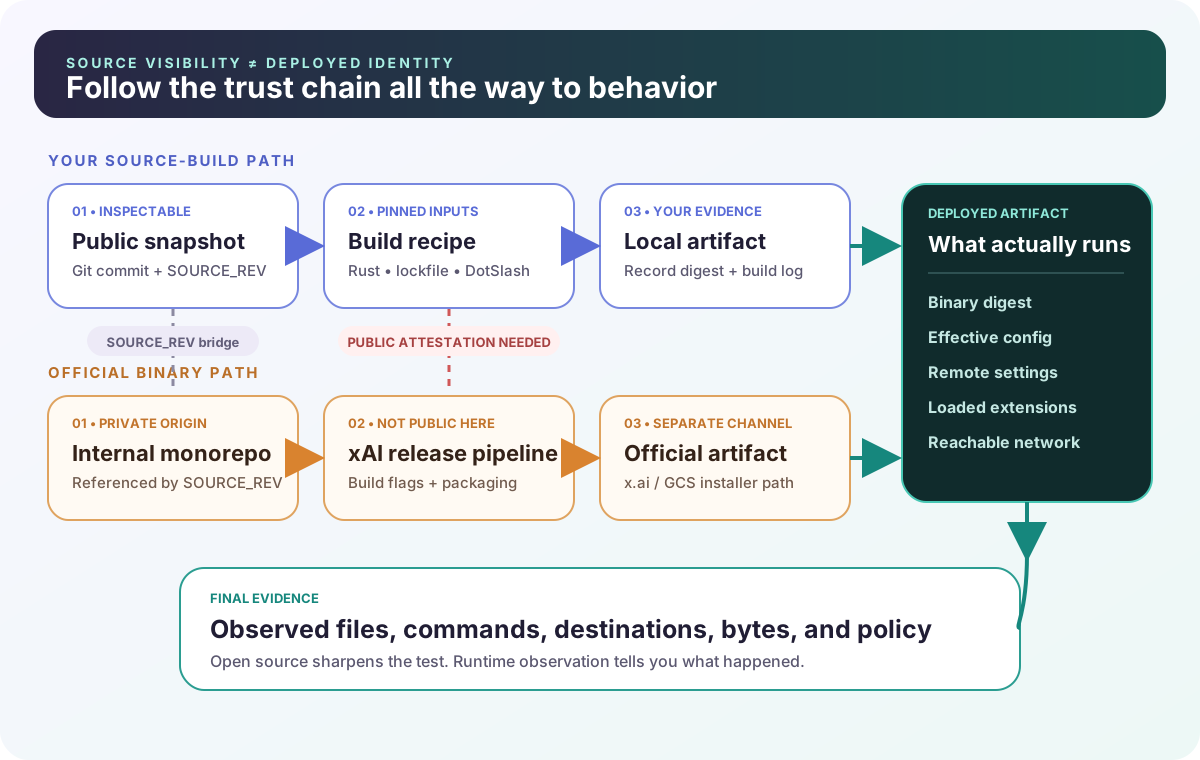
The public repository makes the left side inspectable. Provenance, configuration, and observed behavior determine whether that inspection applies to what actually ran.
The source-build instructions are concrete. The repository pins Rust 1.92.0, commits Cargo.lock, and uses DotSlash to obtain a hashed protobuf compiler. The documented release build is:
cargo install dotslash
/usr/bin/env dotslash --help
cargo build -p xai-grok-pager-bin --release
That produces target/release/xai-grok-pager; xAI’s official install names the executable grok. The README lists macOS and Linux as supported build hosts. Windows source builds are described as best-effort and not currently tested from this public tree, even though xAI separately distributes prebuilt Windows binaries.
Those details make the project buildable and improve dependency control. They do not, by themselves, make the official artifact reproducible from the public commit.
At the July 17 check, the repository’s GitHub Releases page had no published releases. The official install.sh selects a version, downloads a platform binary from x.ai, falls back to a Google Cloud Storage artifact host, smoke-tests the download with --version on macOS and Linux, and installs it. The public installer does not expose a checksum manifest or source-to-binary attestation in that flow. That observation is not a claim that the binaries lack platform code signing; it is a narrower point: the published source materials do not yet let an independent reader cryptographically connect a given official artifact to a public Git commit.
A mature release chain would make four identities easy to join:
public Git commit
    ↕
SOURCE_REV monorepo commit
    ↕
release-pipeline provenance + dependency inputs
    ↕
signed artifact digest for each OS and architecture
Until then, teams have three distinct things they might call “Grok Build”:
The strongest practical feature in the release is provider routing. The custom models guide documents OpenAI Chat Completions, OpenAI Responses, and Anthropic Messages APIs. It includes examples for Anthropic, OpenAI, Together, Ollama, and any local OpenAI-compatible server.
A minimal local-model entry can look like this:
[cli]
auto_update = false

[models]
default = "local-coder"

[model.local-coder]
model = "your-local-model"
base_url = "http://127.0.0.1:11434/v1"
api_backend = "chat_completions"
api_key = "local-placeholder"
context_window = 131072

[features]
telemetry = false
feedback = false
remote_fetch = false

[telemetry]
trace_upload = false
mixpanel_enabled = false
Treat that as an auditable starting point, not a magic “offline mode.” The explicit per-model key is intentional. Grok Build’s documented credential order is per-model api_key, then a named environment key, then an active signed-in session token, then the global XAI_API_KEY. Setting a harmless local credential—and logging out of unused hosted accounts—avoids accidentally relying on a provider token when talking to a local-compatible endpoint.
The context window must also match the model you actually run. Grok Build uses that value to decide when to compact. A local server speaking the right JSON protocol may still be a poor agent backend if it cannot follow the tool schema, sustain long loops, or recover after compaction. Wire compatibility is not task compatibility.
Most importantly, this configuration changes the inference destination. It does not replace the local model with Grok weights. Users supply their own model and server. The open-source asset is the harness.
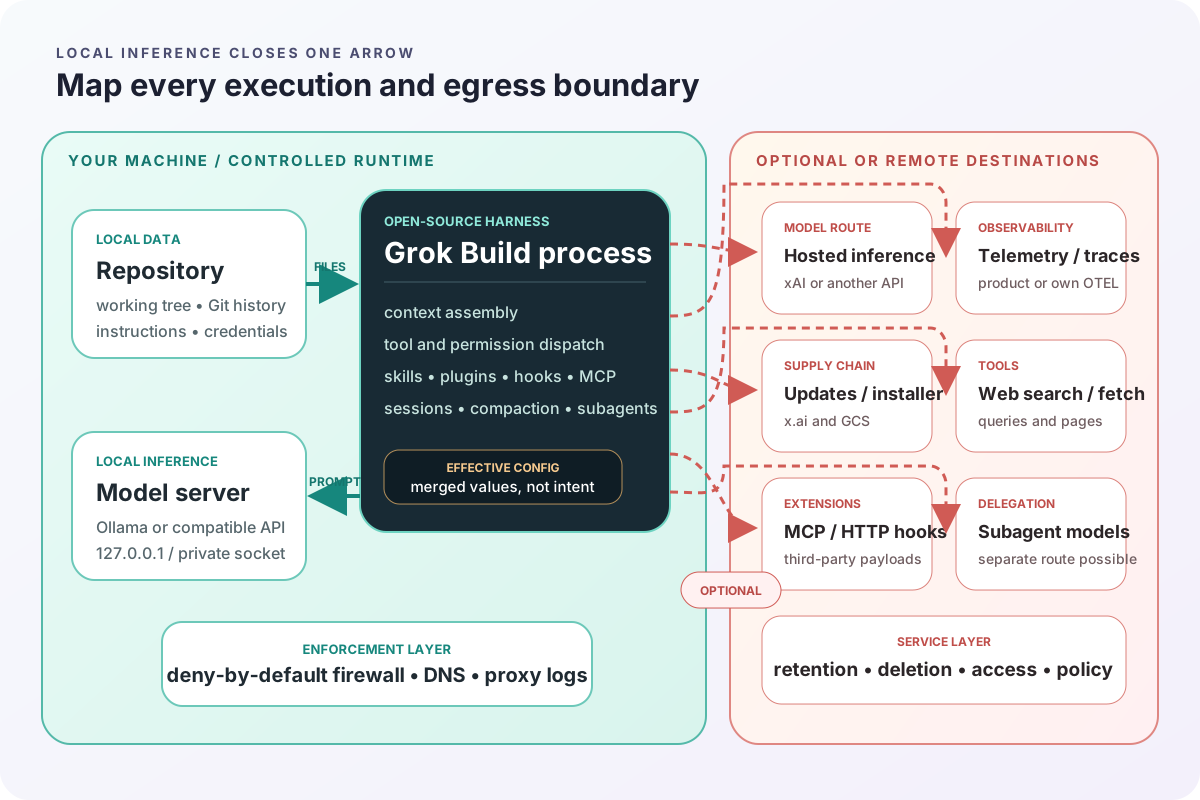
A localhost model closes the main inference hop only. Every optional arrow needs its own configuration, destination policy, and observation test.
The public configuration guide makes several paths visible. Current documented defaults include auto_update = true, optional remote model-catalog fetches enabled, and anonymous product telemetry disabled. Trace upload has its own setting and inherits the telemetry choice when unset. External OpenTelemetry is a separate double opt-in for a customer-controlled collector.
That is better than hiding everything behind one “privacy” switch. It also means “local” has to be defined path by path.
| Path | What may travel | Relevant control | How to prove the boundary |
|---|---|---|---|
| Inference | Prompts, selected code context, tool results, and model metadata. | [model.*] base_url, backend, credentials, default model. | Allow only the local socket or approved provider and capture destination plus byte volume. |
| Model catalog | Catalog requests, authentication, and endpoint metadata. | [features] remote_fetch = false and pinned local models. | Cold-start with DNS and external HTTP denied; confirm the chosen model remains usable. |
| Telemetry and traces | Usage events and, when enabled, session or trace artifacts. | [features] telemetry, [telemetry] trace_upload, Mixpanel, and external OTEL gates. | Inspect merged settings, then test startup, a turn, feedback, and shutdown separately. |
| Updates and installers | Version pointers, binaries, deployment configuration, and update requests. | [cli] auto_update = false, pinned artifact, internal mirror. | Record artifact digests and block xAI/GCS after controlled installation when required. |
| Web, MCP, hooks, plugins | Queries, tool parameters, hook payloads, extension downloads, and third-party responses. | Tool permissions, domain allowlists, local-only MCP, reviewed hooks and plugin sources. | Inventory with grok inspect --json and enforce a process-level egress allowlist. |
| Subagents | Delegated prompts, inherited context, tool results, and traffic to the child’s selected model. | [subagents.models], permission policy, workspace isolation. | Run a delegated canary task and verify the child inherits the intended model and network boundary. |
The sandbox deserves special attention. Grok Build’s sandbox guide says sandboxing is off by default. On Linux, restrictive profiles can block network access for child processes such as curl; on macOS, that child-network restriction is a no-op. In both cases, the guide says in-process web search, web fetch, and model HTTP clients are not blocked by that sandbox control.
So the sandbox is useful for filesystem and command boundaries, but it is not a universal egress firewall. A credible offline deployment needs an external network policy around the process, not only a config.toml and a sandbox badge.
RohitAI’s earlier article covered independent wire testing that reported a separate repository-storage path in Grok Build CLI 0.2.93. We carefully bounded that finding: the report supported unexpected transmission in the tested setup, but did not prove training, attacker access, universal scope, or indefinite retention.
The open-source release changes the investigation surface in three useful ways.
First, auditors can now inspect present client code for storage, trace, privacy, and configuration decisions instead of treating the executable as a black box. The public guide exposes a /privacy command, telemetry controls, trace-upload controls, and external monitoring configuration. The source contains explicit account-state and trace-gating logic that can be tested.
Second, teams can remove or hard-disable a path in their own fork. That moves privacy from a vendor preference to a locally enforceable build decision—provided the team actually deploys its build and constrains updates.
Third, researchers can design narrower tests. Instead of spraying canaries and guessing, they can identify the code that builds an artifact, the config layers that enable it, and the destination types it can use. Source review makes network testing more precise.
But the release does not settle the historical report. The public snapshot cannot establish that it matches version 0.2.93, reconstruct every server-side flag active at the time, or verify deletion from a remote service. It cannot prove that an installed official binary was compiled from the current public tree. And it cannot turn xAI’s service policy into cryptographic evidence.
The clean conclusion is:
xAI’s enterprise deployment documentation says ZDR is enforced at the team level and that no prompts, code, or responses are persisted at the inference layer for ZDR organizations. That is the relevant service claim for those customers. Source review can show how the client receives and acts on account state. Contract, architecture, logs, and provider evidence are what establish the server-side promise.
Study context assembly, tool semantics, permissions, compaction, worktrees, extensions, and subagents. Borrow ideas without making the snapshot a production dependency.
Compile the public tree, route inference to a test endpoint, use synthetic repositories, record egress, and score completed patches rather than terminal polish.
Remove unwanted networking, pin extension sources, change defaults, and publish internal artifacts. Budget for upstream diffs, CVEs, testing, and release engineering.
Require artifact provenance, an approved config baseline, endpoint allowlists, ZDR or retention terms, and a process for detecting remote-policy or update changes.
None is universally correct. A public open-source project may be fine with the official binary and hosted inference. A company handling customer source might prefer a controlled source build plus a private model gateway. A regulated team may need a maintained fork, network enforcement, and written service assurances. The GitHub badge does not collapse those risk classes into one answer.
Three consequences of this release matter beyond Grok Build.
Models change quickly; permissions, session records, extension inventory, and audit controls change slowly. A provider-neutral harness lets a team certify one operating layer and route different models through it. Open code accelerates that shift because security teams can enforce policy in the runtime rather than hoping every model provider exposes identical controls.
This can make the harness stickier than the model. If a company stores its instructions, plugins, MCP integrations, approvals, and workflow history in Grok Build, switching from a local coder to Grok—or from Grok to another hosted model—becomes a configuration change. xAI can win distribution even when it does not win every inference request.
A public source tree creates expectations. When a high-risk client bug is fixed, enterprise users will ask when the relevant diff appears, which SOURCE_REV contains it, which binary contains it, and which advisory explains the exposure. “Periodically synced” is enough for exploration. It is not yet a security service-level objective.
The best next step would be a release ledger that maps public commit, internal revision, official version, per-platform digest, build provenance, and notable remote defaults. That would turn today’s useful repository into an auditable distribution system.
The THIRD-PARTY-NOTICES say Grok Build’s patch, grep, list, and read implementations include modified ports from OpenAI’s Codex project. Its bash, edit, glob, grep, read, skill, todo, and write implementations include modified portions from SST/OpenCode. xAI preserved the Apache and MIT notices and describes the adaptations.
That lineage is not a weakness. It shows an agent-tool commons forming across competitors. Basic reads, patches, searches, and shell wrappers will converge. Differentiation moves up the stack to context quality, failure recovery, isolation, policy, observability, and the evidence connecting source to deployed behavior.
Do not begin with a crown-jewel repository. Use a synthetic project containing harmless canaries in the working tree, ignored files, reachable Git history, extension configuration, and paths that should be denied. Test one outbound purpose at a time.
Then evaluate the model and harness as a pair:
accepted patches / attempted tasks
review minutes / accepted patch
unnecessary files read or touched
permission prompts and overrides
failed tool calls and recovery rate
compactions before completion
unexpected destinations or bytes
wall time and cost / accepted patch
The result is more useful than “it felt fast” or “the repo is open.” It tells you whether your exact artifact, model, config, and network boundary complete work safely enough for your environment.
Yes. xAI licenses the first-party code in the public repository under Apache 2.0, which permits inspection, modification, redistribution, and commercial derivatives under its terms. Third-party and vendored portions retain their original licenses and notices. The upstream governance is closed to outside patches, but that does not make the Apache-licensed code non-open-source; it means community changes must live in forks unless xAI chooses to reproduce them internally.
No. The release is the Grok Build client harness, TUI, tool layer, workspace, configuration, and extension system. It contains adapters that can call Grok, other hosted providers, Ollama, or a local OpenAI-compatible server. It does not include Grok model weights or a self-hosted Grok inference stack.
Yes, the published configuration supports local inference and third-party endpoints, so the main model loop does not have to call xAI. That statement is narrower than “nothing leaves the machine.” Updates, optional catalog fetches, web tools, remote MCP servers, HTTP hooks, plugin installation, telemetry or traces when enabled, and separately routed subagents can create other connections. Enforce and observe the entire egress boundary.
The repository provides a pinned toolchain, lockfile, hashed DotSlash tool input, and working build commands. The public materials checked on July 17 do not document a bit-for-bit reproducible match between a GitHub commit and each official binary, and GitHub had no attached release artifacts. SOURCE_REV is useful provenance for the source snapshot, but it is not a binary attestation. Teams needing high assurance should build a pinned commit themselves or ask xAI for signed digests and build provenance.
It proves that a substantial current client tree is available to inspect and modify. Privacy is a property of execution: the binary, effective configuration, endpoints, extensions, remote settings, account state, and service policy. Source visibility improves the evidence available for one layer; it does not prove server retention, historical behavior, deletion, or the contents of a separately distributed binary.
No. It makes current and future client behavior easier to analyze and lets teams remove unwanted paths in their own builds. It does not reconstruct the exact older binary and server configuration tested in the report or independently verify what happened to data after transmission. The earlier finding and the new source snapshot answer different questions and should remain linked, not collapsed.
Not through the normal pull-request workflow. xAI’s contribution policy says external pull requests and unsolicited patches are not accepted because development happens internally. Developers can still file security reports through the documented HackerOne process, fork the Apache-licensed source, maintain patches, and redistribute compliant builds.
xAI made a consequential move. It exposed the client machinery that turns a model response into action inside a developer’s machine. That improves auditability, gives builders a serious Rust runtime to study and fork, and makes local or alternate inference a supported architecture rather than an unofficial hack.
The release also clarifies what “trust” should mean for coding agents.
Trust is not a license badge. It is a chain of evidence from source snapshot to build inputs to signed artifact to effective configuration to observed network behavior to enforceable service policy. Grok Build now gives users much more of the first link. xAI can strengthen the rest with synchronized releases, public provenance, artifact digests, stable data-flow documentation, and a clearly versioned privacy contract.
For builders, the opportunity is real: inspect the loop, reuse the tools, route your own models, or own a fork. For security teams, the standard should remain equally real: audit the path that runs, not the badge attached to the repository.