Meta Muse Glimmer Fits a 30B Agent Stack on 24 GB—With Fine Print

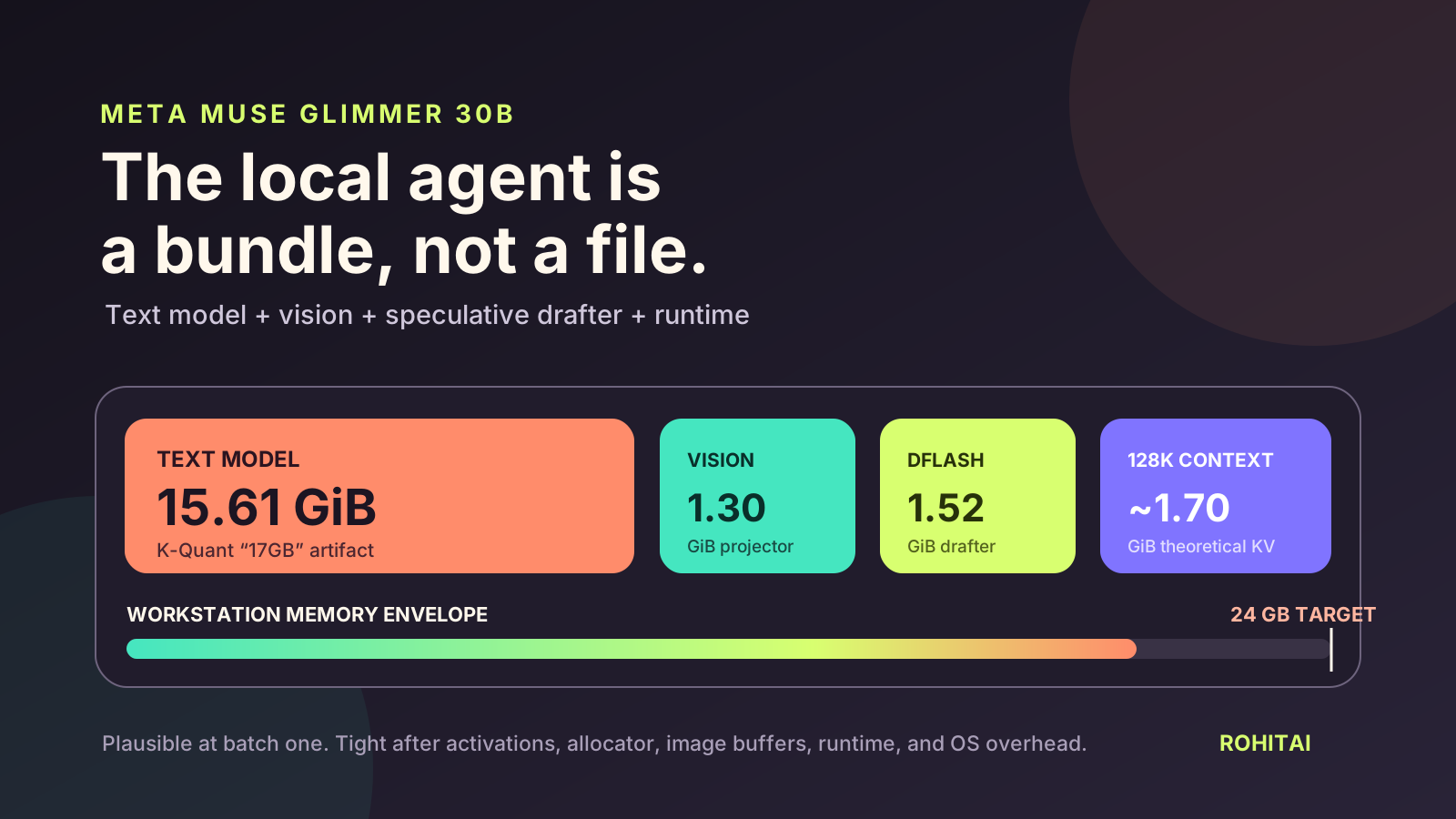
A model file is easy to count. A deployable local agent is not.
Meta’s Muse Glimmer 30B arrives with a neat headline: an Apache-2.0, text-and-image agent model with a 131,072-token configuration, tool-use training, and quantized builds aimed at 24 GB and 32 GB machines. The obvious read is that Meta has put a smaller rival to cloud agent models on Hugging Face.
The hardware bundle tells a more useful story. The “17GB” GGUF is 15.61 GiB on disk. Add the optional 1.30 GiB vision projector and 1.52 GiB DFlash drafter, and the working artifact set reaches 18.43 GiB before KV cache, activations, allocator overhead, image buffers, the runtime, or the operating system. At the full configured context, the released attention layout implies roughly another 1.70 GiB of theoretical BF16 KV cache at batch one.
That is tight, but it is not marketing magic. Meta shaped the architecture, quantization, visual path, and speculative decoder around a workstation memory boundary.
This is why Muse Glimmer matters. It is less convincing as a universal multimodal champion than its label suggests: Meta’s own table has Qwen3.6-27B ahead on GUI work, terminal work, SWE-Bench Verified, and three of four multimodal rows. Glimmer’s sharper proposition is local, inspectable, schema-heavy agent work—coding repair, document analysis, research, and tool calls—delivered as a modular runtime that builders can assemble and audit.
The catch is that every assembly is a different product. Text-only versus vision, solo decoding versus DFlash, 32K versus 128K context, Transformers versus a native runtime, and chat versus tool execution all create separate performance and safety contracts. Downloading the weights is the start of the deployment, not the end.
Meta’s launch post describes Glimmer as an open agentic model distilled from Muse Spark. The public model repository is non-gated and reports 29,776,626,688 BF16 parameters. The text stack is a 52-layer dense transformer; a roughly 1.8B-parameter Perception Encoder supplies image features.
That description still makes Glimmer sound like one checkpoint. The local release is closer to a small bill of materials.
| Artifact or layer | Exact released size | What it buys | When to omit it |
|---|---|---|---|
| K-Quant-17GB GGUF | 15.61 GiB | Core text generation and tool-oriented reasoning | Never for this configuration |
| Perception projector | 1.30 GiB | Image input and sampled-frame video processing | Text-only coding, research, and tool workers |
| DFlash drafter | 1.52 GiB | Speculative decoding with a separate assistant | Memory-constrained or latency-insensitive jobs |
| KV cache | About 1.70 GiB theoretical at 128K, batch one | Long working context | Use a smaller tested window for ordinary tasks |
| Agent runtime | Workload-dependent | Parsing, state, tools, sandboxing, recovery, audit | Never when the model can take actions |
The file sizes come from the GGUF repository metadata. They matter because “runs in 24 GB” is not a property of the model name. It is a property of a precise bundle, context length, batch size, runtime build, and workload.
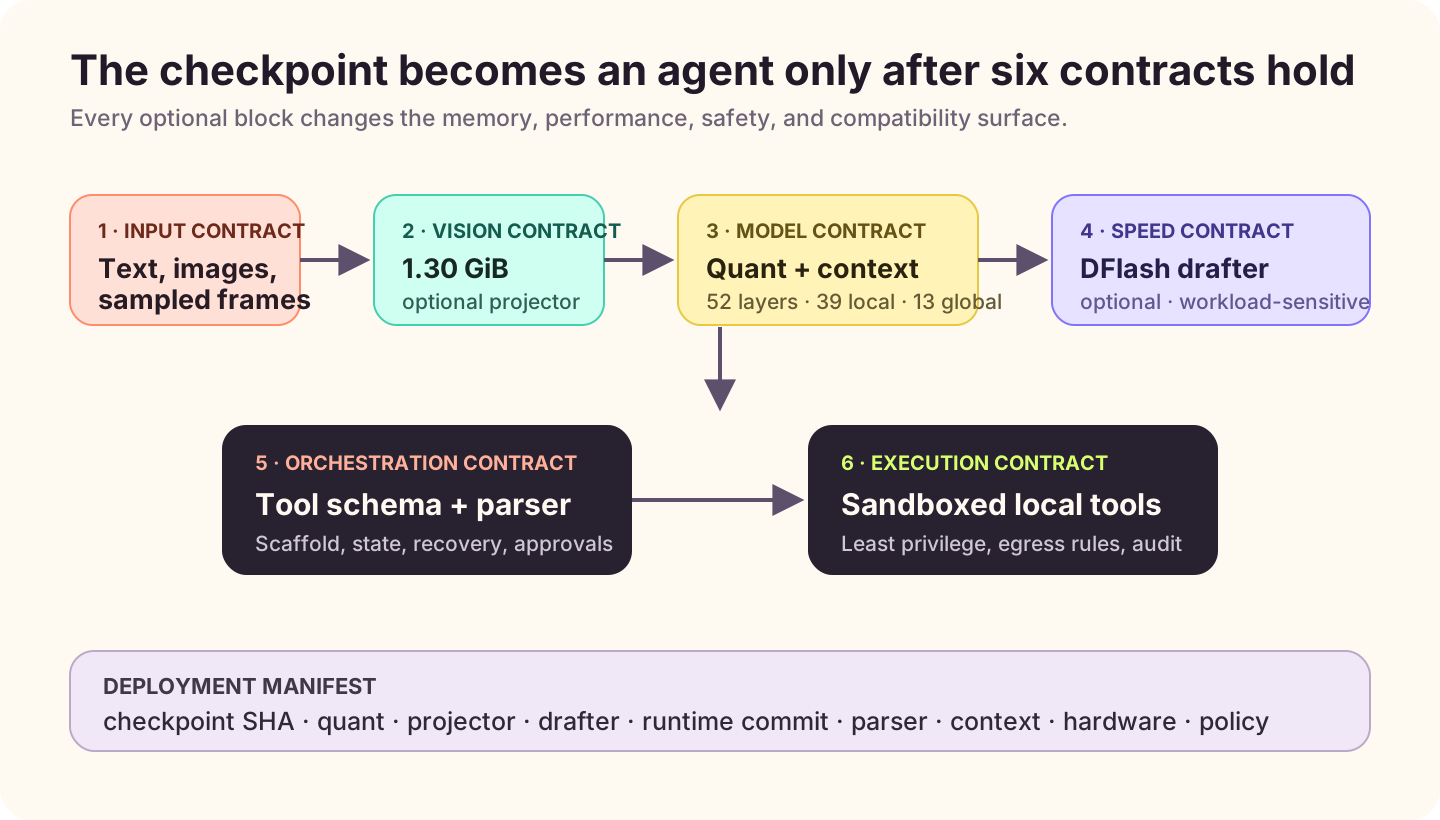
Glimmer becomes an agent through six contracts. Change the quantization, projector, drafter, runtime, parser, or execution boundary and you have changed the deployed product.
Glimmer’s released configuration uses 32 query heads but only two KV heads, a 16:1 grouped-query-attention ratio. Its layer pattern repeats three 2,048-token sliding-window layers and one full-attention layer 13 times. Only 13 of 52 layers retain the entire conversation; the other 39 retain a local window.
That structure changes the local economics of long context. At batch one, two KV heads, 128 dimensions per head, and BF16 keys and values, the rough cache calculation is:
global positions = 13 × 131,072
local positions  = 39 × 2,048
KV cache         ≈ 1.70 GiB
Add that estimate to the 18.43 GiB model, projector, and drafter bundle and the subtotal is about 20.13 GiB. A 24 GB card still needs room for everything the back-of-the-envelope calculation excludes. The claim is architecturally credible, but “24 GB target” should not be translated into “24 GB guaranteed at 128K with every feature enabled.”
The dynamic quant bundle reaches roughly 22.83 GiB before overhead, which explains Meta’s 32 GB target for that tier.
This is the first non-obvious lesson of Glimmer: memory efficiency is part of model behavior. The attention pattern decides which histories remain available at every layer. A smaller KV cache is not merely an inference optimization; it shapes how the model can use a long agent trace. Builders should test retrieval from early context, tool-result recall, instruction persistence, and compaction recovery rather than celebrating the configured maximum.
The Hugging Face launch guide itself uses a 32K window in its OpenClaw example. That is not evidence that 128K is broken. It is a useful reminder that checkpoint capacity, endpoint configuration, acceptable latency, and application-tested context are four different numbers.
Meta’s published results are competitive. They are also easy to misread.
Across the 22 non-safety rows in Meta’s comparison table, Glimmer has the highest listed value on 12, Qwen3.6-27B on eight, and Gemma4-31B on two. Glimmer leads five of eight general-agent rows and four of six general-reasoning rows. It leads only one of four multimodal rows.
The published methodology also says the chart mixes Meta reproductions, competitor self-reported numbers, and Artificial Analysis results. Meta takes the more favorable available result for comparison models, which is fairer than choosing their worst number. It still does not create one controlled experiment across every row.
So use the table as a capability profile, not a league table.
Glimmer’s strongest launch signal is structured tool use, deep search, document work, and tasks where local data access matters.
SWE-Bench Pro is encouraging, but test your languages, test harness, patch acceptance rate, and failure recovery before replacing a coding lane.
Qwen3.6-27B leads the launch table on Terminal-Bench 2.1 and OSWorld-Verified. Do not collapse both into a generic agent route.
Glimmer leads only one of four multimodal rows. Image input is a feature; broad visual leadership is a separate claim.
This is the second useful lesson: “agentic” is too broad to be a routing category. Tool-mediated research, code repair, terminal execution, GUI control, and visual question answering stress different parts of a stack. A local model can be excellent in one lane and mediocre in another without contradiction.
Meta ships a separate approximately 2.56B-parameter assistant for DFlash, a block-diffusion speculative-decoding method. The assistant drafts blocks of tokens; the 30B target verifies them. Correctly implemented speculative decoding preserves the target distribution while reducing expensive target-model steps.
Meta reports dramatic speed for the K-Quant-17GB build: 74.9 to 233.4 tokens per second on an RTX 5090, 23.7 to 37.8 on an M4 Max, and 26.6 to 50.2 on an M5 Max. Those are first-party, batch-one, greedy-decoding measurements. The RTX run used llama.cpp; Apple used ExecuTorch. There was no reputable independent reproduction available in the first launch hour.
Treat 3.1× as a hypothesis for the published RTX setup, not a universal multiplier. Draft acceptance changes with prompt distribution, sampling, structured outputs, multimodal input, long prompts, concurrency, and runtime implementation. Measure time to first token as well as decode rate. An agent that spends most of its wall time waiting on tools will not become three times faster because token decoding did.
This modular assistant is strategically important even if the headline gain shrinks. Open releases are starting to ship companion inference models as first-class artifacts. The model family now includes weights that improve how the main model runs, not only weights that change what it knows.
Hugging Face merged Muse Glimmer support and shipped it in Transformers v5.15.0 on launch day. That is concrete support: a tagged framework release knows the architecture.
The rest of the matrix was still moving when this article was prepared. The native llama.cpp pull request and vLLM pull request remained open. Hugging Face documented a vLLM Transformers-backend route, which is not the same thing as merged native vLLM support. Meta said optimized integrations for llama.cpp, MLX, ExecuTorch, Ollama, LM Studio, Unsloth, Together AI, Fireworks AI, and OpenRouter were landing or coming; that is a roadmap, not proof that every path was production-ready.
This distinction is familiar from RohitAI’s coverage of vLLM’s serving stack and SGLang’s agent runtime work. “Supported” must name the checkpoint, quant, modality, parser, context, hardware, and runtime revision. A green text-generation smoke test says nothing about image projection, tool-call syntax, DFlash acceptance, 128K cache behavior, or concurrent sessions.
Use a deployment manifest like this:
model_sha: f84ecc3a0ea984a4c04542a84269e3d065350a6e
quant: k-quant-17gb
projector: perception-projector
drafter: dflash-quantized
runtime: exact-tag-or-reviewed-commit
context: 32768
tool_parser: pinned-version
hardware: exact-gpu-or-mac
Then promote a new runtime or context limit the same way you would promote a database engine: through the same eval set, with rollback available.
Running Glimmer offline can keep prompts, retrieved documents, screenshots, and tool results from leaving the machine. That is meaningful for source code, personal archives, and internal research. It is a runtime privacy property.
It says nothing about training-data provenance. The model card describes public multimodal material, third-party data, information from Meta products and services, and outputs distilled from Muse Spark. It does not publish a reproducible dataset inventory. The honest statement is “local inference can reduce prompt egress,” not “the model is private.”
Local execution also moves the security boundary onto your machine. Meta reports a 28.4% prompt-injection attack success rate with 94.2 utility on Siren AgentDojo. That is a vendor result, not a universal application rate, but it is more than enough to reject safe-by-default assumptions. A malicious page, issue, document, or image can become an instruction source unless the scaffold separates data from authority.
Finally, the repository carries an Apache 2.0 license badge and a separate Meta Usage Policy covering prohibited categories. The release materials do not explain the legal interaction between the two. Builders distributing derivatives or deploying in regulated, military, critical-infrastructure, security, sensitive-data, or professional-advice contexts should review both with counsel. “Apache-licensed weights with a separate usage policy” is accurate; “restriction-free” is not.
Do not begin with a generic chat arena. Start with the exact lane you want Glimmer to own and compare completed outcomes.
Consumer-local inference does not imply consumer-local training. Hugging Face’s guidance lists one 80 GB H100 for LoRA supervised fine-tuning, eight 80 GB H100s for full SFT, and eight H100s split between LoRA GRPO training and a rollout server. Most teams should begin with retrieval, tools, structured prompts, and small adapters only after measuring a stable base-model gap.
Five days before Glimmer, Meta launched Muse Code around Muse Spark 1.2. RohitAI’s analysis argued that Muse Code’s deeper advantage is its cheap-token trace flywheel: the harness produces long, tool-heavy trajectories that can improve the next model.
Glimmer turns that vertical stack sideways. It distills Muse Spark capability into an openly downloadable model that other runtimes can inspect, quantize, and route. Meta can keep the frontier teacher and hosted coding product in the cloud while recruiting a local ecosystem around the student.
That creates three strategic effects.
First, local adoption becomes an evaluation network. Even without collecting private prompts, the ecosystem will expose which quantizations break, which parsers fail, which tool schemas transfer, and where the model’s “agentic” label is too broad.
Second, the workstation becomes a router lane, not a cloud replacement. Glimmer can own privacy-sensitive document, coding, and structured-tool work while frontier models handle rare, hard, or poorly validated tasks. The economic comparison is hardware amortization, power, engineering, and failure rate against hosted spend—not free versus paid tokens.
Third, Meta is making inference packaging part of model competition. The 24 GB claim works because the text architecture, projector, quantization, and drafter were designed as a bundle. Labs that release a capable checkpoint without a tested local stack will increasingly look unfinished.
Expect early adoption in local code, documents, research, and personal assistants where reduced prompt egress justifies deployment work.
Projectors, drafters, parsers, and runtime manifests will become normal parts of open model releases rather than community afterthoughts.
Glimmer will likely emerge as strong in tool and research work, with separate winners for GUI, terminal, and broad multimodal tasks.
The weights are public, non-gated, and labeled Apache 2.0. Meta also publishes a separate Usage Policy with substantive restrictions. “Open weights under Apache 2.0 with a separate Meta usage policy” is the precise description. Whether a particular use or derivative is acceptable is a legal and policy review, not a benchmark question.
Meta targets its K-Quant-17GB package at 24 GB hardware. The text model, vision projector, and quantized DFlash drafter total 18.43 GiB. A rough batch-one, full-context KV estimate adds about 1.70 GiB before other runtime costs. The envelope is plausible and tight. Test your exact feature bundle, context, runtime, and workload; do not infer full 128K multimodal operation from the label alone.
It accepts text and images. Video is handled as sampled image frames, with Hugging Face documenting a two-frames-per-second target and a 96-frame cap; audio is ignored. That is useful for short visual sequences, but it is not native audio-video understanding.
No. Meta reports about 3.1× on an RTX 5090 for one batch-one greedy-decoding setup, with smaller gains on two Apple systems. Acceptance rate, sampling, prompt length, output structure, multimodal input, hardware, concurrency, and tool wait time all affect end-to-end speed.
Not wholesale. It is a strong candidate for a local router lane where data egress, inspectability, predictable hardware cost, or offline operation matter. Keep alternatives for tasks where your evals show weaker terminal, GUI, general visual, or frontier reasoning performance.
Muse Glimmer does not erase the cloud agent. It gives builders a credible new place to draw the boundary.
The model’s most interesting achievement is not that 30B parameters fit into a compressed file. It is that Meta packaged text reasoning, visual input, long context, speculative decoding, and local runtime targets as one deployable system—while leaving enough seams for builders to remove vision, remove the drafter, lower context, or swap the scaffold.
Those seams are the opportunity and the risk. They let a team build a private, inspectable agent lane on hardware it controls. They also multiply the combinations that can fail.
Treat the release as infrastructure. Version the bundle. Route by workload. Test the maximum context instead of advertising it. Reproduce DFlash under real sampling. Put tools behind hard boundaries. Keep the benchmark claims labeled as Meta’s until independent work lands.
If those practices become normal, Glimmer’s legacy will be larger than one 30B model. It will have helped turn the open agent from a checkpoint download into an engineering discipline.