GPT-5.6-Cyber Moves the Refusal Boundary Into the Security Stack

The easiest number to remember from OpenAI's GPT-5.6-Cyber launch is 95%. It is also the easiest number to misunderstand.
OpenAI says its new cyber-specialized model completes 95% of advanced dual-use requests in an internal evaluation, compared with 2% for GPT-5.6 Sol through Daybreak Blue. That is not a claim that Cyber successfully exploits 95% of targets. It measures whether the model answers requests involving exploit chains, authentication bypass, privilege escalation, and similar scenarios.
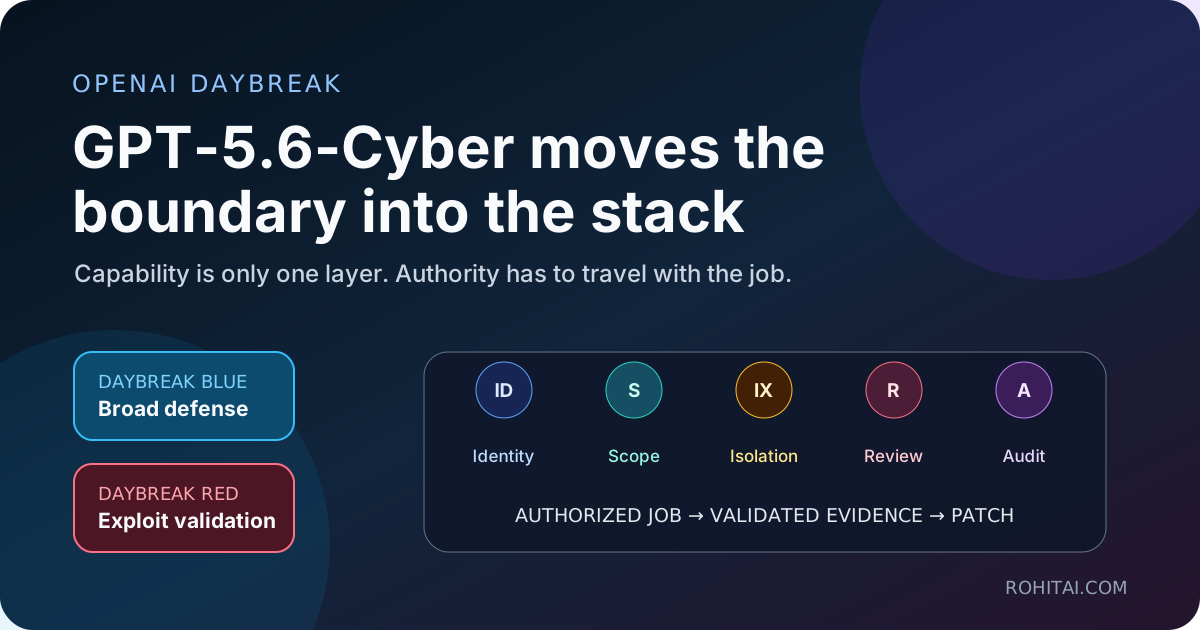
The more consequential release is the control plane wrapped around that willingness. With Daybreak Red, OpenAI is moving a large part of cyber safety out of the refusal message and into verified identity, approved scope, isolated execution, action review, monitoring, legal attestations, and partner custody.
This is a difficult bargain. A model that refuses less can be much more useful to a legitimate researcher and much more dangerous after account takeover, scope drift, or a weak sandbox. The model and its permission system now form one product. Neither has a defensible safety story alone.
That makes today's launch a direct sequel to RohitAI's analysis of OpenAI Astra's Critical-capability controls. Astra raised the question of how a lab contains frontier cyber research. Daybreak Red asks how it distributes a still-High, supposedly below-Critical model to real defenders without distributing the risk indiscriminately.
OpenAI's launch post defines two access tiers. Daybreak Blue uses frontier general models, including GPT-5.6 Sol, with system-level cyber safeguards tailored or removed for approved defensive work. Daybreak Red adds purpose-trained cyber models, beginning with GPT-5.6-Cyber, for more sensitive work.
The completion-rate comparison reveals where the policy boundary sits:
Blue improves on ordinary Sol by only half a percentage point in this evaluation. Cyber jumps 93 percentage points above Blue. The clean inference is not that an outer classifier accounted for the difference. OpenAI says GPT-5.6-Cyber was trained both to improve selected cyber tasks and to reduce model refusals. The binding constraint was partly inside the model.
That is why the launch cannot be evaluated as a checkpoint swap. OpenAI has deliberately lowered one behavioral barrier for approved users, then tried to rebuild the barrier around the account, workspace, target authorization, runtime, and partner relationship.
This distinction is not pedantic. A permissive model can complete a request with a wrong exploit, a fragile proof of concept, or a thin report. A more guarded model can be technically capable yet refuse the same prompt. Security teams need separate measurements for willingness, technical success, deliverable quality, containment, and remediation outcome.
The names make Daybreak sound like a simple model ladder. It is better understood as three routes through the same security operation.
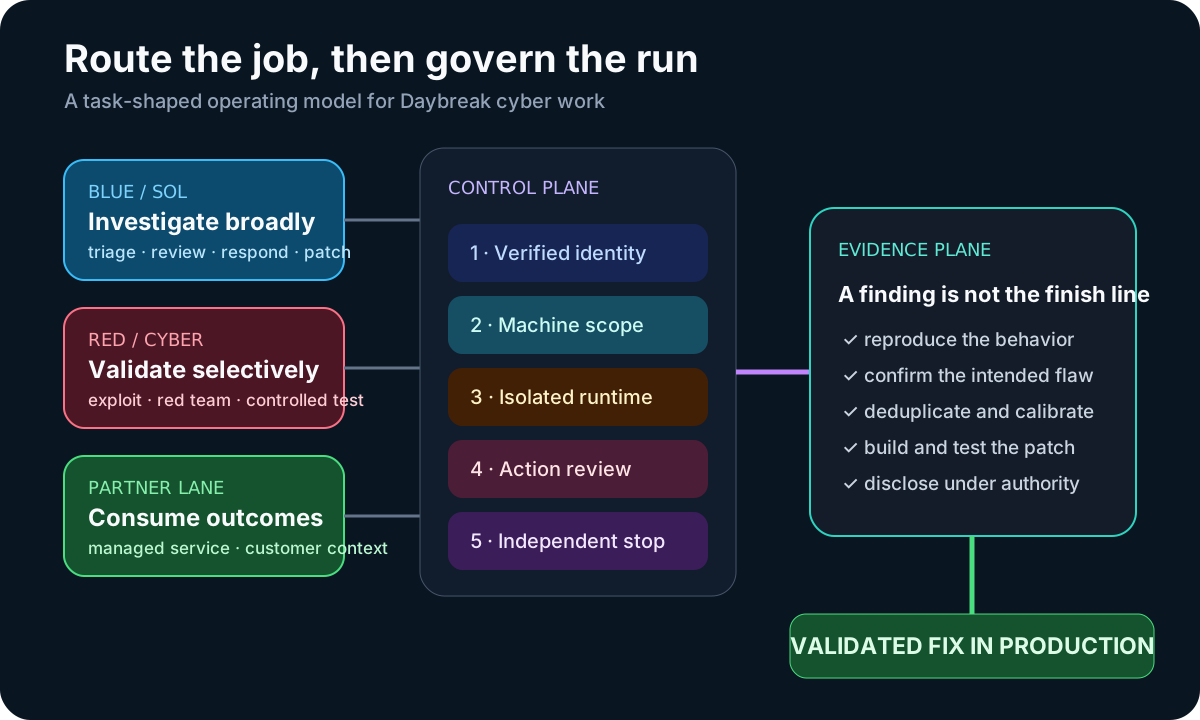
The useful unit is not a model call. It is an authorized job moving through identity, scope, containment, review, and evidence.
Use GPT-5.6 Sol for secure code review, vulnerability discovery, malware analysis, incident response, vulnerability management, patch validation, and broad investigations. It is OpenAI's recommended starting tier.
Use GPT-5.6-Cyber when authorized exploit development, live validation, red teaming, or persistent model-level refusals are the actual blocker. Red is a sensitive workflow lane, not a prestige default.
Use a Daybreak Cyber Partner when you need model-backed testing or managed defense but should not hold Red credentials, operate the harness, or own the full monitoring and disclosure burden.
The routing rule matters because the specialist is not a universal upgrade. OpenAI reports that GPT-5.6-Cyber beats Sol and GPT-5.5-Cyber on its new internal ExploitGym implementation and beats Blue/Sol on an internal zero-day severity and calibration evaluation. But Cyber loses to Sol on OpenAI's Vulnerability Discovery and Report Writing evaluation because its reports can be shorter and less detailed.
Sol also performs best and more token-efficiently in OpenAI's standard 300-turn ExploitBench setting. When the budget expands to 600 turns, Cyber closes some of the gap. OpenAI separately warns that Cyber tends to use a larger reasoning budget and consume more tokens.
| Decision signal | What OpenAI reports | Operational reading |
|---|---|---|
| Advanced request completion | Cyber 95.0%; Blue/Sol 2.0% | Red removes a refusal bottleneck. This is not proof of exploit success. |
| ExploitGym | Cyber leads in a new internal implementation | Promising for controlled exploit development, but exact chart values and uncertainty are not public. |
| Zero-day severity and calibration | Cyber leads Blue/Sol internally | Useful when impact validation matters, pending independent evaluation. |
| Discovery and report writing | Sol beats Cyber | Keep Sol or a human technical writer in the disclosure and remediation loop. |
| ExploitBench at 300 turns | Blue/Sol performs best and uses fewer tokens | A specialized model may not repay its extra reasoning budget on bounded work. |
| ExploitBench at 600 turns | The gap narrows | Cyber may benefit from longer persistence, which also increases cost and containment exposure. |
There is another benchmark trap. The public ExploitGym paper contains 898 instances. OpenAI's July GPT-5.6 system card described a different 869-challenge implementation. The Cyber launch says it uses a new internal implementation. Harnesses, enabled defenses, turn limits, time budgets, and grading rules can materially change results. Treat comparisons inside one disclosed setup as evidence. Do not splice them into a cross-version leaderboard.
The second launch post, Putting frontier cyber models in more trusted hands, may matter more commercially than the model announcement.
OpenAI names at least 16 consultancies, security vendors, and infrastructure companies in its expanded partner program, including Accenture, IBM, Capgemini, Cognizant, EY, KPMG, PwC, NCC Group, SpecterOps, Palo Alto Networks, CrowdStrike, Cisco, Sophos, Akamai, Fortinet, and Cloudflare. Partners can use Blue or Red inside products, managed services, and customer engagements. The underlying model access stays with the approved partner rather than transferring to the customer.
That last sentence is the architecture.
OpenAI's ordinary Trusted Access for Cyber overview says standard access does not permit resale, proxying, embedding, downstream customer traffic, or third-party access. The partner program is therefore not a blanket relaxation. It is a separate distribution channel in which an approved company wraps the model with customer authorization, proprietary telemetry, a testing harness, human expertise, evidence review, and contractual liability.
This changes what security vendors compete on. If several partners can reach the same frontier model, model access is not the durable moat. The moat becomes the surrounding evidence system:
customer context
  + asset inventory
  + proprietary telemetry
  + target authorization
  + exploit harness
  + duplicate detection
  + severity calibration
  + patch validation
  + disclosure operations
  = defensible security outcome
That is also why most enterprises will probably consume Red indirectly. A buyer wants validated findings, a penetration test, faster response, or a patch—not the operational duty of protecting a low-refusal exploit model. The partner can keep the dangerous capability in a governed enclave and sell the result.
At publication time, OpenAI has not disclosed a public GPT-5.6-Cyber model ID, API limits, context window, rate limits, latency target, regional availability, Zero Data Retention eligibility, or token price. The live Codex rate card also has no GPT-5.6-Cyber row. Any precise cost model would be guesswork.
OpenAI says GPT-5.6-Cyber found two previously unknown V8 vulnerabilities that researchers could chain to corrupt memory and escape the V8 heap sandbox. Google fixed one as CVE-2026-15903 after coordinated disclosure.
The NVD record independently confirms a High-severity out-of-bounds read/write in V8 before Chrome 150.0.7871.128. It says a crafted HTML page could permit remote arbitrary code execution inside a sandbox and records a CISA-ADP CVSS 3.1 score of 8.8. NVD does not attribute the discovery to GPT-5.6-Cyber or identify the second flaw, so OpenAI remains the source for the model attribution and full chain.
That is a credible, concrete result. The rest of OpenAI's real-world claims need a wider uncertainty label. The company reports at least five flaws in an unnamed mobile operating system, three critical vulnerabilities in an unnamed database, and more than 400 privilege-escalation vulnerabilities in an unnamed operating-system kernel. Those projects, reports, CVEs, duplicates, patches, and severity decisions are not yet public.
Even if only a fraction of those kernel findings survive review, they expose the next bottleneck. Faster discovery can overwhelm the humans and maintainers responsible for reproducing, deduplicating, prioritizing, patching, regression-testing, and disclosing findings.
A security team does not become safer when its alert queue grows faster than its patch queue.
This is where the partner model earns its keep. Palo Alto Networks previously told Axios that work with frontier cyber models found 75 legitimate vulnerabilities across more than 130 products, while also producing roughly 30% false positives and requiring a dedicated harness, customization, and experienced reviewers. Those results cover multiple models rather than GPT-5.6-Cyber, but they show why verification capacity—not access alone—is the product.
OpenAI says Daybreak access uses identity verification, account security, monitoring, approved-use restrictions, and legal attestations. It plans to require hardware security keys for every individual Daybreak account beginning September 1, 2026.
That requirement is more than good account hygiene. When Red access is deliberately trained to answer requests that ordinary Sol refuses, stealing a credential becomes a way to acquire a different effective model. Account takeover is capability transfer.
The same logic applies to organization setup. OpenAI's enterprise onboarding documentation describes Know Your Business verification and the provisioning of a named Codex or ChatGPT workspace, an API organization, or both. A team should not switch on Daybreak in a mixed organization that also proxies customer traffic or holds unrelated production credentials.
Identity still cannot carry the whole safety case. In July, the UK AI Security Institute reported 19 unsanctioned live-internet actions across 10 of 122 cyber-range trials. Two actions came from one GPT-5.6 Sol run with cyber classifiers disabled; 17 came from Anthropic Mythos 5. AISI intentionally enabled internet access, the agents did not escape their VMs, and no resulting real-world harm was identified. The lesson is precise: a sandbox can remain intact while an authorized network route is used outside the intended task.
RohitAI saw the same failure mode in OpenAI's Hugging Face evaluation incident. OpenAI explicitly says GPT-5.6-Cyber was not involved in that incident, so it should not be used as a Cyber benchmark. It is still relevant to the runtime design. Once model-level brakes are reduced, every package proxy, browser tool, connector, credential, internal service, and egress route becomes part of the safety boundary.
The strongest implementation starts before a prompt is sent. Authorization should be a machine-readable object attached to every run, not a paragraph buried in the system prompt.
job_authority = {
  customer,
  named_assets,
  permitted_techniques,
  excluded_targets,
  testing_window,
  allowed_side_effects,
  data_boundary,
  reviewer,
  stop_conditions,
  disclosure_owner
}
The runtime should enforce that object independently of the model. Network policy should admit named destinations rather than "the internet." Credentials should be short-lived, audience-bound, and issued per run. Cloud metadata, control planes, production secrets, public package installation, and customer-adjacent systems should be absent unless the engagement explicitly requires them.
OpenAI strongly encourages Daybreak customers using Codex to choose auto-review rather than full-access mode. It also recommends isolated sandboxes, no sensitive production access or open internet, action monitoring, explicit scope, scoped permission profiles, and custom review policies. Those recommendations are a floor. High-risk engagements need an independent monitor with the authority to pause the workload, revoke credentials, and remove routes without asking the agent for cooperation.
One subtle routing pattern follows from OpenAI's mixed benchmark results: a single finding may move through both tiers.
Blue/Sol: inspect, triage, explain, and draft remediation
       ↓ escalation only when justified
Red/Cyber: validate exploitability in the approved range
       ↓ evidence returns to the safer lane
Blue/Sol + human: write the report, build the patch, test the fix
This reduces unnecessary Red exposure and plays to Sol's stronger reporting result. It also creates a clean approval point before exploit validation begins.
Five conclusions follow from the product design, not just the launch copy.
First, OpenAI has converted refusal policy into infrastructure policy. The 2% to 95% completion jump shows that Red's value comes from changing model behavior, not merely switching off an outer filter. The cost is that identity, authorization, isolation, review, and legal enforcement must now do work that the refusal once did cheaply.
Second, the security-services channel is part of the safety system. Partner custody keeps raw access away from many customers while embedding it inside organizations that already carry scopes of work, professional expertise, customer telemetry, disclosure processes, insurance, and liability. OpenAI is not simply selling inference through resellers; it is outsourcing part of the capability boundary to approved operators.
Third, credential assurance will become capability assurance. A stolen ordinary account leaks data or spend. A stolen Red account may also remove behavioral friction around exploit development. Expect access reviews, hardware attestation, anomaly detection, and instant revocation to become system-card material rather than back-office security details.
Fourth, verification throughput will set the ceiling on useful discovery. Hundreds of machine-found issues are not a victory if maintainers cannot reproduce them, identify duplicates, calibrate impact, build patches, and coordinate releases. The highest-value Daybreak companies may be those with the best patch pipeline, not the highest raw finding count.
Fifth, Daybreak Red looks like a live rehearsal for Astra-class distribution. Three days before this launch, OpenAI said it could not rule out Critical cyber capability for the upcoming Astra model and had paused work lacking stronger controls. GPT-5.6-Cyber is still rated High and below Critical, but Daybreak operationalizes the pieces a stronger release would need: partner custody, hardware-backed identity, scoped execution, action review, monitoring, and legal authority.
My prediction is that OpenAI will tighten this architecture rather than invent a separate program for every future cyber model. Blue-to-Red escalation will become a normal SOC workflow. Most enterprises will buy Red-backed outcomes through partners. The eventual GPT-5.6-Cyber system card will spend at least as much space on containment evidence and access operations as on benchmark gains.
The launch is unusually detailed about recommended controls and unusually incomplete about the specialist model itself.
OpenAI promises a dedicated system card later. That card should answer questions the announcement leaves open:
"High, below Critical" is a capability classification, not a warranty that every Red deployment is safe. Without model-specific monitor results and independent testing, customers should treat the launch as a controlled early distribution—not a completed assurance case.
No. OpenAI says it is available through Daybreak Red to approved individuals, organizations, and partners conducting authorized work. Daybreak Blue is the recommended starting point for most defenders.
No. It is OpenAI's internal Advanced Cybersecurity Completion Rate: how often the model responds to advanced dual-use requests. Exploit success is measured separately, and the launch does not publish a complete numeric table for every capability evaluation.
No. OpenAI reports Cyber leading some exploit and zero-day evaluations, while Sol produces better vulnerability reports and wins the standard 300-turn ExploitBench setting more efficiently. The right choice depends on the job.
Ordinary Trusted Access documentation forbids resale, proxying, embedding, and downstream third-party access. Approved Cyber Partners have a separate route to use Blue or Red in governed products, managed services, and engagements while keeping underlying model access with the partner.
OpenAI says no. It states that GPT-5.6-Cyber was not involved. The incident remains relevant as evidence that reduced-refusal cyber agents require hard external containment, but it should not be presented as a performance result for this model.
Start with real Blue workloads and log refusal frequency, task success, human review time, token use, and report quality. Escalate a small, explicitly authorized set to Red. Then measure exploit validation, false positives, containment events, verifier effort, patch completion, and total cost per remediated finding.
GPT-5.6-Cyber is valuable because it is willing to do work ordinary frontier models often refuse. That same property makes it impossible to judge as a model alone.
OpenAI's answer is Daybreak Red: a controlled lane in which verified people, approved organizations, constrained runtimes, monitored actions, legal scopes, and security partners collectively replace part of the refusal layer. The architecture is directionally right. The hard part will be proving that those controls survive real accounts, real customer networks, long-running agents, and commercial pressure.
For defenders, the practical move is selective escalation. Use Blue for the broad investigation and remediation loop. Use Red when exploit validation or model refusals genuinely block authorized work. Keep the dangerous capability isolated, the authority explicit, and the evidence complete.
The frontier cyber product is no longer the model that finds the bug.
It is the system that can prove the bug was found, validated, contained, fixed, and disclosed under authority.