DeepSeek V4-Flash-0731 Makes the Harness Part of the Model

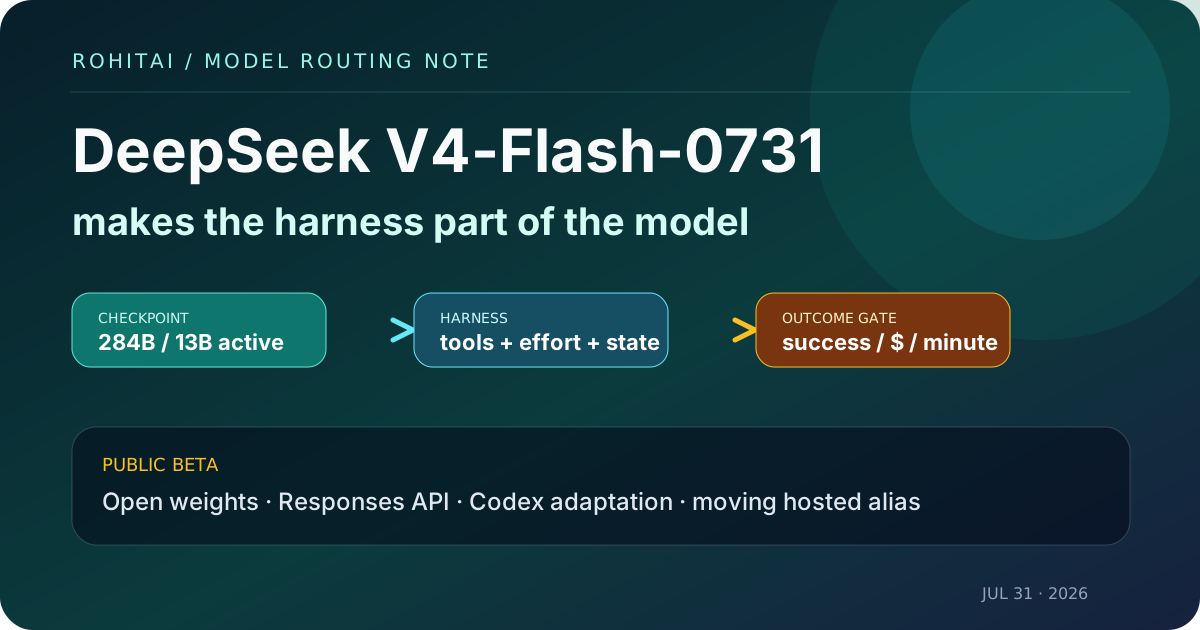
DeepSeek upgraded V4-Flash without changing its architecture. That is exactly why the July 31 release matters.
The public-beta model, DeepSeek-V4-Flash-0731, remains a 284-billion-parameter mixture-of-experts model with 13 billion parameters active per token and a one-million-token context window. DeepSeek says it “was only re-post-trained.” Yet its reported agent scores moved sharply: Terminal-Bench 2.1 rose from 61.8 to 82.7, DeepSWE from 7.3 to 54.4, and Toolathlon-Verified from 49.7 to 70.3.
That is not evidence that architecture has stopped mattering. It is evidence that the unit builders buy is no longer a checkpoint in isolation. It is model × post-training × reasoning effort × harness × execution environment.
DeepSeek has packaged that stack for distribution, too. The hosted Flash alias now points to 0731, the weights are MIT-licensed, the API implements a Codex-oriented subset of the OpenAI Responses API, and current token prices are low enough to make a production shadow test an easy decision. But “OpenAI-compatible” does not mean behaviorally interchangeable, and “13B active” does not mean a 13B deployment.
My read: V4-Flash-0731 deserves a place in the agent router today. It has not earned an unsupervised primary route simply because one vendor table looks extraordinary.
DeepSeek's July 31 changelog is unusually direct: V4-Flash-0731 keeps the preview architecture and size and was re-post-trained. The official model card ties it back to the 284B-total, 13B-active design and adds a DSpark speculative-decoding module. The earlier V4 technical report documents the one-million-token architecture behind the family.
The launch numbers make post-training look like a product release in its own right.
DeepSeek ran the public coding benchmarks at max reasoning effort with “DeepSeek Harness minimal mode,” temperature 1.0, and top-p 0.95. The harness is promised, but unavailable at launch. Two other results, DSBench-FullStack and DSBench-Hard, use internal datasets. Those facts do not invalidate the scores. They define what the scores can prove.
The independent check is useful. Artificial Analysis scored the max-effort model about 50 on its Intelligence Index, 69.06 on its Coding Index, 45.67 on its Agentic Index, and 78.65% on Terminal-Bench 2.1. The 4.05-point gap from DeepSeek's 82.7 is not a scandal; agent results move with timeouts, task images, tool schemas, retries, reasoning settings, and the agent loop.
Terminal-Bench itself is a warning against false precision. The maintainers say version 2.1 revised 28 of 89 tasks for issues including dependency drift and specification errors. They documented double-digit score movement for some model-agent pairs between versions.
The most important original insight in this release is the inversion of DeepSeek's own ladder. In its table, re-post-trained Flash beats the unchanged V4-Pro Preview by 10.6 points on Terminal-Bench, 15.7 on NL2Repo, and 41.6 on DeepSWE. “Pro for difficult work, Flash for easy work” is currently a naming convention, not a defensible router policy.
The useful mental model is not a box labeled “LLM.” It is a stack whose layers can amplify or erase each other.
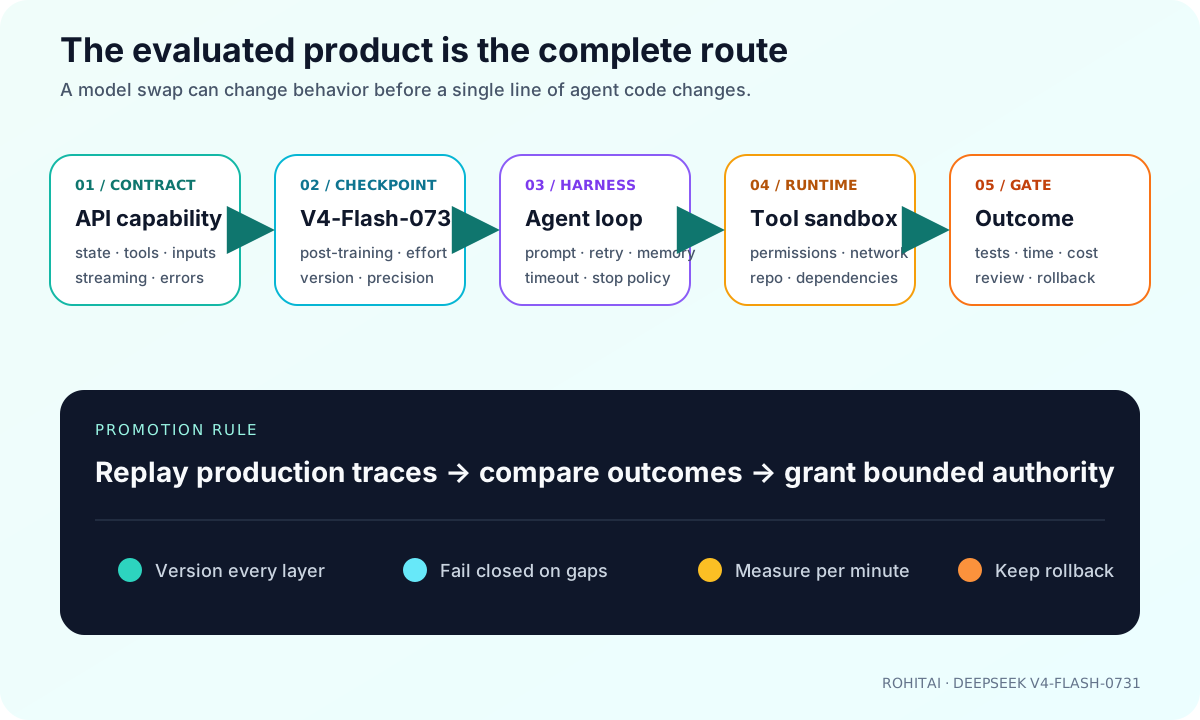
The score belongs to the complete route. Change the compatibility layer, tool policy, or sandbox and you have changed the evaluated system.
This explains how an unchanged architecture can feel like a different product. Re-post-training changes planning, persistence, tool selection, error recovery, and stopping behavior. The harness decides what context the model sees, how tools are described, when results return, and whether the loop retries. The environment decides whether a correct plan can actually execute.
The NL2Repo-Bench paper is a good example. Its 104 tasks start with requirements and an empty workspace, then ask an agent to produce an installable Python library. That is a test of planning, repository structure, dependency choices, execution, and repair. Toolathlon spans 108 tasks, 32 applications, and 604 tools. In both cases, the scaffold is inseparable from the behavior being scored.
This is why production evaluations should replay traces rather than copy benchmark prompts. Your agent has different tools, permissions, repositories, latency, secrets, tests, and stopping conditions. A score earned inside DeepSeek Harness predicts direction. Your route still needs its own acceptance test.
DeepSeek did more than add an endpoint. It adapted Flash for Codex and documented a direct setup path. Its Codex integration guide targets Codex CLI 0.144.0 or later and advertises text input, low/high/max effort, parallel tool calls, and the full 1,048,576-token window.
That turns OpenAI's client and API shape into a distribution channel for a competing model. A builder can keep a familiar coding-agent interface while changing the inference provider underneath it. The earlier RohitAI analysis of Codex moving the agent boundary beyond the terminal matters here: the client, plugin system, network policy, and execution surface remain part of the product even when the model changes.
Compatibility, however, is a gradient. DeepSeek's Responses API support matrix exposes the boundaries clearly.
| Capability | DeepSeek behavior | Production consequence |
|---|---|---|
| Function tools and web search | Supported | Core text-and-tool agent loops can transfer with limited adaptation. |
| Custom tools | Only apply_patch is supported | Codex editing works; other custom tool names fail. |
| previous_response_id, conversation, store | Not supported | Your application must persist history, task state, and compaction. |
| MCP, computer use, file search, code interpreter | Ignored | A request may succeed while the intended capability never runs. |
| Image and file inputs | Not supported | Image parts become placeholder text; multimodal workflows need another route. |
| Automatic truncation | Not supported | Over-context requests return HTTP 400; compaction is your job. |
The sharp edge is silent ignoring. DeepSeek says unsupported parameters are silently ignored so existing clients can connect without modification. That is convenient during setup and dangerous during migration. A call that returns HTTP 200 can still violate the application's capability assumptions.
For example, an agent configured with background: true, an MCP tool, and previous_response_id may appear connected while losing background execution, tool access, and server-side continuity. This is why provider negotiation needs contract tests, not a base-URL switch. It also echoes the point in RohitAI's analysis of stateless MCP: removing transport state does not remove the need for durable task state.
DeepSeek's current pricing page lists Flash at $0.14 per million cache-miss input tokens, $0.0028 per million cache-hit input tokens, and $0.28 per million output tokens. The account-wide concurrency limit is 2,500, five times V4-Pro's 500. Flash is about 3.1 times cheaper than Pro for cache misses and outputs.
The cache row deserves more attention than the headline price. A hit costs 2% of a Flash miss, a 98% discount. But Pro's cache-hit price is $0.003625, so Flash is only about 1.29 times cheaper on warm input. If an agent repeatedly sends a large, stable repository prefix, the economic gap between the two tiers narrows. Output volume, pass rate, and turnaround time start to dominate.
Artificial Analysis measured roughly $72 for its full Intelligence Index run and about $0.027 weighted cost per task. It also recorded 210 million output tokens, more than twice the 100-million median shown for comparable models. Output speed was still unavailable at publication time.
That combination breaks the shortcut “cheap tokens equal cheap agents.” A long loop consumes sandbox minutes, CI capacity, external API quotas, database transactions, and human attention. One destructive tool call can dwarf the inference bill. The metric to optimize is:
successful tasks
-------------------------------
model + tools + compute + review
There is another time-sensitive caveat: DeepSeek says a peak/off-peak policy will eventually double all prices during two Beijing-time peak windows, but it has not announced an effective date. Route economics need a live price input, not a number copied permanently into configuration.
The 0731 weights are available under the MIT license. That gives teams a reproducible checkpoint, control over retention, and the option to tune the serving stack. It does not make the model small.
Hugging Face reports a checkpoint footprint around 166.9 GB across 48 safetensor shards. DeepSeek's reference vLLM command uses a single node with four GB300 GPUs and seven speculative tokens through DSpark. Thirteen billion active parameters describe per-token expert activation; they do not describe the memory required to hold and route across 284 billion total parameters.
Self-hosters must evaluate expert parallelism, weight precision, KV-cache policy, tokenizer and chat encoding, speculative acceptance, kernel support, failover, and observability. The RohitAI vLLM 0.26 analysis is the useful companion: once the weights are yours, serving behavior becomes an infrastructure contract.
Open weights therefore create two forms of version control. You can pin DeepSeek-V4-Flash-0731 and reproduce an incident. Hosted callers use the moving deepseek-v4-flash alias, which DeepSeek changed in place on July 31. That is excellent for transparent upgrades and awkward for audit trails.
At minimum, log provider, reported model, request date, reasoning effort, response identifiers, tool policy version, and evaluation build. If reproducibility is mandatory, use the explicit checkpoint or a versioned route such as the first-day OpenRouter catalog entry, then verify what quantization and provider implementation sit behind it.
V4-Flash-0731 is the strongest kind of beta candidate: cheap to test, open enough to inspect, and independently good enough that the vendor claims cannot be dismissed as launch theater. It is also young, served under a moving alias, missing several Responses features, and evaluated by its maker with an unreleased harness.
That combination points to progressive routing.
Replay real coding, terminal, and tool traces without granting side effects. Compare completion, elapsed time, retries, tokens, tool calls, and human corrections against the current route.
Send bounded repository tasks with sandboxed writes, explicit budgets, capability checks, patch review, and an automatic escalation model for failures.
Use the 0731 checkpoint when data control and reproducibility justify operating a 284B-total serving stack. Benchmark the exact precision and DSpark configuration you will run.
Three less-obvious consequences follow.
First, Responses API compatibility is becoming a go-to-market feature. Model vendors can meet developers inside an existing client instead of asking them to adopt another agent shell. Expect more providers to publish Codex-specific catalogs and narrower compatibility profiles.
Second, moving aliases turn regression testing into release engineering. Existing Flash callers received materially different behavior without changing a model string. Golden traces, route manifests, and rollback thresholds are now basic operational hygiene.
Third, the agent ladder should be empirical, not branded. Flash currently beats the older Pro preview on several vendor agent tests. When the refreshed Pro arrives, that may reverse. A static easy → Flash, hard → Pro rule will age badly; task-family evals should decide.
The first signal is the release of DeepSeek Harness. Reproduction artifacts will show how much of the gain survives outside DeepSeek's environment and whether “minimal mode” is genuinely minimal.
The second is speed. A max-effort model that is exceptionally cheap but verbose may win cost charts while losing interactive and CI workflows on elapsed time. First-token latency, output speed, tool-loop duration, and cancellation behavior matter more than another composite score.
The third is V4-Pro. DeepSeek says Responses API and Codex support are expected in early August and the official Pro release will follow soon. If Pro receives comparable post-training, it may recover the hard-task tier. Flash's five-times-higher concurrency and lower miss/output prices should still make it the volume route for many teams.
Finally, watch provider diversity and beta operations: capacity, regional availability, error rates, data controls, rollback policy, and change notices. None is established by a benchmark table, and each can decide whether an agent route survives production traffic.
No. DeepSeek says it keeps the same architecture and size as V4-Flash Preview and was re-post-trained. It remains a 284B-total, 13B-active MoE with a one-million-token context window.
The precise term is open weights. DeepSeek published the checkpoint under the MIT license on Hugging Face. Training data and the July re-post-training recipe are not fully published, and the launch harness is still unreleased.
Some text-and-function-tool clients can connect with minimal changes. Production behavior is not fully interchangeable: state objects, background mode, MCP, computer use, file search, code interpreter, and image inputs are unsupported or ignored. Build a capability matrix and contract tests.
They should test immediately. Start with shadow traffic, then promote only the task families that beat the current route on successful outcomes per dollar and per minute. Keep writes sandboxed and retain an escalation path until the beta's operational behavior is understood.
DeepSeek V4-Flash-0731 is important because it makes the hidden parts of agent performance visible. The base architecture did not move. The post-training, harness adaptation, API surface, and product route did—and task scores moved with them.
For builders, the opportunity is unusually practical. You can call a very cheap hosted API, use a familiar Codex-shaped workflow, inspect MIT-licensed weights, and compare against a credible independent evaluation on day one.
The discipline is equally practical. Do not promote a leaderboard. Promote a measured route. Version the whole stack, test capability contracts, own state and compaction, sandbox tools, count time as well as tokens, and make rollback boring.
V4-Flash has earned the audition. Your harness decides whether it gets the job.