Grok Imagine Video 1.5 Turns One Model ID Into Three Media APIs

xAI changed what grok-imagine-video-1.5 means without changing its name.
In June, Video 1.5 arrived as an image-to-video model: give it a first frame, receive a short clip, and top out at 720p. On July 31, xAI widened that same API identifier into three different generation surfaces—text-to-video, first-frame image-to-video, and reference-to-video—then added native 1080p output for the first two. Reference requests can carry people, products, clothing, and up to three preset xAI voices. Generated clips include audio by default.
The obvious reading is “Grok now makes sharper videos from text.” That undersells the update.
For builders, this is a contract migration disguised as a capability release. A wrapper that learned in June that image was required can now reject a perfectly valid text-only request. A generic audio_reference field can falsely imply that xAI accepts uploaded speech, when the public API actually uses a gated catalogue of preset voice IDs. A global resolution: 1080p toggle fails for reference-to-video, which remains capped at 720p.
The release is more interesting above the renderer. xAI now has the pieces of a media-agent backend: asynchronous jobs, three creative input lanes, exact request-level cost telemetry, durable Files storage, revocable URLs, moderation results, and Batch admission. But it has not published a post-expansion latency distribution, a reproducible Video 1.5 benchmark suite, or clear Video 1.5 watermark/C2PA documentation.
That combination is useful enough to test and incomplete enough to resist treating as a drop-in winner.
xAI's July 31 release note is short, but its interface consequence is large. grok-imagine-video-1.5 now covers three mutually exclusive modes:
| Mode | What anchors the clip | Maximum resolution | Integration trap |
|---|---|---|---|
| Text-to-video | A required prompt | 1080p | Older adapters may still require an image |
| Image-to-video | One image used as the first frame; prompt optional | 1080p | A first frame is not the same as an identity reference |
| Reference-to-video | Up to seven reference images, three preset voices, or both, plus a prompt | 720p | Cannot be combined with first-frame image-to-video |
The reference-to-video guide says only one mode can be active per request. Send both image and reference_images, and the API returns a 400. That is good validation behavior, but the client should catch it before a paid creative workflow reaches the provider.
The semantic distinction matters. In image-to-video, the supplied image is frame zero. In reference-to-video, images act as a vocabulary for people, objects, clothes, or style without forcing the opening frame. Flattening both into one portable images[] field throws away the reason the user supplied them.
The model page also lists aliases including grok-imagine-video-1.5-preview and the dated grok-imagine-video-1.5-2026-05-30. xAI does not explicitly say whether every alias inherits every July capability. A sensible gateway should treat aliases as separately testable routes, not assume a family resemblance is a schema guarantee.
capabilities[provider][model_or_alias][mode] = {
  required_fields,
  forbidden_fields,
  max_resolution,
  duration_range,
  reference_limits,
  region,
  checked_at
}
That registry looks less elegant than switching on a model string. It is also the difference between a wrapper that survives provider changes and one that wakes up stale.
Video 1.5 uses an asynchronous start/get flow. A POST /v1/videos/generations returns a request_id; the application later reads the result from GET /v1/videos/{request_id}. xAI documents pending, done, expired, and failed states. Its SDK can poll for you, but the generation guide warns that jobs may take several minutes.
That last detail should change the agent architecture.
Do not keep a reasoning model—and its entire working context—alive while a video renders. Let the planning agent produce a typed creative packet, submit the job, persist its ID, and release the worker. A cheaper event handler can reconcile completion and wake the evaluation or editing stage.
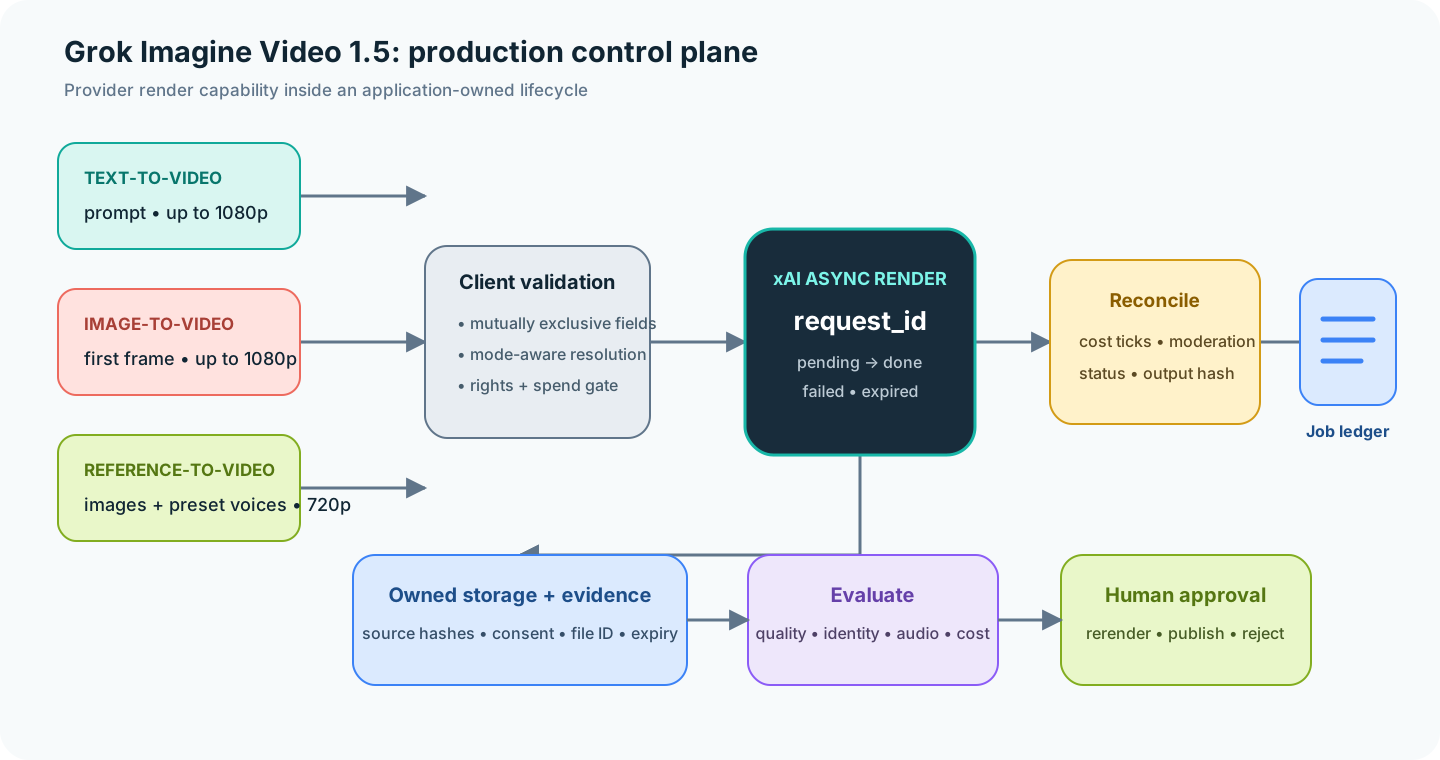
The provider renders the clip. Your application still owns intent, rights, durable job state, spend policy, evaluation, and publication authority.
This is where xAI's surrounding API is stronger than the release-note headline suggests. Completed responses can include exact usage.cost_in_usd_ticks, with ten billion ticks equal to one US dollar. storage_options can save output into xAI Files, return a stable file_id, and optionally create a public URL that can be expired or revoked. Public URLs are capped at 1,000 active links per team, while default generation URLs remain ephemeral.
Batch can admit large video workloads, but xAI's pricing page is explicit: image and video jobs receive no Batch discount. Batch is a queueing primitive here, not a cheaper render lane.
The public 10 RPS figure is especially easy to misuse. It controls submission, not concurrent renders, queue depth, or completed videos per minute. Until xAI publishes latency and capacity distributions, measure p50, p95, and p99 render time by mode, duration, and resolution inside your own account.
The detailed Video 1.5 model page prices output at $0.08 per second for 480p, $0.14 for 720p, and $0.25 for 1080p. Input images add $0.01 each.
That makes 1080p 3.125 times the 480p output cost. It may be worth it for an approved hero shot. It is wasteful for the first pass through 100 speculative concepts.
| Output tier | Eight seconds | Fifteen seconds | 100 × 15-second candidates | Best role |
|---|---|---|---|---|
| 480p | $0.64 | $1.20 | $120 | Prompt and motion screening |
| 720p | $1.12 | $2.10 | $210 | Reference work and review |
| 1080p | $2.00 | $3.75 | $375 | Accepted shots and delivery |
Calculated from xAI's published per-second rates; totals exclude image inputs, storage, retries, failed jobs, and human review.
The right unit is not cost per submitted video. It is cost per accepted second:
cost per accepted second =
  draft renders + final rerenders + rejected branches + review cost
  divided by seconds approved for use
A production router can generate candidates at 480p, run automated and human rejection, then rerender only accepted compositions at 1080p. That strategy is not glamorous. It is the difference between adding a high-resolution feature and building a viable margin around it.
At publication time, Artificial Analysis's image-to-video arena with audio placed Grok Imagine Video 1.5 fourth at 1,114 Elo, behind Dreamina Seedance 2.0, Gemini Omni Flash, and MiniMax H3. That is a useful signal: Video 1.5 is competitive enough to merit evaluation, but it is not leading that board.
It does not answer whether the new text-to-video mode is good. The separate text-to-video leaderboard still listed only the older grok-imagine-video, not 1.5. Reference identity, preset-voice synchronization, and 1080p output need different test sets again.
This matters because a widened API surface encourages benchmark laundering: one score earned by one mode gets repeated as evidence for every new mode. Builders should resist it.
Run four suites separately:
Compare accepted-output cost and latency, not only preference scores. Google's current video API emphasizes multimodal conversational editing through Gemini Omni Flash and specialist controls through Veo. MiniMax H3 exposes 2K, 24 fps, and richer uploaded media references. OpenAI's Sora API is now a migration risk rather than a durable default because OpenAI schedules it to shut down on September 24, 2026.
No provider currently wins price, resolution, duration, native audio, reference control, editing, provenance, storage, and platform longevity at once. A typed provider adapter is not premature abstraction in AI video. It is procurement leverage.
Strong fit when 15-second clips, native audio, text and first-frame 1080p, preset voice identity, Files persistence, revocable URLs, and exact cost telemetry matter together.
Evaluate Gemini Omni, Veo, MiniMax H3, Kling, and Runway when uploaded audio/video references, conversational editing, higher resolution, frame controls, or a different queue contract matter more.
Normalize creative intent and lifecycle fields, but preserve provider-specific modes, safety responses, identity grammar, retention rules, and output ownership instead of collapsing them into a lowest-common-denominator API.
Reference-to-video is the most strategically interesting and easiest feature to misdescribe.
xAI allows up to three preset voices selected by case-insensitive voice_id. Prompts refer to them with tokens such as AUDIO_0. The documented public request does not accept an arbitrary uploaded voice clip, and xAI says reference audio is available only in the United States and to trusted partners.
So this is not a general “clone any voice into a video” endpoint. It is a provider-controlled identity vocabulary that can make a recurring character sound consistent across xAI surfaces.
That creates useful continuity for brand characters, training presenters, or fictional casts. It also creates portability debt. A generic gateway needs to expose that the voice is an xAI catalogue entry, that account and geography gates apply, and that moving the workflow to another renderer may require re-authorizing or recreating the identity layer.
Identity inputs also widen the evidence boundary. Seven reference images can establish a recognizable person or product far more strongly than a text prompt. xAI's acceptable-use policy prohibits deceptive impersonation, sexualized real-person edits, child exploitation, IP violations, and removal of embedded provenance metadata or watermarks. Those rules are necessary; they are not an application-level consent system.
The surrounding legal context is not theoretical. Canada's privacy regulator issued findings about sexualized imagery in the wider Grok deployment and required a risk-mitigation process. That finding was not a technical judgment on this Video 1.5 API, but it is a clear reason to preserve rights records, consent, source hashes, moderation responses, and takedown paths for identity-conditioned media.
The reviewed Video 1.5 pages do not specify a watermark, C2PA credential, or public detector. That is an evidence gap, not proof that xAI adds none. Until the documentation is clear, follow the same application-side principle from our GPT-Live provenance analysis: preserve the chain of evidence even when a provider supplies a watermark.
xAI says standard API inputs and outputs are encrypted at rest, retained for 30 days for abuse auditing, and not used for training without explicit permission. Its security FAQ also offers team-wide zero data retention, but ZDR removes many conveniences that make the normal video stack attractive.
Under ZDR:
output.upload_url.That is not a privacy toggle applied to one unchanged architecture. It is a second deployment topology.
Provider Files, stable file IDs, controlled public URLs, Batch admission, and xAI-hosted outputs.
Caller-owned storage, caller-provided upload URL, separate job plumbing, and no Files or Batch dependency.
Build and test those paths independently. The provider even returns an x-zero-data-retention response header, which should be captured with the job record. Privacy posture now determines eligible features, storage ownership, testing tools, and failure recovery.
Three conclusions follow from this release.
Video models are widening faster than their IDs change. Request shapes, resolution ceilings, identity inputs, editing support, and regions will keep moving independently. Gateways that version only model will accumulate silent schema debt. The durable abstraction is a dated capability registry with contract tests.
Reasoning agents are too expensive and stateful to sit in polling loops for multi-minute renders. Media systems will separate planning, rendering, evaluation, and approval into resumable stages. This is the video counterpart to the orchestration thesis in Grok Build Workflows, though xAI has not announced a direct integration between Grok Build and Imagine Video.
As identity control improves, a prompt and output file are no longer enough to explain a video. Production records will need source ownership, subject consent, allowed uses, voice provenance, model alias, prompt version, moderation result, output hash, human approver, and takedown status. The application that can prove those facts will be more deployable than the one with the prettiest demo.
My prediction is that serious media products will route across providers while keeping one internal creative packet and one evidence ledger. The renderer will be replaceable. The rights, state, evals, and acceptance history will not.
No. xAI documents native 1080p for text-to-video and image-to-video. Reference-to-video remains capped at 720p.
Not through the documented public Video 1.5 request shape. Reference audio uses up to three preset xAI voice IDs, is geographically and account restricted, and is addressed in the prompt with indexed audio tokens.
No. xAI's roughly 25-second figure refers to a six-second 720p clip in the consumer Video 1.5 Fast experience. The API guide says jobs may take several minutes and publishes no latency SLA or post-expansion percentile data.
The reviewed documentation does not say. xAI's policy mentions embedded provenance metadata or watermarks, but that does not establish what every Video 1.5 output contains. Treat the point as unverified and keep application-side generation evidence.
Only after a modality-specific evaluation. xAI has a credible managed stack and practical 15-second pricing, but it is not the current image-to-video preference leader, the new text mode lacks independent results, and other providers expose controls or reference types that xAI does not.
Grok Imagine Video 1.5 is now much more useful than the model xAI shipped in June. Text prompts remove the first-frame requirement. References bring repeatable people and products into the request. Preset voices hint at a shared identity layer. Native 1080p gives accepted shots a higher delivery tier. Files, cost ticks, moderation, and asynchronous jobs make the API viable as a worker inside a larger media system.
But the July expansion also exposes the engineering truth of modern video APIs: the model name is the least stable part of the contract to trust.
Ship a capability registry, not a string switch. Detach render jobs from reasoning sessions. Promote only accepted clips to 1080p. Keep a separate ZDR path. Preserve rights and provenance records. Benchmark each mode on its own.
xAI has supplied a broader renderer. Builders still have to supply the control plane.