OpenAI Watermarks Supported GPT-Live Audio. The Evidence Trail Is Still Yours

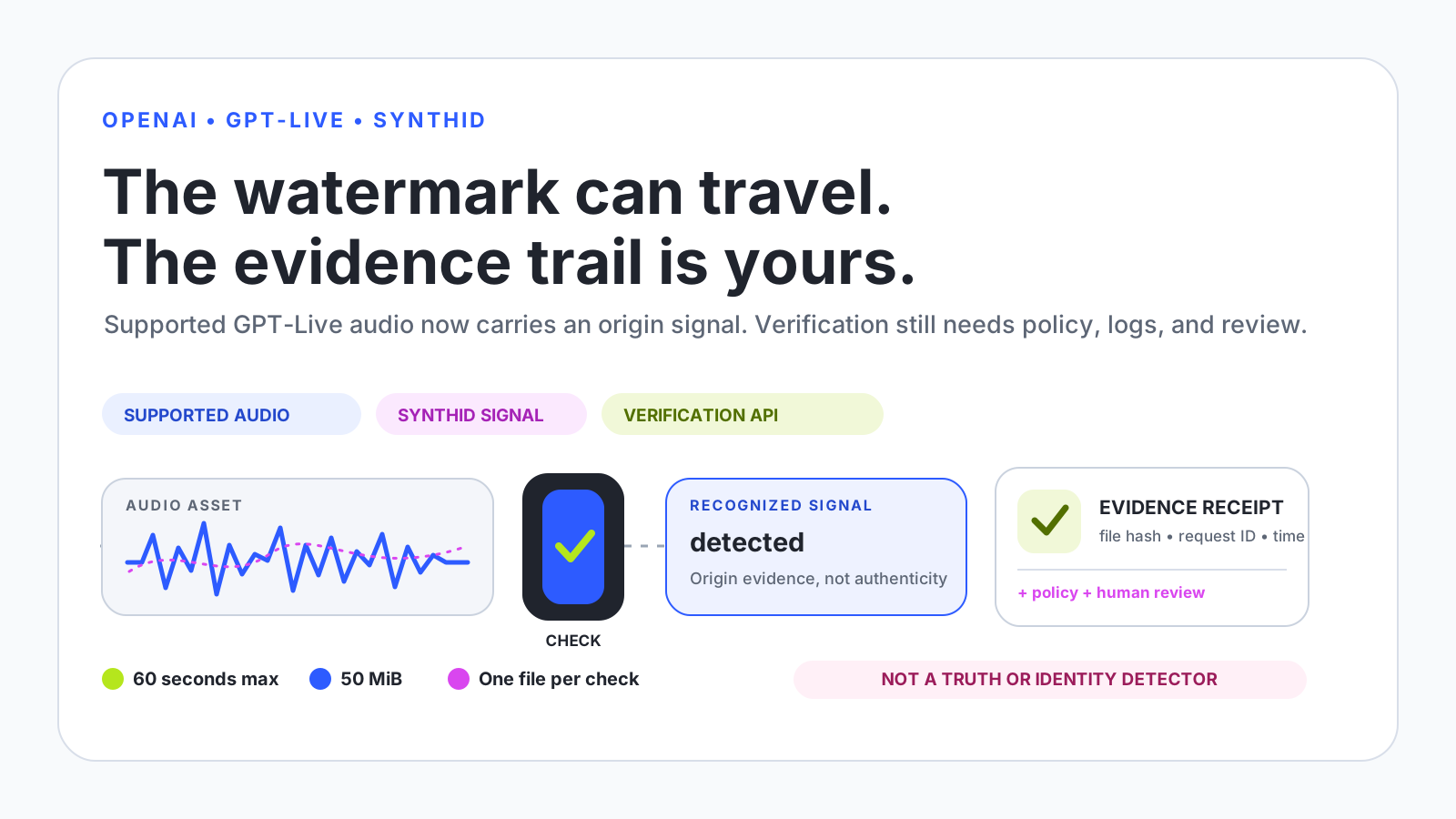
A 20-minute support call contains a five-second malicious insert. Most of the recording began as supported GPT-Live output, so a file-level check finds SynthID. What did the verifier establish? Only that a recognized watermark is present—not that every sentence came from OpenAI, the voice was authorized, or the recording is intact.
On July 31, OpenAI said supported audio generated with GPT-Live through ChatGPT Voice and the OpenAI API now includes Google’s SynthID watermark. It also opened a Content Provenance API so developers can submit supported files and check for OpenAI provenance signals. That sounds like a safety feature attached to a voice model. In production, it is closer to a new infrastructure contract.
A voice agent can no longer be evaluated only on latency, interruption handling, tool use, and how human it sounds. Teams now need to decide where verification runs, which transformations are tested, how a result is bound to an exact file, what a negative result means, who may submit sensitive recordings, and what evidence survives after the provider changes its detector.
OpenAI has created a provider-scoped origin signal and an API surface for acting on it. That signal can support disclosure and investigations. It cannot certify a speaker, a claim, consent, or an entire edited recording. Builders who turn not_detected into “human” will make their systems less trustworthy, not more. The watermark may travel with the waveform; the chain of custody still belongs to the application.
GPT-Live launched on July 8 as a full-duplex model family that can listen and speak at the same time, decide whether to respond many times per second, invoke tools, and delegate deeper work to a frontier model. OpenAI says more than 150 million people use ChatGPT Voice or Dictation each week. Adding a watermark to supported output at that distribution scale matters more than announcing a new watermark algorithm.
RohitAI’s earlier GPT-Realtime 2.1 analysis focused on the production bet behind low-latency voice agents. This is the follow-up: once generated speech leaves that runtime, origin evidence becomes another system that must survive transport, storage, review, and dispute.
Google had already said in May that OpenAI was among the companies adopting SynthID. The July update is where that partnership becomes operational: watermarking is attached to supported GPT-Live audio, the public verification surface expands, and developers get a documented endpoint.
The current contract is precise enough to build against, but narrower than a general “AI detector.”
| Surface | Documented behavior | What builders must not infer |
|---|---|---|
| Generation | Supported GPT-Live audio from ChatGPT Voice and the OpenAI API includes SynthID | That every OpenAI audio model, historical clip, voice, account, or export path is covered |
| Verification | POST /v1/content_provenance_checks returns completed results in the same response | That the endpoint classifies arbitrary media as AI-generated or human-made |
| Audio result | A SynthID outcome is detected or not_detected; model and time may be null | That a positive authenticates every word, or a negative authenticates the speaker |
| Input | One MP3, Opus, AAC, FLAC, WAV, or PCM file; 50 MiB maximum and 60 seconds decoded | That accepting a codec proves the watermark survives every transcode into that codec |
| Operations | Strict rate limits, case-by-case higher-limit access, and no Zero Data Retention eligibility | That the verifier is an unlimited, anonymous, privacy-neutral public utility |
Those limits come directly from OpenAI’s Content Provenance API guide and response schema. One launch detail is still unresolved: the GPT-Live page’s July 31 update refers to audio generated through the API, while unchanged July 8 copy on the same page says API access is coming soon. Teams should verify access, model IDs, generation formats, quotas, and pricing in their own organization rather than infer a broad general rollout.
The safest way to read the API is as a one-way evidence signal.
When SynthID is detected, the file contains a watermark that OpenAI recognizes. That is useful evidence that supported OpenAI tooling was involved. It does not reveal the prompt or the account. It does not prove the speaker consented, the clip has not been spliced, the claims are accurate, or the file is being shown in its original context.
When SynthID is not detected, less can be concluded. OpenAI explicitly says the content may still be AI-generated if the watermark was degraded, it came from a legacy model, it was created before provenance signals were available, or it came from another company’s system. A network failure, unsupported file, missing API access, and rate-limit response are not negative detections either. They are operationally different states.
This distinction matters because voice is often used as identity evidence. AI has already made voiceprint-only authentication unsafe; a watermark does not repair it. Banks, call centers, healthcare providers, and families still need callbacks, liveness checks, transaction limits, account history, device or session binding, and human escalation.
The same is true for edited media. Imagine a 45-second clip containing 40 seconds of watermarked GPT-Live output and a malicious five-second insert. A file-level positive could be misread as authenticating the whole clip even though the dangerous sentence came from somewhere else. OpenAI’s public schema does not document partial-audio localization, so product copy and review policy must resist that overclaim.
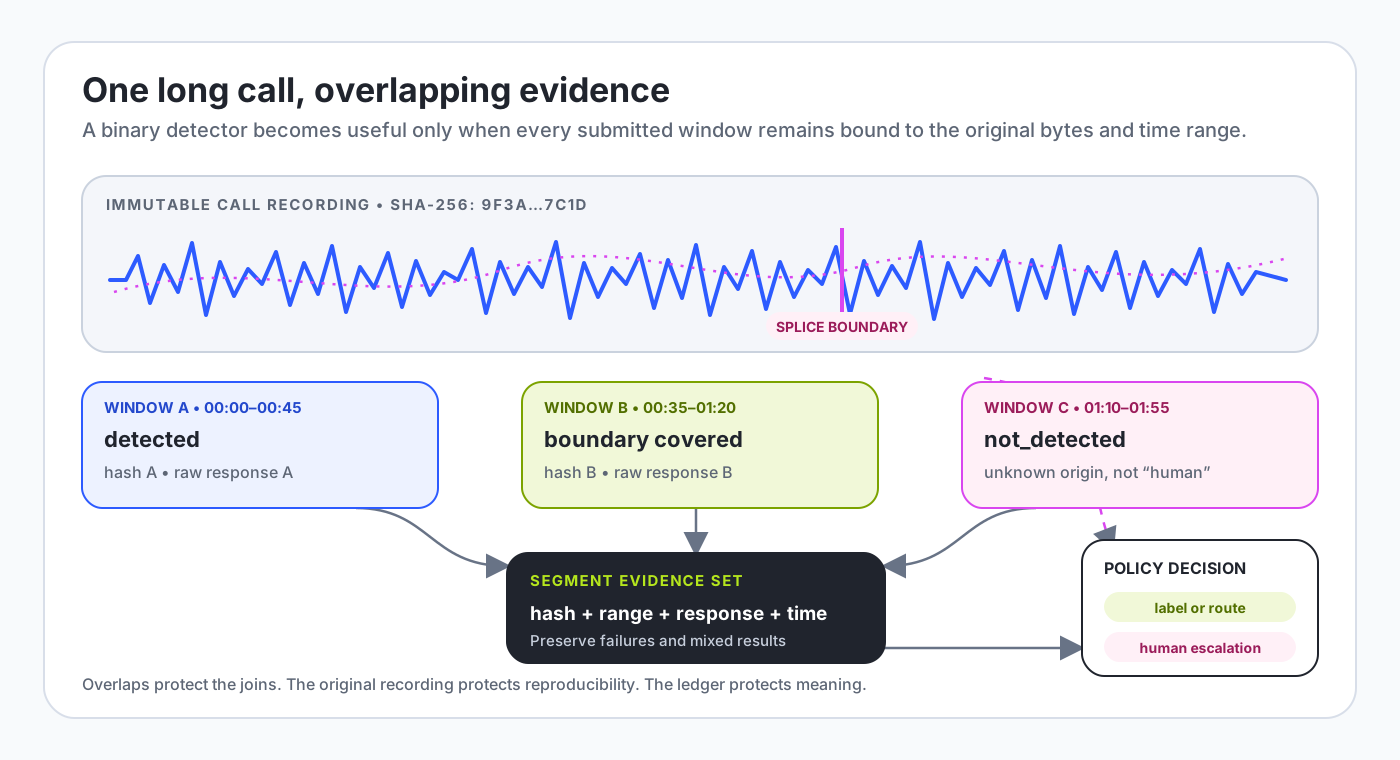
The detector supplies one input to a decision. Transformations, unknown coverage, and evidence handling sit outside the watermark itself.
Audio watermarking gets tested by the messy systems between a model and a listener: WebRTC, SIP, gain control, denoising, echo cancellation, resampling, packet loss, voicemail, messaging-app recompression, screen recording, and speaker-to-microphone rerecording.
Google describes SynthID audio as an inaudible signal embedded in a time-frequency representation and says it is designed to remain detectable after common changes such as noise, MP3 compression, and speed adjustments. That is useful mechanism-level context from Google DeepMind’s original audio deployment and current SynthID documentation. It is not a public codec-by-codec evaluation of OpenAI’s GPT-Live implementation.
The absence of that evaluation matters. OpenAI has not published an audio-specific false-positive rate, recall table, detector threshold, codec matrix, localization result, or independent test for this deployment. General research gives builders a reason to test, not a license to declare SynthID broken. Ofcom’s review of content attribution tools notes that speech is harder to watermark than music and that phone or messaging transformations can remove audio watermarks. AudioMarkBench tested other watermark systems—not SynthID—across 20,000 speech samples, 25 languages, and 15 perturbations, finding failure modes under unseen codecs and adversarial changes.
The correct conclusion is practical: an accepted upload format is not a survival guarantee. If your agent speaks into a telephony network, the test asset is not the WAV master. It is the recording that comes out of the exact phone and storage chain your investigators will later inspect.
The API’s 60-second decoded-audio ceiling is easy to treat as an upload nuisance. For a long call, it changes the shape of the application.
Non-overlapping one-minute chunks are not enough. A splice or degradation event can land exactly at a boundary. Overlapping windows are safer: for example, 45-second segments with a 10-second overlap, each bound to a start time, end time, and cryptographic digest. Preserve the immutable original and record the segmentation algorithm so an investigator can reproduce the submitted bytes.
Your application also needs a policy above the binary detector. A useful internal state model looks like this:
recognized_signal     -> retain evidence; label or route according to policy
no_recognized_signal  -> unknown origin; never certify human authorship
unsupported_input     -> convert only under a logged, reproducible rule
verification_failed   -> retry transient errors; preserve the failure
mixed_segment_results -> escalate; inspect transcript and transformation history
That model is RohitAI’s recommendation, not OpenAI’s response schema. The point is to prevent API errors and coverage gaps from masquerading as clean negatives.
Record the verdict beside the asset and show a careful provenance label. Do not block ordinary playback or imply that an unmarked file is human-made.
Route detected, mixed, failed, or suspicious recordings to a reviewer with the original, transcript, segment map, and transformation history.
Never let the watermark authorize a payment, identity claim, moderation penalty, or legal conclusion by itself. Require independent controls and accountable approval.
A screenshot of “detected” is weak evidence. A production receipt should bind the result to the exact asset and the exact check.
At generation time, store the OpenAI request ID, requested and resolved model when available, tenant, timestamp, user disclosure and consent state, raw output hash, and every downstream transformation. At verification time, add the submitted-file hash, byte size, decoded duration, codec, segment range, API request ID, HTTP status, raw result object, response timestamp, retry history, and your policy decision.
OpenAI’s response can leave the generating model and time null. That makes your own generation receipt more valuable, not redundant. It also makes detector evolution a future audit problem. The public schema does not currently expose a detector version or confidence score, so rechecking the same file months later may produce a result without an obvious way to explain whether coverage changed.
This is where watermarking and signed metadata should complement each other. C2PA can carry signed issuer, creation, and edit assertions, but its metadata can be removed and its assertions are not guarantees of objective truth. A durable in-signal watermark may survive when metadata is stripped, while a signed manifest can say far more about the asset. Keep both when available, plus your own evidence log.
There is also a useful architectural contrast. Meta’s open-source AudioSeal exposes streaming detection, sample-level localization, and optional message payloads. That does not establish anything about SynthID’s accuracy. It shows what enterprises may eventually ask OpenAI for: detector-version fields, localization, signed receipts, self-hosted or escrowed verification, and evidence that remains usable if the original API changes.
The Content Provenance API is not eligible for Zero Data Retention. OpenAI does not publish an endpoint-specific retention period in the guide. For a newsroom source recording, medical call, fraud investigation, or private customer conversation, uploading the file is therefore a data-handling decision, not a harmless lookup.
Strict, unpublished rate limits create another dependency. Organizations can apply for higher limits case by case, and the API may return 429 rate_limit_exceeded. Capacity planning needs a queue, cache, retry policy, and a graceful “verification pending” state. Pricing is not separately listed in OpenAI’s current pricing documentation, which means “not published” rather than “free.”
Those limits also reduce abuse. NIST’s synthetic-content transparency guidance describes a basic detector tradeoff: keep verification private and access becomes a bottleneck; expose it freely and repeated queries can become an oracle for testing watermark removal. Do not put your API key behind an anonymous pass-through endpoint. Authenticate callers, cache by file hash, cap budgets, monitor probing patterns, and follow OpenAI’s prohibition on repeated queries intended to evade the signal.
This expands the migration discipline already discussed in OpenAI’s Audio API Retirement Turns Aliases Into Migration Debt: model and endpoint names are only part of the contract. Codec behavior, retention, evidence, and failure semantics travel with the route.
Four consequences of this launch will outlast GPT-Live’s current model names.
First, verification will become a sidecar, not a destination. The public checker is useful for a person inspecting one clip. The developer API matters because provenance can now sit beside moderation, policy, logging, and incident response. The important product is the workflow after detection.
Second, “unknown” becomes durable data. Most product schemas are biased toward booleans because booleans are easy to query. Audio provenance needs a state machine. If a platform stores every timeout, unsupported format, old-model gap, and negative as is_ai = false, it manufactures certainty that the detector never supplied.
Third, a common watermark family is arriving before a common verification network. Google, OpenAI, and ElevenLabs use SynthID, yet their current tools describe provider-scoped detection. ElevenLabs, for example, says its detector recognizes ElevenLabs SynthID watermarks and explains historical and third-party coverage gaps. Builders still need provider routing, generation receipts, or a future issuer registry. A shared embedding technology is not the same thing as a universal trust layer.
Fourth, distribution platforms may become the most important verifier customers. A model provider sees the pristine output. A messaging service, call platform, newsroom, marketplace, or social network sees the transformed asset where provenance decisions are actually needed. Those platforms will push for codec-survival commitments, signed receipts, detector versioning, bulk access, cross-provider routing, and partial-audio localization.
The timing also deserves careful context. OpenAI’s deployment lands two days before the general application date for EU AI Act Article 50 transparency duties on August 2, 2026. The European Commission says providers of systems generating synthetic audio, image, video, or text must mark outputs in a machine-readable and detectable format under the relevant transparency framework. Commission guidance separately gives pre-existing generative systems a transition until December 2, so August 2 should not be described as GPT-Live’s specific compliance deadline. The launch aligns with the regulatory direction. No public source proves the regulation caused OpenAI to choose July 31, so alignment is the defensible claim—not motive.
The immediate gaps are not reasons to dismiss the launch. They are the next contract surface.
Watch for OpenAI to clarify which GPT-Live model versions and API paths are covered; publish generation pricing and quotas; expose detector coverage or version information; document retention more precisely; and add richer states, confidence, localization, or signed verification receipts. Cross-provider detection will matter even more as SynthID adoption grows.
Independent evaluation is the other missing piece. Teams need false-positive and recall measurements for actual GPT-Live speech across languages, voices, bitrates, codecs, channel noise, splicing, rerecording, and adversarial changes. Until those numbers exist, every serious deployment should maintain its own survival matrix and treat OpenAI’s result as one evidence layer.
OpenAI has made a useful move: supported GPT-Live audio can now carry an origin signal, and organizations can integrate checks into software instead of relying only on a consumer upload page. The mistake would be asking that signal to do work it was never designed to do.
The right production rule is simple. Verify origin when you can, preserve uncertainty when you cannot, and never confuse either result with truth.
OpenAI’s announcement is limited to supported GPT-Live audio generated through ChatGPT Voice and the OpenAI API. It does not publish a complete matrix of historical models, product paths, tiers, regions, or transformations. Verify your exact route and keep generation receipts.
It can tell you whether it detected a supported OpenAI SynthID watermark. It is not a universal AI classifier, does not detect every provider, and cannot prove a file is human-made when no signal is found.
The documented formats are MP3, Opus, AAC, FLAC, WAV, and PCM. Each request contains one file, the maximum size is 50 MiB, and decoded audio must be 60 seconds or shorter.
Segment them into overlapping windows, keep the immutable original, hash every submitted chunk, record exact time ranges, and aggregate results without turning an uncovered interval into a negative. Escalate mixed results for transcript-aligned review.
No. It supports that a recognized OpenAI provenance signal is present. It does not prove speaker identity, consent, factual accuracy, full-file integrity, or proper context, and it does not reveal who prompted or published the audio.
No. OpenAI’s guide explicitly excludes content provenance checks from Zero Data Retention and does not state an endpoint-specific retention period. Review sensitive recordings before submission.