MiniMax H3 Gives Media Agents a 2K Render Queue

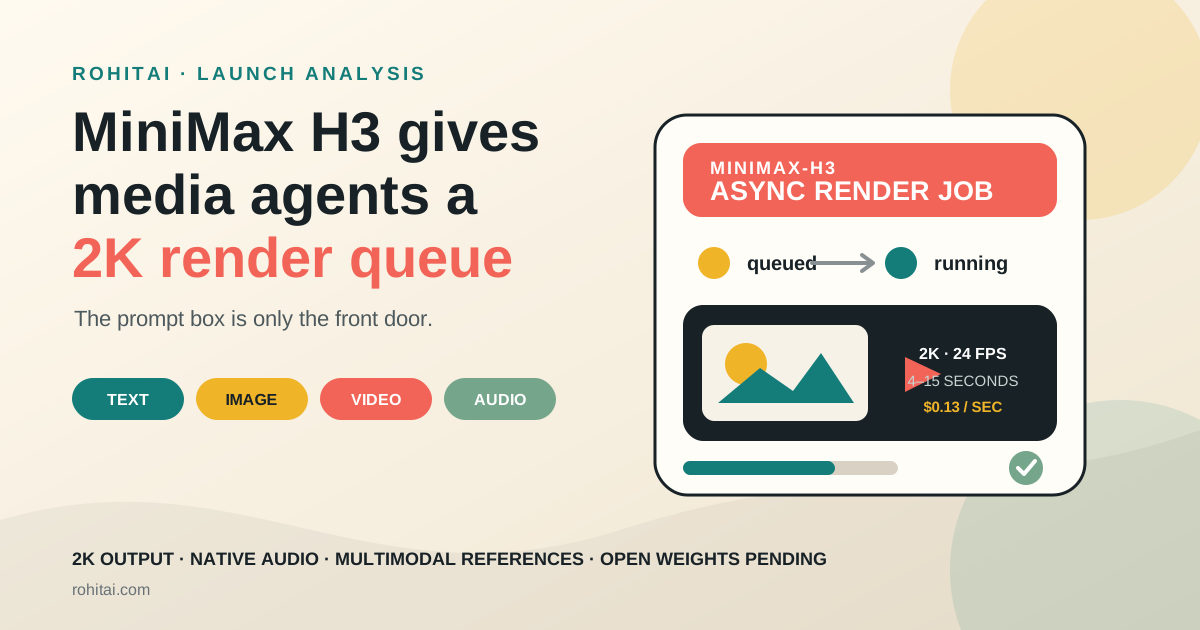
MiniMax launched H3 today with the kind of checklist that usually dominates video-model coverage: 2K output, native stereo audio, clips up to 15 seconds, multimodal references, early leaderboard strength, and promised open weights.
The more consequential change is hiding in the API contract.
H3 does not behave like a clever prompt box. It behaves like a priced, asynchronous render queue that accepts a creative packet: text, images, video, and audio. The packet enters a job system, consumes a scarce concurrency slot, accumulates cost according to its reference mix, and eventually returns a temporary asset URL. Once a render starts, it cannot be cancelled. Seven days later, the provider-side task record falls outside the query window.
That design turns the application around the model into the product. A useful H3 system needs durable creative state, cost-aware routing, owned asset storage, provenance, review branches, and recovery from missed callbacks. Prompt quality matters, but it is no longer the hardest engineering problem.
The launch also contains two distinct releases that should not be collapsed. The hosted MiniMax-H3 API is live and documented. The downloadable checkpoint is promised and scheduled, but was not public when this article was prepared. “API available” and “open weights available” are different operational facts.
That distinction is worth holding onto because H3 could become an unusually important render worker for media agents. Its strongest early independent result is in video editing, not a clean sweep of generation leaderboards. The likely winner is therefore not another one-shot text-to-video toy. It is software that can assemble references, preserve intent across iterations, decide which modality is worth paying for, and turn a probabilistic render into an auditable production asset.
The official H3 create endpoint is explicit. A request goes to POST /v2/video_generation, names MiniMax-H3, supplies a required text item and optional media, then receives a task_id. The application queries that task or handles callbacks until it reaches a terminal state.
In compact form:
creative packet
  -> validate media and rights
  -> estimate the maximum charge
  -> reserve a concurrency slot
  -> submit MiniMax-H3 task
  -> persist task_id and source hashes
  -> receive callback or poll
  -> copy the MP4 into owned storage
  -> score, review, approve, or branch
That is a resource lifecycle, not a synchronous inference call.
The query response makes the shift visible. It returns timestamps, status, duration, resolution, ratio, usage fields, and eventually content.url. The model output is part of a job record with billing information. Treating the returned URL as the permanent product asset would be a mistake because MiniMax says result URLs expire.
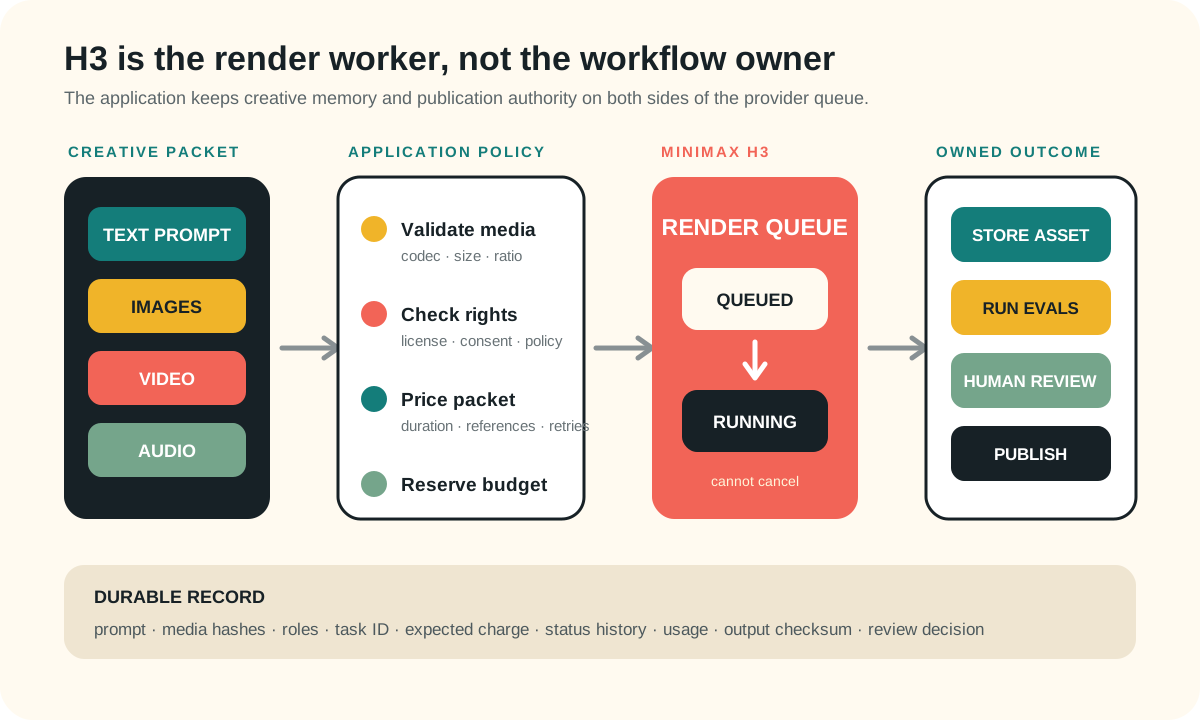
H3 can be the render worker. The application still owns creative state, cost policy, storage, evaluation, and publication authority.
This resembles a broader agent lesson we covered after the latest MCP protocol release: making a transport or capability stateless does not remove state from the product. It moves state into the layer that can actually own it.
MiniMax calls H3 a general-purpose multimodal video model. That is fair at the capability level, but the typed API still has distinct lanes.
Text-to-video accepts only the required text item. The caller must choose a ratio from 21:9, 16:9, 4:3, 1:1, 3:4, or 9:16.
Frame-anchored image-to-video accepts a first frame, a last frame, or both. The input frame determines the output shape, so the endpoint treats the ratio as adaptive.
Reference-to-video accepts reference images, video, and audio alongside text. MiniMax says references can carry identity, objects, motion, camera language, style, voice, and editing rhythm. Audio cannot be the only media reference; at least one image or video must accompany it.
The important boundary is that frame anchoring and the reference workflow are mutually exclusive in one request. You cannot combine a first-frame constraint with arbitrary reference images, videos, or audio and ask the endpoint to reconcile everything. The product needs separate adapters and, in some cases, a multi-step workflow.
The documented envelope is generous but finite: up to nine reference images, three video clips, and three audio clips, with no more than 12 mixed media files. Reference video and audio can each total at most 15 seconds. The entire JSON body is capped at 64 MB, which makes URLs or MiniMax file references preferable to Base64 for serious inputs.
This is also not a deterministic nonlinear editor. The public schema exposes no masks, regions, keyframe timeline, seed, sampler, negative prompt, timecodes, or per-track audio controls. H3 may understand an edit semantically, but production software still needs an orchestration layer for versioning, selection, compositing, and exact corrections.
The confirmed public contract is already substantial. MiniMax’s model overview, pricing page, and rate-limit table establish the following:
MiniMax also says H3 jointly generates video and native stereo audio. Its launch material names a stack that includes Contextual Omni Representation, H3-VAE, H3-Omni Transformer, and In-Context Regeneration. Those are useful clues about the design, but they remain vendor claims until MiniMax publishes the promised technical report, model card, and reproducible artifacts.
The early independent signal is better than most day-one launches. At the research cutoff, Artificial Analysis placed H3 second in its with-audio text-to-video arena at 1,242 Elo from 5,084 samples. It ranked first for with-audio video editing at 1,130 Elo from 5,044 samples and third for with-audio image-to-video at 1,185 Elo from 5,016 samples.
Those rankings are live, and the leading confidence intervals overlap. They support “highly competitive on day one,” not “proven best video model.” More interestingly, the editing lead is the cleanest clue about H3’s product wedge. A reference-heavy editor has more repeat use and more application state than a prompt lottery.
MiniMax’s pricing design makes modality part of unit economics.
At 2K, generated output is $0.13 per second. Reference audio is free. The first five images are free, then each additional image costs $0.04. Reference video is billed by its own duration at the same resolution-based rate as output video.
| 2K workflow | 4-second output | 10-second output | 15-second output |
|---|---|---|---|
| Output only | $0.52 | $1.30 | $1.95 |
| Same-length reference video | $1.04 | $2.60 | $3.90 |
| Same-length video + nine images | $1.20 | $2.76 | $4.06 |
Calculated from MiniMax’s listed rates. Nine images add $0.16 because the first five are free. The table excludes retries and any downstream storage, review, or editing cost.
This creates a non-obvious product opportunity: the media agent can act as a reference compiler. It can decide whether a creative instruction really needs a video clip or whether a few stills plus audio preserve enough intent. The choice affects both control and price.
That does not mean “always avoid video.” Motion transfer and editing rhythm may be exactly why H3 is valuable. It means the interface should show the cost consequence before submission and learn which reference mix produces the lowest cost per accepted second.
The relevant metric is not cost per generated clip:
cost per accepted second =
  all render charges
  + reference surcharges
  + failed creative branches
  + human review cost
  divided by approved output seconds
That is the video equivalent of the cost-per-completed-task framing in our Lyria 3.5 production analysis. Cheap drafts are not cheap if nobody can use them.
H3’s rate limit is concurrency: two simultaneous tasks in the tier labeled free and 15 on paid accounts. Without a published latency distribution or SLA, that is not enough information to promise turnaround time.
A team should measure at least four distributions:
Those distributions determine useful capacity. Fifteen concurrent tasks can support a responsive tool if renders finish quickly and pass review. The same cap can become a bottleneck if long reference-heavy jobs sit in the running state for minutes and require multiple attempts.
Cancellation makes this sharper. MiniMax’s delete endpoint can cancel a queued task without charge, but a running task cannot be cancelled. A user closing the browser or changing their mind does not stop the compute bill. The product therefore needs admission control before submission, not a decorative cancel button after the expensive state begins.
Callbacks help, but they do not transfer ownership of reliability. The callback endpoint must answer MiniMax’s verification challenge within three seconds. Applications still need deduplication, polling recovery, and reconciliation for events that arrive late or twice.
MiniMax’s API release notes describe H3 as an open, general-purpose model, and the company says weights are coming. That direction matters. Open video weights with native audio and rich references could unlock local customization, private media pipelines, new accelerator support, and a much faster community optimization cycle.
But the artifact state at publication is simple: the hosted API exists; the public checkpoint does not.
MiniMax’s official ModelScope H3 record is a pre-release page scheduled for August 3 at midnight Beijing time, or August 2 at 16:00 UTC. It lists the planned MiniMax/MiniMax-H3 artifact but no downloadable revision, model card, final license, parameter count, checkpoint size, hardware floor, serving code, or reproducible local benchmark.
That makes the weight drop a second launch with its own acceptance tests:
We made the same release-state distinction in our Inkling-Small analysis: a checkpoint, a hosted API, and a production serving path are related, but they are not interchangeable.
Best when shipping speed, 2K output, multimodal references, and managed inference matter more than data locality or runtime control. Persist assets and job state outside MiniMax from day one.
Best when local deployment, customization, private media, or accelerator choice is central. Wait for the actual files, license, model card, hardware envelope, and parity tests.
Best for products that cannot let one render queue become their architecture. Normalize creative packets, job state, spend limits, storage, and evals across H3 and alternative backends.
Three less obvious consequences follow from this launch.
If H3 can absorb many kinds of context, assembling that context well becomes more valuable than writing one perfect prompt. Products will compete on reusable characters, brand packs, shot history, reference permissions, rejected branches, review notes, and the ability to resume a campaign without rebuilding its context.
The defensible asset is not a textbox. It is a state graph that knows which references were used, what changed, what was approved, and which outputs may be published.
Because images, audio, and video have different prices and control properties, routing is no longer a purely technical optimization. Choosing stills over motion references can change both the bill and the result. The best agent will learn a project’s acceptance function: when a paid motion reference materially improves continuity, when audio is enough to establish rhythm, and when extra images stop helping.
That is a new kind of model router. It routes evidence, not just prompts.
Even if the same base weights ship, the API and local route will diverge through quantization, schedulers, regeneration stages, safety systems, caching, and hardware constraints. Builders should expect output parity to be a measured variable, not a default assumption.
The market will argue about whether a checkpoint “matches the API.” The more useful question is whether each route meets the product’s quality, latency, privacy, and cost target.
There is a fourth signal in the early rankings: H3’s cleanest lead is editing. That points toward tools where each render belongs to a continuing project—advertising variants, e-commerce motion, UI demonstrations, game assets, and reference-driven post-production. Those workflows reward memory and control. They also create switching costs above the model.
Commercial teams should add one more review. MiniMax’s API terms place responsibility for reference rights and consent on the customer and allow service-related uses of submitted content under the contract. Account-specific retention and training controls deserve clarification before sensitive customer media enters the system.
There is also an active copyright case brought by major studios against MiniMax and its Hailuo service. A court denied MiniMax’s motion to dismiss the copyright claims in May, finding the allegations plausible at the pleading stage. That is not a finding of liability. It is, however, a reason for brands to treat asset lineage, rights review, and provider disclosure as release gates rather than paperwork after publication.
The H3 endpoint documentation reviewed for this article does not describe masks, C2PA credentials, watermark controls, or API-level provenance metadata. That is a documentation gap, not proof that safeguards are absent. Builders should ask MiniMax directly and preserve their own lineage either way.
The first checkpoint drop will answer the most urgent unknowns: license, size, architecture detail, hardware floor, and whether native audio plus 2K regeneration survive the local path.
After that, watch the 768P route. MiniMax already lists it at $0.09 per second but labels it closed beta, while the public V2 schema exposes only 2K. A broadly available draft tier would materially change iteration economics.
Also watch the concurrency model. If H3 wins commercial volume, serious customers will need higher caps, priority admission, or published completion-time targets. Queue capacity will matter as much as model quality.
Finally, watch whether competitors respond to H3’s price-quality position with lower rates or richer reference APIs. Google’s Veo API pricing ranges from cheaper Lite and Fast options to a much more expensive Standard tier, so “H3 is one-third the price” is not a universal comparison. The durable competitive pressure comes from combining credible quality, 2K output, native audio, reference control, and a usable price—not from one selective ratio.
MiniMax calls H3 open and says it plans to release weights. At publication time, the hosted API was live, but the public checkpoint, final license, model card, and serving code were not yet downloadable. “Open-weight promised” is the accurate current label.
The public V2 endpoint currently accepts 2K and whole-second durations from four through 15 seconds at 24 fps. MiniMax lists 768P pricing, but says that route is in closed beta.
Yes, reference audio is supported and is free under the current pricing. It cannot be the only media reference; the request must include at least one reference image or video. MiniMax also says H3 generates native stereo audio with video.
A 15-second 2K output costs $1.95 before reference charges. Adding 15 seconds of reference video raises the model charge to $3.90. Using all nine reference images adds another $0.16.
No. It returns a task ID. The application must receive callbacks or query the job until it succeeds, then copy the result from a temporary URL into durable storage.
MiniMax H3 is a strong video-model launch. More importantly, it is a clear preview of how media agents will be built.
The model consumes a multimodal creative packet. The surrounding product decides what belongs in that packet, how much it may cost, where the job waits, how the output is preserved, whether it matches the brief, and who may publish it.
H3 can own the render. It should not own the workflow.