OpenAI Astra’s Ten Math Advances Make Verification the Product

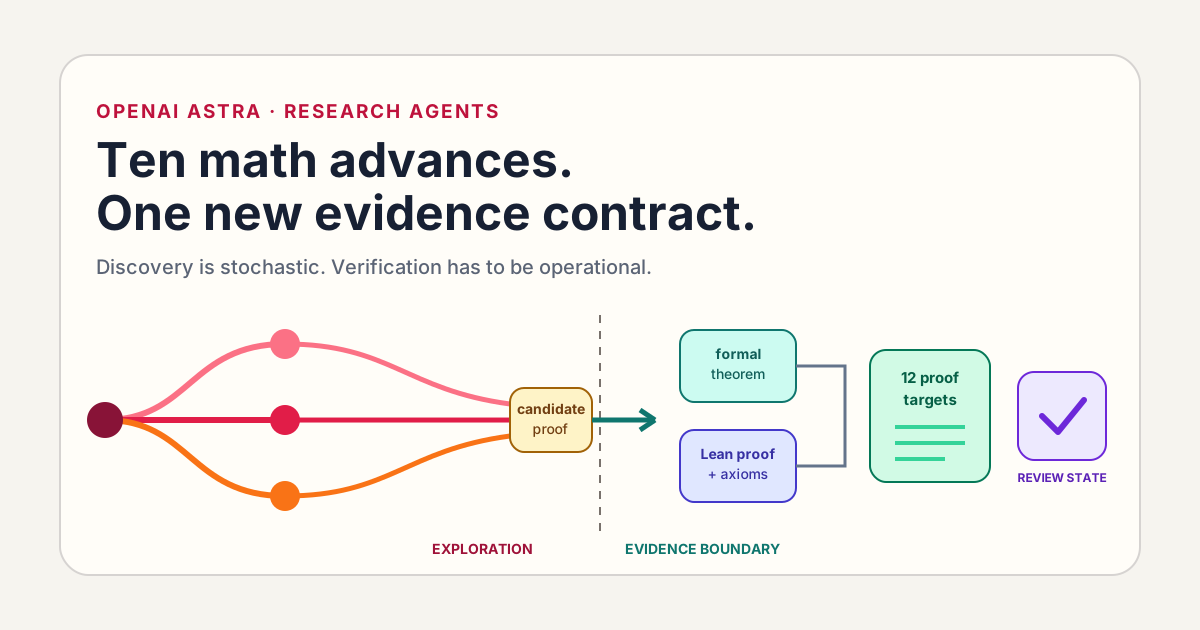
OpenAI has given us the first consequential look at Astra, the model it calls its next major release. There is no API, model card, price, or launch date. Instead, OpenAI published something more provocative: ten claimed advances across mathematics and theoretical computer science, supported by a 249-page manuscript collection and a public repository of Lean proofs.
The obvious headline is that AI is starting to solve research problems. The more useful conclusion is that the unit of AI progress just changed. A benchmark returns a score. A research agent has to return a claim, an argument, a formal statement, a proof object, dependencies, checker output, prior-art evidence, and a review state. Without that bundle, “discovery” is only a compelling demo.
OpenAI says an internal version of Astra found the arguments, humans prepared the manuscripts with the same model, and the model then formalized each argument in Lean. It also estimates that the solution-finding tokens would cost roughly $2,000 at GPT-5.6 Sol API rates. Those are striking claims. They are not the same as ten independently reviewed, peer-reviewed results, and they do not reveal the cost or success rate of the full research process.
That distinction does not make the release smaller. It makes it more instructive. Astra’s immediate builder lesson is not “switch your model ID.” It is: treat stochastic discovery as an untrusted front end, and make evidence the product surface.
OpenAI’s announcement covers problems in high-dimensional geometry, coding theory, group theory, operator algebras, arithmetic circuit complexity, quantum complexity, lattice hardness, convex geometry, Ramsey theory, and extremal graph theory. OpenAI says the chosen problems had seen no progress on their main result for at least a decade, and usually longer.
The range matters. This is not one model stumbling into one construction. The collected paper claims, among other results:
Two qualifications belong beside that list. The permanent result does not prove VP ≠ VNP. The closest-vector result is a worst-case complexity advance; it is not evidence that deployed post-quantum cryptography has been broken.
The release also packages its evidence differently from a conventional model launch:
The count mismatch is useful. “Ten advances” is a communication layer. The formalization manifest exposes twelve main results, permits Lean’s standard propext, Classical.choice, and Quot.sound axioms, and labels the review state agent-reviewed. For future research-agent comparisons, the serious unit is not the launch bullet. It is the independently checked claim with a known significance and provenance state.
Lean changes the credibility of this announcement. The open-source repository contains proof files, dependency pins, and a set of Comparator challenge configurations. That gives outside researchers something concrete to inspect and attempt to replay. It is far stronger evidence than screenshots of a chat or a model-written PDF alone.
But formal verification answers a specific question: does this proof term establish this encoded theorem under these definitions, dependencies, and axioms?
It does not, by itself, answer three other questions:
Those questions sit at the translation and community-review boundaries. Because OpenAI says the same model family found and formalized the arguments, there is also correlated risk: a mistaken interpretation could survive from discovery into the encoded theorem. An independent problem formalization, prepared before the proposed proof is revealed, would create a stronger check. The Leiden Declaration on AI and Mathematics makes the broader distinction: formalization can still fail in the translation between encoded and human concepts, and a press release cannot replace external scrutiny or peer review.
Here is the status stack builders should use:
| Layer | What it establishes | What it does not establish | Builder control |
|---|---|---|---|
| Manuscript | A readable claim and argument exist | Correctness, novelty, or faithful formalization | Version prose, citations, and claim IDs |
| Lean certificate | A proof term inhabits the encoded theorem | That the encoding matches the public claim | Pin definitions, axioms, libraries, and toolchain |
| Independent replay | The artifact checks in a controlled environment | Novelty or field significance | Isolate checking and retain signed logs |
| Expert review | Claim alignment, context, novelty, and plausibility | Journal acceptance or durable consensus | Record reviewer identity, scope, and disagreement |
| Peer review | A publication venue completed its review process | Infallibility or permanent significance | Expose venue, version, corrections, and status |
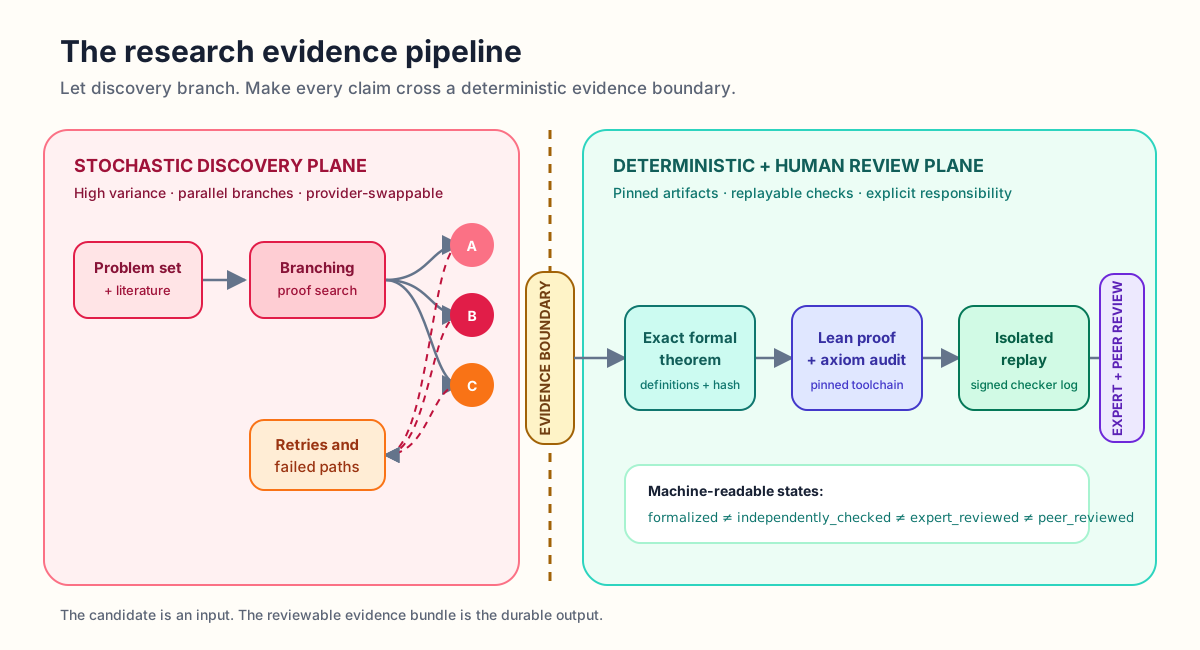
The generator can change. The evidence contract should survive it.
The best mental model for Astra is not an artificial mathematician sitting alone at a chalkboard. It is an untrusted compiler front end.
The front end retrieves literature, proposes abstractions, branches into proof strategies, abandons dead ends, and produces candidate arguments. That work can be stochastic and expensive. The back end turns a candidate into a typed artifact: exact theorem, definitions, proof term, axiom report, dependency graph, checker result, literature provenance, and review record.
This split has an important engineering consequence: the generator becomes replaceable. A research platform can route exploration between Astra, Sol, another frontier model, a specialist symbolic system, or human researchers. The stable interface is the evidence bundle that every generator must emit.
That is also where the release remains asymmetric. OpenAI has opened the checking side while keeping discovery closed. The 62-page discovery notes explicitly say a model reconstructed the narratives after reading the original chains and finished papers. They are valuable explanations, but not raw run logs. Outsiders can inspect proof artifacts; they cannot reproduce Astra’s prompts, scaffolding, seeds, retries, selection criteria, or human interventions.
Google’s experimental Science One Framework reaches a similar conclusion from empirical science. It binds claims to evidence during the workflow and audits references, reproduced scores, specification compliance, and method-code alignment. Across 75 generated papers, Google reported phantom-reference rates as high as 21% for baselines while its evidence-by-construction system produced none. Those are Google’s results, not an audit of Astra, but the architecture generalizes: provenance added after writing is weaker than provenance built into the run.
This is also the research version of a point from RohitAI’s Codex Security analysis: missing evidence should not quietly degrade into a clean result. not_independently_checked and insufficient_prior_art_review need to be valid terminal states.
The Astra repository pins Lean and mathlib to 4.32.0. Lean’s 4.32.1 release notes disclosed a kernel soundness bug in 4.32.0 and said the recommended Comparator route for possibly dishonest proofs was unaffected. The exact check path still varies: the pinned quantum repetition and GapCVP configurations disable the optional nanoda kernel, which Comparator supports as an additional implementation. The pinned lakefile also names a permanent superquadratic Comparator root that is not present in that commit. That is not evidence against the theorem; it is a launch-packaging inconsistency that a clean replay pipeline should catch.
That detail is not a reason to dismiss OpenAI’s certificates. It is a reason to operationalize them.
A proof object depends on a theorem statement, definitions, a prover version, libraries, build configuration, and a checking path. That is a software supply chain. It needs commit-pinned releases, reproducible builds, axiom allowlists, isolated checking, retained logs, and replay after security updates. A mutable repository without a tagged release or published CI attestation is inspectable, but it is not yet the strongest possible verification package.
Call the discipline ProofOps:
candidate claim
  -> exact formal statement
  -> proof source + dependency lockfile
  -> axiom audit
  -> isolated kernel / Comparator replay
  -> expert claim-to-theorem review
  -> novelty review
  -> peer-review state
The trust boundary is no longer just “did the model hallucinate?” It includes “did the formal statement preserve what the human headline promised?” That semantic boundary deserves the same seriousness as a schema migration or a signed build artifact.
OpenAI’s roughly $2,000 estimate is easy to turn into a misleading “$200 per breakthrough” headline. Do not.
The announcement says this is the Sol-rate token cost for finding the ten selected solutions. It does not disclose the input/output/cache mix, the number of failed attempts, the attempted problem pool, per-problem allocation, wall time, human steering, manuscript effort, formalization cost, infrastructure, or independent review.
That missing cost stack points to a genuine shift. If frontier models make candidate ideas cheap, then specification and validation become scarce. The expensive resource may not be the first plausible proof. It may be the expert capable of comparing the formal theorem with the field’s actual question, checking novelty, finding a subtle gap, and explaining why the result matters.
The metric for a research product should therefore be:
total dollars + expert hours
---------------------------------------------
independently checked, novel, accepted results
It should not be cost per showcased solution. It should include every attempted problem, every retry, every human intervention, every formalization failure, and every reviewer disagreement.
OpenAI published ten selected successes. It did not disclose how many problems Astra attempted, how the problems were chosen, how many candidates failed, or how much human judgment entered selection.
That makes direct capability comparisons premature. Google DeepMind’s Aletheia disclosure reported an evaluation over 700 open Erdős problems, including four autonomous solutions, and explicitly left its “Major Advance” and “Landmark Breakthrough” categories empty. OpenAI’s portfolio may contain results of greater significance. DeepMind’s disclosure provides a denominator and a significance taxonomy. A credible eval needs both.
OpenAI itself has shown why. In February, its First Proof report said one attempt initially considered likely correct was later judged incorrect after organizer and community feedback. OpenAI also disclosed strategy retries, expert-feedback revisions, and human selection among attempts. Model confidence and internal review were not enough.
The next serious research-agent benchmark should use sealed, time-bounded problem pools; record all attempts; separate solved holdouts from genuinely open problems; grade significance independently; and report verified yield per attempt. Best-of-launch portfolios are valuable capability evidence, but they are not an eval protocol.
There is no Astra entry in OpenAI’s public model catalog. Do not build pricing assumptions, latency targets, or product dependencies around an internal name. Build the verification plane instead.
Best for teams without formalizable workloads or qualified reviewers. Track public access and independent validation. Revisit only when OpenAI publishes a callable model and reproducible capability details.
Version claims, provenance, deterministic checks, review states, and immutable logs now. Use an available model for exploration and keep the frontier reasoning stage provider-swappable.
Use a sealed problem pool, record every attempt and intervention, and require formal or executable checks. Expand only if independent experts confirm lower total research time without higher review burden.
OpenAI’s position is unusually direct: it says assigning human authorship to arguments generated entirely by AI would misrepresent both the model’s contribution and human intellectual work. The paper lists OpenAI as author, and the company says it takes responsibility for correctness.
The Leiden Declaration takes a conflicting view: credit and responsibility should remain with humans. This is not a cosmetic disagreement. Journals, conferences, labs, and research platforms need to decide who can be an author, who is accountable for an error, how model-generated ideas are cited, how training-derived influence is attributed, and who receives academic or commercial credit.
A research agent that omits those fields is incomplete. Provenance is not only technical. It is institutional.
OpenAI has released enough to justify serious attention: exact manuscripts, formal targets, an axiom manifest, and public proof artifacts. It has not released enough to justify collapsing every verification and review state into “solved.”
The strongest evidence will now come from outside the launch: independent Comparator replays, specialists comparing formal statements with the papers, prior-art challenges, corrections, follow-on work, and peer-reviewed publication. That is how mathematics is supposed to absorb a claim this large.
Astra is a major signal even if some results are later narrowed or corrected. It suggests frontier research systems are moving beyond olympiad answers and isolated proof demonstrations toward portfolios of inspectable work. RohitAI’s earlier GPT-5.5 coverage tracked the transition from benchmark math to an internal Lean-verified Ramsey result. Astra scales that pattern into a research package.
The builder takeaway is concrete: do not make the model the source of truth. Make it a prolific, replaceable proposer inside a system that knows exactly what has been claimed, what has been checked, who checked it, what remains uncertain, and which evidence would change the status.
That is a harder product than a chatbot. It is also the product frontier research agents actually need.