OpenAI’s Agents SDK Turns a Package Upgrade Into a Runtime Migration

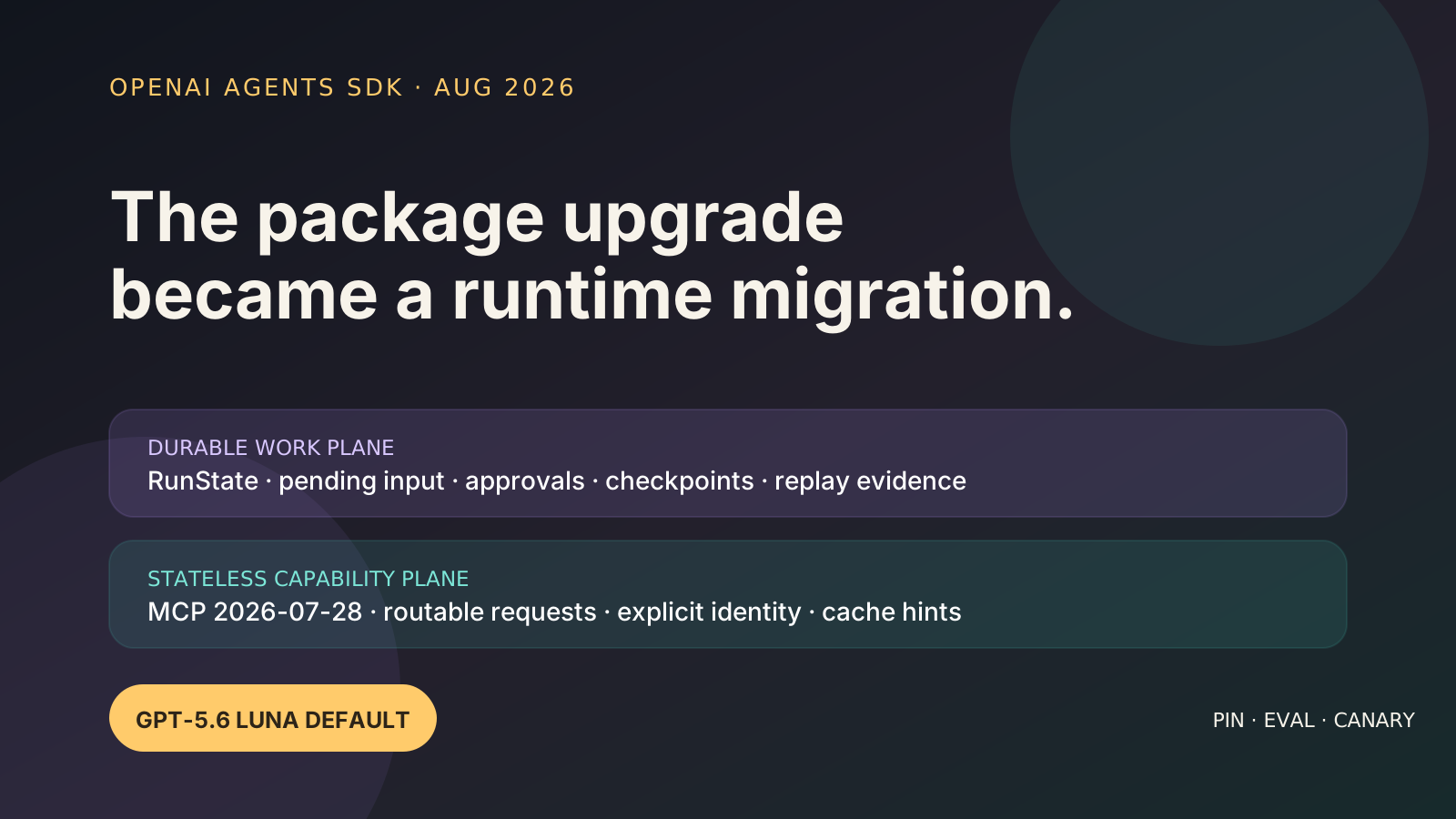
OpenAI shipped two Agents SDK releases on August 11 that look like ordinary version bumps until you count how many production assumptions move at once.
Python openai-agents v0.20.0 and JavaScript @openai/agents v0.15.0 change the implicit model from GPT-5.4 mini to GPT-5.6 Luna. They negotiate the new MCP 2026-07-28 protocol while retaining legacy fallback. They make pending input and completed tool progress more durable across pauses and retries. They also tighten which sandbox credentials survive a resume.
That combination is the story. OpenAI is turning the Agents SDK from a convenient orchestration layer into a runtime that owns economic policy, protocol compatibility, work state, replay boundaries, and authority restoration.
The tempting headline is that Luna makes agents cheaper. At current list prices, it costs 73.3% less per token than the previous default and offers a 1.05 million-token context window. But a production deployment does not buy tokens in isolation. It buys completed runs, tool effects, recovery behavior, and evidence. An SDK upgrade that silently changes the model can alter all four.
The right response is neither “upgrade immediately” nor “pin forever.” Treat this as a runtime migration: make the hidden defaults visible, canary the whole agent loop, record the negotiated MCP version, crash the run on purpose, and prove that progress can move between workers without credential authority hitching a ride.
That is a bigger shift than the package numbers suggest.
The JavaScript v0.15.0 release and Python v0.20.0 release are coordinated, but they are not just language-parity housekeeping.
They move five boundaries that production teams normally review separately.
| Boundary | What changed | What can break | Evidence to keep |
|---|---|---|---|
| Model policy | Implicit default moves to GPT-5.6 Luna | Tool choice, latency, refusals, output shape | Requested model, served model, settings, eval version |
| Protocol | MCP 2026-07-28 negotiation with legacy fallback | Custom auth, SSE assumptions, stale capability caches | Negotiated version, transport, extensions, cache scope |
| Work state | Pending input and structured tool state survive serialization | Duplicate admission, lost approvals, unsafe replay | Checkpoint ID, invocation identity, replay decision |
| Authority | Credential mounts fail closed on resume | Resumed jobs lack access—or regain too much | Effective mount path, grant, broker issuance |
| Observability | More raw usage, request IDs, citations, and tool structure are preserved | Cost or incident analysis based on incomplete traces | Provider request ID, raw usage, citations, effect receipt |
This is why the minor-version framing is appropriate. The Python SDK’s own release policy reserves minor bumps for public-interface breaking changes, and the MCP dependency edge can be genuinely breaking for custom transports.
The model swap has a clean headline. OpenAI’s current model pages list GPT-5.6 Luna at $0.20 per million input tokens, $0.02 cached input, and $1.20 output. GPT-5.4 mini costs $0.75, $0.075, and $4.50 respectively. Luna’s rate is 26.67% of the old default across all three categories.
Luna also raises the nominal context window from 400,000 to 1,050,000 tokens while retaining a 128,000-token maximum output. That looks like a free expansion. It is not.
According to the current Luna model reference, requests above 272,000 input tokens are billed at 2× input and 1.5× output for the full request. Cache writes cost 1.25× uncached input. A team that allows histories to grow because the new window can hold them may spend more than its per-token spreadsheet predicts.
The release keeps reasoning.effort at none and text verbosity at low. That matters more than the launch benchmark table. OpenAI reports strong Luna results on coding and agent evaluations, but those vendor results are not an Agents-SDK-specific comparison of Luna-at-none against GPT-5.4-mini-at-none.
So the honest claim is narrow: the default is much cheaper per token and has more context capacity. Whether it is better per completed run is your eval result, not OpenAI’s launch result.
This connects directly to RohitAI’s earlier argument that every agent run is a cost graph. The useful unit is not dollars per million tokens. It is dollars per accepted outcome, including retries, tool calls, review, safeguard latency, and cleanup.
RohitAI covered the protocol change when MCP 2026-07-28 deleted the transport session. The new Agents SDK releases are the implementation sequel.
Modern MCP retires the initialize / initialized exchange and the Mcp-Session-Id header. Each request carries its protocol version, client identity, and capabilities. Optional discovery, header-visible routing, cacheable list responses, and Multi Round-Trip Requests make the capability layer easier to route and scale.
At the same time, OpenAI makes RunState more durable.
That is not a contradiction. It is a two-plane architecture.
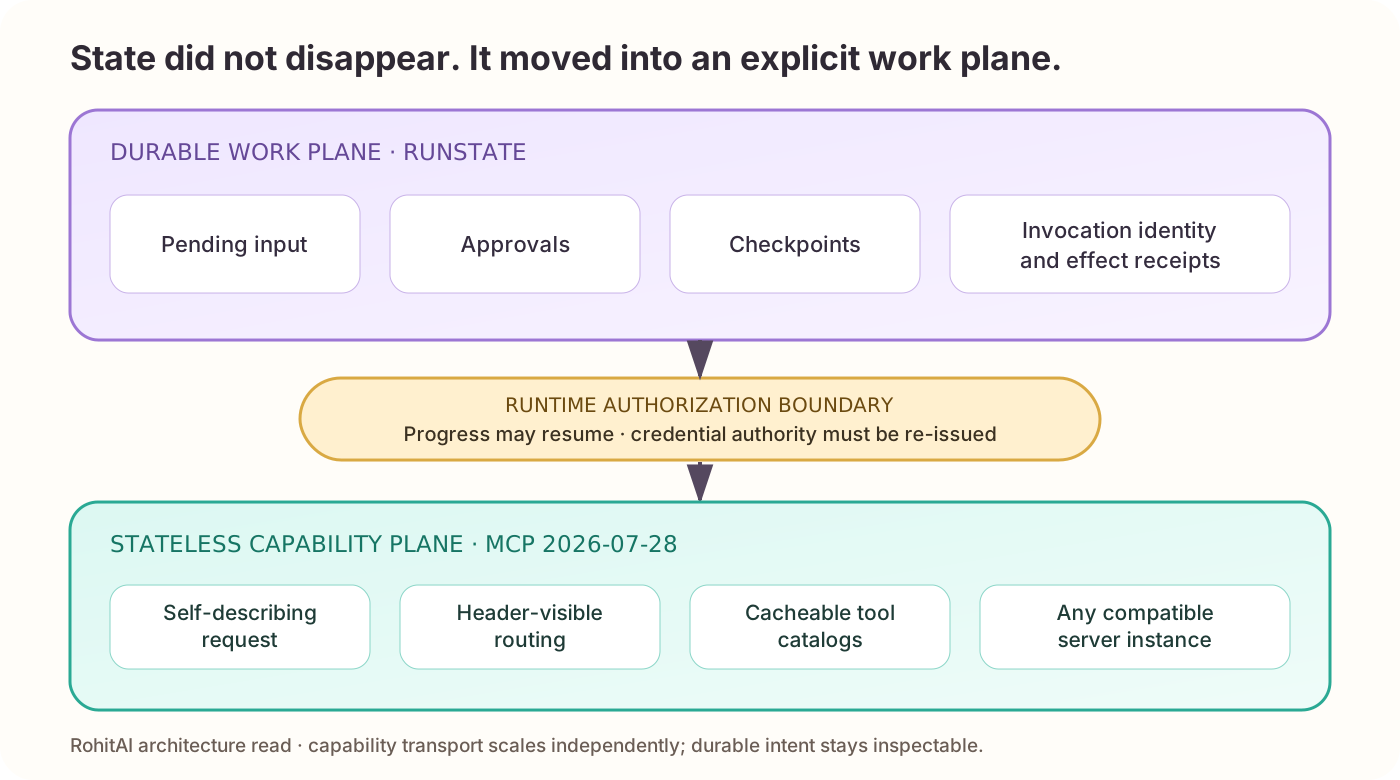
The useful split: capability calls become independently routable, while pending intent, approvals, checkpoints, and replay authority stay explicit in the work layer.
The lower plane answers: What tool exists, who may call it, and where should this request go?
The upper plane answers: What work is unfinished, what has already happened, what input arrived while paused, and what may be replayed?
This is the first non-obvious lesson from the release: stateless infrastructure does not remove state. It forces state into a place where it can be named, serialized, inspected, and governed.
That is healthier than hiding durable intent inside a sticky HTTP session. It also creates a clearer failure model. An MCP request can land on any compatible server instance; the agent runtime carries the workflow’s continuity.
Python’s RunState.add_input() and JavaScript’s RunState.addInput() can stage user input while a run is paused. The pending input survives serialization, passes input guardrails, and is admitted before the next safe model call after unfinished work completes.
The SDKs also preserve structured tool outputs and bind approvals or completed replays to canonical invocations. Checkpointed model responses and finished local tool progress reduce the chance that a normal retry will resend pending input or re-run a completed local side effect.
That is meaningful reliability work. It is not a universal exactly-once guarantee.
Suppose an agent calls send_invoice, the downstream service accepts it, and the worker dies before recording the response. No amount of local RunState precision can prove that the invoice was not sent. An explicitly approved unsafe provider replay can also repeat work. The application still needs an idempotency key, an effect receipt, and a reconciliation path.
The useful promise is closer to exactly-once-ish admission inside the SDK. The SDK can remember which input it admitted and which canonical tool invocation it completed. Your external systems remain responsible for effect semantics.
The sandbox credential changes reveal a second architectural principle.
Credential-bearing in-container mounts now fail closed unless the application acknowledges the exact effective mount path or explicitly grants broader exposure. Serialized state does not restore that authority by itself. A resumed job must regain access through current runtime policy.
That is deliberately inconvenient. It is also correct.
A resumable agent needs to carry its plan, checkpoints, structured tool evidence, and workspace references between workers. It should not carry ambient cloud credentials as though they were ordinary progress data. If a snapshot leaks, is copied into another environment, or resumes under a different workload identity, authorization should not silently follow it.
RohitAI’s coverage of RufRoot’s MCP compromise domain showed the cost of ambient keys and loose invocation identity. These releases answer the same root-of-trust problem in runtime form: approvals bind to canonical calls, mount grants bind to effective paths, and credential authority expires at serialization.
My read is that serious agent platforms will converge on credential brokers that issue short-lived, audience-bound authority when a run resumes. The durable object says what work remains. The broker decides what this worker may do now.
The compatibility story is good, but the shorthand can mislead.
There are at least four independent facts:
JavaScript v0.15.0 uses the TypeScript MCP v2 client and negotiates 2026-07-28 over stdio and Streamable HTTP, with legacy fallback. Deprecated SSE stays on the legacy path. Applications supplying their own OpenAI client need openai 7.2 or later.
Python v0.20.0 accepts MCP Python SDK v1 or v2 through mcp>=1.19.0,<3 and adapts ordinary connections. But custom HTTP authentication and AsyncClient factories may encounter the v2 SDK’s httpx2 types. Teams with custom transports can temporarily pin mcp<2, but that should be a migration window, not an invisible permanent fork.
Neither language package proves that every optional 2026 extension is present. Tasks, MCP Apps, and Enterprise Managed Authorization still need method-level compatibility checks.
Keep the current model explicit, upgrade the SDK in a canary, test modern and legacy MCP paths, then promote Luna only after outcome-level evals pass.
Use Luna for high-volume stages that pass evals, while escalating harder planning or recovery work to a stronger tier. Record the route in every trace.
Pin mcp<2 only where custom auth or client factories need migration. Add an owner, compatibility test, and removal date so fallback does not become architecture.
The obvious interpretation is that OpenAI selected a cheaper model and caught the SDK up to the new MCP spec. The more useful interpretation is that the unit of release has changed.
An agent runtime now includes:
model + reasoning settings + SDK + provider client
+ negotiated protocol + tool schemas + persistence format
+ sandbox manifest + credential grants + eval corpus
Change any term and the operational behavior may change.
This gives builders three practical insights that do not fit in release notes.
An SDK default now alters inference economics. A transitive MCP dependency can alter wire behavior. A persistence change can alter replay. Review those diffs like infrastructure policy, not UI-library churn.
That is the self-managed version of the release discipline RohitAI described in OpenAI Presence: prompts, models, tools, graders, and deployment configuration form one versioned bundle.
The releases preserve more request IDs, raw usage, citations, structured tool results, program item IDs, and apply-patch destinations. That looks like adapter polish until an incident happens.
Together, those fields let a team reconstruct which model ran, what it cost, which evidence it cited, which tool invocation was approved, what external effect occurred, and whether a replay was safe. Observability is moving from logs about the run to evidence of the run.
Setting gpt-5.6-luna protects you from a future SDK-default change. The current model page, however, lists only the undated Luna alias. OpenAI describes Sol, Terra, and Luna as durable tiers that can advance on their own cadence.
Production teams therefore need provider-side regression monitoring even after they set the model explicitly. Pinning the name and pinning the behavior are not always the same thing.
Do not begin with a giant benchmark suite. Start with a small, hostile deployment rehearsal that crosses every new boundary.
The last point prevents a subtle category mistake. Both releases include GA transcription and Realtime improvements, and JavaScript adds React Native package conditions. Those features are valuable, but they travel through a different model and transport path. Do not use a successful Luna migration as evidence that your audio lifecycle, permissions, or WebRTC ownership are correct.
First, mature agent teams will stop relying on a single implicit model. Luna will become the cheap baseline for routing, with stronger tiers promoted for planning, recovery, or high-value stages. The release makes the economic case; internal evals will define the routing boundary.
Second, MCP 2026-07-28 adoption will move faster in mainstream clients than in bespoke enterprise transports. Automatic fallback will make ordinary deployments feel smooth while custom auth and sticky-session assumptions fail at the edges. Negotiation telemetry will matter more than dependency-version telemetry.
Third, agent platforms will expose the two planes directly. Stateless capability services will scale underneath durable workflow state, approvals, budgets, and effect ledgers. The Agents SDK is already assembling that shape.
Finally, short-lived credential brokerage will become part of normal resume logic. The durable run will be portable; the authority to continue it will be freshly issued, scoped to the worker and path, and independently auditable.
These are predictions, not announced OpenAI roadmap items. But they follow from the problems this release chose to solve.
Only agents that rely on the implicit SDK model. An explicit agent model, run-level override, or OPENAI_DEFAULT_MODEL takes precedence. Production teams should set one of those before upgrading if they want to separate framework changes from model changes.
No. That is the per-token list-rate reduction versus GPT-5.4 mini. Total run cost depends on token volume, tool loops, retries, cache behavior, and the over-272K full-request multipliers. Measure cost per accepted result.
No. MCP 2026-07-28 removes hidden protocol-session state. The application can still carry explicit handles, and the Agents SDK’s RunState owns durable pending input, approvals, checkpoints, and replay information above that transport.
No. The SDK reduces duplicate admission and replay inside its boundary. External effects still need idempotency keys, receipts, and reconciliation because a worker can fail after a downstream commit but before recording success.
mcp<2?Only as a temporary compatibility measure for custom HTTP auth or client factories that need migration. Ordinary stdio, SSE, and Streamable HTTP connections are designed to adapt automatically. Give any pin an owner and removal test.
OpenAI’s coordinated Agents SDK releases make a quiet but consequential claim: production agents need a runtime contract, not just a model call and a tool loop.
Luna changes the economic baseline. MCP 2026-07-28 changes the capability transport. Durable RunState changes how unfinished work survives. Credential acknowledgements change what authority may cross a resume. Richer provider metadata changes what a team can prove afterward.
Those are not five unrelated features. They are the beginnings of an agent operating model.
Upgrade if the fixes and protocol support help you. Promote Luna if it wins your real evals. But make each choice visible, versioned, and reversible.
The teams that do that will get the cheaper default without turning their package manager into their release manager.