LG’s K-EXAONE 2.0 Makes Open Weights a Cluster Procurement Decision

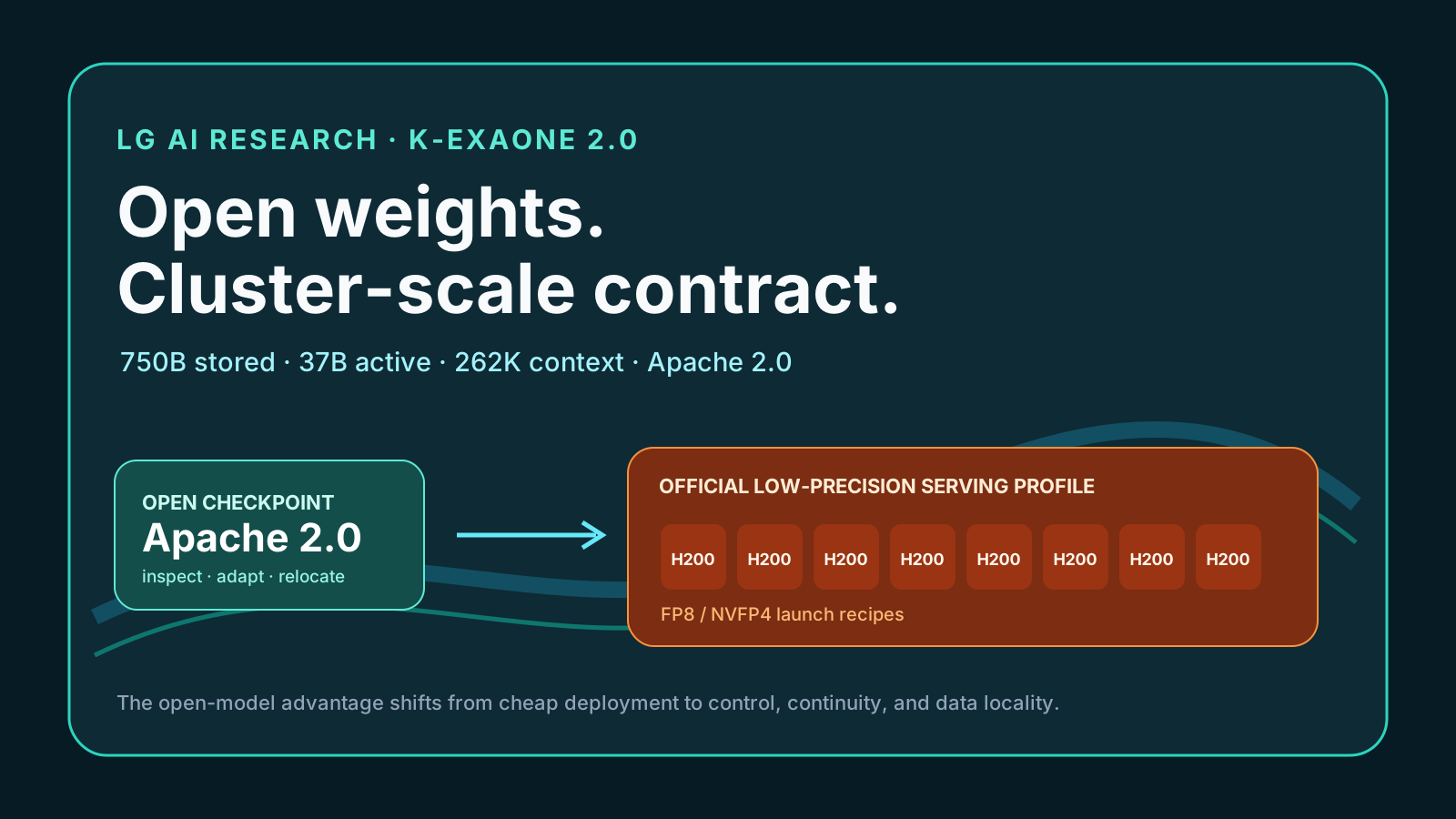
The easiest number to misunderstand in LG AI Research’s K-EXAONE 2.0 release is 37 billion.
That is how many parameters the sparse mixture-of-experts model activates for each token. It sounds like the operating profile of a dense 37B model: substantial, but familiar. The K-EXAONE 2.0 model card tells a different story. The model stores roughly 750 billion parameters, its BF16 artifacts approach 1.5TB, and even LG’s low-precision serving recipes use a full node of eight NVIDIA H200 GPUs.
This is an open-weight model, but it is not a casual self-hosting model.
That distinction is the useful part of the launch. LG has released the weights without a gate under Apache 2.0, added thinking and non-thinking modes, exposed tool calling through OpenAI-compatible servers, and documented a 262K context window. Legally, the release is unusually permissive. Operationally, it behaves more like infrastructure procurement than a model download.
The obvious take is that LG built a much larger Korean frontier model. The more important take is that “open” is splitting into two markets. One values local inference on affordable hardware. The other values control: the ability to inspect, adapt, retain, move, and operate a strategically important model without depending on a closed API. K-EXAONE 2.0 is designed for the second market.
That makes the launch relevant well beyond Korea. It is a concrete test of whether open weights can remain strategically useful after the models become too large for most of their nominal users to run.
LG announced K-EXAONE 2.0 on July 31 as the second-phase model in South Korea’s sovereign foundation-model program. The release expands the first K-EXAONE from 236B total and 23B active parameters to 750B total and 37B active.
Those two growth rates matter.
Total capacity increased by about 3.18×. The active path increased by about 1.61×. Put another way, LG more than doubled the ratio between stored capacity and the parameters used for a token—from roughly 10:1 to 20:1.
That is a smart scaling move if routing can turn the extra experts into useful specialization. It gives the model much more capacity without multiplying dense compute in lockstep. But the cost does not disappear. It moves into weight storage, memory bandwidth, expert communication, quantization, network topology, and the software needed to keep routed experts fed.
The released configuration shows the shape:
The hybrid attention layout is another example of cost being managed rather than erased. Most layers use a small sliding window, while a smaller set carries global context. That limits KV-cache growth compared with making every layer globally attentive. It does not make every 262K request cheap, and it certainly does not turn an advertised maximum into a sensible default service class.
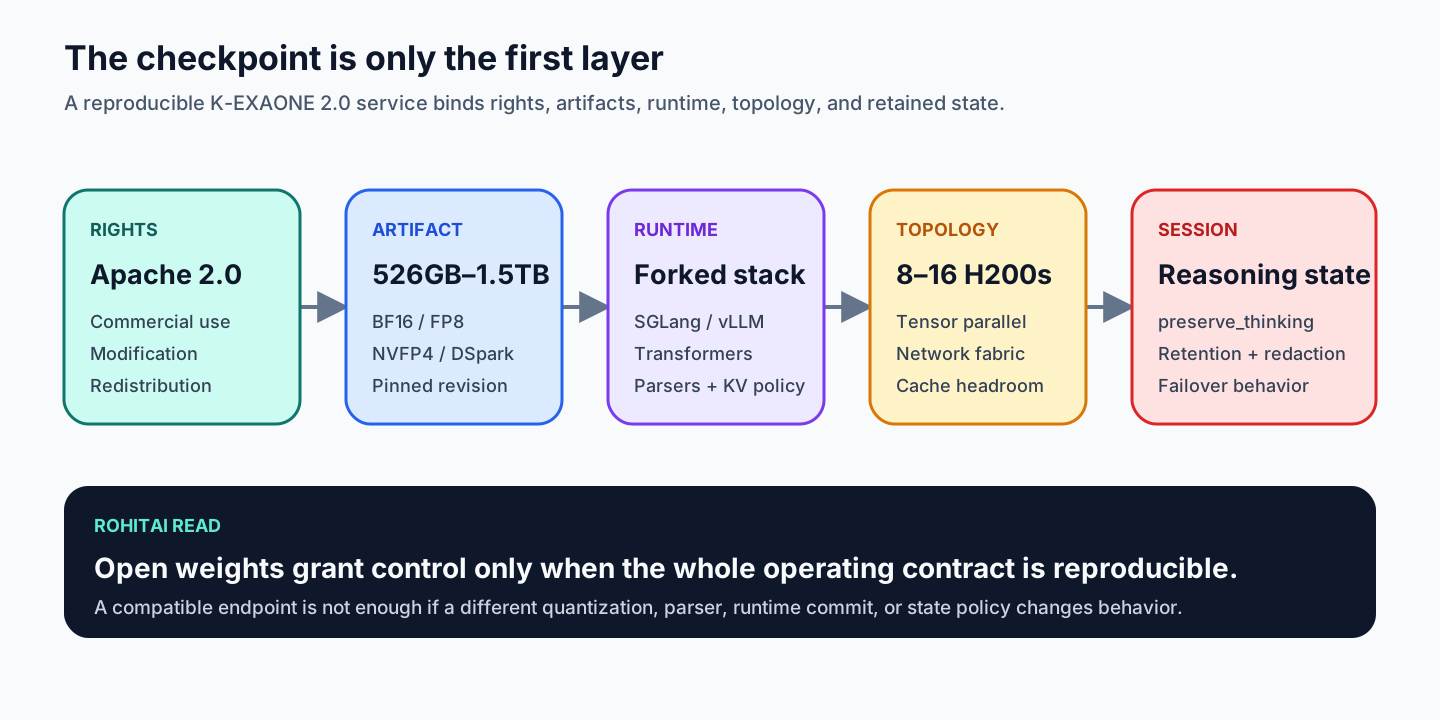
The model is open at the checkpoint layer. A deployable service still depends on artifacts, runtime commits, accelerator topology, cache policy, and session-state handling.
LG did not publish one interchangeable checkpoint. Its launch collection contains BF16, FP8, NVFP4, and DSpark variants with materially different operational profiles.
The main BF16 weight index is about 1.499TB, before the tokenizer, metadata, and a separate MTP file. The FP8 index is about 752GB. NVFP4 is about 526GB. DSpark keeps a BF16-scale main model and adds a larger speculative drafter.
The official examples are equally revealing. LG’s FP8 card documents the one-node low-precision path, while its DSpark card documents the larger speculative setup and launch limitations.
| Launch artifact | Indexed weight size | LG serving example | What still needs proof |
|---|---|---|---|
| BF16 | About 1.50TB | Two nodes × 8 H200 | Your workload throughput and cluster efficiency |
| FP8 | About 752GB | One node × 8 H200 | Quality, tool-call, safety, and long-context parity |
| NVFP4 | About 526GB | One node × 8 H200 | Behavior under quantization and realistic concurrency |
| DSpark | About 1.50TB plus drafter | Two nodes × 8 H200 | SGLang-only launch path and production stability |
These are LG’s launch recipes, not a proof that no clever operator can fit a variant onto a different topology. They are still the right planning baseline. NVIDIA lists 141GB of HBM3e per H200, so four have more aggregate memory than the raw NVFP4 index, yet LG specifies eight. That gap is where production reality lives: KV cache, allocator headroom, CUDA graphs, communication, batch shape, speculative decoding, and concurrency.
This is why artifact size is not a hardware plan.
It is also why “open weights are cheaper” has become too broad to be useful. An illustrative Google Cloud spot price available at research time put an H200 GPU component at $4.2834 per hour. Eight of them would be about $34.27 per hour, or roughly $25,000 over a 730-hour month, before the host, networking, storage, availability, and interruption risk. That is not K-EXAONE pricing, nor a reliable production quote. It is simply enough to show that low utilization can destroy the self-hosting case.
The economic question is no longer “Can I download it?” It is “Do I have enough sustained, high-value work to keep the deployment busy?”
LG reports an average of 70.1 across 24 metrics, up from 63.3 for the predecessor. That aggregate is less informative than where the model improved.
All of these are vendor-reported BF16 reasoning-mode results. Some comparator values came from official sources; others were measured in LG’s environment. The coding evaluations use particular agents and generous execution budgets. KGC-Safety is an internal benchmark. None of that makes the results useless. It tells us what they can and cannot establish.
The pattern fits the training changes described in LG’s technical report. The pipeline added repository pull requests, diffs, review comments, executable SWE tasks in Docker, terminal environments, synthetic MCP servers, Korean public APIs, and deep-research search tasks. LG also performed long-context mid-training and targeted multilingual work.
The biggest gains land close to those investments: repository repair, terminal work, long retrieval, and multilingual mathematics.
Meanwhile, MMLU-Pro slips by 0.3, HMMT February 2026 drops from 80.7 to 78.4, the Korean HRM8K-KSM score falls from 91.9 to 91.1, and τ3-Banking stays at 14.2. GlobalMMLU-Lite is also slightly lower, while most reported WMT24++ translation directions are flat or down.
That leads to a better interpretation than “750B is smarter.” Capacity became useful where LG built the environments and data to teach it a job. The release is evidence for capability shaping, not a clean law that more stored experts produce uniform intelligence.
K-EXAONE 2.0 supports a 262,144-token context and LG documents up to 32,768 output tokens in its OpenAI-compatible example. Those are useful ceilings for large repositories, regulatory evidence bundles, or long research sessions.
They are not evidence that hundreds of simultaneous sessions can all occupy the maximum window.
LG’s vLLM example includes --max-num-seqs 256. That parameter is a scheduler limit, not a promise of 256 fully populated 262K contexts. Real capacity depends on the request-length distribution, KV precision, prefix reuse, speculative path, batch shape, and acceptable latency.
The long-context evidence also stops short of the full ceiling. The report’s 94.4 OpenAI-MRCR result covers bins through 128K. LG separately reports perfect needle-in-a-haystack retrieval through 256K, but synthetic retrieval does not prove coherent reasoning and tool use across a realistic 256K agent trace.
A 262K configured window, hybrid attention, MRCR through 128K, and synthetic retrieval through 256K.
Long-context routes need their own admission, cache, latency, and concurrency budgets.
Realistic 128K–262K agent coherence and behavior parity across FP8 and NVFP4.
Production teams should therefore create context classes:
interactive       8K–16K     latency-sensitive
project          32K–64K     repository or document work
deep evidence    128K        separately capacity-limited
maximum          262K        exceptional, queued, and explicitly budgeted
The exact thresholds will vary. The principle should not: a model’s maximum context belongs in admission control, not in marketing-led defaults.
LG provides SGLang and vLLM serving paths with an OpenAI-compatible API. That is helpful. It also risks hiding the most important launch-day dependency.
The official installation commands do not point to ordinary upstream releases. They install add-k-exaone2 branches from model-specific forks of SGLang, vLLM, and Transformers. The vLLM path does not support DSpark at launch. The SGLang instructions warn B200 operators to disable SWA KV behavior and prefill CUDA graphs to prevent generation collapse. The sample vLLM multi-node command also contains a duplicated --master-addr flag where the second value appears intended to be a port.
These are normal signs of fresh model support, not reasons to dismiss the release. They do change what “ready to operate” should mean on day one.
For a deployment, the model identity is closer to this:
checkpoint revision
+ quantization
+ runtime commit
+ GPU topology
+ reasoning parser
+ tool-call parser
+ KV policy
+ speculative decoder
+ session-state policy
= the behavior you actually serve
This extends an argument I made in the Kimi K3 harness-contract analysis and the vLLM 0.26 infrastructure piece: open models increasingly ship as operating contracts, not isolated files. K-EXAONE 2.0 makes that contract unusually visible.
The model defaults to thinking mode and exposes a preserve_thinking option. LG recommends enabling it for long-running agentic or deep-research work so previous reasoning_content can be carried into later turns.
This looks like a quality knob. It is also an architecture and governance decision.
If a gateway drops the field, compacts it differently, or cannot restore it after failover, the same checkpoint may behave differently. If a service retains it, reasoning content consumes context and cache, can carry stale assumptions or injected instructions forward, and becomes another category of session data that needs access control, retention limits, deletion, and redaction.
That creates a new failure mode for “compatible” gateways: the API shape may work while the agent’s cognitive continuity changes.
Teams should decide route by route whether preserved reasoning is worth the cost. A long research investigation may benefit. A high-volume extraction endpoint probably does not. A security-sensitive workflow may need aggressive compaction and injection boundaries even if that gives up some continuity.
K-EXAONE 2.0 is genuinely open in ways that matter. The repository is ungated. Its standard Apache 2.0 license permits commercial use, modification, and redistribution subject to the license. An organization can mirror the checkpoint, audit its serving stack, adapt it, and continue operating if a vendor relationship changes.
But the people who can exercise those rights at full scale are a narrower group than the people who can click Download.
That is not hypocrisy. It is a shift in what open-weight models are for.
The first wave of open models made inference accessible. This infrastructure-scale wave makes model sovereignty accessible—to governments, regulated enterprises, national labs, clouds, and well-funded product companies. The prize is not necessarily a lower token bill. It is a credible exit from API dependence, plus control over data location, model adaptation, release timing, and incident response.
The contrast with Inkling-Small’s router-oriented role is useful. Both releases use sparse activation and permissive weights, but they point to different open-model products: one designed to sit inside an agent routing layer, the other substantial enough to become the controlled foundation underneath an institution’s AI estate.
Three implications follow.
The public benchmark table is explicitly for BF16. Most practical deployments will care about FP8 or NVFP4. Until those artifacts receive independent evaluations, teams should not assume identical coding accuracy, tool-call reliability, long-context behavior, multilingual quality, or refusal behavior.
A quantized checkpoint is a distinct deployment product, and at this scale it is the one most customers will actually encounter.
Stable support in ordinary Transformers, SGLang, and vLLM releases would remove floating-fork risk, simplify security review, and let existing observability and capacity tooling work with fewer exceptions. For most operators, that is more valuable than moving a benchmark from 68 to 69.
Upstreaming is the next meaningful launch milestone.
LG did not start from zero. It upcycled the 236B predecessor, expanding depth and expert count while preserving parts of the architecture, tokenizer, and routing policy. That saved more than compute. It kept the development path inside a lineage that Korea’s sovereign-model program recognizes as domestically controlled.
In a policy program that distinguishes domestically developed models from foreign-model adaptation, the ability to reuse and improve a locally controlled base becomes a strategic asset. Each generation carries forward training investment, operational knowledge, evaluation practice, and institutional legitimacy.
That is the least discussed advantage in this release.
Governments, finance, manufacturing, healthcare, and regulated enterprises can justify the cluster when data locality, customization, auditability, and provider exit are procurement requirements.
Managed services can amortize eight-H200-class deployments across customers, hide fork and topology complexity, and expose K-EXAONE through familiar endpoints.
If utilization is uncertain, evaluate on short-lived rented capacity or wait for hosted inference and upstream runtimes. Download rights do not create a good unit-economic case.
The first adoption wave should be Korean public-sector and regulated-industry deployments, followed by regional clouds and optimization providers. LG already frames the EXAONE family around manufacturing, bio, finance, and public applications. The license and local lineage fit those buyers. The hardware profile does not fit a hobbyist distribution curve.
Second, independent evaluation will probably preserve the model’s distinctive shape rather than crown it the broad open-weight leader. LG’s own table has K-EXAONE 2.0 trailing Qwen3.5, GLM-5.1, and DeepSeek V4 Pro on many knowledge, hard-reasoning, coding, and agent tasks, while leading the reported OpenAI-MRCR comparison and both safety benchmarks. Independent harnesses may move individual numbers, but they are unlikely to erase that specialist profile.
Third, hosted inference will arrive before widespread self-hosting. At research time, the Hugging Face collection listed no provider, and LG said broader public access was still being prepared. The gap is an opportunity: an Apache checkpoint plus scarce, complicated hardware naturally invites a managed distribution layer.
Finally, preserved reasoning will become an explicit gateway capability. Agent platforms already care about tool schemas, context compaction, and resumable sessions. They will increasingly need a declared policy for model-specific reasoning state: preserve, summarize, redact, encrypt, expire, or discard.
Do not start by reproducing all 24 vendor benchmarks. Start with work your organization would pay to complete.
Build a small but hard suite:
Measure wall time, occupied GPU time, successful completion, human review minutes, retry rate, tool-call repair, and incident rate. Then compare K-EXAONE 2.0 with a managed API and a smaller open model on cost per accepted outcome.
Also retrieve current facts by default. The model card lists a 2025 Q2 knowledge cutoff. Longer thinking cannot infer events that are not in the weights.
If the cluster only wins when it is busy, model realistic utilization. If control is worth paying for, price that benefit explicitly instead of pretending it is free inference.
K-EXAONE 2.0 is an important open-weight release precisely because it makes the limits of the old open-model story impossible to ignore.
The checkpoint is downloadable and commercially usable. The service is a multi-layer system: half-terabyte-plus artifacts, eight or sixteen H200s in LG’s examples, forked runtimes, quantization-specific behavior, long-context admission control, and reasoning state that survives across turns.
That does not make the model less open. It changes the value of openness.
For a small team, the right answer may be to wait for a provider. For a cloud, government, lab, or regulated enterprise, the right answer may be to pay more than an API would cost because control, continuity, and data locality are the product.
K-EXAONE 2.0’s most consequential number is therefore not 750B or 37B. It is the number of organizations for which owning the operating contract is worth owning the cluster.
LG released the model weights ungated under Apache 2.0, which permits commercial use, modification, and redistribution subject to the license. “Open-weight” is the more precise term because the public materials do not provide everything required to reproduce the training run from scratch.
Not according to LG’s official launch recipes. The FP8 and NVFP4 examples use one node with eight H200 GPUs. BF16 and DSpark use two nodes with eight H200s each. Other configurations may emerge, but builders should plan from tested recipes rather than raw weight size alone.
No. About 37B parameters are active per token, which helps explain expert compute, but roughly 750B parameters must still be stored and routed. Hardware sizing must include the complete artifact, KV cache, runtime overhead, communication, and concurrency.
The configuration supports 262,144 tokens, and LG reports synthetic retrieval through 256K. However, its OpenAI-MRCR evaluation covered bins through 128K. Teams should independently test realistic long-context reasoning, tool coherence, latency, and concurrent capacity.
Teams with eight-H200-class infrastructure and a strong need for sovereignty, data locality, or customization can begin evaluation now. Most product teams should use rented capacity for testing or wait for hosted endpoints and stable upstream runtime support.