Qwen3.8-Max-Preview: Alibaba Subsidizes Agent Adoption Before the Proof Arrives

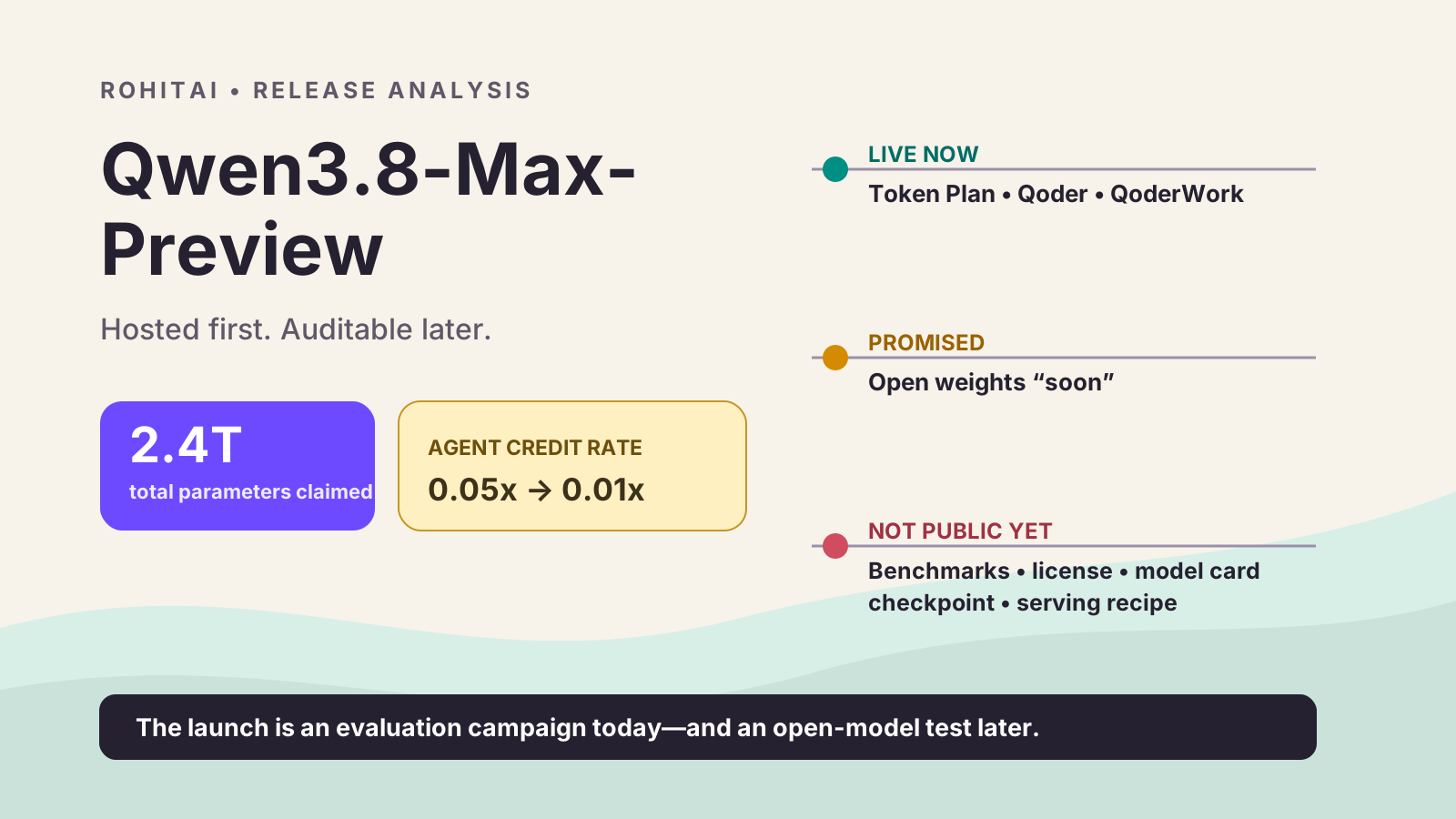
At 10 p.m. in Singapore, Qwen3.8-Max-Preview’s Qoder credit coefficient falls to 0.01x. A few hours after launch, BenchLM showed zero published results for the model across 321 tracked benchmarks.
Those two numbers explain this release better than the 2.4-trillion-parameter headline.
Alibaba’s official Qwen announcement says Qwen3.8 is comparable with leading frontier models, “second only” to Claude Fable 5, and headed for an open-weight release. The hosted preview is already usable through Token Plan, Qoder, and QoderWork. Official documentation also gives builders a nominal one-million-token context window, always-on thinking, function calling, and built-in tools.
What Alibaba has not published is equally important: no checkpoint, license, architecture, active-parameter count, model card, technical report, safety report, reproducible benchmark table, or firm date for the promised weights.
This makes Qwen3.8-Max-Preview a concrete agent adoption campaign, but not yet an open-weight release. Alibaba is making supervised evaluation unusually cheap before outsiders can audit a frozen artifact. Current Token Plan terms also prohibit application backends, automated scripts, and non-interactive batch processing. And a session labeled Qwen3.8 can include Qwen3.7 sub-agents, hosted tools, and integration-specific defaults.
The rational builder response is simple: test aggressively, commit cautiously. Use the subsidy to learn where the model helps. Do not treat cheap access as verified capability, protocol compatibility as production permission, or promised weights as portable infrastructure.
There is plenty here that can be verified.
Qwen’s own repository merged built-in qwen3.8-max-preview support on launch day with a one-million-token context setting, thinking enabled, and image and video input declared in the client preset. Qwen Cloud’s current model guide lists one-million-token context, function calling, built-in tools, and no structured-output support. Alibaba Cloud’s model catalog lists the exact preview identifier as Token Plan-only for that API surface. Qoder’s campaign page names the eligible plans and products, the coefficient schedule, and the calls excluded from the offer.
There is almost no public scientific package behind the ranking claim yet.
At 18:47 UTC on July 19, 2026, BenchLM listed Qwen3.8-Max-Preview as unranked with no results across its 321 tracked benchmarks. That snapshot will age quickly, and BenchLM’s specification fields already lagged Alibaba’s fresh documentation. It is useful here as an evidence-coverage check, not as the source of truth for model capabilities.
The absence stands out because Alibaba supplied more quantitative detail for the preceding Qwen3.6-Max-Preview launch, including named benchmark deltas over Qwen3.6-Plus. This time, distribution moved ahead of a comparable evaluation package.
One plausible reason is visible in the terms: Qwen Cloud describes Qwen3.8-Max-Preview as a model that will be iteratively upgraded during preview and may be retired or replaced later. A moving service is good for collecting feedback. It is awkward for a durable leaderboard claim. A serious result now needs a timestamp, model ID, client version, route, and settings—not just the word “Qwen3.8.”
Qoder normally assigns Qwen3.8-Max-Preview a 0.5x credit coefficient. During the launch campaign, the coefficient drops to 0.05x during regular hours and 0.01x from 22:00 to 08:00 Singapore time. Qoder describes those as 90% and 98% discounts relative to the standard coefficient.
That is a strong incentive, but it is not a public per-million-token API price. Qoder’s credit documentation says consumption is calculated dynamically from factors such as model, token volume, accumulated context, and task type. Discounted calls still consume plan quota. When quota is exhausted, the promotion does not create a free overflow pool. Experts mode and certain sub-agent calls to other models remain at their regular rates.
Qoder coefficient ladder
The coefficient changes Qoder credit consumption. Qoder plan quotas and excluded supporting routes remain in force.
The time window reveals a second strategy. Singapore’s 22:00–08:00 period is 14:00–00:00 UTC. In July, that overlaps roughly 10 a.m.–8 p.m. on the US East Coast and 7 a.m.–5 p.m. on the West Coast. “Night-time” pricing is effectively an American-workday discount.
That looks like demand shaping. Alibaba can steer evaluation toward a chosen capacity window while Qoder users run repository work during normal office hours. It also makes the model cheap enough to earn a place in real workflows before benchmark debates settle.
RohitAI has argued before that agent credits are capacity allocation, not merely a prettier token bill. Qwen3.8 adds time to the router. The scheduling variable is no longer only which model handles the task. It is also when the human starts the supervised run.
There is an important boundary around Qwen Cloud’s parallel Token Plan offer: its API keys cannot be used for automated or non-interactive batch work. Token Plan users can move attended evaluation sessions and interactive maintenance work into the cheaper window, but cannot turn that offer into an unattended discount scheduler. Qoder and QoderWork are separate products with their own terms; the Qoder promotion should be evaluated under those terms rather than importing Token Plan’s rules.
Model launches often collapse access, behavior, and portability into one word: available. Qwen3.8 shows why those need separate treatment.
| Contract | Question it answers | Qwen3.8 status on July 19 | What builders still need |
|---|---|---|---|
| Access contract | Where and under what terms can I use it? | Hosted preview in Token Plan, Qoder, and QoderWork; Token Plan keys are interactive-only and quota-bound, while Qoder surfaces follow separate product terms and credit quotas | Stable production access, metered pricing, rate limits, regional detail, and an SLA |
| Harness contract | What surrounding system produces the result? | Partly documented: thinking state, tools, context, client defaults, and some mixed routing | Versioned recipes, complete route traces, compaction policy, and comparable eval settings |
| Artifact contract | What can I inspect, reproduce, or deploy elsewhere? | Promised, not delivered | Checkpoint, license, architecture, active parameters, tokenizer, checksums, serving recipe, and safety documentation |
Only the access contract is clearly live. The harness contract is visible in fragments. The artifact contract is future tense.
That distinction updates the pattern RohitAI covered in Kimi K3’s hidden harness contract. A downloadable checkpoint does not make the hosted behavior reproducible on its own. But Qwen3.8 has not reached even that checkpoint stage yet. Alibaba is asking developers to evaluate a service whose most important portable artifact has not been named.
Alibaba’s own integration documentation makes a nominal Qwen3.8 session more complicated than it appears.
The official Claude Code configuration maps the primary, Sonnet, and Opus roles to qwen3.8-max-preview, but maps CLAUDE_CODE_SUBAGENT_MODEL to qwen3.7-max. Qoder separately warns that certain sub-agent calls to specific models, plus Experts mode, are outside the discount.
So a coding session can combine:
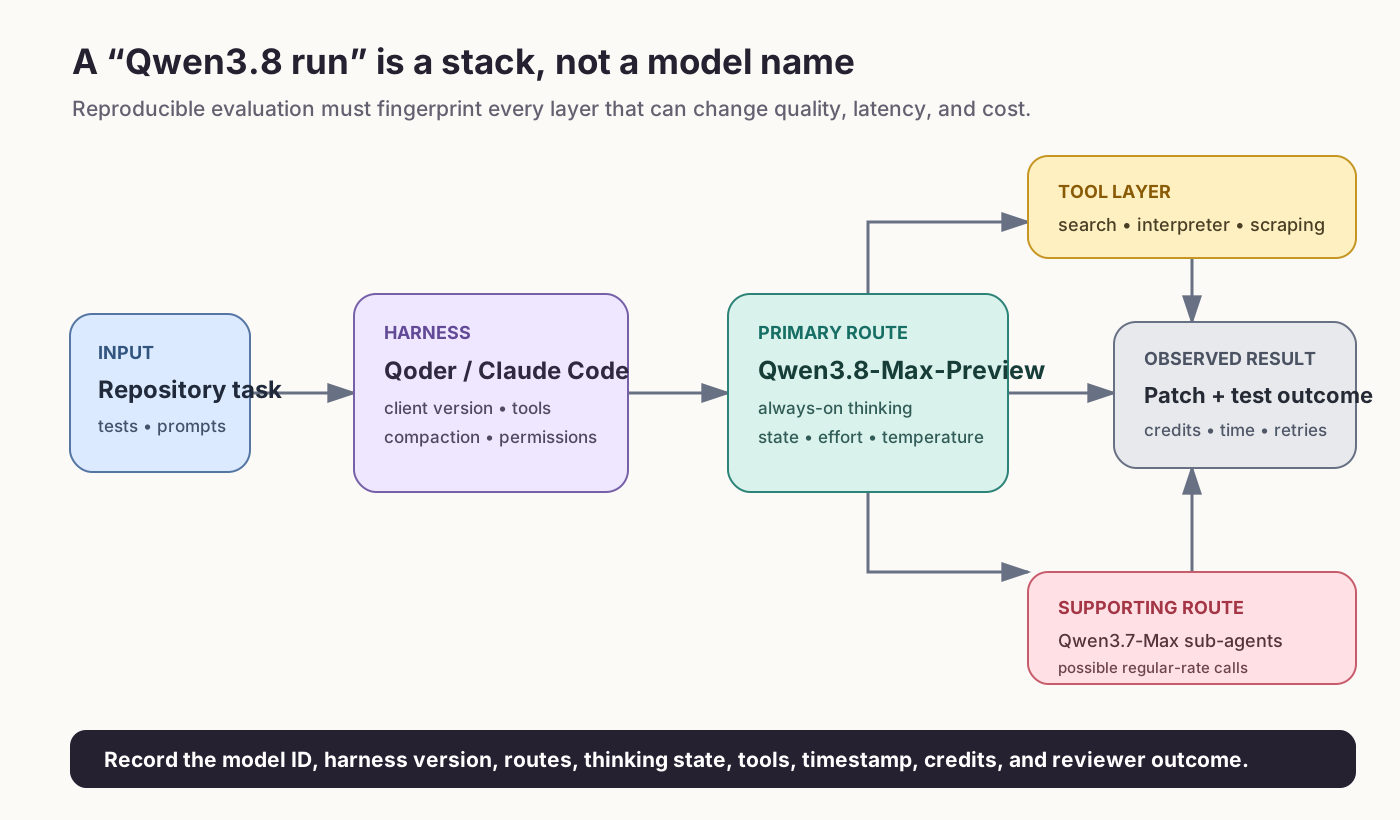
The model selector names the primary route. It does not fingerprint the full system that produced the patch.
The state contract matters too. Qwen Cloud’s thinking documentation identifies Qwen3.8 as thinking-only and says thinking cannot be disabled. It supports preserve_thinking; when tools are involved, the docs tell clients to return the assistant’s reasoning_content with tool results because omitting it may degrade accuracy. Preserved reasoning becomes input on later turns, affecting usage as well as behavior.
The official client recipes add more non-obvious defaults. The Codex setup and OpenClaw setup publish a 983,616-token context setting rather than a round one million. The OpenClaw and Claude Code guides set a temperature floor of 0.6 and offer low, high, and xhigh reasoning effort with xhigh as the default. The general model guide marks structured output unsupported. Other integration pages differ on modalities and parallel tool behavior.
These are not footnotes to an agent benchmark. They are benchmark variables.
Qwen Cloud exposes familiar protocol surfaces, including OpenAI- and Anthropic-compatible routes. That can make the preview feel ready to drop into an application.
The commercial terms say otherwise.
The Token Plan Individual terms limit use to interactive programming and agent tools. Automated scripts, application backends, and non-interactive batch processing are prohibited. The Team Edition terms also limit use to interactive compatible tools. Alibaba’s pricing guidance points application and batch workloads toward pay-as-you-go access, yet Qwen Cloud’s model catalog listed Qwen3.8 as Token Plan-only at the research snapshot, and no metered per-token rate was published for it.
There are three additional deployment risks:
Data handling also depends on the exact region and plan. The international Team documentation says conversation data is not used for model training and places the service in Singapore with Global deployment and cross-border transfer implications. Separate mainland-China Personal terms use different data-improvement language. Qoder has its own privacy policy and product terms. Teams with confidential repositories need to read the contract attached to their exact surface and account, not import a promise from another plan or product.
Cheap calls are valuable only if the evaluation produces evidence you can use later.
Start with a compact suite from your own repository. Ten to twenty tasks are enough for a first pass if they represent work your team actually reviews: a cross-file bug fix, a dependency migration, a test repair, a small feature, a flaky failure, a code-reading question, a documentation update, and one long-context task. Keep the acceptance tests fixed.
Run the same suite against your current agent baseline and Qwen3.8. For Qwen3.8, repeat a subset at low, high, and xhigh reasoning effort. Do not ask only whether the final answer looks smart. Measure whether the patch is accepted.
The most useful economic unit is:
effective task cost = model credits
                    + retry cost
                    + reviewer repair time
                    + failed-run opportunity cost
That is the same principle behind RohitAI’s cost-per-accepted-task analysis. A 0.01x coefficient is impressive, but it cannot tell you whether the model closes the task, loops, calls an undiscounted sub-agent, or leaves an hour of cleanup.
Two practices matter more for a mutable preview.
First, snapshot transcripts and results. If the same model ID changes next week, a dated trace lets you distinguish model drift from a repository change. Second, keep the harness fixed before comparing models. Swapping Qoder for Claude Code, changing compaction, or discarding reasoning history can produce a bigger difference than the model change you meant to test.
For Token Plan, use the cheaper window if it fits your working day, but preserve human supervision. That offer is well suited to interactive regression work under its terms; it is not permission to batch the entire backlog overnight. Evaluate Qoder’s separate promotion under Qoder’s own terms.
Alibaba’s promise matters. Qwen’s Max line has recently been proprietary, so a genuine Qwen3.8 weight release would widen the field of institutions able to inspect the artifact and, if the eventual license permits, adapt or serve a frontier-scale Chinese model.
But 2.4 trillion total parameters is not a deployment plan.
Builders still need to know whether the architecture is dense or mixture-of-experts, how many parameters activate per token, which precision and quantization formats are supported, how expert routing works, which runtimes are ready, and what memory and interconnect the serving recipe assumes. Without those details, nobody can responsibly turn the headline parameter count into a hardware estimate.
Kimi K3 is a useful nearby scale reference, not a sizing proxy. Moonshot’s Kimi K3 technical launch disclosed 2.8T total parameters, 16 active experts out of 896, API pricing, architecture details, a July 27 weight-release target, and a recommendation of at least 64 accelerators for deployment. Alibaba has not published equivalent Qwen3.8 details. RohitAI’s Kimi K3 analysis explains why even that richer package still leaves a serving-and-harness contract to reproduce.
If Qwen3.8 weights arrive at this scale, the immediate beneficiaries are more likely to be cloud providers, research labs, sovereign AI programs, and large enterprises than laptop users. That could still be meaningful openness. Depending on the license, it could change who can negotiate hosting, inspect the artifact, fine-tune it, or keep deployment within a chosen jurisdiction.
It will not erase Alibaba’s distribution advantage. Qoder project state, hosted tools, credit accounting, routing policy, and tuned defaults remain services. The checkpoint may become portable while the highest-performing workflow stays attached to Alibaba’s stack—a pattern that also appears in local open-model agent infrastructure.
Use the promotion for representative repository tasks, long-context work, and side-by-side harness tests. Log the full route and judge accepted outcomes.
Current Token Plan terms, preview mutability, missing metered pricing, and unspecified service limits make a customer-facing dependency premature.
Draft requirements now, but size nothing until Alibaba publishes the checkpoint, license, active parameters, precision, runtime support, and serving guidance.
The conventional launch order is evidence, access, then adoption: publish benchmarks and technical material, expose an API, and let developers decide whether to integrate.
Qwen3.8’s order is different:
deeply subsidized access
        ↓
real agent usage and workflow familiarity
        ↓
independent evaluation
        ↓
promised portable artifact
That sequence can be strategically effective even if the model’s eventual independent ranking is less dramatic than Alibaba’s claim.
First, the preview gets used. Long-horizon coding models improve their position by becoming familiar inside the tools where developers already hold context, permissions, and project history. Second, low coefficients reduce the cost of generating precisely the usage data and feedback needed to tune a mutable preview. Third, promising weights keeps the open-model community interested while Alibaba’s hosted products own the first evaluation surface.
My expectation is that public benchmark coverage will appear quickly and show a more conditional result than “second only to Fable 5.” Agent performance is unusually sensitive to the harness, thinking-state retention, tool permissions, compaction, and sub-agent routing. Different teams can honestly get different answers from what appears to be the same model.
I also expect production economics to be less generous than the preview headline. The campaign has no fixed end date, the model may be replaced, and the current coefficient is explicitly promotional. A production successor could arrive with a higher coefficient, metered API pricing, tighter quotas, or a different model ID.
Finally, open weights will not turn Qwen3.8 into a commodity. At this scale, operational knowledge, optimized kernels, routing, and high-bandwidth infrastructure become part of the moat. The open artifact can increase buyer leverage while hosted execution remains the default for most users.
The preview is worth testing. The next disclosure package will determine whether it is worth adopting.
Until those arrive, “open-weight soon” should remain a statement of intent. Earlier Qwen releases used Apache 2.0, but that precedent does not establish Qwen3.8’s license.
No. Alibaba announced that Qwen3.8 will become open-weight soon, but no downloadable checkpoint, license, or release date was public at the July 19 research snapshot. The hosted qwen3.8-max-preview service is available now.
Not under the current Token Plan access described in Alibaba’s terms. Individual and Team Token Plan usage is limited to interactive compatible tools; application backends, automated scripts, and non-interactive batch work are prohibited. A future pay-as-you-go or production contract could change that.
Alibaba’s general model guide lists a nominal one-million-token context window. Official Codex, OpenClaw, and Claude Code configurations publish 983,616 tokens instead; Alibaba does not explain the difference. Test the usable limit, output allowance, and compaction behavior in the exact client you plan to use.
No. It is a Qoder credit coefficient during the 22:00–08:00 Singapore off-peak window, not a public per-million-token price. Dynamic credit calculation, plan quota, and excluded supporting calls still apply. Qwen Cloud Individual describes a parallel one-fiftieth promotional credit rate for the same time window.
No. That ordering comes from Alibaba’s launch statement. No reproducible Qwen3.8 benchmark table accompanied the announcement, and the time-stamped BenchLM snapshot contained no published results. Independent evidence may arrive quickly; it should be evaluated with its harness and settings attached.
Alibaba has said “soon” but has not given a date. The exact relationship between the changing hosted preview and any future checkpoint is also unspecified.
Qwen3.8-Max-Preview gives builders something genuinely valuable today: low-cost access to a new flagship model inside real agent tools. That is enough reason to run disciplined evaluations.
It does not yet provide a verified frontier ranking, a production backend contract, or an auditable open-weight artifact.
Keep those claims separate. Measure the entire routed session. Preserve the traces. Price the accepted task, not the coefficient. And when Alibaba publishes weights, ask whether the artifact matches the service you tested.
Cheap access is evidence-gathering capacity. It is not the evidence itself.