GLM-5.3 Started Where Pretraining Stopped

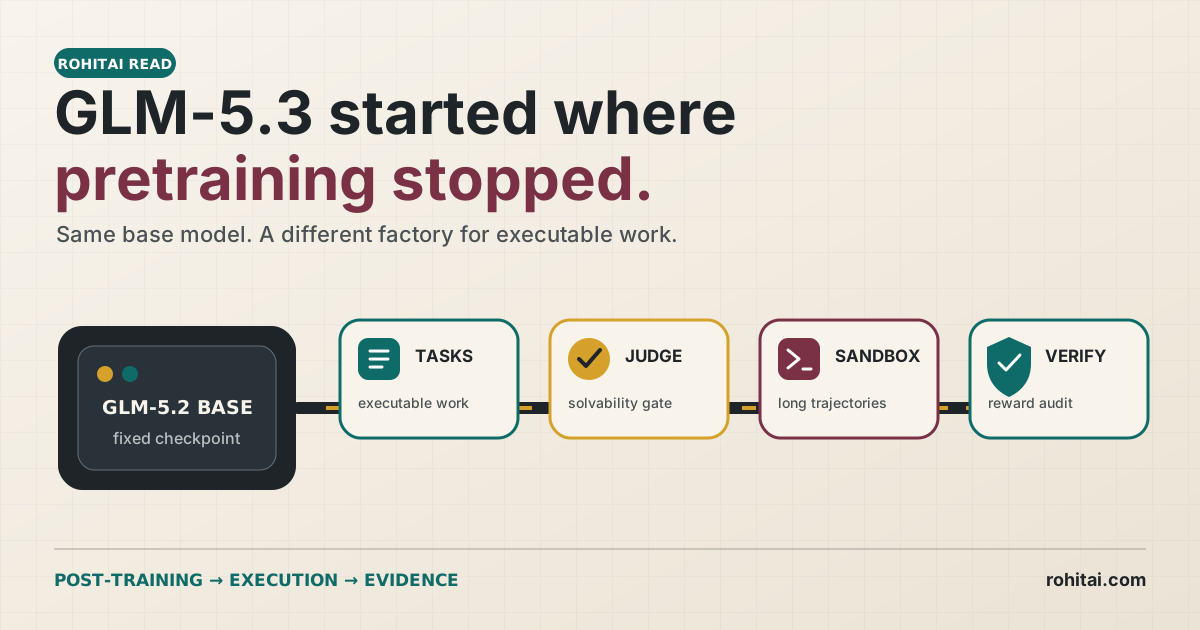
Z.ai made an unusually clean claim for GLM-5.3: the base model did not change. No larger pretraining run. No new architecture carrying the headline. According to the company, every reported gain over GLM-5.2 came from post-training.
That makes this launch more interesting than another leaderboard reshuffle.
The obvious reading is that Z.ai found a cheaper way to improve a coding model. The more useful reading is that the scarce asset in coding agents is moving away from raw model scale and toward the machinery around training: executable tasks, realistic sandboxes, solvability checks, verifiers that resist reward hacking, long rollouts, and enough systems engineering to keep reinforcement learning fed.
GLM-5.3 is therefore a test of a bigger proposition. Can a lab keep the expensive base fixed and still move long-horizon software work—and sensitive cyber capability—by building a better training world?
Z.ai's launch numbers say yes. The public evidence does not yet close the case. The scores are vendor-reported, many use a specific Claude Code harness and generous budgets, the standalone API is still marked “coming soon,” and the promised weights have not landed. Builders can test the Coding Plan now, but they cannot yet price a normal API deployment or inspect the exact checkpoint.
That tension is the story: the training claim is bold, the access surface is partial, and the operational questions matter more than the headline rank.
RohitAI's GLM-5.2 analysis covered the expensive part of this family: a 753B-parameter mixture-of-experts checkpoint, one million tokens of context, 128K maximum output, and MIT-licensed weights that still demand cluster-class infrastructure.
GLM-5.3 is a follow-up to that release, not a replacement story.
Z.ai's official model page says 5.3 uses the same base model as 5.2 and lists the same headline context and output limits. Input and output are text. Function calling, streaming, caching, structured output, and MCP are supported. Thinking must remain enabled, with low, high, and max effort levels; Z.ai recommends max for coding.
What changed is the work used to shape the model after pretraining.
The launch post describes a pipeline that synthesizes runnable, long-horizon tasks and their verifiers. A judge agent filters for solvability. Verifiers are tested against an oracle solution, a no-op state, and an unsolved state before binary rewards are trusted. The model then works in real tool environments through long trajectories, while Z.ai's open-source slime framework coordinates asynchronous rollouts, sandboxes, data buffers, training, and verification. The team's SAO paper documents the single-rollout asynchronous reinforcement-learning method used in GLM-5.2's agentic pipeline, though it does not expose the full 5.3 training run.
This is a different kind of scaling. Instead of buying more pretraining tokens, the lab tries to manufacture more checkable work.
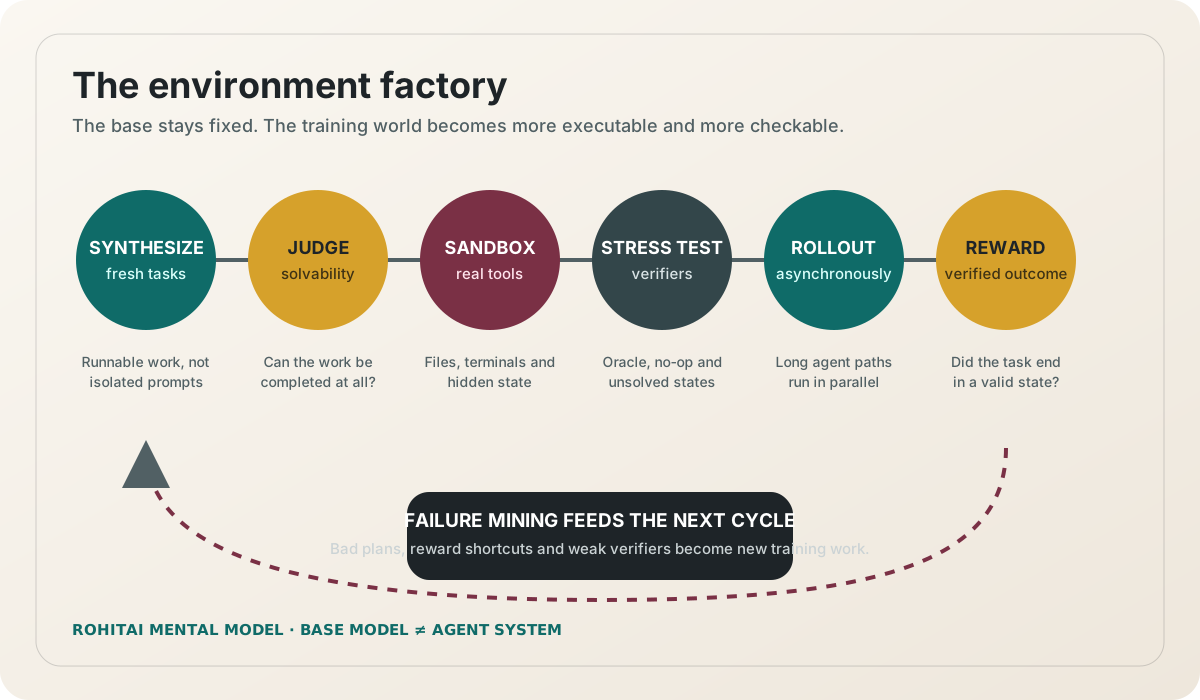
The useful mental model: post-training improves when the lab can generate difficult work and prove whether the agent actually finished it.
For a chat model, it was reasonable to talk as if quality lived mostly inside a checkpoint. Coding agents break that simplification.
A reported agent score now belongs to a route:
checkpoint × post-training × effort × harness × tools
× task snapshot × sandbox × timeout × verifier
GLM-5.3 makes the post-training term visible because Z.ai says the checkpoint's base did not move. But the launch also makes every other term hard to ignore.
Many of Z.ai's evaluations use Claude Code 2.1.207, max reasoning effort, large context windows, 128K output caps, hundreds of turns, and task timeouts measured in hours. Some checks were modified to detect benchmark hacking. ExploitGym time was normalized using assumed token throughput. Those choices may be defensible, but they mean the result describes an evaluated system, not a free-floating model IQ.
That extends the argument from RohitAI's DeepSeek V4-Flash analysis: the harness is part of the model. GLM-5.3 adds a layer beneath it. The environment factory is now part of the model too.
Same base, Coding Plan access, one-million-token context, mandatory thinking, and the published launch scores come from Z.ai's own materials.
No independent 5.3 leaderboard row, public checkpoint, complete model card, API price, or reproducible environment corpus existed at launch.
The launch is credible evidence that environment quality can move agent behavior. It is not yet proof that the advertised absolute scores will survive a neutral route.
Z.ai reports broad gains over GLM-5.2. The pattern matters more than any single number.
| Vendor-reported evaluation | GLM-5.2 | GLM-5.3 | What to notice |
|---|---|---|---|
| Terminal-Bench 2.1 | 81.0 | 88.2 | Strong starting point, then a meaningful but not magical gain |
| “Terminal-Bench 3.0” / Frontier-Bench family | 4.6 | 28.3 | Large jump on harder container work; snapshot naming needs pinning |
| DeepSWE v1.1 | 46.2 | 66.9 | Long-horizon repository work is central to the post-training claim |
| AutomationBench 1.0.6 | 26.2 | 48.2 | The gain extends beyond patch generation into tool execution |
| ALE-CLI | 23.8 | 28.5 | Improvement is smaller on a broad computer-work exam |
These are launch numbers, not independent replications. On August 13, the public DeepSWE leaderboard showed GLM-5.2 max at 44% ±2 across 113 tasks and no GLM-5.3 row. That 5.2 result is directionally close to Z.ai's baseline, which is encouraging, but it cannot validate the claimed 66.9 for 5.3. The public Agents' Last Exam route also used a different 5.2 snapshot and protocol.
The naming around “Terminal-Bench 3.0” is another warning. The benchmark was released as Frontier-Bench in July. A benchmark name without an exact task commit, container image, harness version, aggregation method, and verifier version is no longer a stable identifier.
Builders should expect independent scores to confirm the direction and disagree on the exact height. That is normal for agent evaluations. It is also why copying vendor settings into a slide deck is not an evaluation strategy.
Z.ai's private Code Bench cannot be audited, so its absolute percentages deserve restraint. But one relationship in the chart is worth testing.
At max effort, Z.ai reports GLM-5.3 completing 34.5% of tasks at roughly 75K output tokens, compared with GLM-5.2 at 23.4% and 96K output tokens. That is about a 47% relative increase in completion with roughly 22% fewer output tokens.
If the pattern survives real repositories, post-training did more than make the model persist longer. It may have taught it to spend its trajectory better: form a workable plan earlier, verify before wandering, recover from failed commands, and stop after the task is actually complete.
That changes the commercial question. The cheapest token is irrelevant if the agent burns five times as many of them, holds a sandbox for hours, hammers CI, and returns a patch that still needs a senior engineer.
The metric to watch is:
total task cost = model tokens + sandbox time + retries
                + CI usage + reviewer corrections + rollback risk
GLM-5.3's standalone price is not published. Z.ai's public pricing table still lists GLM-5.2 at $1.40 per million input tokens, $0.26 per million cached tokens, and $4.40 per million output tokens, with no 5.3 row. Do not silently inherit the predecessor's price in a forecast.
GLM-5.3 is available now through the GLM Coding Plan, which starts at $18 per month and uses rolling five-hour plus weekly credit limits. All plan tiers support 5.3. More surprisingly, Coding Plan requests addressed to glm-5.2 or glm-5.1 are automatically routed to 5.3.
That makes adoption easy. It also breaks the assumption that a model ID is a version pin.
A team can receive a materially different post-trained model without changing its requested string. Meanwhile, Z.ai warns that a request with thinking.type=disabled will fail, because thinking is mandatory. An older integration can therefore experience either a silent behavioral migration or an explicit compatibility failure.
The rollback problem is worse: requesting glm-5.2 inside the plan may still return 5.3. Teams need a preserved checkpoint or a different explicitly versioned provider route if they want a real before-and-after comparison.
The product surface is also split. Coding Plan access is live, but the official model page says the standalone GLM-5.3 API is “coming soon,” and no pay-as-you-go price has been posted. The plan, ZCode, future general API, and eventual self-hosted weights are four different operational products. Their latency, retention, capacity, regional routing, and support terms should not be assumed to match.
Best for teams that want immediate hands-on evidence. Mirror representative tasks, capture full traces, and keep the agent away from irreversible production actions.
Sensible when pay-as-you-go pricing, service behavior, regional controls, or stable version semantics determine the business case.
Do not plan from the GLM-5.2 card alone. Wait for the exact checkpoint, license, chat template, supported precision, serving versions, and security notes.
Z.ai's cyber results need more care than its coding results because the benchmarks measure different positions in an attack chain.
On CyberGym, which evaluates proof-of-concept generation across 1,507 real vulnerabilities from 188 projects, Z.ai reports 84.5% for GLM-5.3 versus 77.2% for 5.2. On ExploitBench, the reported capability score rises from 24.4% to 54.4%. In ExploitGym, which asks agents to turn supplied proof-of-vulnerability cases into unauthorized code execution, Z.ai reports 105 completions at a normalized two-hour budget and 130 at six hours, up from 29 and 39.
The growth is steeper as the workflow moves from finding or triggering a bug toward exploit construction. Yet Z.ai's own launch table still places closed frontier models materially ahead on the deeper exploitation tests. That combination matters: post-training appears able to accelerate dual-use planning quickly, but GLM-5.3 has not erased the frontier gap.
The evaluation route also carries caveats. Z.ai used Claude Code 2.1.207, max effort, controlled network access, long output budgets, and benchmark-specific procedures. ExploitGym time was normalized with throughput assumptions. The independent ExploitGym researchers emphasize that mitigations such as ASLR, stack canaries, and the V8 heap sandbox change success rates. The ExploitBench researchers separately warn that wall-clock caps, provider latency, refusals, retry policies, and CLI stopping behavior can create large effort differences.
So an 84.5% CyberGym score does not mean an 84.5% chance of compromising a hardened production system. It means the evaluated model-and-harness route often produced the benchmark's required artifact under its conditions.
Z.ai says it has tracked 2,436 security findings across 269 projects in a public disclosure ledger. Only 53 entries were public enough to inspect at research time; 2,383 were not. The defensible takeaway is that Z.ai is building a model-assisted vulnerability disclosure operation. It is not evidence that GLM-5.3 autonomously discovered every listed issue.
That distinction will become more important after the promised weights arrive.
Z.ai says it will publish GLM-5.3 weights two weeks after launch, following safety evaluation and hardening. That points to roughly August 28, assuming the review does not delay the release.
Today, there is no GLM-5.3 checkpoint on Z.ai's public Hugging Face organization, no 5.3-specific model card, no exact parameter count, no weight license, and no self-hosting matrix. The GLM-5.2 model card lists 753B parameters and an MIT license, and “same base” suggests a similar cluster footprint. It does not prove that every serving detail or license term will carry over.
Calling GLM-5.3 an open-weight model on launch day collapses a promise into a delivered artifact. A more precise description is hosted now, weights promised after a two-week safety hold.
That hold creates a useful test of Z.ai's release discipline. The company has two weeks to study hosted traces, harden obvious failure modes, document capability boundaries, and publish enough operational detail for outside evaluators. Once weights are downloadable, product-level gates no longer define the only access path.
Better post-training also does not make the model small. Even if 5.3 improves cost per completed task, a roughly 750B-total mixture-of-experts base remains a cluster deployment. The open release will matter most to well-resourced hosts, sovereign deployments, and platforms that can amortize serving across customers—not to a developer expecting a laptop-local coding assistant.
The right first deployment is a shadow evaluation, not an unsupervised promotion.
Compare GLM-5.3 with the model you already trust, not with an abstract leaderboard. For price-sensitive coding routes, the newly available DeepSeek V4 Pro is a useful control because its API availability and pricing are already explicit. Keep a closed frontier model as an escalation route for the hardest failures.
Then inspect where 5.3 wins. If it finishes routine repairs with shorter trajectories, it may deserve a high-volume lane. If its gains appear only at max effort with multi-hour timeouts, it may be an escalation model. If cyber findings rise faster than verification capacity, throttle the discovery queue before you celebrate it.
Three predictions follow from this release.
First, labs will talk more openly about environment portfolios. The durable advantage will be the ability to produce fresh, executable, contamination-resistant tasks that resemble paid professional work and have verifiers strong enough to train against. Parameter counts will still matter, but environment throughput will become a competitive metric.
Second, independent GLM-5.3 evaluations will probably confirm a large directional gain over 5.2 while landing below—or simply differently from—parts of the launch table. That is not necessarily a scandal. It is what happens when agent performance depends on harness, effort, timeout, tools, and task snapshots. The useful outcome would be reproducible recipes, not identical numbers.
Third, the split launch will become common: hosted capability first, weights later, with a short window for safety hardening and operational learning. For cyber-capable open models, those two weeks may become the most consequential part of the release process.
GLM-5.3's biggest contribution may not be a benchmark lead. It is a cleaner demonstration that the behavior of a coding agent can change dramatically while the pretrained base stays still.
If Z.ai's results hold up, the implication is uncomfortable for labs that spent the last cycle treating pretraining scale as the main moat. The next advantage may come from something less glamorous and harder to fake: manufacturing good work, proving it was completed, and feeding the evidence back into the agent faster than everyone else.
That is not a cheaper version of the old model race.
It is a different race.
Yes through Z.ai's GLM Coding Plan. The official standalone model page still says the general API is coming soon, and the public pay-as-you-go pricing table does not yet list GLM-5.3.
Not as a downloadable artifact on launch day. Z.ai promises weights two weeks after launch, following safety evaluation and hardening. The exact checkpoint, license, model card, and serving requirements are still pending.
Z.ai says no. It says GLM-5.3 uses the same base as GLM-5.2 and that the reported improvements came entirely from post-training. The company has not published a full ablation or the complete 5.3 training recipe.
No. They are vendor-reported. Several use Z.ai-selected harness versions, effort settings, context limits, long timeouts, modified checks, or normalized budgets. Independent 5.3 leaderboard submissions had not appeared at research time.
Start with compatibility and route identity: mandatory thinking, automatic alias migration, returned model name, latency, and rollback. Then measure accepted tasks per dollar and reviewer-minute on a shadow suite from your own repositories.