LM Studio Bionic Makes Compute Location the Agent Control Plane

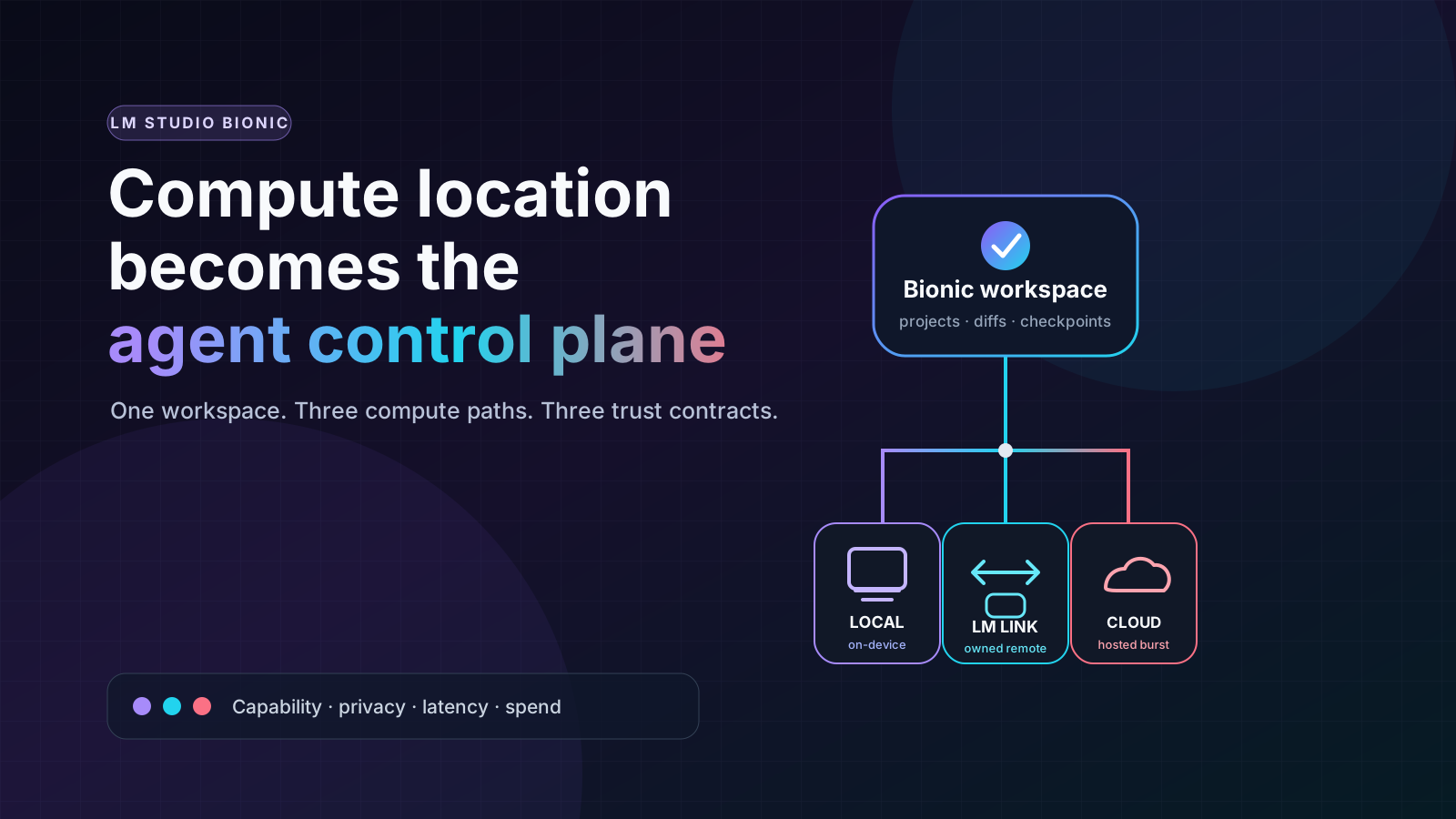
A model picker is usually a cosmetic control. In LM Studio Bionic, it can decide where a prompt goes, which machine pays for the work, how fast the answer arrives, and what trust boundary a file crosses.
That is the useful way to read LM Studio's July 16 launch. Bionic is a separate desktop app for coding, research, documents, slides, and spreadsheets; LM Studio's homepage labels the release an initial preview. It can use a model on the current computer, reach a model on user-owned hardware through LM Link, or call a large open model in LM Studio Secure Cloud.
The obvious take is that LM Studio has put a Codex-style agent interface on top of local models. That is accurate, but incomplete. LM Studio already supplied local inference to Codex, Claude Code, Hermes Agent, OpenClaw, and other tools. Bionic moves the company upward into projects, diffs, checkpoints, artifact previews, voice input, web search, and cloud credits. It now wants to own the work surface as well as the engine.
That move creates a product with an unusual shape: an open-model control plane inside a proprietary workspace. The models can be open. The runtime can run on hardware you control. The project and recovery layer around them is still LM Studio's product.
It also makes “local” a per-task claim, not a permanent badge. Local inference and voice can stay on-device. LM Link sends encrypted traffic to another machine you own. Secure Cloud and native web search transmit requests for zero-retention processing. Builders should evaluate those paths separately instead of inheriting one privacy label for the whole app.
The launch feature list is broad. A Code project can inspect a selected local folder, search a repository, trace behavior, edit files, debug, and show inline diffs. A Work project can handle PDFs, documents, decks, and spreadsheets; create artifacts; use native web search; preview results; and roll changes back through automatic checkpoints. Bionic also ships a system-wide voice keyboard using local Voxtral transcription.
The execution design is more consequential than any one of those features. Bionic exposes three compute locations:
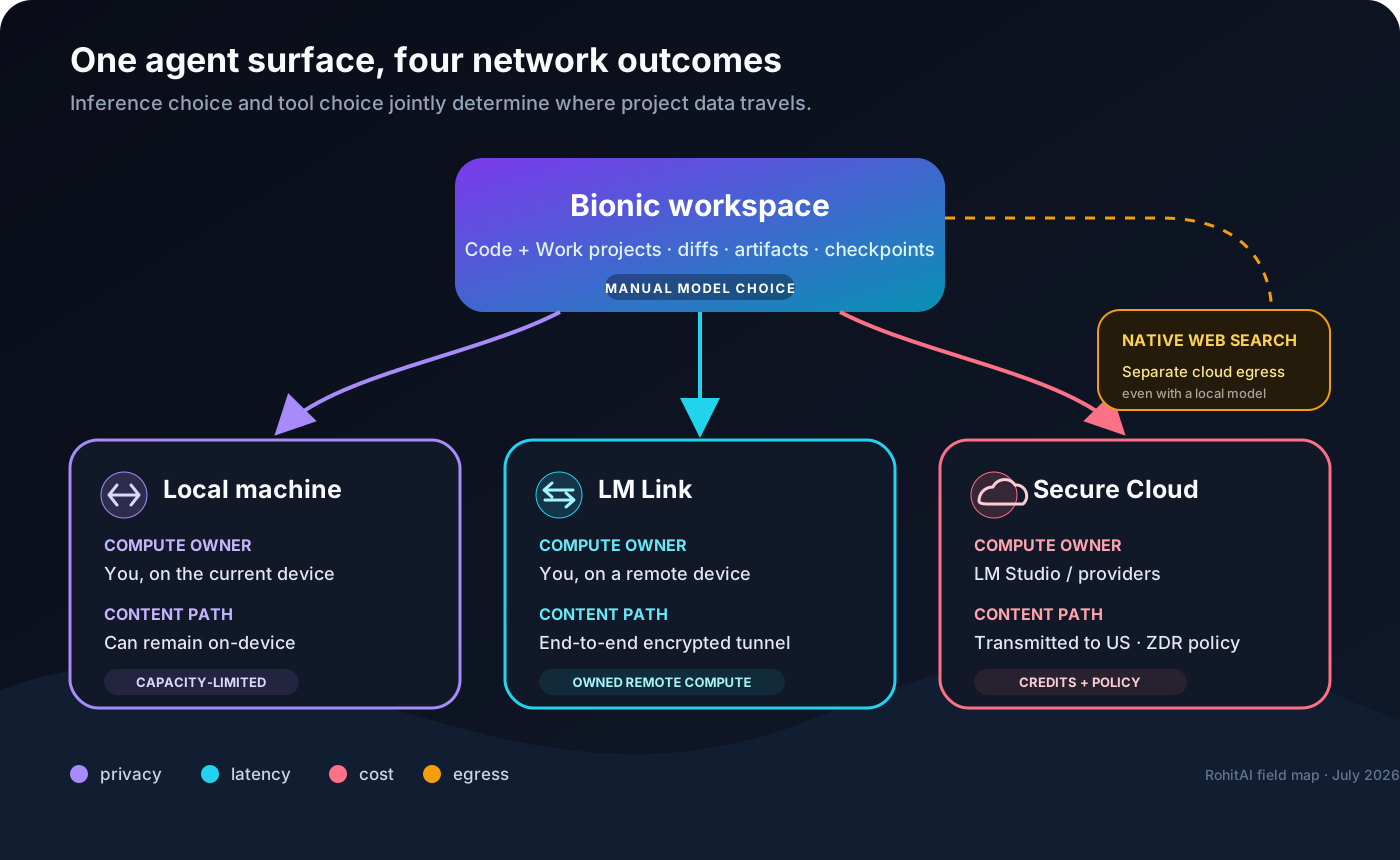
Bionic's practical control plane: the same project surface can cross different compute, cost, and data boundaries. Native web search is a cloud path even when the selected model is local.
| Execution path | Where inference runs | What crosses the network | Best fit | Question to settle |
|---|---|---|---|---|
| Local | The current Mac or Windows PC | Model downloads and update checks use the network; local prompts and files can remain on-device | Sensitive work, offline use, small-to-mid-size models, predictable marginal cost | Can the chosen quantization complete the task at usable speed and context? |
| LM Link | A remote workstation or server owned by the user | Encrypted inference traffic travels over a dedicated Tailscale-based mesh | Shared GPU rigs, bigger private models, laptop-to-workstation workflows | Does network latency or remote availability damage long agent loops? |
| Secure Cloud | LM Studio's US-based hosted infrastructure and providers | Prompts, attached files, and responses are processed transiently under the company's zero-retention policy | Flagship-scale models and tasks that outrun owned hardware | What do credits cost, what limits apply, and is this data allowed to leave the device? |
| Native web search | A cloud search service, alongside whichever inference path is selected | The search request is sent for transient processing | Current research and outside context | Has the team accounted for this egress in an otherwise local workflow? |
LM Studio's privacy policy supports this more precise reading. It says local-model messages, histories, and documents stay on the device. It separately defines cloud services to include both hosted inference and web search, with “User Requests” covering prompts, attached files, and other inputs. The company says those requests and responses are processed transiently, are not retained, and are not used for training.
Zero data retention is a meaningful contractual commitment. It is not the same as zero transmission. The distinction matters for regulated files, client code, legal documents, export-controlled data, and any team whose policy depends on processing location.
Bionic did not arrive on an empty foundation. The visible agent UI is the newest layer in a sequence of runtime investments.
In January, LM Studio 0.4.0 separated the GUI from its headless llmster runtime. It added continuous batching, parallel inference, a stateful REST API, and permission keys for MCP access. In June, LM Studio described disk-backed KV-cache checkpoints for its MLX engine, aimed at repeated and parallel agent workloads. That cache mechanism is distinct from Bionic's user-facing project checkpoints and rollback. LM Link added encrypted discovery and remote inference across user-owned devices.
Those features sound like infrastructure because they are infrastructure. They are also what makes a desktop agent tolerable during a long task. A useful agent needs more than an attractive diff view. It needs a server that can survive multi-step sessions, reuse expensive prompt state, handle concurrent work, enforce tool permissions, and move between machines without turning remote inference into a networking project.
The stack LM Studio now wants to own
Open model catalog → optimized local runtime → encrypted remote compute → stateful agent loop → projects and diffs → checkpoints and artifacts → cloud credits.
Before Bionic, LM Studio's integration docs encouraged users to point Codex, Claude Code, Hermes Agent, and OpenClaw at localhost:1234. That option remains strategically important. Bionic competes with those harnesses for the project layer while the underlying LM Studio server can still supply their models.
This is a smart form of verticalization. If users prefer Bionic, LM Studio owns more of the relationship. If they prefer another agent, LM Studio can still own inference. The tension is manageable as long as the runtime interface stays useful outside the first-party app.
LM Studio calls Bionic an agent for open models. That wording is careful. Bionic itself is not presented as open-source software.
The company's desktop terms describe the software and its source structure as proprietary, prohibit reverse engineering except where law permits it, and grant a license for personal or internal business use. The practical boundary looks like this:
This is one of the launch's most important builder implications. Open weights reduce model dependency. They do not automatically reduce workflow dependency.
The stickiest part of an agent product may become the accumulated state around the model: which folders are connected, how approvals work, what a checkpoint records, which edits were accepted, how artifacts render, and how a team resumes unfinished work. If that state cannot travel, a “model-independent” workspace can still have strong proprietary gravity.
That does not make Bionic a bad product. Good opinionated software is often proprietary. It means buyers should put exportability on the evaluation sheet instead of assuming it follows from the word “open.”
The Secure Cloud catalog explains why LM Studio needs three paths. It lists GLM 5.2, Kimi K2.6, and Kimi Code K2.7. These are enormous models.
GLM-5.2's official model card describes a 753-billion-parameter model with a one-million-token context window; its full BF16 repository is roughly 1.51 TB. RohitAI previously examined what GLM-5.2 changed in the open-coding race. Kimi K2.7 Code is a one-trillion-parameter mixture-of-experts model with 32 billion active parameters, and its repository is roughly 595 GB.
Those repository sizes are not runtime-memory requirements for every quantization, and Bionic may serve different limits in the cloud. They still make the topology clear. Most laptops will not run the flagship catalog at anything close to its native form. A user will choose among a smaller or more aggressively quantized local model, a stronger GPU box through LM Link, and hosted compute.
Hybrid execution is therefore not an embarrassing fallback until laptops catch up. It is the product architecture. Local models can cover private, cheap, and offline tasks. LM Link can turn a workstation into a personal inference cloud. Secure Cloud can provide the models that owned hardware cannot serve efficiently.
The missing piece is transparent economics. LM Studio's pricing page shows a $0 plan, pay-as-you-go cloud credits, and a coming Bionic Pass. As of July 17, its public page does not list per-token rates, credit conversion, expiration rules, context caps, or minimum purchases. Direct API prices from Z.ai or Moonshot cannot fill that gap; they are not Bionic prices.
Without a public rate card, users cannot answer the central buy-versus-own question. The correct comparison includes cloud credits per accepted task, local hardware amortization, energy, operator time, latency, and failure rates. “Free locally” and “pay as you go” are product labels, not a cost model.
Use a local model for sensitive drafts, offline research over provided files, small repository changes, and repeatable tasks that fit the machine. Test actual context and tool reliability rather than choosing by parameter count.
Put a larger model on a workstation or GPU server and reach it through LM Link when compute ownership matters but laptop capacity does not. Measure p95 latency, disconnect recovery, and concurrent demand.
Use Secure Cloud when task value justifies hosted processing and policy allows it. Wait for clear rates and limits before making it a default production route.
Bionic's two project modes expose different trust boundaries.
LM Studio says a Work project processes documents in a sandboxed environment that keeps the rest of the computer and files safe. That is a vendor claim worth testing. At launch, the company had not published the sandbox technology, mount rules, network policy, credential handling, process privileges, audit logs, or escape analysis.
A Code project is intentionally less abstract: the user points Bionic at a selected local folder, and the agent inspects and edits it. The launch post promises inline diffs for review. It does not extend the Work-project sandbox description to Code projects.
That asymmetry is sensible. A coding agent needs to touch a repository. It also means “Bionic is sandboxed” is too broad a sentence.
Checkpoints help with recovery, but recovery and containment are different controls. A checkpoint may restore tracked files after a poor edit. It may not stop a spawned process, revoke a leaked credential, reverse a network request, undo a database migration, or restore files outside the checkpoint boundary. LM Studio has not yet documented the cadence, storage, encryption, granularity, or external-side-effect behavior of Bionic checkpoints.
LM Studio has not published a Bionic benchmark. That absence should prevent two common mistakes.
First, do not transfer GLM or Kimi model-card scores to Bionic. The app may use different quantizations, context limits, prompts, tool schemas, and serving configurations. Agent quality depends on the whole loop: planning, search, edit application, error recovery, checkpointing, and human review.
Second, do not assume that lacking a leaderboard win makes the harness unimportant. An independent JobBench preprint evaluated 130 tasks across 35 occupations and reported a 45.9% completion rate for its best tested system, Claude Opus 4.7 under Claude Code. JobBench did not evaluate Bionic, and it is a preprint. Its useful signal is narrower: even strong agents still leave a large recovery problem.
That makes diffs, checkpoints, and scope controls economically important. A somewhat weaker local model that produces inspectable edits and rolls back cleanly may be preferable to a stronger model whose failures are expensive to locate. Reliability can be a property of the harness, not only the checkpoint.
A second preprint from Microsoft researchers found roughly 24% more pull requests merged among coding-agent adopters across a large field study. The authors also warn that pull-request counts are not delivered value and that token costs can be substantial. Bionic should be evaluated with the same discipline: accepted outcomes and correction time, not activity volume.
Desktop agents are converging on the same broad shape: files, code, documents, browsing, artifact creation, state, review, and remote compute.
OpenAI's Codex desktop app established a coding-oriented reference point with parallel agents, worktrees, skills, automations, and an open-source sandbox. ChatGPT Work pushes the same work-surface idea across documents, spreadsheets, presentations, browser activity, connectors, and Codex. Ollama is also adding hosted open models to a product known for local inference.
Bionic should not be judged by whether it reproduces every feature from those products in its first preview. Its differentiated asset is the middle lane: user-owned remote inference that behaves like local compute.
LM Link uses a dedicated Tailscale-based network. LM Studio says it runs in userspace, opens no public ports, stays separate from an existing Tailscale network, and exposes model or API access rather than general access to the remote operating system. A linked model can appear through the familiar localhost:1234 interface. That turns a desktop workstation, home GPU server, or lab box into a personal model endpoint without making LM Studio the compute owner.
This topology gives Bionic a credible answer to a problem cloud-first products do not solve in the same way: “I want a stronger machine than my laptop, but I still want to own the hardware running the model.”
Its weakness is product maturity. Codex and other established agents have more visible orchestration and security documentation. Bionic has a promising runtime foundation, but the launch leaves basic questions about sandbox design, project portability, cloud pricing, admin controls, and benchmarks unanswered.
Do not start by asking Bionic to impress you with a greenfield demo. Give it repeated work where failures are visible.
For each run, record:
The goal is not to crown one route. It is to discover which route deserves which class of work.
Bionic currently asks the user to choose a model and execution environment. The launch does not advertise automatic cloud fallback or policy-aware routing. That manual design is probably temporary.
My medium-confidence prediction is that LM Studio will add a router that considers data sensitivity, hardware fit, required capability, latency target, and spend ceiling.
The naive router sends hard tasks to the biggest model. The useful router knows that a confidential repository cannot use one path, a one-trillion-parameter model cannot use another, a quick edit should not wake a remote rig, and a low-value task should not consume cloud credits.
That could become Bionic's strongest feature because LM Studio controls all three lanes. A policy could say:
My high-confidence commercial prediction is simpler: LM Studio will keep a useful local agent free and monetize overflow. The current $0 tier brings users into Bionic; flagship cloud models and a forthcoming Bionic Pass create revenue when tasks outrun local hardware. That is a coherent business, provided pricing becomes transparent.
The third prediction is about lock-in. If Bionic succeeds, its durable retention mechanism will be project state rather than model exclusivity. Users can swap weights. They will be slower to abandon checkpoints, review history, artifact conventions, and team policy. Export formats will decide whether that becomes healthy workflow continuity or an avoidable migration cost.
Bionic is credible because LM Studio has already built much of the unglamorous infrastructure beneath it. The local runtime works with outside agents. LM Link supplies a genuinely distinct owned-compute path. The app combines code, documents, voice, search, diffs, and rollback in one surface.
It is still a preview, and four debts remain:
Until then, the responsible verdict is neither dismissal nor blanket trust.
LM Studio has built a compelling way to put open models behind a desktop agent without forcing every task onto one computer or into one vendor's cloud. The product's success will depend less on whether its chat window looks polished and more on whether users can understand and control the path from project to processor.
That is the standard builders should apply: know where the work runs, know what leaves the machine, know what can be reversed, and know what it costs before the agent starts.