Alibaba’s Qoder Agent Desktop Puts the Harness Above the Model

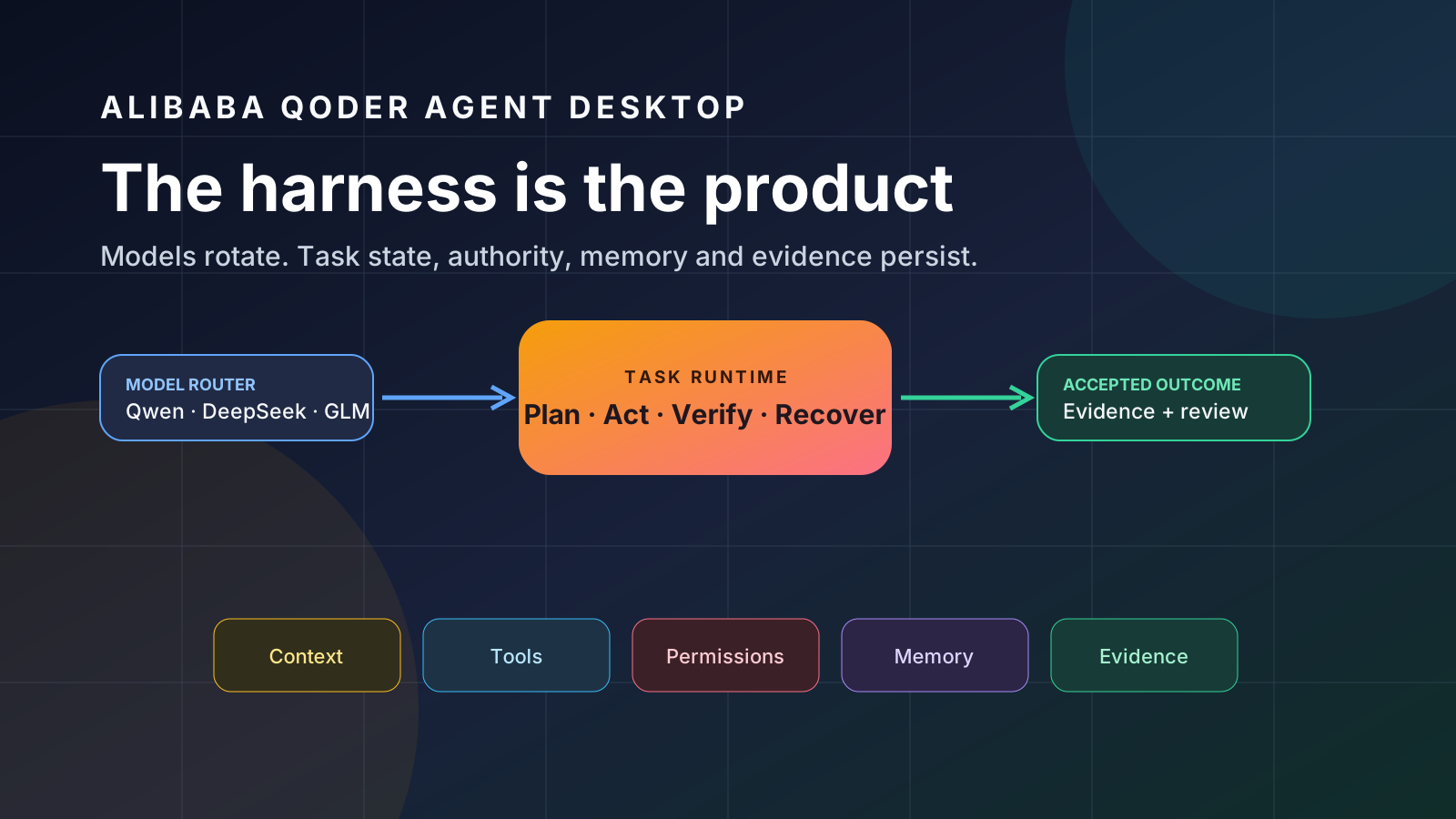
Alibaba has launched a desktop agent that makes an unusually revealing product decision: the model is a menu item.
Qoder can route a task across Qwen, DeepSeek, GLM, Kimi and MiniMax models, or use a personal model key. What stays constant is everything around that choice—the task history, project context, permissions, tools, memory, verification loop and review surface. That is the launch worth paying attention to.
The new Qoder release, shipped on August 27, 2026, moves the product beyond its AI-IDE roots. It offers Coding and General work modes, can operate a browser or desktop app, schedules tasks, remembers project conventions, installs skills and connectors, and lets a person watch several delegated jobs instead of driving every edit. Alibaba calls it an agentic platform for everyone. A more useful description is a control plane for delegated computer work.
That framing also exposes what can go wrong. A browser connection can inherit live cookies. Memory can carry context into a later task. A recorded workflow can become a reusable skill. Full access can remove the next permission prompt. Meanwhile, a scheduled automation still needs Qoder running and the machine awake. Qoder has assembled many of the ingredients of an agent operating layer, but the hard product is no longer code generation. It is authority, recovery, evidence and attention management.
Qoder began as an agentic coding product in August 2025. Its May 2026 release pushed further into autonomous development. The August desktop launch changes the center of gravity again.
In Coding mode, work is organized around repositories and workspaces, with Git branches and worktrees available for isolated parallel tasks. In General mode, the boundary is a folder: reports, research, documents, prototypes and other artifacts that may use code without asking the user to live inside an editor. The official quickstart makes that split explicit.
This is a bigger interface change than it first appears. A file-centric tool waits for a human to choose the file, request an edit and judge the result. A task-centric workbench has to preserve a goal, choose tools, monitor state, recover from failure and decide what deserves the user's attention. Qoder describes a continuous loop of context gathering, planning, execution, verification and self-correction, with retries or rollback when needed.
Those are operating-system-like responsibilities, but the analogy needs discipline. Qoder does not replace Windows or macOS. It sits above them and tries to schedule intent across models, tools and applications. It is closer to a task runtime and control plane than a new operating system.
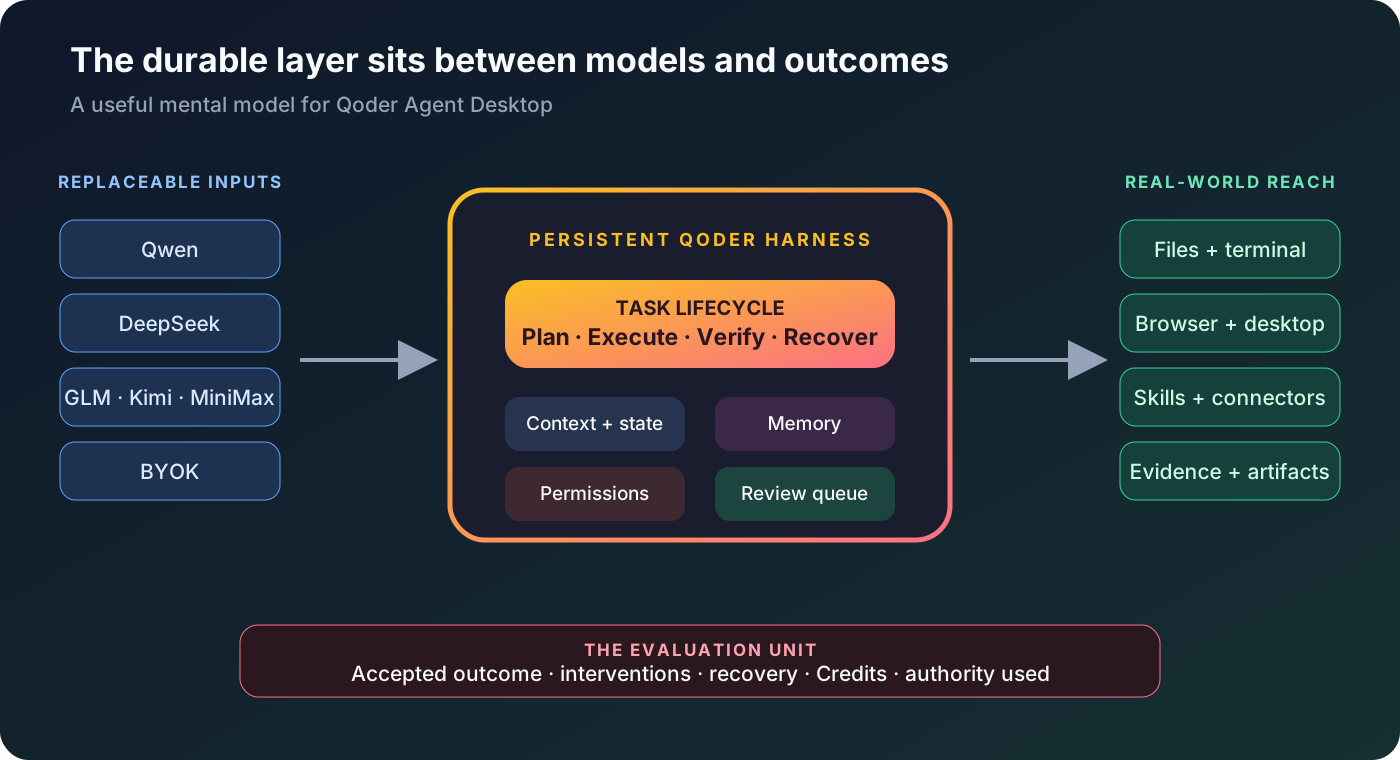
Qoder's strategic layer is the middle of this map. Models can change; the task runtime still owns context, execution policy and review.
The current model selector offers policy tiers—Lite, Efficient, Auto, Performance and Ultimate—alongside named models from at least five model families. Personal models added with BYOK can appear in task, Agent and automation selectors too. The documented context options reach 1 million tokens where a model supports them.
Consumer choice is the surface. The deeper statement is where Qoder expects value to accumulate.
If the best model changes every quarter, a product tied to one provider inherits every quality regression, price move and access dispute. A harness that can route a stable workload across models has a hedge. RohitAI made the same point from the opposite direction when OpenAI's planned Cursor cutoff turned model access into an M&A risk: the workload and its evidence need to survive a provider change.
There is a catch. Auto routing makes model selection easier for the user while making evaluation harder for the buyer. A result can improve or regress because the prompt changed, the context changed, the router changed, the model changed or the Credit rate changed. Serious teams should record the effective model, tier, context size, reasoning setting, tool count, retries and Credits for important runs. Otherwise “Auto” becomes an unobservable production dependency.
Qoder's individual pricing is straightforward on paper. The variable is how many Credits a real task burns after model tier, context, tools and retries are included.
| Plan | Monthly price | Premium-model Credits | Best evaluation question |
|---|---|---|---|
| Free | $0 | Basic-model limits; 14-day trial includes 300 Credits | Can the harness improve a real task before the trial expires? |
| Pro | $20 | 2,000 | How many accepted routine outcomes fit inside the quota? |
| Pro+ | $60 | 6,000 | Do longer agent runs reduce human review enough to justify the jump? |
| Ultra | $200 | 20,000 | Which high-value workloads earn back their retries and tool use? |
Paid users can also buy 1,500 Credits for $20; the pack expires after one month and is non-refundable. Qoder's selector illustrates the variability: Lite is free, Efficient is roughly 0.3 times the baseline, Auto about 1.0, Performance about 1.1 and Ultimate about 1.6. Those are estimates, not fixed task prices, and Qoder says the in-app rate is authoritative.
The useful metric is therefore not Credits per month. It is Credits per accepted outcome. A $20 plan that yields four approved changes may be worse than a $60 plan that closes twenty useful tasks with less review. Conversely, a premium model that keeps retrying an underspecified task can turn intelligence into an expensive loop.
Qoder's desktop position gives it context that a remote chat agent struggles to acquire. Its Computer Use documentation says the browser connector can attach to an existing Chromium browser while preserving sign-in state, cookies and form data. It can list tabs, navigate, click, fill forms, take screenshots, run scripts and inspect network or console activity. AppShot can add a foreground window and accessibility text to a task. On supported systems, Computer Use can click and type in graphical applications.
That is useful because real work is scattered across repositories, dashboards, documents, ticket systems and authenticated web applications. It also means the agent may inherit the same authority as the person sitting at the machine.
The reliability trade is easy to miss. Qoder Automations can start recurring tasks and collect run history, but the app must be running at the scheduled time. The computer must still have power, network access, files and valid account sessions. “Keep device awake” reduces one failure mode; it does not turn a laptop into durable cloud infrastructure.
That creates a coherent product trade:
rich local context + live user authority
                    versus
weaker guarantees for unattended execution
For personal research, code maintenance or a morning report, that may be exactly right. For a task with a service-level objective, an irreversible external write or a dependency on expiring credentials, a local scheduler is the wrong reliability boundary. Alibaba already has Qoder Cloud Agents in the wider product family. The obvious next move is an explicit handoff from local context gathering to durable remote execution, with a visible transfer of state and authority.
Qoder defaults to Ask for approval. Auto approve prompts when the product detects potential risk. Full access can read, modify or delete files, run terminal commands and reach the internet without asking again. Those modes are understandable, but the dangerous unit is larger than a toggle.
Consider this route:
Each capability may look reasonable in isolation. The chain can still turn untrusted input into persistent procedure and then into an external side effect. This is why plugin portability does not make trust portable, and why Broadcom's AgentMinder control-plane framing matters: identity, intent and per-tool authorization have to survive the entire route.
Qoder has some promising control points. Its Hooks can run command, HTTP, prompt or agent handlers around tool calls, permission requests, file changes, worktrees and failures. Version 0.1.2 added enterprise policies for extensions and MCP servers just two days after launch. That speed suggests Alibaba understands governance is part of the runtime. It also tells buyers that the control layer is still moving.
Qoder says it has more than 6 million users and serves more than 100,000 businesses. It also points to a large extension ecosystem. These are company disclosures; public material does not define active users, paid users, duplicated accounts or extension review quality.
Independent market context is useful but narrower. Reporting based on IDC data put Qoder at 47.6% of China's 2025 AI-programming revenue market. Jiemian's follow-up documented developer questions about category boundaries, ByteDance Trae's absence from the top five and the difference between Chinese revenue share and global product leadership. The underlying paid IDC methodology was not publicly available for independent inspection.
Most importantly, no independent benchmark was found for the August general-purpose desktop release. Qoder published improvements for its May coding stack—lower token use, fewer turns and better task completion—but it did not publish the test set, baseline detail or reproducible artifacts, and those figures predate General mode, broad desktop control and the new task workbench.
| Evidence | What it supports | What it does not prove |
|---|---|---|
| 6M users; 100K businesses | Qoder has meaningful reported distribution | Active use, retention, paid conversion or outcome quality |
| 47.6% China revenue share | Commercial strength in one 2025 market definition | Global leadership or general desktop-agent performance |
| May internal improvement claims | The engineering team prioritizes harness efficiency | August success rates for browser, document or desktop work |
| 0.1.2 and 0.1.3 fixes | Enterprise controls and reliability are active priorities | That long-running sessions are already production-settled |
The fair conclusion is neither “Qoder leads” nor “the numbers are marketing.” Alibaba has distribution, a serious product surface and a coherent harness thesis. The expanded claim—an agentic platform for everyone—now needs evidence across task success, recovery, safety, latency, cost and intervention.
Do not begin with a leaderboard. Begin with twenty tasks that your team already knows how to judge: a repository change, an incident investigation, a source-backed report, a spreadsheet reconciliation and a browser workflow. Keep the underlying model fixed where possible so the harness is the main variable.
The acceptance metric matters most. “Agent finished” is a UI state, not evidence. A code task needs a reviewed diff and tests. A report needs sources and factual sampling. A browser action needs the destination, before-and-after state and a receipt. A failed run should reveal whether the agent recovered, rolled back or quietly changed the goal.
Use Qoder for research, reversible prototypes and scoped repository work. Keep approvals on and learn which tasks the harness completes cleanly.
Standardize an eval set, dedicated accounts, worktrees, evidence requirements and extension admission. Compare Credits and review time by accepted outcome.
Require identity, policy, audit evidence, memory governance, connector scopes and tested revocation before broad browser or Full access deployment.
The common reading of Qoder is that Alibaba has expanded a coding agent into a broader desktop assistant. That is accurate but strategically shallow.
The better reading is that Qoder is turning human attention into a scheduled resource. Once several agents can work in parallel, the primary interface is no longer the prompt box. It is the queue that tells a person what is running, what is blocked, what changed, what evidence exists, what authority is being requested and what deserves review now. RohitAI previously argued that agent swarms need an operating system, not a better group chat. Qoder is one of the clearest consumer-facing attempts to build that layer.
Three consequences follow.
First, model brands recede behind workload policy. Users will choose “fast,” “deep,” “private” or “within budget,” while the harness keeps the task coherent. The model still matters, but it becomes an execution dependency rather than the whole product identity.
Second, permission design moves from prompts to paths. The important question is not whether a user approved the browser once. It is whether browser content can become memory, memory can influence a skill, and that skill can write through a connector under unattended authorization. Enterprise winners will visualize and constrain those paths.
Third, local and cloud agents converge through explicit handoff. Local agents have the best personal context. Cloud agents have better durability. The product that transfers a task between them—with checkpointed state, scoped credentials, an idempotency plan and a visible authority receipt—will be more useful than either surface alone.
My near-term prediction is that Qoder will make cross-task triage, per-task budget estimates and routing receipts much more prominent. Its launch language already treats human attention as scarce. The next interface has to tell users not merely that an agent is busy, but whether continuing the run is still worth the money and authority it consumes.
It is Alibaba's task-centered desktop agent platform, launched in its new 0.1.x form on August 27, 2026. It combines Coding and General work modes with model routing, a planning and verification harness, browser and desktop control, memory, extensions, connectors, hooks and scheduled Automations.
No. Coding mode is repository-oriented, while General mode is designed around folders and outcomes such as research, documents, content and prototypes. Code remains an execution substrate, but a non-developer may judge the resulting artifact rather than edit the generated program.
The documented selector currently includes Qwen, DeepSeek, GLM, Kimi and MiniMax models, plus policy-based tiers and personal BYOK models. Availability and Credit rates can change by app version and account, so Qoder says the in-product selector is authoritative.
Not through the documented local Automations feature. Qoder must be running, and the task still depends on power, network, files and account access. Keeping the device awake reduces sleep interruptions but does not create cloud-grade durability.
It is powerful, not inherently safe. Full access lets Qoder use files, the terminal and the network without asking again. Use it only inside a reviewed scope with reversible inputs, least-privilege credentials, monitored destinations and clear verification. New projects and untrusted web content belong in Ask for approval mode.
Measure accepted task completion, human interventions, recovery and rollback success, wall time, evidence quality, Credits, reviewer time and permission behavior. The goal is not to discover whether Qoder can produce an impressive answer. It is to learn whether the harness can finish your work predictably at an acceptable cost and authority level.
Alibaba's most important choice in Qoder Agent Desktop is to make many models available behind one persistent task interface. That choice acknowledges where coding agents are heading: model intelligence will keep improving and changing, while users invest in the harness that remembers their work, reaches their tools, enforces their boundaries and proves what happened.
Qoder already has enough pieces to make that thesis credible. It has task modes, worktrees, model routing, browser and computer control, memory, hooks, connectors, automations and a rapidly growing control surface. It also has the category's unresolved problems in plain view: opaque routing, variable cost, live-account authority, extension provenance, local-scheduler fragility and a lack of independent end-to-end benchmarks.
That is why this launch matters. Qoder is not evidence that the agent operating layer is solved. It is evidence that the competitive battlefield has moved there.