A Disputed White House AI Gate Turns Model Access Into Runtime Risk

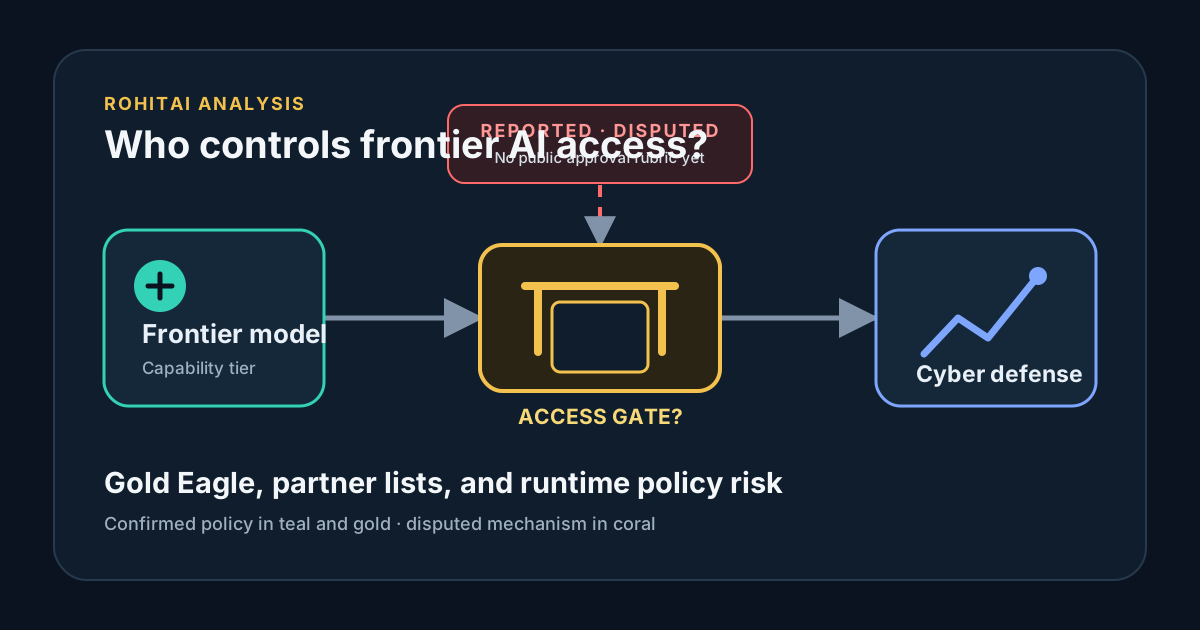
CNBC reported on July 17, citing two unnamed people familiar with the matter, that the White House is now dictating which companies and entities may access the newest frontier AI models. One source connected that authority to Gold Eagle, the government's new cybersecurity clearinghouse. Another said future partner cohorts for Anthropic's Project Glasswing and OpenAI's Daybreak would need explicit government approval.
That would be a major change. It is also disputed, and the public record does not yet prove it.
The White House's Gold Eagle announcement describes vulnerability intake, scan deconfliction, validation, prioritization, remediation, and patch coordination. It does not describe a model-access board. A White House official told CNBC that the government does not approve private-company model releases, participation in testing and meetings is voluntary, and release timing and scope remain with the companies.
The easy headline—Washington now approves frontier AI releases—is therefore too blunt. The more useful question is narrower: has the government moved from temporarily influencing a few early-access lists to shaping who receives the most capable cyber tiers as a standing practice?
We know the temporary version happened. Anthropic says U.S. government approval restored Mythos 5 to a limited set of American organizations in June. OpenAI says it restricted the first GPT-5.6 preview at the government's request and shared the participants with officials. What remains unproven is whether those episodes have hardened into permanent entitlement infrastructure, and whether Gold Eagle is actually part of it.
That distinction matters to builders now. A model can be broadly released while its most useful cyber capability remains gated by organization, identity, jurisdiction, retention rules, and downstream-use rights. Access is no longer a procurement footnote. It is a runtime dependency.
This is the live test of RohitAI's earlier analysis of the new frontier access regime. The partner list, not the launch date, may be becoming the real control surface.
Three records are being compressed into one story.
First, the official record confirms a federal vulnerability-coordination program. Second, it confirms a separate voluntary framework for government prerelease access and collaboration on trusted early partners. Third, CNBC reports that Gold Eagle will connect those functions by greenlighting future access. Only the third claim is both central to the headline and unresolved.
| Claim | Evidence status | What can safely be said |
|---|---|---|
| Gold Eagle coordinates AI-found vulnerabilities | Confirmed | Official materials describe scan deconfliction, validation, prioritization, remediation, and patch distribution. |
| The order creates a trusted-partner framework | Confirmed, separate rail | Section 3(b) calls for a voluntary framework for prerelease access and government-developer collaboration on early partners. |
| Gold Eagle will approve future Glasswing and Daybreak partners | Reported and disputed | CNBC attributes this to an unnamed source. No public directive, lab confirmation, approval rubric, or appeal process establishes it. |
| All frontier releases now require White House approval | Unsupported | GPT-5.6 reached broad availability on July 9, and the White House says companies retain release timing and scope. |
| Criteria, decision maker, review time, and appeal rights | Unknown | None of these mechanics was public by the July 18 research cutoff. |
The Next Web and several same-day rewrites repeated CNBC's account but did not add independent sourcing. A targeted check found Reuters describing Gold Eagle as a voluntary coordination group, not an access gate. That does not disprove CNBC. It means the strongest accurate label remains reported and disputed.
The text of Executive Order 14409 is clearer than the surrounding argument.
Section 2(d) directs Treasury, consulting the National Cyber Director, NSA, DHS, and CISA, to form an AI cybersecurity clearinghouse in voluntary collaboration with industry and critical-infrastructure operators. Its job is operational: coordinate and deconflict scans, discover and validate vulnerabilities, then coordinate and prioritize remediation and patch distribution. Gold Eagle is the White House's named implementation of that rail.
Section 3 is different. It directs agencies to develop a classified process for deciding when advanced cyber capability makes a model a covered frontier model. Section 3(b) then calls for a voluntary framework through which developers can engage the government, provide it access for up to 30 days before planned release to other trusted partners, and collaborate on selecting those early partners.
Section 3(c) says nothing in that section authorizes mandatory government licensing, preclearance, or permitting for model development or distribution. That is a meaningful limit, but a specific one. It does not erase authority that might come from export controls, procurement, national-security contracts, or other law.
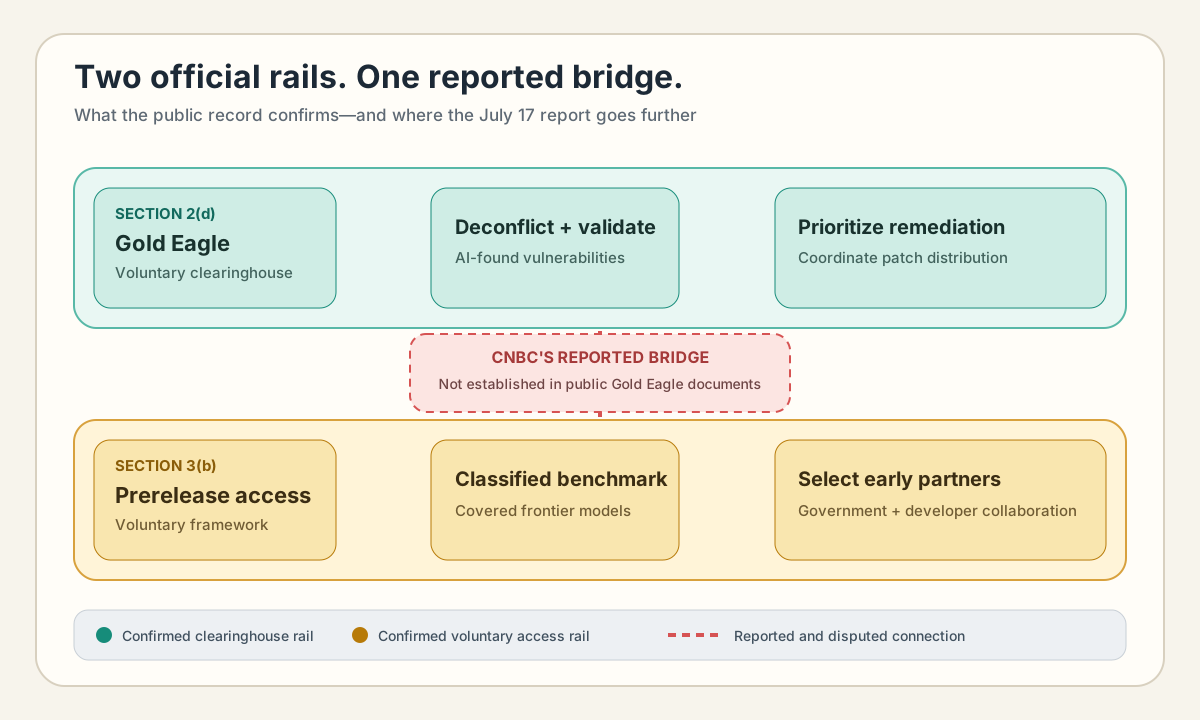
The public order contains two distinct tracks. CNBC's account is the reported bridge between them; the Gold Eagle release itself does not draw it.
This is not pedantry. A clearinghouse that receives vulnerability reports is different from a body that chooses who gets a less-safeguarded cyber model. Combining the two could make sense operationally: trusted partners get capability, generate findings, and route them into coordinated remediation. It could also concentrate three powers in one network—selecting capable participants, receiving what they discover, and prioritizing what gets fixed.
That closed loop is a conditional governance risk, not a confirmed Gold Eagle design. The distinction should remain visible until an official document or independently corroborated account closes the gap.
The administration says it does not approve private-company model releases. CNBC's narrower allegation concerns approval of companies and partners receiving access.
Those propositions can be different. A lab may choose when to launch a model family while a specialized tier remains restricted to approved organizations. GPT-5.6 is the clean example: OpenAI made the family broadly available on July 9, ending the limited Sol preview, while Trusted Access for Cyber still uses organization, user, workflow, and model-specific controls.
That does not make CNBC right. It means the White House statement does not fully answer the most consequential version of the claim.
The model name is becoming the least precise part of an entitlement:
usable capability =
  model × safeguard tier × approved organization × approved user
  × jurisdiction × retention terms × downstream-use rights
If any factor becomes zero, the product loses that capability even while the API is healthy.
June showed how abrupt that failure can be. Anthropic says a June 12 export-control directive covering foreign nationals forced it to suspend Fable 5 and Mythos 5 for everyone because it could not verify nationality in real time. After the controls were lifted, Fable returned broadly, but Mythos access was restored to a set of U.S. organizations following government approval on June 26. Associated Press reporting also documented limited government-approved access for Mythos and roughly 20 customers in OpenAI's initial preview.
OpenAI's own GPT-5.6 preview announcement says the company started with a small trusted group at the government's request and shared participants with officials. OpenAI did not say the government approved each name, and it argued that this process should not become the long-term default.
Those are case-specific precedents. They prove practical influence, not a permanent universal gate.
Glasswing and Daybreak are often grouped together because both put powerful cyber capability behind trust checks. They do not distribute the same right.
Anthropic's model is closer to selected direct access. Project Glasswing gives approved critical-software and infrastructure participants access to Mythos-class capability for defensive work. Anthropic later said it was expanding the program by about 150 organizations across more than 15 countries, with each organization required to meet its security standards. Mythos is a distinct, less-safeguarded tier with published pricing and retention terms; being part of the wider ecosystem does not mean every participant automatically receives every entitlement.
OpenAI's distribution model is more layered. Its Trusted Access for Cyber documentation separates default GPT-5.5 access, more precise safeguards for verified defensive work, and narrower GPT-5.5-Cyber access for specialized authorized workflows. Approval is not automatic. It does not guarantee every cyber model or zero-data retention. It also prohibits resale, proxying, embedding, and downstream access for customer-facing products.
At the same time, OpenAI has a public Daybreak directory of cybersecurity product partners and systems integrators. That creates a second route: an end customer can buy a security product improved by frontier models without receiving direct model access.
Here is the non-obvious consequence. Partner selection can become channel policy. If the reported government role exists, approving a product vendor or integrator could influence which commercial security tools gain earlier capabilities, data, credibility, and customer distribution. The gate would shape a market, not just a research cohort.
That raises questions beyond classic model safety:
There is no public evidence that Gold Eagle currently allocates commercial advantage this way. But if CNBC's account is accurate, those are not side effects. They are part of the governance design.
The best argument for a clearinghouse has little to do with controlling models. It is that AI is finding vulnerabilities faster than people can validate, disclose, own, patch, deploy, and recertify them.
Anthropic's initial Glasswing update is provider-reported rather than an independent audit, but its funnel is unusually detailed. The company said partners found more than 10,000 high- or critical-severity issues in roughly a month. In its separate open-source pipeline, 1,752 suspected high/critical issues had been assessed; 1,587 were true positives; 1,094 were confirmed high or critical; 530 high/critical issues had been reported; 75 had been patched; and another 827 confirmed findings were awaiting disclosure.
Do not divide 75 by 10,000. Those numbers describe different populations and stages. The useful signal is the drop-off from machine discovery to human resolution.
Gold Eagle can create real value if it reduces duplicates, routes a validated issue to the right owner, protects sensitive details, and accelerates a verified patch. It can make matters worse if it centralizes low-quality reports, creates a high-value repository for attackers, or gives maintainers another queue without staff and liability protection.
Gross findings are the wrong success metric. Watch validated severity, duplicate rate, time to owner, time to patch, patch deployment, recurrence, disclosure backlog, and false-positive burden. A clearinghouse should be judged by vulnerabilities removed from production, not vulnerabilities accumulated in a dashboard.
Builders do not need to know whether CNBC's report is ultimately confirmed before changing architecture. June already demonstrated that entitlement can disappear while the model provider remains online.
Best for approved internal cyber work that genuinely needs the least-safeguarded model. Expect organization, named-user, jurisdiction, retention, and workflow constraints. Treat withdrawal as an availability incident.
Useful when direct model access is unnecessary or prohibited. The tradeoff is concentration: capability, evidence, and portability depend on the selected security vendor or integrator.
A generally available hosted model or open-weight stack reduces entitlement dependence. It may trail the strongest cyber tier and shifts safeguarding, monitoring, patching, and misuse response onto your team.
The right design is usually a portfolio, not a single card. Keep restricted access for the work that earns it. Route ordinary secure-development tasks to broadly available models. Maintain an open or self-hosted fallback where the risk model permits. Most important, preserve one evaluation suite across all three paths so a policy switch does not become a blind migration.
Your contract should cover the nontechnical failure modes too. Ask whether eligibility depends on nationality, country, sector, named-user identity, hardware-backed authentication, a government-approved list, classified evaluation, or vulnerability-sharing obligations. Negotiate suspension notice, model-substitution rights, data export, termination assistance, fallback service levels, and audit access.
Do not mix an internal trusted-cyber organization with customer-facing product traffic. OpenAI explicitly prohibits extending Trusted Access for Cyber through resale, proxying, embedding, or downstream external access. Do not assume zero-data retention either. Access approval, retention approval, and downstream-use approval are separate decisions.
This is ordinary reliability engineering applied to a new kind of failure domain. A 500 response, a revoked organization, a nationality mismatch, and a prohibited downstream use all look different in logs. They can have the same effect on the product.
Access controls can buy defenders time. They cannot freeze the global capability curve.
The UK AI Security Institute's new analysis found that leading tested open-weight cyber models performed similarly to closed models released roughly four to seven months earlier. That is a benchmark comparison, not a universal countdown. The open models did not match the newest closed frontier on every task, and future progress may not follow the same rate.
Still, the result changes the strategy. A U.S. access gate may redistribute an early advantage for months. It is unlikely to contain the capability permanently. Opaque restrictions can also increase the value of substitutes that sit outside the approved network—exactly the preparation-window problem in RohitAI's open-weight cyber analysis.
The institutional half-life may be much longer than the technical one. Identity systems, audit requirements, government-relations teams, preferred vendors, procurement language, and trusted-partner channels can persist after open models narrow the capability gap. Large labs and security companies can absorb that overhead. Small defenders, researchers, and maintainers cannot do so as easily.
That produces three predictions.
The first company to make that routing observable and portable will solve a problem the model labs are currently creating one policy page at a time.
The executive order gave agencies 60 days from June 2 to design the classified benchmark and voluntary framework, making August 1 the administrative deadline. That framework is the next document to watch, if it becomes public.
Useful disclosure would answer eight questions:
A second outlet with independent sources, an official directive, or a first-party lab statement could also materially change the evidence ledger. Until then, certainty in either direction is premature.
Not in the public documents reviewed through July 18. Gold Eagle is officially described as a vulnerability-coordination clearinghouse. CNBC reports that it will be used to greenlight access, but that claim is anonymously sourced and disputed by the White House.
Yes, in specific June episodes. Anthropic says government approval restored Mythos 5 to a set of U.S. organizations after a global suspension. OpenAI says it limited the initial GPT-5.6 preview at the government's request and shared its participant list. Those cases do not establish a permanent rule for every future release.
Section 3(b) describes a voluntary framework. Section 3(c) disclaims authority under that section to create mandatory licensing, preclearance, or permitting for model development or distribution. Separate authorities and practical government leverage are different questions.
Because the access pattern is portable. Organization approval, identity checks, jurisdiction, retention, safeguard tier, and downstream-use rights can become separate entitlements in coding, biology, science, and agent products. A restricted tier can fail independently of the provider's public API.
Map entitlement dependencies, separate internal restricted workflows from customer traffic, keep portable evals and fallbacks, negotiate suspension and substitution terms, and rehearse a safe switch. None of those steps depends on the CNBC report being confirmed.
The public record does not prove that Gold Eagle is a permanent White House approval board for frontier AI access. It does prove that government-influenced customer gating is no longer hypothetical.
The unresolved step is institutionalization: whether temporary June controls become a repeatable system for deciding which organizations receive the strongest cyber capability. If that happens, the important artifact will not be a model launch. It will be the entitlement graph around the model.
Builders should not wait for a policy memo to make that dependency visible. Treat restricted access like any other revocable piece of infrastructure: isolate it, monitor it, contract for failure, keep a fallback, and know exactly what the product can still do when the gate closes.