GPT-Realtime-2.1 Makes Voice Agents a Production API Bet

OpenAI's July 6 release of GPT-Realtime-2.1 looks modest if you read it like a model card. Better alphanumeric recognition. Better silence and noise handling. Better interruption behavior. A mini version. Clearer prices.
That is the surface story.
The sharper read is that OpenAI is turning realtime voice agents into a measurable production surface. The company is no longer just telling developers that speech-to-speech agents feel natural. It is giving teams a model pair, transport choices, SIP call handling, tool use, cached-token economics, and enough pricing detail to start routing live calls the way they already route text workloads.
That matters because voice agents fail differently from chatbots. A chatbot can be a little slow and still be useful. A phone agent that talks over a customer, misses an order number, waits too long after silence, or calls the wrong tool loses trust immediately. The unit of value is not one token. It is one completed conversation.
This post is a follow-up to RohitAI's broader OpenAI agent-stack coverage, especially GPT-5.6 GA Turns OpenAI's Agent Stack Into a Product. GPT-5.6 made the agent stack feel like a product platform. GPT-Realtime-2.1 narrows that bet into the hardest interface: live speech.
OpenAI's API changelog lists GPT-Realtime-2.1 and GPT-Realtime-2.1 mini as a July 6, 2026 release on v1/realtime. The changelog describes the full model as an updated realtime reasoning model with improved alphanumeric recognition, silence and noise handling, and interruption behavior. It describes mini as a faster, lower-cost distilled reasoning model for realtime voice applications.
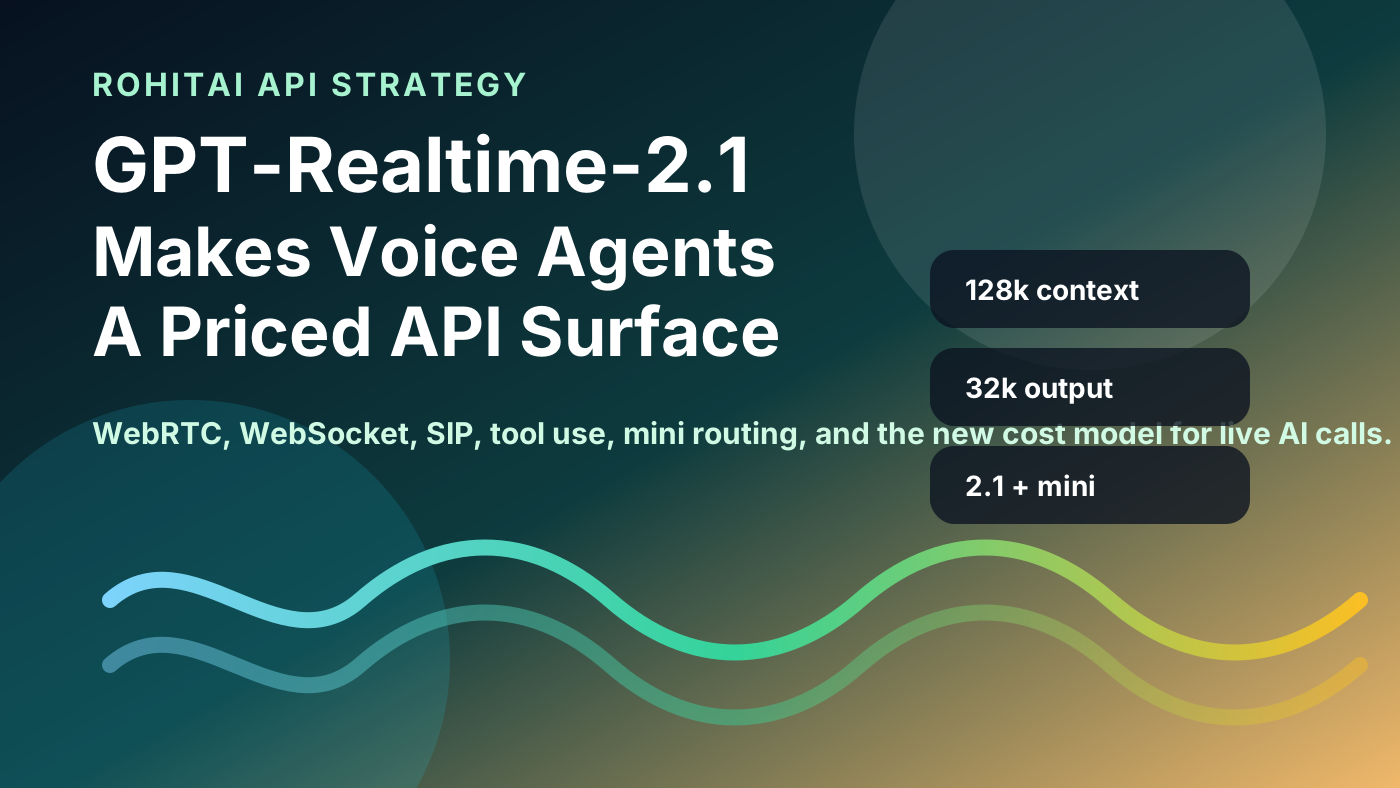
The GPT-Realtime-2.1 model page lists a 128,000 token context window, 32,000 max output tokens, text/audio/image input, text/audio output, configurable reasoning effort, instruction following, tool use, and reasoning token support. The model page prices text at $4.00 per million input tokens and $24.00 per million output tokens, with audio at $32.00 per million input tokens and $64.00 per million output tokens.
The GPT-Realtime-2.1 mini page keeps the same 128,000 context window and 32,000 max output ceiling, but cuts prices sharply: $0.60 per million text input tokens, $2.40 per million text output tokens, $10.00 per million audio input tokens, and $20.00 per million audio output tokens.
OpenAI's developer announcement adds one important operational claim: with this release, OpenAI says it has reduced p95 latency by at least 25% across Realtime voice models through improved caching. That claim is not a benchmark leaderboard. It is more useful than that. P95 is where real calls start to feel broken.
Text agents can hide behind the interface. A user types, waits, scans, edits, and retries. Voice agents have no such luxury. They run inside time.
A bad voice model does not merely answer incorrectly. It creates social friction. It interrupts someone who is thinking. It mistakes background noise for intent. It says a tracking number with the confidence of a person and the precision of a randomizer. It asks for information twice because it failed to capture the entity the first time. It speaks while a tool is still working, then has to correct itself.
That is why OpenAI's specific improvements matter. Alphanumeric recognition is not a small accuracy detail. It is the difference between a useful phone agent and a support loop. Silence handling is not polish. It decides whether the system respects a human pause. Interruption behavior is not personality. It governs whether the user can recover control.
OpenAI has been moving in this direction for a while. In May, it introduced GPT-Realtime-2, GPT-Realtime-Translate, and GPT-Realtime-Whisper in a broader voice intelligence API release. In late 2025, it made the Realtime API generally available with SIP, image input, remote MCP support, and production-oriented changes in the gpt-realtime launch. GPT-Realtime-2.1 is not a new category. It is a tightening of the product surface.
That tightening is happening just days after OpenAI launched GPT-Live for ChatGPT Voice on July 8, 2026. GPT-Live is a ChatGPT consumer voice model with full-duplex interaction and background delegation to frontier models. GPT-Realtime-2.1 is the API builder surface. They are not the same release, but they point in the same direction: voice is becoming an orchestration layer, not a microphone bolted onto chat.
The wrong way to adopt GPT-Realtime-2.1 is to replace every voice model string and declare victory.
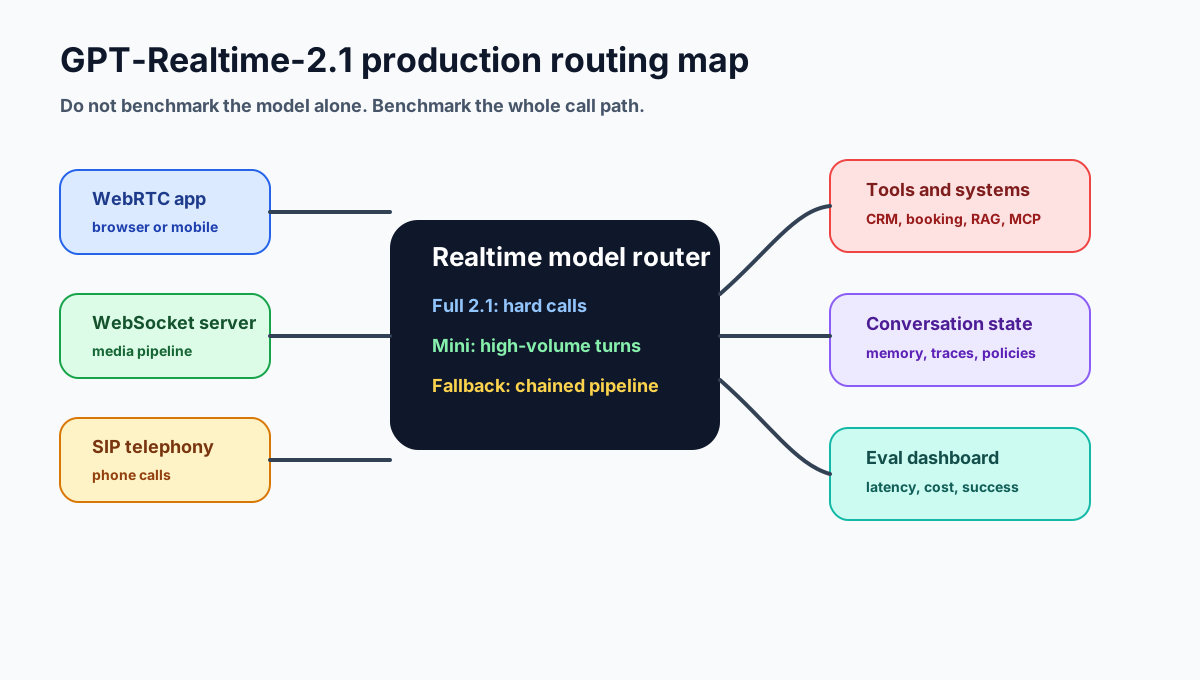
The better way is to route. Most production voice systems already have different paths for simple questions, authenticated workflows, payment flows, handoff, and escalation. Realtime models should sit inside that router.
Pick the full model when the caller's request requires complex reasoning, careful tool sequencing, exact entity capture, or a higher tolerance for output-token cost.
Start mini where the goal is fast containment: FAQs, status checks, appointment confirmation, intake, triage, and low-risk tool calls that can be verified.
Keep speech-to-text, text reasoning, and text-to-speech separate when transcripts, policy checks, deterministic approval gates, or custom model mixing matter more than native speech-to-speech flow.
OpenAI's own voice agents guide makes this architecture choice explicit. It separates speech-to-speech live audio sessions from chained voice pipelines. Live sessions are for low first-audio latency, barge-in, natural turn taking, and realtime tool use. Chained pipelines are better when a team wants stronger control over transcript storage, intermediate reasoning, policy checks, and speech generation.
That distinction is going to matter more now that full and mini have different economics.
The non-obvious implication: voice teams should stop treating model choice as a global setting. Model choice should be a runtime policy. If the caller asks for store hours, mini should probably answer. If the caller changes a flight, disputes a bill, reports a safety issue, or asks the agent to reason across several constraints, the system should upgrade the session or hand off.
Voice cost is easy to underestimate because it feels like a call, not a token stream. But audio output is expensive. Every extra sentence the agent speaks has a price. Every rambling confirmation costs money and time.
| Model | Text input / output | Audio input / output | Image input | Best initial role |
|---|---|---|---|---|
| GPT-Realtime-2.1 | $4.00 / $24.00 per 1M tokens | $32.00 / $64.00 per 1M tokens | $5.00 per 1M tokens | Hard calls, complex tool workflows, premium voice agents |
| GPT-Realtime-2.1 mini | $0.60 / $2.40 per 1M tokens | $10.00 / $20.00 per 1M tokens | $0.80 per 1M tokens | Default traffic, intake, triage, low-risk production turns |
The useful metric is not cost per token. It is cost per resolved call.
A cheaper model that misses order numbers, fails to call tools, or triggers human escalation too often can be more expensive than a stronger model. A stronger model that talks too much can also waste money. The best system will be one where prompts, voices, preambles, tool policies, and escalation rules are tuned to shorten successful calls without making the agent feel abrupt.
This is where OpenAI's cached-token story matters. The developer announcement's p95 latency claim is tied to improved caching. The model pages also expose cached input prices. Voice agents have repeated instructions, repeated policies, repeated tool schemas, repeated brand behavior, and repeated compliance language. If teams structure sessions so that stable context is cacheable, caching becomes both a latency tool and a cost tool.
The transport story is not a footnote. OpenAI supports WebRTC, WebSocket, and SIP across the Realtime surface. The Realtime overview recommends choosing transport based on where the application captures and plays audio. The WebRTC guide recommends WebRTC over WebSockets for browser and mobile clients because performance is more consistent. The SIP guide explains how to route phone calls through a SIP trunking provider and respond to incoming calls using OpenAI webhooks.
SIP is the enterprise wedge. It lets voice agents sit closer to the public phone network, PBX systems, carriers, and desk phones. Twilio has already published guides for connecting Twilio Voice and Elastic SIP Trunking to OpenAI's Realtime API, including a SIP connector tutorial for building support agents that answer inbound calls.
That does not mean every company should connect directly to OpenAI and skip orchestration vendors. The opposite may be true for serious deployments.
LiveKit's OpenAI integration docs describe LiveKit Agents as a bridge between frontend WebRTC and OpenAI's Realtime API over WebSockets, handling interruption logic, transcription sync, telephony, and noise cancellation around the model. LiveKit's own argument is blunt: model APIs give inference, but real voice products need transport, echo cancellation, turn detection, client SDKs, scaling, and model flexibility.
Deepgram is attacking from another direction with a bundled Voice Agent API, priced at $4.50 per hour, that combines speech-to-text, LLM orchestration, and text-to-speech. Google is pushing the Gemini Live API, currently marked preview, with low-latency voice and vision, barge-in, tool use, transcripts, and partner integrations.
The market is splitting into two layers:
Model layer: OpenAI, Google, and specialized audio labs compete on native speech reasoning, tool calling, language coverage, latency, and cost.
Orchestration layer: LiveKit, Vapi, Retell, Twilio, Deepgram, and others compete on telephony, SDKs, monitoring, turn detection, compliance, deployment, and outcome analytics.
Product layer: enterprises care about resolved calls, handoff quality, customer satisfaction, regulatory logs, and whether the agent can be tuned without a rebuild.
That is why GPT-Realtime-2.1 is good news and bad news for voice-agent platforms. It raises the baseline model quality. It also makes the surrounding infrastructure more valuable, because the model is only one part of a live call.
TechCrunch reported in May that Amazon Ring routes inbound calls through Vapi, after evaluating more than 40 AI voice vendors, and that Vapi said it had handled more than 1 billion calls. That is not proof Vapi is the winner. It is proof the buyer category is real.
The best demo for a realtime voice model is a charming conversation. The best production eval is a ledger.
For GPT-Realtime-2.1, I would build an eval suite around tasks where voice agents usually break:
The scorecard should track first-audio latency, p95 latency, interruption recovery, entity capture, tool-call correctness, call containment, cost per resolved call, customer satisfaction, and whether a human reviewer would accept the transcript.
My prediction: the winning voice-agent teams will not be the ones with the most human-sounding voice. They will be the ones with the cleanest routing and observability.
The model has to speak naturally, yes. But production quality comes from knowing when to use mini, when to upgrade, when to stop speaking, when to call a tool, when to confirm, when to hand off, and when to abandon voice entirely for a structured flow.
GPT-Realtime-2.1 gives teams a stronger model layer. It does not remove the need for product discipline.
If you already use OpenAI's Realtime API, do not migrate blind. Run a short eval against your hardest transcripts. Pay special attention to function tools over SIP, because early developer-forum feedback includes at least one report of mini behaving differently from the prior realtime mini in a SIP tool-calling flow. That is not a reason to avoid the model. It is a reason to test the exact path you run in production.
If you are new to voice agents, start with the architecture choice. Use OpenAI's speech-to-speech path for natural, low-latency conversation. Use a chained pipeline when you need transcript-first control, separate policy gates, or provider flexibility. Use a platform layer like LiveKit, Vapi, Retell, Twilio, or Deepgram when telephony, SDKs, monitoring, and call operations are the hard part.
If you are an enterprise buyer, ask vendors for more than model names. Ask for p95 latency under load, interruption test results, tool-call audit logs, data residency, SIP support, human handoff mechanics, and cost per completed workflow. A vendor that only says it uses the latest OpenAI model is not answering the real question.
First, watch whether GPT-Realtime-2.1 mini becomes the default production choice. If mini is good enough for most calls, OpenAI has a serious volume play. The full model becomes the premium escalation lane.
Second, watch how quickly GPT-Live concepts move into the API. OpenAI says GPT-Live is coming to the API soon. If developers get a full-duplex API model with background delegation, the current Realtime routing story gets more interesting. Voice agents could keep a conversational thread alive while deeper model work runs behind it.
Third, watch the platform fight around call analytics. The model providers will publish model cards and prices. The orchestration platforms will sell dashboards, handoff rules, telephony reliability, and outcome tuning. The value may sit wherever the customer can see what happened in the call.
No. GPT-Realtime-2.1 is an API model for realtime voice agents. GPT-Live is OpenAI's July 8, 2026 ChatGPT Voice model family. OpenAI says GPT-Live will come to the API soon, but this article is about the July 6 GPT-Realtime-2.1 API release.
Start by testing both. My default would be mini for high-volume routine calls and full 2.1 for hard workflows where reasoning quality, tool timing, and entity capture justify the higher audio output cost.
Not automatically. GPT-Realtime-2.1 improves the model layer. Production voice still needs transport, noise handling, telephony, SDKs, monitoring, compliance, handoff, and analytics. Some teams will go direct. Many serious teams will still use an orchestration layer.
Cost per resolved call. Latency, token cost, tool accuracy, containment, and human escalation all feed into that. A voice agent is only cheap if it completes the conversation correctly.