OpenAI’s Audio API Retirement Turns Aliases Into Migration Debt

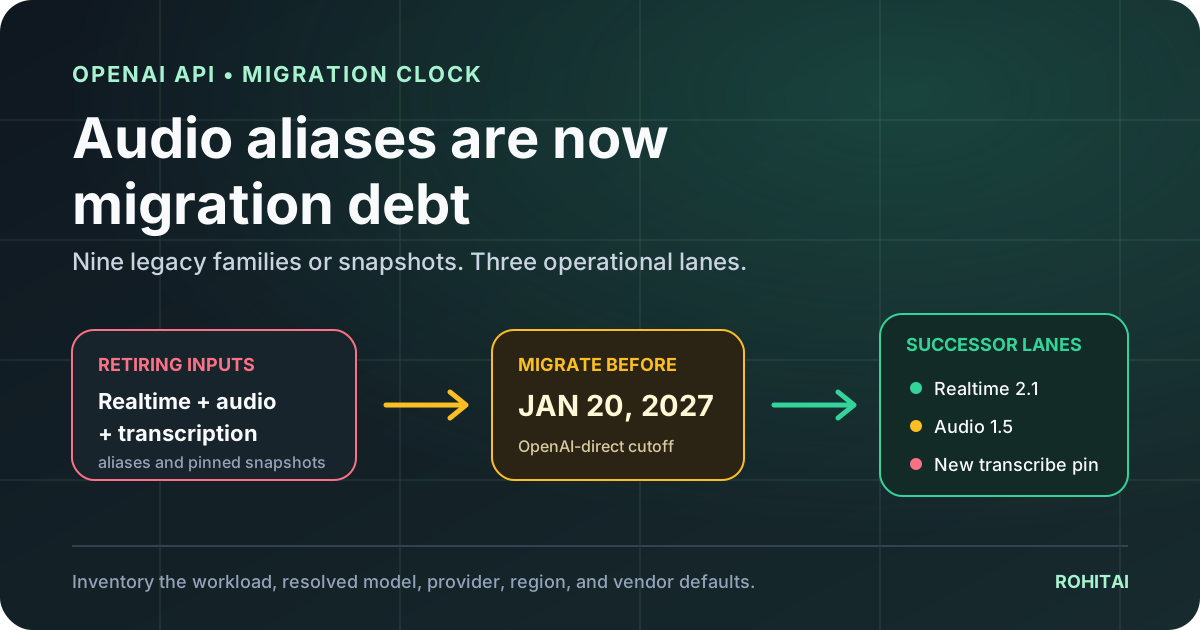
OpenAI has put an expiry date on a large slice of its older voice stack. On January 20, 2027, the company plans to remove nine legacy audio, Realtime, and transcription model families or snapshots from its direct API. The official replacement table looks reassuring: old model on the left, new model on the right, six months to change a string.
That reading is too comfortable.
The table actually hides three different migrations. Realtime voice agents stay on the Realtime API but move to reasoning-capable successors. Request-based audio remains in Chat Completions, while its low-cost mini lane disappears into gpt-audio-1.5. A pinned transcription snapshot simply advances from March to December 2025. The endpoints may stay familiar, but the behavioral, latency, and economic contracts do not collapse into one neat upgrade.
The practical lesson is bigger than this retirement: a provider alias is an infrastructure dependency, not a harmless label. If a model ID can change behavior, cost, regional eligibility, or availability, it belongs in the same lifecycle inventory as an SDK, database engine, or cloud runtime.
This is a migration notice for voice builders. It is also a warning about how casually many teams manage model names.
OpenAI’s deprecation ledger says developers were notified on July 20, 2026. Every row in this new group carries the same January 20 shutdown date, but grouping them under “audio” obscures what changes.
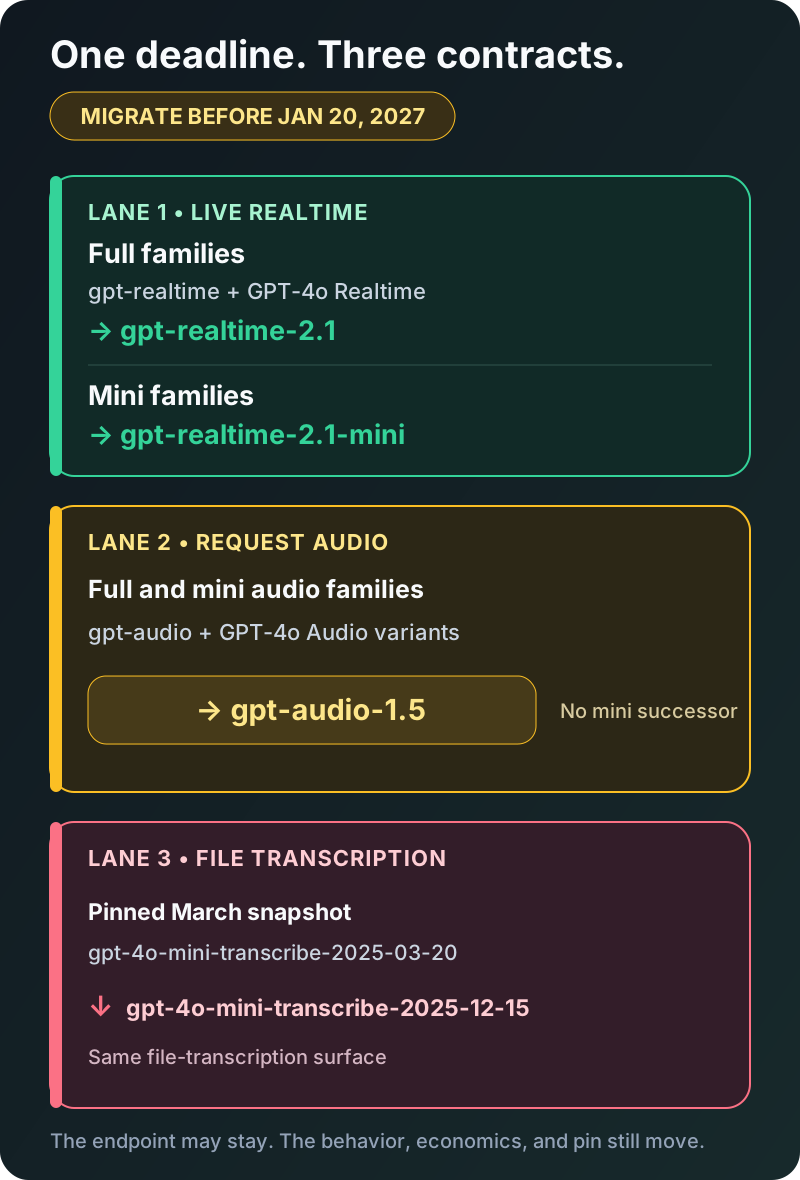
One retirement notice routes workloads into three operationally different successor lanes.
The first lane is live conversation. gpt-realtime and the older GPT-4o-branded Realtime families move to gpt-realtime-2.1; mini Realtime families move to gpt-realtime-2.1-mini. The successors still support WebRTC, WebSocket, and SIP, according to OpenAI’s full and mini model pages.
The second lane is request-response audio in Chat Completions. The gpt-audio, GPT-4o audio, and audio-mini families all converge on gpt-audio-1.5. That is endpoint continuity, but it is also product consolidation: OpenAI lists no mini request-audio successor.
The third lane is bounded transcription. The explicit gpt-4o-mini-transcribe-2025-03-20 snapshot moves to gpt-4o-mini-transcribe-2025-12-15. The /v1/audio/transcriptions surface remains the relevant API for uploaded files; OpenAI’s speech-to-text guide documents no endpoint redesign for this snapshot change.
Here is the July 20 notice as an operational ledger.
| Retiring family or snapshot | Recommended replacement | Workload lane |
|---|---|---|
gpt-realtime | gpt-realtime-2.1 | Live Realtime |
gpt-4o-realtime | gpt-realtime-2.1 | Live Realtime |
gpt-realtime-mini | gpt-realtime-2.1-mini | Lower-cost live Realtime |
gpt-4o-mini-realtime | gpt-realtime-2.1-mini | Lower-cost live Realtime |
gpt-audio | gpt-audio-1.5 | Request-based audio |
gpt-4o-audio | gpt-audio-1.5 | Request-based audio |
gpt-audio-mini | gpt-audio-1.5 | Request-based audio |
gpt-4o-mini-audio | gpt-audio-1.5 | Request-based audio |
gpt-4o-mini-transcribe-2025-03-20 | gpt-4o-mini-transcribe-2025-12-15 | File transcription |
There is an important documentation wrinkle. OpenAI’s table uses four GPT-4o family labels without the historical -preview suffix: gpt-4o-audio, gpt-4o-realtime, gpt-4o-mini-audio, and gpt-4o-mini-realtime. The current catalog does not clearly resolve those literal strings, while similarly named preview models had a separate May 7, 2026 shutdown. The safest wording is therefore OpenAI’s own: these are family labels or snapshots. Do not infer the status of every historical dated ID from a shorthand row; verify the exact model used by your account.
Also keep a nearer deadline separate. The dated gpt-audio-mini-2025-10-06 and gpt-realtime-mini-2025-10-06 snapshots are scheduled to shut down on July 23, 2026. That earlier retirement is not the new January window.
Teams often treat a rolling model name as a convenience and a dated model name as the “serious” production choice. This retirement shows why both need lifecycle ownership.
The rolling gpt-4o-mini-transcribe alias has pointed to the December 15, 2025 snapshot since January 13, 2026, according to the API changelog. Applications following the alias have already crossed this migration boundary. Applications pinned to the March snapshot retained reproducibility, but they also retained an explicit deadline.
Now look at Realtime. OpenAI is retiring the unversioned gpt-realtime family itself, while the current 2.1 model pages expose aliases but no distinct dated snapshot. Builders are being pushed toward a newer rolling dependency without a publicly listed version pin today.
That creates a useful internal pattern:
application capability: support_voice_agent
provider: openai-direct
resolved model: gpt-realtime-2.1
resolution checked: 2026-07-21
owner: voice-platform
rollback target: tested and explicit
The application should ask for a logical capability. A deployment manifest should resolve that capability to a provider, control plane, region, model, SDK version, and checked date. That extra indirection is not abstraction for its own sake. It makes a moving provider pointer visible and auditable.
The successor models offer much larger working windows. gpt-realtime-2.1 expands the legacy full model’s context from 32,000 to 128,000 tokens and maximum output from 4,096 to 32,000. The mini successor makes the same size jump. Larger ceilings are useful, but ceilings are not free operationally: longer histories, more output, reasoning effort, and cache misses can change both latency and cost.
For full Realtime, legacy pricing and 2.1 pricing show the same $4 text-input, $32 audio-input, and $64 audio-output rates per million tokens. Only text output rises from $16 to $24. It would be wrong to translate that into “sessions cost 50% more.” OpenAI’s Realtime cost guide explains that conversation history is repeatedly included, transcription can be billed separately, and usage is split across text, audio, image, cached input, and output. Workload shape decides the invoice.
The request-audio lane deserves more scrutiny. Moving from gpt-audio-mini to gpt-audio-1.5 takes documented text rates from $0.60 input and $2.40 output to $2.50 and $10. That is about 4.17 times in both directions. The legacy mini page does not expose enough current audio-rate detail to claim the whole workload becomes 4.17 times more expensive.
Still, the product signal is clear: OpenAI preserves a mini lane for live Realtime and removes it for request-based audio. High-volume gpt-audio-mini users should revisit architecture, not accept the replacement row mechanically.
Best when bounded audio-in/audio-out calls and Chat Completions semantics are integral to the product. Re-benchmark cost per successful task with the new rate card.
Consider this when conversation is naturally session-based and low latency matters. It is a different architecture, not a cheaper string replacement.
Useful when each stage needs separate control, observability, or vendor choice. Measure added latency, failure handling, and voice quality before switching.
The dossier found no announced model-specific Realtime wire-schema break in this July retirement. That matters: the earlier beta-to-GA endpoint and event changes were a separate historical migration. But “no documented break” is not the same as a compatibility guarantee.
GPT-Realtime-2.1 is a reasoning model. OpenAI says higher reasoning effort trades more latency and cost for deeper reasoning, and its Realtime prompting guide discusses response phases, exact tool schemas, and entity-handling instructions. A successor can preserve the transport while changing when it calls a tool, how it handles an interruption, how long it waits through silence, or how much session history it consumes.
Run two separate test planes.
The method echoes our GitHub Models shutdown guide: migrate at contract boundaries, not brand names. For voice, those boundaries include events, VAD, tool timing, codecs, latency distributions, usage, and side effects.
Semantic parity asks whether the job still gets done:
Interaction parity asks whether the conversation still feels and operates correctly:
A June 2026 preprint on realtime voice systems offers a useful warning for test design: systems can agree with the words while missing contradictory vocal delivery. It used synthetic audio, a small repeated design, and GPT-Realtime-2 rather than 2.1, so it does not establish a flaw in the successor. It does show why a transcript-only golden set is incomplete.
January 20, 2027 is the OpenAI-direct API deadline. Production voice stacks often have at least three clocks:
There are no confirmed July-wave cutoff dates in the evidence for Vapi, LiveKit, Twilio, Retell, Make, Zapier, or other intermediaries. The point is not that they will all cut access early. The point is that their defaults and deadlines must be checked.
The same applies to compliance. OpenAI’s data-controls matrix documents US and European options for the direct Realtime 2.1 and GPT-4o transcription families, while Realtime tracing is not EU-data-residency compliant. gpt-audio-1.5 is absent from the current Chat Completions regional table. Absence does not prove it is unavailable in Europe; it means a compliance owner should verify the target instead of inheriting an assumption.
Six months is generous only if discovery starts early. GPT-Realtime-2.1 and its mini sibling arrived on July 6, just fourteen days before the retirement notice. Teams have runway, but they begin with limited public field history and no official numerical 2.1-versus-legacy benchmark across latency, interruption behavior, tool use, or transcription accuracy.
For the pinned transcription snapshot, the path is narrower: move to gpt-4o-mini-transcribe-2025-12-15, replay representative files, and test names, numerals, punctuation, prompts, log-probability thresholds, streaming order, and supported formats. Then decide deliberately whether to keep pinning a snapshot or follow the rolling alias.
For Realtime, start successor reasoning effort low, as OpenAI recommends, and raise it only where measured task complexity justifies the latency and observed cost. Audit tool names, parameters, enums, retry behavior, and preambles. The model string is one line; the contract lives in all the behavior around it.
The sourced facts are straightforward. The six-month span matches OpenAI’s stated minimum notice for generally available models, although the retirement table does not separately classify every row. OpenAI published a replacement map. It says post-shutdown access through dedicated capacity may be available in some cases, which is a sales conversation, not a guaranteed extension. It advertises improved alphanumeric recognition, silence and noise handling, and interruption behavior for 2.1.
Several tempting conclusions are not supported:
That boundary between fact and inference matters. Migration urgency is real without inventing a hidden incident or a guaranteed incompatibility.
This retirement looks less like emergency cleanup and more like product-taxonomy consolidation.
Older names mixed generic gpt-audio, GPT-4o branding, full models, mini models, live sessions, request audio, and transcription snapshots. The replacements sort more cleanly around jobs: Realtime reasoning, lower-cost Realtime reasoning, request-based audio, and a newer bounded-transcription snapshot. OpenAI’s broader audio guidance similarly separates voice agents, live translation, streaming transcription, file transcription, and audio chat.
Three consequences follow.
First, architecture now determines unit economics earlier. Losing the request-audio mini successor means “Realtime or not?” is no longer only a latency decision.
Second, current SDK defaults can hide migration debt. The OpenAI Agents JavaScript SDK already defaults new Realtime agents to gpt-realtime-2.1, which helps greenfield code. Explicit pins, old SDKs, internal gateways, allowlists, and vendor dashboards are more likely to become the late surprises.
Third, alias management becomes a platform capability. Teams that record only “we use OpenAI audio” will struggle. Teams that resolve a logical workload to an observable deployment can change provider pointers, canary successors, and prove which model handled a session.
My prediction is that most failures near the deadline will come from hidden pins and integration defaults, not from freshly written OpenAI SDK code. A second group will come from teams that tested transcript quality but ignored barge-in, tool timing, latency tails, or session cost. And a meaningful share of high-volume gpt-audio-mini users will redesign their pipeline instead of accepting gpt-audio-1.5 unchanged.
Those are RohitAI’s inferences, not claims OpenAI has made. They follow from the shape of the replacement map and the places production dependencies tend to hide.
OpenAI says the nine family labels or snapshots in its July 20 notice will be removed from the direct API on January 20, 2027. Two older dated mini snapshots—gpt-audio-mini-2025-10-06 and gpt-realtime-mini-2025-10-06—have a separate July 23, 2026 deadline. Azure and third-party platforms can have different schedules.
No. The advertised replacements remain on familiar API surfaces, and no new model-specific wire-schema break is documented. But successor reasoning, tool timing, interruption behavior, latency, context growth, and effective cost still need production evaluation.
OpenAI recommends gpt-audio-1.5. Its documented text-token prices are about 4.17 times the legacy mini rates. That is not a proven total-cost multiplier, but it is enough reason to compare direct migration with Realtime mini or a composed speech pipeline.
The rolling alias has pointed to the December 15, 2025 snapshot since January 13, 2026. Users explicitly pinned to gpt-4o-mini-transcribe-2025-03-20 must change. Alias users should still confirm observed quality and decide whether rolling behavior matches their reproducibility needs.
Do not assume so. Azure Foundry publishes a separate retirement schedule by model version, region, and deployment type. Inventory the control plane before assigning a deadline.
OpenAI has given builders time. The mistake would be spending that time treating nine rows as nine search-and-replace operations.
Start with the workload, not the old model name. Make every alias and pin visible. Separate semantic quality from conversational behavior. Measure successful-session cost instead of extrapolating from one token rate. Ask each cloud and orchestration layer which model it actually serves. Canary with rollback before the holiday freeze turns a six-month notice into a two-week incident.
Our earlier GPT-Realtime-2.1 launch analysis covered why the new reasoning voice models look like a serious production bet. This retirement supplies the other half of that story: OpenAI is no longer merely offering the successors. It is closing access to the older model families.
The durable takeaway is simple. Model IDs belong in infrastructure governance. Voice makes the lesson impossible to ignore because the contract is audible: not only what the system says, but when it speaks, when it listens, what it costs, and whether it still does the job.