Fable 5’s Biology Guardrail Got Narrower. The Model Didn’t Change.

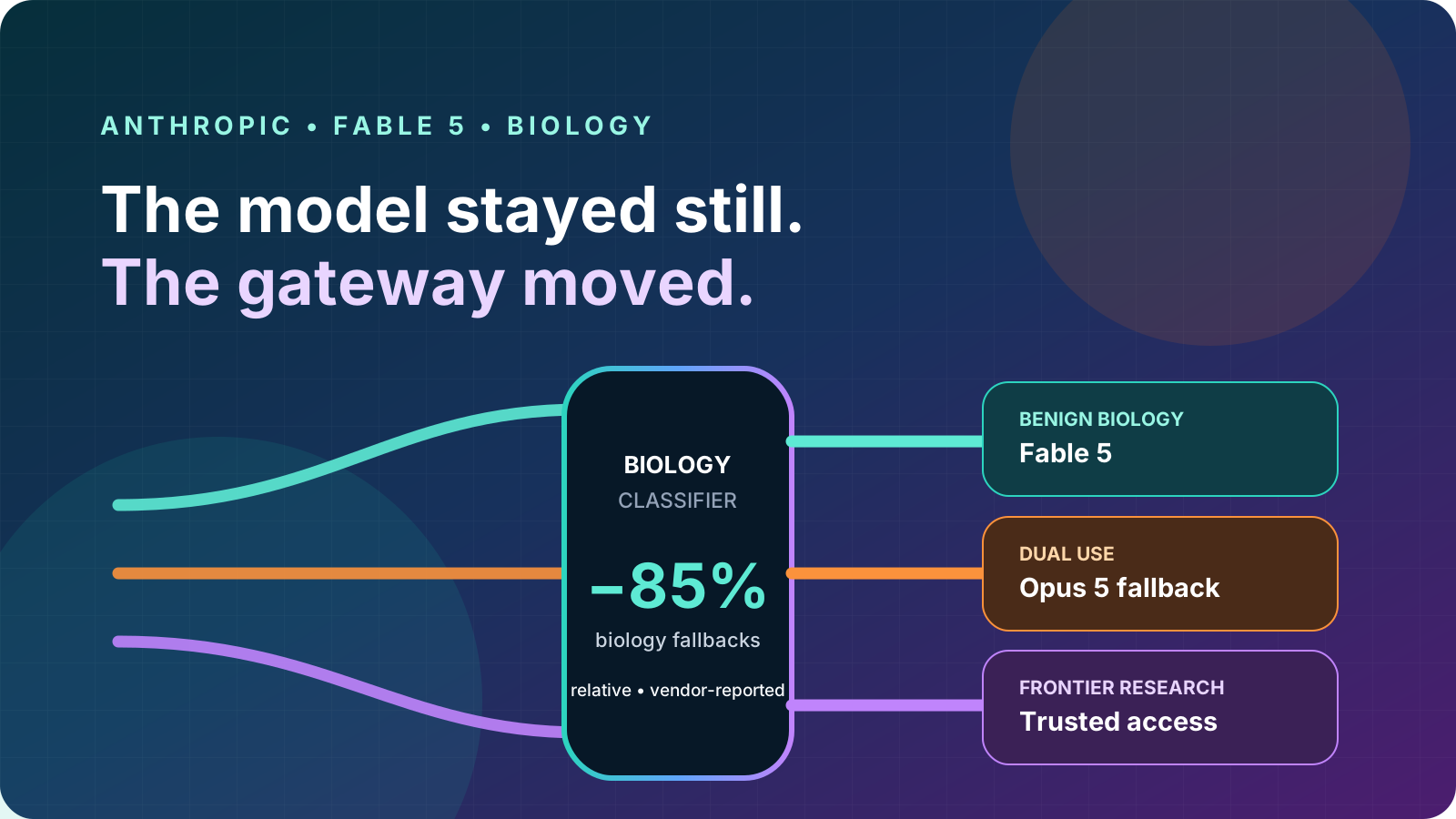
Anthropic just made Claude Fable 5 materially more useful for biology without announcing a new core-model release.
The company says a retrained biology safety classifier now causes about 85% fewer biology-related fallbacks across its products. Questions about lab results, symptoms, biology education, and some clinical support should reach Fable more often. Virology, toxicology, molecular design, professional biology research, and drug development still route away from it.
The obvious reading is that Anthropic relaxed a guardrail. The more important reading is that it shipped a capability update in the control plane.
The requested model is still claude-fable-5. Its token price is unchanged. Anthropic did not announce new Fable weights. Yet the same request can now reach a stronger public system because Anthropic rewrote the classifier's constitution, created new training data, retrained the classifier, and moved the routing boundary.
That makes the biology gateway a product surface in its own right. It determines which intelligence a user gets, which model serves the answer, what the task costs, and whether an evaluation can be reproduced a month later.
This is also a useful update to RohitAI's June analysis, Claude Fable 5 and Mythos 5: Anthropic's Frontier Model Is Now a Release Strategy. The launch thesis was that classifiers, fallbacks, retention, and trust zones were becoming part of the model product. Anthropic has now changed that product without changing the checkpoint name.
Anthropic's August 7 announcement says it narrowed the automated classifier that stands between a biology request and Fable 5.
At launch, the company deliberately used broad biology and chemistry safeguards. That got Fable into general release quickly, but it also caught benign work. The new classifier is meant to distinguish ordinary medical or educational questions from research tasks that can be dual use.
The deployment now has three practical lanes:
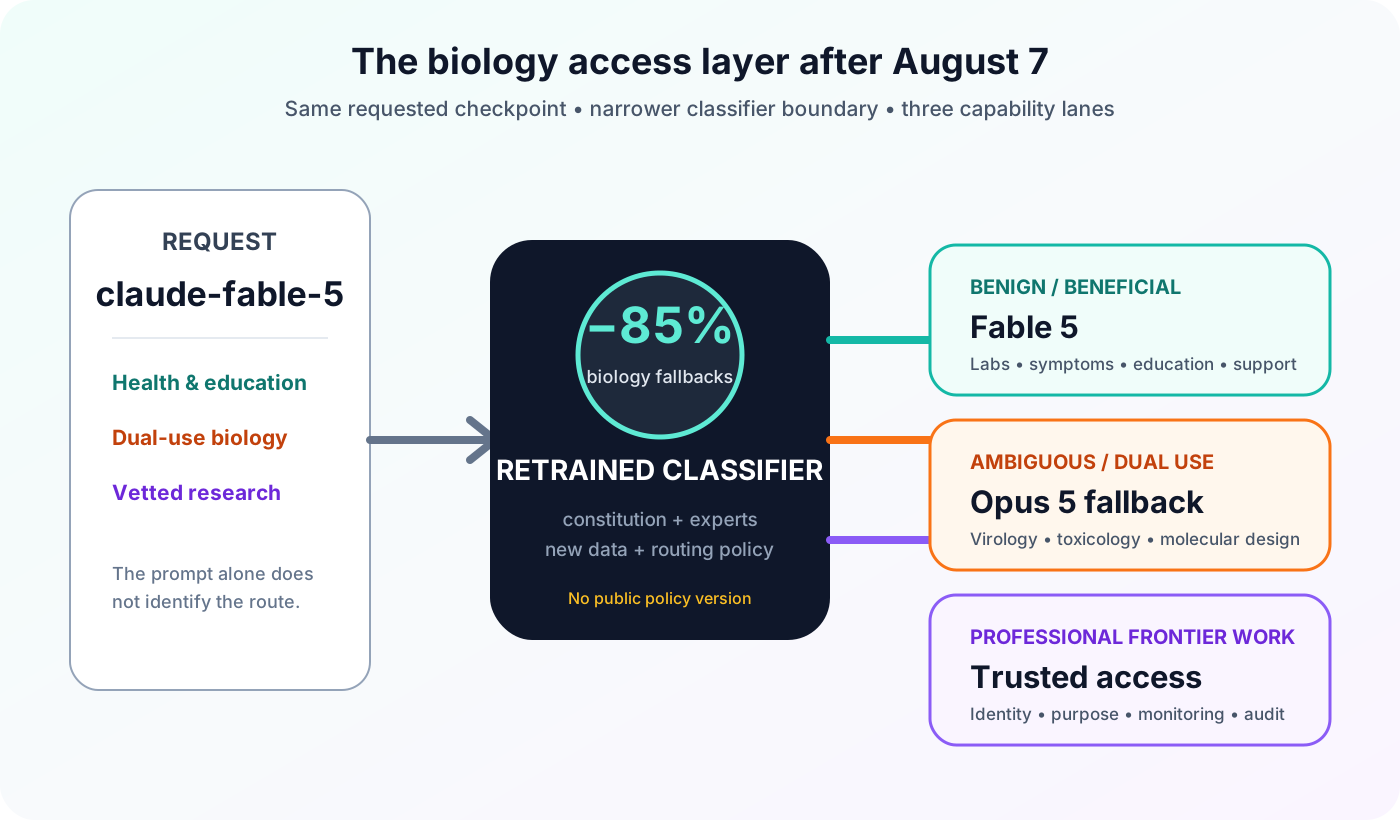
The checkpoint is only one layer. Classification and identity decide which capability lane a request can enter.
This is narrower than “Fable's biology safeguards are gone.” They are not. Anthropic has tried to replace a topic-wide firewall with a task-risk router.
The cleanest way to read this release is to keep three evidence layers separate.
About 85% fewer biology fallbacks, plus expected total-fallback declines of 67%, 55%, 17%, and 7% across four product surfaces.
Biology probably dominated old consumer fallbacks but formed a much smaller share of aggregate Platform fallbacks. This depends on traffic staying otherwise constant.
Absolute fallback rates, workload mix, classifier precision and recall, harmful-compliance results, rollout hash, and a public safeguard-policy version.
Anthropic's footnote says the biology change should reduce all fallbacks, including those caused by other safeguards, by the following amounts:
| Surface | Expected decline in total fallbacks | Implied old fallback share from biology | How to use the number |
|---|---|---|---|
| Claude.ai | 67% | About 79% | Large consumer UX shift |
| Cowork | 55% | About 65% | Large knowledge-work shift |
| Claude Code | 17% | About 20% | Meaningful, but not dominant |
| Claude Platform | 7% | About 8% | Small aggregate; workload mix matters |
The third column is RohitAI's illustrative algebra, not Anthropic's metric. It divides each expected total-fallback decline by the reported 85% biology decline. It is only valid if the biology reduction was the same 85% on every surface, this classifier change caused the whole expected decline, and other fallback traffic stayed fixed. Anthropic has not disclosed those conditions, so treat the ratios as a scenario—not measurements.
Even with that caveat, the pattern is useful. The same update can feel dramatic in Claude.ai and barely move a general API dashboard. A biology-heavy Platform application can still change far more than 7%, because Anthropic's Platform number averages across unrelated workloads.
A July 12 preprint tested Fable 5 on eight biomedical benchmarks before this update. Its reported refusal rate varied from 8.0% to 99.4%, depending on the dataset. Fable refused 17.4% of MedQA, 20.0% of PubMedQA, 41.5% of PathVQA, and 99.4% of RareBench questions under the study's primary prompt.
Those numbers do not contradict Anthropic's launch claim that more than 95% of all Fable sessions avoided fallback. General product traffic and biology-heavy benchmark traffic have different denominators.
The paper's more interesting result was conditional performance. On the questions Fable did answer, it matched or exceeded the comparison models on every benchmark in that study. Refusals also clustered in basic science and mechanism-heavy questions: 92.3% of its MedQA refusals were Step 1 basic science, while Step 1 made up 45.1% of answered questions.
That is a picture of capability trapped behind a coarse boundary. Anthropic's new carve-outs—education, symptom understanding, lab-result interpretation, and some clinical support—line up with the areas where benign questions were getting caught.
But this is not a before-and-after evaluation. The paper is not peer reviewed, tested pre-August behavior, and did not configure an Opus fallback in its API pipeline. You cannot multiply its refusal rates by 0.15 and call that today's result.
Anthropic's model documentation says dateless IDs such as claude-fable-5 are pinned snapshots. That is helpful for weight stability. It does not pin the separate policy system around the snapshot.
Two benchmark runs can therefore use the same requested model ID and test meaningfully different public systems:
evaluation record = checkpoint + classifier policy + route + surface + date
The August update changed the classifier constitution, training data, and routing behavior. Anthropic did not publish a classifier ID, policy hash, or rollout version that a customer can record. The next-best evidence is operational telemetry: timestamp, product surface, requested model, served model, stop_reason, stop_details.category, fallback boundary blocks, and usage.iterations.
This extends a point from RohitAI's Fable 5 usage, credits, and billing guide: requested-versus-served model belongs in the billing trace. It now belongs in the evaluation manifest too.
One early false positive can also change an entire conversation. Anthropic's client middleware can pin later turns to the model that accepted after a refusal. Remove that first false positive and several follow-up turns may remain on Fable. The session-level experience can improve more than a turn-level fallback count suggests.
That is why teams should monitor route transitions per conversation, not only an aggregate refusal percentage.
Fallbacks sound like wasted work, so it is natural to assume that reducing them lowers cost. With Fable, the opposite can happen.
Anthropic lists Fable 5 at $10 per million input tokens and $50 per million output tokens. Claude Opus 5 costs $5 and $25—exactly half. A Fable refusal before any output is not billed, while fallback credit avoids charging the prompt-cache creation cost twice when the request is retried correctly.
So a benign biology task that previously fell back to Opus 5 may now remain on the twice-as-expensive Fable route.
| Path | Serving model | Standard input / output price | Likely product effect |
|---|---|---|---|
| Old false positive plus fallback | Opus 5 after Fable declines | $5 / $25 per million tokens | Cheaper serving route, extra handoff, lower frontier capability |
| Newly accepted benign request | Fable 5 | $10 / $50 per million tokens | Better continuity and capability, potentially higher token spend |
This does not mean the update is bad economics. Fable may finish the task with fewer retries, less latency, better answers, or less human review. It means retry count is the wrong cost metric.
Measure cost per successful outcome: inference, latency, fallback rate, human review, and task completion together. Also benchmark Opus 5 directly. As RohitAI argued when Opus 5 launched, the cheaper model may already be good enough for ordinary clinical or scientific support.
Anthropic's refusal and fallback documentation makes the integration trap explicit: a classifier refusal is a successful HTTP 200 response with stop_reason: "refusal".
An uptime dashboard that watches only HTTP failures can show green while a biology workflow is functionally unavailable.
For direct Claude API users, server-side default fallback is beta behind server-side-fallback-2026-07-01. The response's top-level model, fallback content block, and usage.iterations reveal which route actually served the turn. The provider-selected default is server-defined and can change; the Models API does not publish that routing table.
Platform details differ:
The fallback target is another reason to log, not assume. The August biology post names Opus 5. Older guidance still uses Opus 4.8 examples, and both remain permitted targets. Record what served the response.
Educational explanations, non-sensitive literature synthesis, symptom education, and lab-result context are the workloads most likely to benefit. Re-run real acceptance tests after August 7.
Greater willingness to answer is not clinical validation. Preserve source provenance, missing-data checks, uncertainty, privacy review, and a clear path to qualified human care.
Virology, toxicology, molecular design, and drug development remain gated. Do not prompt-engineer around the boundary; use approved access and auditable research controls.
Anthropic's own Fable/Mythos system card explains why the company is tuning rather than removing the boundary. It treats the underlying Mythos 5 capability as CB-1 and near the CB-2 threshold. In a vendor-run tabletop exercise, two-person teams using Mythos produced work in 16 hours that graders estimated would otherwise take 40 to 95 working days.
Those are Anthropic's assessments, not independent replication. They still make the product direction clear.
For professional biology, the scarce thing is no longer raw model access alone. It is permission to cross a capability boundary under a known identity, research purpose, retention rule, monitoring regime, and audit trail.
That leads to four predictions.
There is a fifth operational consequence worth testing now. If an agent ingests untrusted documents, irrelevant biology language could accidentally trigger a lower-capability route. A malicious document might even try to exploit that boundary as a semantic quality-denial attack. Anthropic has not reported such an attack; this is a RohitAI hypothesis. But teams running retrieval agents should include irrelevant and adversarial biology snippets in route-stability evals.
RohitAI's health AI deployment analysis is relevant here: answer quality, provenance, permissions, missingness, and escalation remain separate product obligations. A narrower classifier only removes one access failure.
No. Anthropic says biology-related fallbacks fell by about 85%. That is a relative routing metric. The company did not publish the absolute rate or the false-negative evidence needed to convert it into a broad safety claim.
Not in the public configuration. Anthropic explicitly says professional research and drug development remain unavailable, while virology, toxicology, molecular design, and other dual-use work still route to Opus 5. Governed trusted access is the intended path for frontier research.
The August announcement names Opus 5 for the remaining biology boundary. Anthropic's API allows Opus 4.8 and Opus 5 as Fable fallback targets, while default routing is server-defined and can vary. Applications should log the response's actual model.
No. The figure covers biology-related fallbacks across Anthropic's products. Anthropic expects all fallbacks on Claude Platform to fall about 7% in aggregate. A biology-heavy application may see a much larger change; only a workload-specific retest can answer it.
Anthropic announced a rewritten classifier constitution, new training data, and a retrained separate classifier. It did not announce a new Fable checkpoint or model ID. The served product changed even though the requested checkpoint name did not.
Anthropic did not simply make Fable more permissive. It moved the frontier-biology gate closer to the task.
That is good for students, patients seeking general explanations, clinicians doing some support work, and builders whose benign prompts were being caught by a blunt topic boundary. It is also unfinished evidence. An 85% relative decline with no absolute denominator or published missed-harm rate cannot establish where the new boundary should sit.
For builders, the immediate lesson is practical: retest, log the served route, version the policy context, and reforecast cost.
For the market, the lesson is larger. Frontier capability can now change materially through policy infrastructure while the model ID stands still. The next important AI release may not be a checkpoint at all. It may be the gateway deciding who gets to use it.