Reported U.S. Limits on Chinese Open-Weight AI Could Target the Runtime While the Files Stay Public

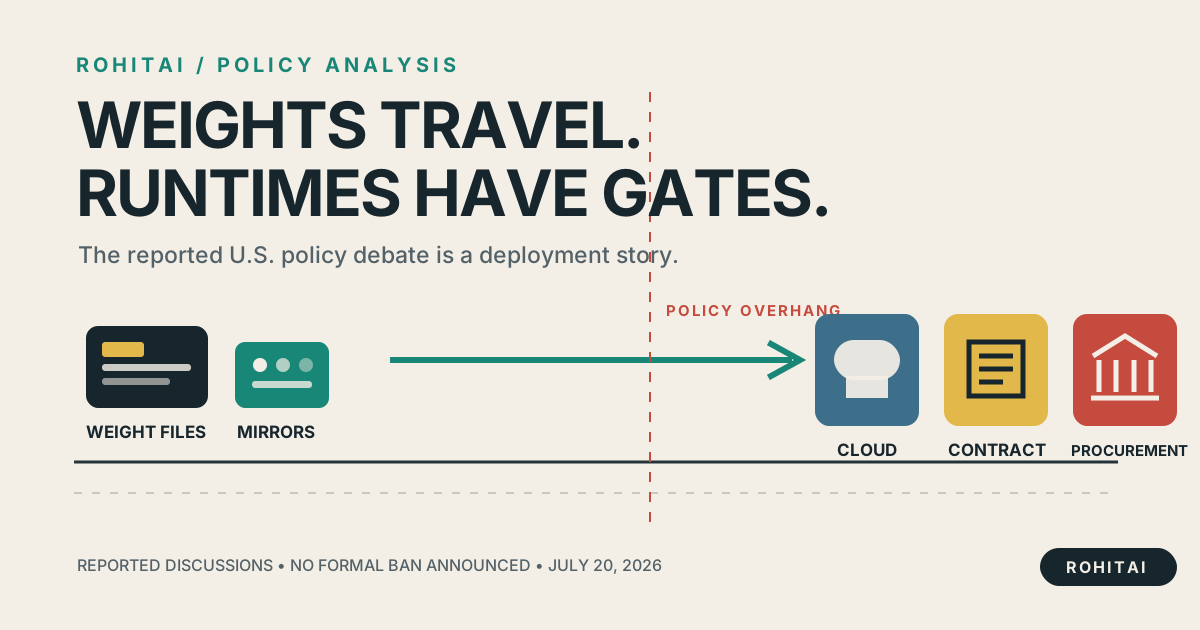
Seven days separate reported Washington discussions from Moonshot's promised Kimi K3 weight release. In policy terms, that is a long week.
Axios reported on July 20, citing unnamed sources, that pressure is again building inside parts of the Trump administration to discourage U.S. use of advanced Chinese AI models. The story describes earlier proposals—including Entity List additions, a security advisory, hosting conditions, liability, and domestic supply-chain rules—that were reportedly killed, plus current discussion of procurement, public pressure, and similar leverage.
No ban has been announced. Axios identified no current draft rule, executive order, designation, or advisory, and said the White House and Commerce did not comment. A July 15 Semafor View item separately described Washington discussion and a possible supply-chain-risk route. That suggests the issue predates Axios, but it does not independently verify the full menu of mechanisms.
The leverage changes depending on whether K3's promised weights ship. Before public release, pressure can reach the vendor, API, or checkpoint. After mirrors and derivatives appear, government cannot reliably recall every globally mirrored copy. It can still make the compliant U.S. deployment path expensive or unusable: remove a model from federal procurement, pressure clouds and marketplaces, raise liability, constrain payments or support, and make risk committees reject it.
Open-weight irreversibility and enterprise reversibility can exist at the same time. The file may remain available while the product built on it becomes hard to insure, host, sell, or approve.
Moonshot launched Kimi K3 as a hosted model on July 16 and says full weights will arrive by July 27. RohitAI's Kimi K3 launch analysis covers the model itself. This update is about the policy overhang now attached to Kimi, Qwen, DeepSeek, GLM, and every U.S. team treating model provenance as a secondary field in a spreadsheet.
The public record supports four different confidence levels. Keeping them separate prevents a policy rumor from turning into imaginary law by repetition.
The procedural pressure is not hypothetical. On April 29, House committee chairs opened an investigation into Anysphere's and Airbnb's use of Chinese models and APIs. The committees named DeepSeek, Alibaba, Moonshot, and MiniMax. That confirms political and procurement scrutiny. Their security allegations remain allegations under investigation, not adjudicated findings.
The instrument matters more than the headline. Each lever reaches a different transaction and therefore a different builder.
| Policy lever | What it primarily reaches | Likely builder effect | Erases released weights? |
|---|---|---|---|
| Entity List | Exports, reexports, and in-country transfers of items subject to the EAR to a listed party | Can isolate a lab from U.S. chips, software, cloud services, and partners; exact scope depends on the entry and transaction | No, not by itself |
| Commerce ICTS review | Acquisition, electronic importation, transfer, dealing in, hosting, or use of foreign-adversary ICTS | Could target U.S.-side hosting, marketplaces, services, or defined classes of transactions after a risk determination | No; constrains transactions |
| Procurement exclusion | Federal agencies, contractors, subcontractors, and sensitive supply chains | Makes eligibility, representations, flow-down clauses, and customer mix more important than model price | No; removes approved demand |
| Security advisory | Risk committees, insurers, vendors, app stores, and voluntary security baselines | Can chill adoption without directly prohibiting it, especially in regulated enterprises | No; changes risk appetite |
| Hosting and liability pressure | Clouds, model marketplaces, API intermediaries, enterprise hosts, and their customers | Raises compliance cost or removes the convenient deployment route even when files remain public | No; chokes the runtime |
The legal correction is important. The Bureau of Industry and Security's own Entity List FAQ says a U.S. company can have other dealings with a listed entity, although such transactions are a red flag. The list specifies license rules for exports, reexports, and transfers of EAR-covered items. It is a formidable supplier-side tool. It is not a magic switch that makes every foreign-origin tensor file illegal to possess.
Commerce's ICTS rules are built differently. Their definitions include electronic importation, acquisition, use, dealing in, cloud services, hosting, and ongoing software updates. An ICTS action would still need the required foreign-adversary nexus and risk findings, but its shape fits a U.S.-side deployment restriction more directly.
Federal procurement is narrower and potentially faster in practice. The proposed No Adversarial AI Act offers a useful template for an acquisition-security list, exclusions, and exceptions. It remained a bill rather than enacted law at the research cutoff, so it is evidence of policy design—not a current prohibition.
Moonshot's Kimi K3 launch post says the model is available now through Kimi products and its API, with full weights and a technical report due by July 27. As of July 20, there was no official K3 repository, model card, or K3-specific license. Calling it downloadable open weight in the present tense would be premature.
The date matters because the NTIA open-weight report makes a blunt operational point: once weights are widely released, they are difficult to “un-release.” Controls aimed at the file work best before public distribution. After mirrors and derivatives appear, policy shifts toward providers, infrastructure, buyers, and future updates.
K3 also shows why “weights released” does not mean “infrastructure independent.” Moonshot describes a 2.8-trillion-parameter mixture-of-experts model and recommends a supernode with at least 64 accelerators. Most teams will not casually rack that system beside the office coffee machine.
The cleanest correction to the “Entity List equals download ban” story already exists.
BIS added Zhipu AI entities to the Entity List in January 2025, applying a presumption of denial to covered exports. The Federal Register notice says the action concerned support for Chinese military modernization through advanced AI research and development.
Yet Zhipu's GLM-5.2 weights remain publicly downloadable under an MIT license. That does not make the listing toothless. It can constrain the developer's access to U.S. technology and commercial relationships. It proves something narrower: supplier isolation does not automatically recall a globally distributed artifact.
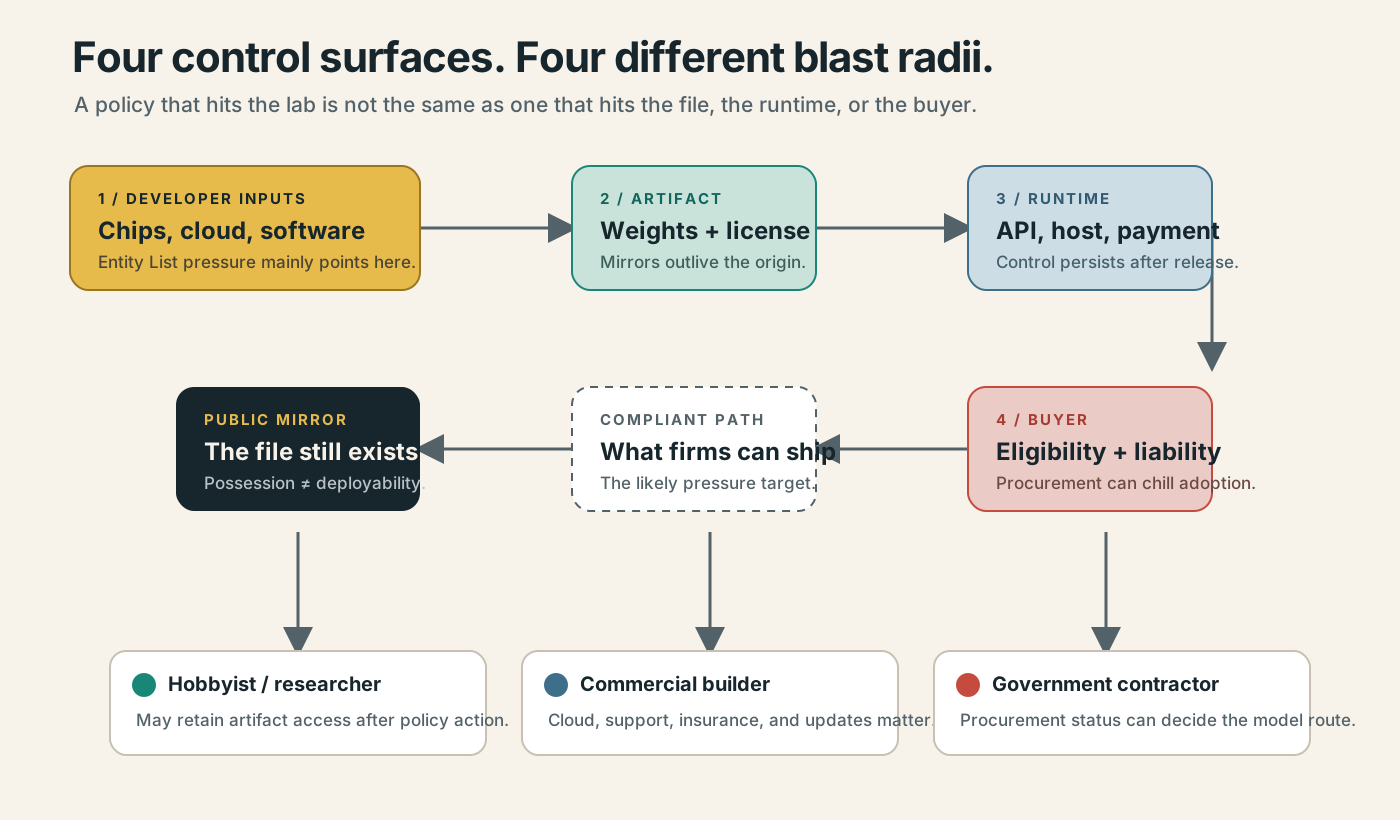
The same model family can remain visible in public mirrors while becoming difficult to deploy inside a compliant U.S. product. The legal instrument determines which layer feels the pressure.
The result is durable asymmetry: a researcher may keep a checkpoint while a startup loses its preferred U.S. host and a contractor loses eligibility. “Available” becomes a different answer for each user.
Policy language often groups Kimi, Qwen, DeepSeek, and GLM together as Chinese open models. That category is too coarse for an architecture review or a compliance decision.
At the July 20 cutoff, DeepSeek V4 Pro and GLM-5.2 had downloadable MIT-licensed weights. Kimi K3 only promised a future release. Alibaba's Qwen3.8 Max Preview was hosted-only. Older Qwen branches had downloadable artifacts. One brand can therefore contain open, closed, hosted, mutable, licensed, and mirrored versions at the same time.
The useful inventory key is not country=China. It is closer to this:
model identity =
  developer + exact version + weight hash + license + base ancestry
  + provider + hosting region + serving stack + update channel + date
That schema handles derivatives too. A fine-tune hosted by an American company can still descend from a listed or procurement-excluded base. A public checkpoint can be served by a third party with different retention and telemetry. A model branded open may still rely on proprietary kernels or an official update stream.
This is why self-hosting is a data-flow choice, not a universal policy answer. It can keep prompts off a vendor API. It does not settle model provenance, license rights, procurement eligibility, serving-code integrity, accelerator availability, or whether a future customer will accept the dependency.
Axios reports discussion of highlighting possible backdoors and weak security. That wording deserves caution because four separate risks are often squeezed into one alarming noun.
The controls are different. API risk calls for data minimization and contract review. Behavioral risk calls for version-specific evals. Supply-chain risk calls for reproducible builds, sandboxing, egress controls, signatures, and dependency review. A backdoor claim requires forensic evidence.
NIST's Center for AI Standards and Innovation found Chinese-language censorship behavior in Kimi K2 Thinking and, in a separate evaluation, jailbreak and agent-hijacking weaknesses in tested DeepSeek models. Those version-specific results justify testing the exact model and harness a team plans to deploy. They do not prove a hidden backdoor in Kimi K3. RohitAI's earlier open-weight cyber analysis explains why capability convergence deserves preparation without turning every risk claim into evidence.
The United States is not starting from a blanket anti-open policy. The 2025 AI Action Plan backs open-source and open-weight AI for startups, research, competition, and sensitive-data use while also calling for evaluation of Chinese frontier models. A June 2026 order created a voluntary frontier-model framework and explicitly disclaimed mandatory release licensing. That disclaimer is scoped to the order's framework, which also preserves agencies' existing legal authorities. A separate national-security directive promoted open-source AI, supplier diversity, and reduced lock-in.
RohitAI recently described a disputed White House frontier-model access gate as runtime risk for closed models. This is the inverse problem: the weights may be public while the approved deployment path becomes gated.
That tension points toward selective provenance rules, not a general war on weight access. If action emerges, the politically stable package is likely to pressure specified Chinese labs, models, providers, or transactions while promoting American and allied open alternatives through procurement preference, evaluation support, hosting, or research funding.
Three second-order effects matter.
First, enterprise access can be reversible even when artifact access is irreversible. Risk committees, insurers, cloud catalogs, and procurement officers can remove a model faster than the internet can remove a checkpoint. The regulated market does not need universal technical enforcement to change behavior.
Second, a domestic restriction can strengthen Chinese standards abroad. Alibaba reported in a Hong Kong exchange filing that Qwen passed one billion cumulative Hugging Face downloads by January 2026. If U.S. enterprises consolidate around domestic closed providers while non-U.S. builders keep adopting Qwen, DeepSeek, GLM, and Kimi derivatives, tooling and evaluation standards split by jurisdiction rather than converging on one stack.
Third, compliance data will enter the model router. Today's gateways route on price, latency, context, capability, and health. Tomorrow's route record will also need developer origin, ownership and control, base ancestry, artifact state, license, hosting jurisdiction, procurement status, and permitted customer class.
The correct response depends on the work. One blanket migration plan is as imprecise as one blanket ban headline.
Inventory every Chinese base, derivative, API, provider, and transitive integration now. Validate a non-PRC route, review contract flow-downs, and assume procurement or advisory pressure could arrive before a broad consumer restriction.
Keep pilots bounded, use provider-neutral adapters, define exit terms, and test alternatives on real tasks. Do not move production solely because of an anonymously sourced report, but do not let a cheap model become an undocumented single point of failure.
When legally permitted, preserve hashes, licenses, model cards, eval outputs, and reproducible serving instructions. Sandbox code and tools. Remember that possession of weights does not guarantee future cloud capacity, support, updates, or customer acceptance.
This is an architectural exercise, not a political loyalty test. A good fallback may be another open model, a domestic hosted model, a smaller task-specific system, or a degraded mode that waits for human review. What matters is that the switch is observable and rehearsed.
Builders should watch for documents, not adjectives.
Until one of those appears, the accurate sentence is: U.S. officials are reportedly discussing restrictions; no general ban has been announced.
No. As of July 20, Axios had reported internal discussions, but no general ban, final rule, executive order, Entity List action covering Chinese AI labs as a class, or model-specific security advisory had been announced. Existing restrictions and investigations may affect particular entities or transactions.
Not automatically. The Entity List sets license requirements for exports, reexports, and in-country transfers of items subject to the EAR to listed parties. Other laws, procurement rules, contracts, or a separate Commerce action could affect U.S. acquisition, hosting, or use. The exact entry and transaction matter.
It can reduce dependence on an official API and keep sensitive prompts within infrastructure you control. It does not eliminate license, provenance, procurement, customer, serving-code, hardware, update, or support risk. At K3 scale, self-hosting also requires infrastructure most teams will obtain through a commercial provider.
Usually not because of this report alone. A company should first identify the exact artifact and provider, classify its customer and procurement exposure, review data flows, run security and task evals, and validate an alternative. Federal, defense, and critical-infrastructure work deserves a faster and more conservative review.
Moonshot says that is when full weights and its technical report will be released. Before a public, redistributable release, pressure on the vendor can still affect the checkpoint. After broad distribution, policy is more likely to target hosting, integrations, procurement, payments, updates, and support.
Axios's report matters because Washington has credible ways to make Chinese models unattractive inside U.S. enterprises. It should not be inflated into a ban that does not exist or a technical finding that has not been shown.
The durable policy target is unlikely to be every copy of every weight file. It is the path from artifact to approved production system.
For builders, that turns model origin from a vendor note into an architectural property. Know the exact checkpoint. Know who serves it. Know which customer rules it inherits. Know how the product degrades if the route closes.
The weights may travel. Your production dependency still has an address.