Claude Fable 5 and Mythos 5: Anthropic's Frontier Model Is Now a Release Strategy

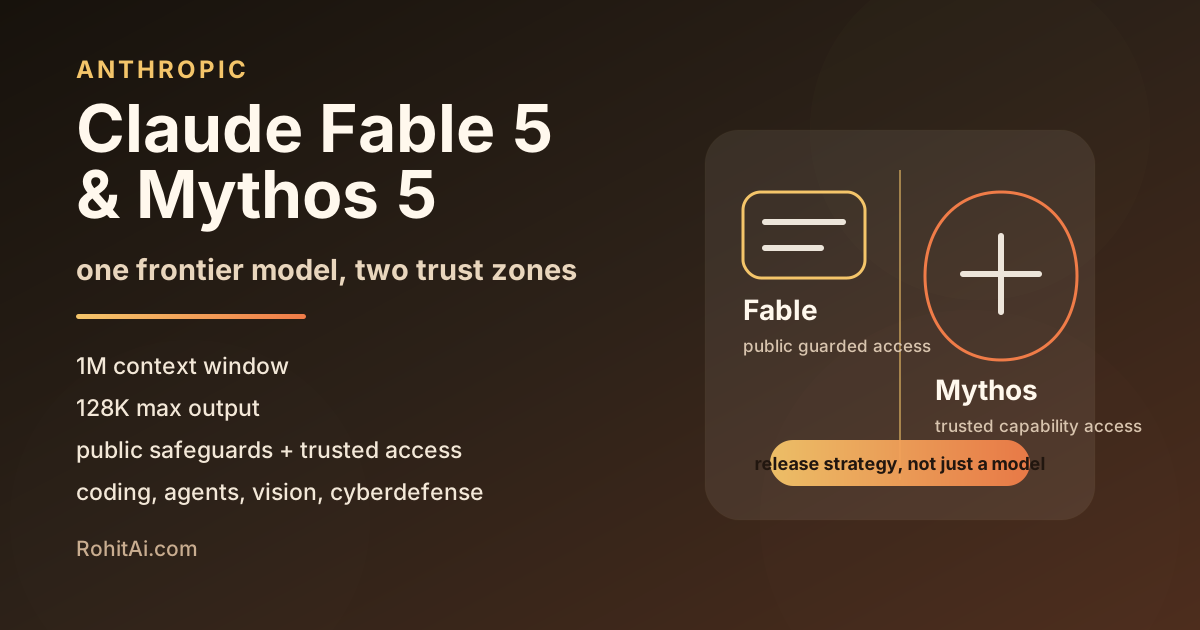
Anthropic's June 9 release is not just another Claude upgrade.
Yes, the headline is simple: Anthropic launched Claude Fable 5 and Claude Mythos 5. Fable 5 is the new broadly available model. Mythos 5 is the restricted version for trusted users. Both are built around the same Mythos-class capability layer, but Fable 5 adds safeguards for general use while Mythos 5 lifts some restrictions for approved cyberdefense and infrastructure partners.
You can read Anthropic's launch post here: Claude Fable 5 and Claude Mythos 5.
But the deeper story is bigger than one model.
This release is Anthropic showing what the next phase of frontier AI probably looks like: not one model for everyone, but one capability layer split across different trust zones.
That matters because the model is now only half the product. The other half is the release system around it: routing, fallbacks, retention, classifiers, access tiers, safety monitoring, and enterprise controls.
This is the public sequel to the earlier Mythos Preview and Project Glasswing story. Back then, Mythos was powerful enough that Anthropic kept it behind a trusted-access program. Now Fable 5 brings much of that capability to normal developers and companies, but wrapped in a safety layer that changes how the model behaves in sensitive areas.
That is the real release.
Not just "Claude got smarter."
It is "frontier capability now ships with policy architecture."
Anthropic launched two names:
The names make it sound like two completely separate models. Practically, the better mental model is this:
Fable 5 = public, safeguarded access to Mythos-class capability
Mythos 5 = trusted-access interface to that same frontier capability
Anthropic describes Fable 5 as "a Mythos-class model" made safe for general use. It is broadly available through Claude, the Claude API, enterprise consumption plans, and major cloud platforms. Mythos 5 is reserved for a smaller trusted group, starting with Project Glasswing partners, cyberdefenders, infrastructure providers, and other approved organizations.
This split is the important design choice.
In older model launches, you usually had a simple ladder:
Haiku -> Sonnet -> Opus
cheap -> balanced -> powerful
Fable and Mythos change that into something closer to:
same frontier capability
        |
public safeguarded access
        |
trusted restricted access
        |
domain-specific permissioning
That is a very different release philosophy.
The model is not only differentiated by intelligence, cost, or latency anymore. It is differentiated by permission.
The normal way to cover this release is to list benchmarks, pricing, availability, and a few launch quotes.
That is useful, but incomplete.
The real story is that Anthropic is separating capability from access.
For years, the industry mostly shipped models like software versions. A company would release GPT-4, Claude 3, Gemini 2, Opus 4, and so on. Everyone argued about which was smarter.
But when a model becomes strong enough to help with advanced cyber operations, biological reasoning, autonomous coding, long-running agents, and scientific research, "release it to everyone" becomes much harder.
Anthropic's answer here is not to hide the whole model. It is to release a safer public version, then keep the riskier modes behind trusted access.
That is why Fable 5 is interesting. It is not merely a weaker Mythos 5. It is a governed interface to Mythos-class capability.
This is probably the template we will see more often from frontier labs:
one powerful base model
multiple product surfaces
different safety policies
different logging requirements
different customers
different legal exposure
The winner in frontier AI may not be the company with the best model alone. It may be the company that can commercialize the strongest model without losing trust from governments, enterprises, developers, and the public.
That is what Anthropic is trying to prove here.
The most impressive part of the release is not one isolated score. It is the pattern.
Fable and Mythos appear strongest in tasks that require multiple steps, long context, tool use, code understanding, visual reasoning, and persistence over time.
Here are the numbers from Anthropic's benchmark table that stood out to me:
Anthropic compares Fable/Mythos against Mythos Preview, Opus 4.8, GPT-5.5, and Gemini 3.1 Pro. The biggest gaps are in coding, agentic terminal work, offensive cyber capability, and hard long-horizon reasoning.
The important caveat: some cyber and biology results are complicated because Fable 5 intentionally falls back or refuses in sensitive categories. Anthropic says starred benchmark results can show larger differences between Fable 5 and Mythos 5 because Fable's safeguards route certain requests away from the full Mythos-class model.
So the honest interpretation is:
Fable 5 is not unrestricted Mythos 5 for everyone.
It is Mythos-class capability for most normal workflows,
with restricted handling for sensitive domains.
That is exactly why the release matters.
Fable 5 looks like a major coding model. But the interesting shift is not better code snippets.
It is better delegation.
Anthropic says Fable 5 can work autonomously longer than previous Claude models. It highlights tasks like large code migrations, long-running software engineering work, and agents that can plan, check their own work, and sustain progress over time.
One example from the launch: Stripe reportedly tested Fable 5 on a migration across a 50-million-line Ruby codebase, completing in a day work that otherwise could have taken a team more than two months.
That is the part builders should pay attention to.
The future of AI coding is not just:
write this function
fix this error
explain this file
It is becoming:
understand this system
plan a migration
modify many files
run checks
notice failures
repair the plan
document what changed
ask for approval before risky steps
That is a different product category.
The best coding models are becoming junior-to-mid-level autonomous engineering agents, not just chat assistants. They still need review. They still make mistakes. But the unit of work is moving from "answer" to "completed task."
That changes how companies should evaluate models.
Do not only ask:
Which model gives the best answer?
Ask:
Which model closes the most tickets correctly?
Which model needs the fewest retries?
Which model causes the least cleanup?
Which model knows when to stop?
Which model can handle the ugly middle of a migration?
That is where Fable 5 may matter.
Good for snippets, explanations, and quick fixes. Useful, but still centered on a human doing most of the orchestration.
Better fit for migrations, multi-file patches, test loops, refactors, and tasks where the model has to keep going.
A 1 million token context window is impressive, but big context windows are often overhyped.
The problem with long context is not only whether the model can fit more text. The question is whether it can actually use that context reliably.
Anthropic claims Fable/Mythos can stay focused across millions of tokens, improve using its own notes, and perform better in persistent-memory-style tasks. In one internal game-like evaluation, persistent file memory improved Slay the Spire performance substantially more than with Opus 4.8.
The practical implication is huge for agents.
A serious agent does not just need a big prompt. It needs a working memory:
What have I tried?
What failed?
What constraints did the user give?
Which files did I edit?
Which tests passed?
Which assumptions are still open?
What should I not touch?
That is where a model like Fable 5 could be meaningfully better than a smaller model with the same tools.
Long context is not valuable because you can paste a million tokens once. It is valuable because the model can carry a project state across a longer arc of work.
My prediction: the next serious AI coding products will stop looking like chat windows. They will look more like workspaces with memory, checkpoints, traces, approvals, and rollback.
Fable 5 is built for that world.
One underrated part of the release is vision.
Anthropic says Fable 5 is state-of-the-art on vision tasks, including extracting precise numbers from scientific figures and rebuilding web app source code from screenshots.
That sounds like a demo feature, but it is actually very practical.
For product teams, frontend teams, QA teams, and design-heavy workflows, vision turns the model from a text-only assistant into a real review partner.
You can imagine workflows like:
compare this screenshot to the Figma spec
find layout regressions
rebuild this component
read this chart
extract the table values
explain why this dashboard changed
verify the UI after a code migration
This matters because software work is not only code. It is visual behavior, browser output, screenshots, logs, dashboards, traces, and docs.
A model that can reason across code, UI, documents, terminal output, and tool traces is much more useful than a model that is only good at isolated code generation.
This is also why the agent framing matters. Agents need to see the world they are changing.
The most unusual part of Fable 5 is the fallback system.
Anthropic says Fable 5 uses classifiers to detect requests related to cybersecurity, biology, chemistry, or model distillation. In some cases, the request is automatically handled by Claude Opus 4.8 instead of the full Fable/Mythos capability. Users are informed when that happens.
This is not a small detail. It means the model you call may not be the model that answers every part of the request.
For normal users, that is probably fine. Anthropic says more than 95% of Fable sessions do not trigger a fallback.
For developers building serious products, it matters a lot.
You now need to log things like:
requested_model
actual_model_used
fallback_triggered
fallback_category
stop_reason
token_count
cost
user_visible_refusal
Otherwise, you may not understand why the same workflow behaves differently across tasks.
For example, a security education product, a code scanning tool, a bioinformatics app, or a compliance-heavy enterprise workflow could accidentally sit near a fallback boundary. That means you need evals not just for quality, but for routing behavior.
The new engineering question is:
Does my workflow still work when the frontier model decides not to be the frontier model?
That is going to become a real production issue.
Another important detail: Fable/Mythos traffic has a 30-day retention requirement for trust and safety. Anthropic says prompts and outputs are retained for safety monitoring and are not used for training by default. The retention update matters especially for organizations that previously relied on zero-data-retention workspaces or cloud arrangements.
Anthropic's data retention note for Mythos-class models explains the reasoning: some abuse patterns only become visible across multiple requests. One bad prompt is easy to miss. A coordinated jailbreak or misuse campaign may only show up when you zoom out.
This is going to matter for enterprise adoption.
For years, many AI buyers asked for one thing above everything else:
Can we use the model with zero retention?
With Fable 5, the answer is more complicated.
Anthropic's position is basically: this model is powerful enough that detecting abuse may require looking across multiple requests, not just one message. That makes some retention necessary for safety monitoring.
This creates a real split:
low-risk workflows -> ZDR-friendly models
high-capability workflows -> retained frontier models
My prediction: enterprises will create separate AI workspaces.
One workspace will be for sensitive internal data where retention is unacceptable. Another will be for high-value agentic work where the company accepts retention because the productivity gain is worth it.
That means model routing will become part of data governance.
Not just:
Which model is best?
But:
Which model is allowed to see this data?
Which model is allowed to retain this interaction?
Which tasks justify the stronger model?
Who approved the route?
That is not flashy, but it is exactly where enterprise AI is heading.
Use lower-retention routes when legal, customer, source-code, or regulated-data constraints matter more than maximum capability.
Use retained frontier routes when the task is hard enough that capability and completion rate justify the governance tradeoff.
Fable 5 and Mythos 5 are priced at $10 per million input tokens and $50 per million output tokens. Anthropic's pricing docs also list batch pricing at $5 per million input tokens and $25 per million output tokens, with separate prompt-caching rates.
At first glance, that is expensive.
But for frontier agents, per-token pricing can be misleading.
The real metric is:
cost per completed task
A cheaper model that needs 12 retries, loses context, writes bad patches, or requires heavy human cleanup may be more expensive than a stronger model that finishes correctly in one or two passes.
This is especially true for work like:
large code migrations
deep research
contract analysis
multi-document reasoning
financial modeling
UI reconstruction
debugging across many files
agentic QA
For simple tasks, Fable 5 is likely overkill.
For hard tasks, it may be cheaper in the only way that matters: total human time saved.
The right way to evaluate it is not:
Fable 5 costs more than Sonnet
The right way is:
How many successful tasks do I get per $100?
How much review time is saved?
How many failures reach production?
How often does the model need escalation?
That is the benchmark every serious team should build internally.
Fable 5 is available as claude-fable-5. Mythos 5 is listed as claude-mythos-5, but is limited to approved Project Glasswing customers and other trusted-access users.
Anthropic's model overview lists both models with a 1M token context window, 128K max output, and adaptive thinking always on.
A few practical details matter:
Adaptive thinking is always on. You should not assume older manual extended-thinking patterns apply the same way.
The tokenizer changed. Anthropic says Opus 4.7 and later use a newer tokenizer and that the same fixed text may use up to 35% more tokens. If you are estimating cost from older Claude models, recount with the Fable model ID.
Fallback handling is production behavior. If you build around Fable 5, log when fallbacks or refusals happen. Otherwise, quality issues will look random.
Raw chain-of-thought is not a product surface. Design your app around final answers, structured traces, tool logs, and user-visible reasoning summaries, not raw hidden thinking.
That is how you get value from Fable 5 without turning every product call into an expensive frontier request.
Fable 5 is most interesting for people building or buying serious agentic systems.
Large codebase migrations, complex debugging, multi-step software agents, long-context document analysis, financial or legal research, visual QA, scientific literature review, dashboard interpretation, multi-file refactors, and agentic planning.
Simple summarization, basic classification, short extraction, support routing, single-file snippets, high-volume low-complexity jobs, or strict zero-retention workflows.
The model is powerful, but that does not mean it belongs everywhere.
The best use of Fable 5 is probably as an escalation layer.
Your product should not ask:
Can Fable do this?
It should ask:
Is this task hard enough to deserve Fable?
That mindset will save money and improve reliability.
Mythos 5 may be even more strategically important than Fable 5.
Anthropic says Project Glasswing partners using earlier Mythos access found more than 10,000 high- or critical-severity security flaws. Anthropic is expanding the program to around 150 additional organizations across more than 15 countries, including power, water, healthcare, communications, and hardware sectors. That update is covered in Anthropic's post on expanding Project Glasswing.
That tells us something important:
The bottleneck in cybersecurity may move from finding vulnerabilities to verifying, prioritizing, disclosing, and patching them.
If AI systems become very good at finding bugs, the world gets flooded with findings. That sounds good, but it creates a new problem:
Which findings are real?
Which are critical?
Who owns the fix?
How fast can vendors patch?
How do we avoid handing attackers the same capability?
Anthropic explicitly says the bottleneck is shifting toward verification, disclosure, and patching rather than discovery alone.
This is a big deal.
The first-order effect of AI in security is faster vulnerability discovery.
The second-order effect is chaos unless the ecosystem builds better patch pipelines.
My prediction: trusted cyber-AI access programs will become a normal part of national infrastructure defense. Governments, cloud providers, large software vendors, and critical infrastructure operators will want access to these models, but only with monitoring, auditing, and disclosure obligations.
That could create a new category:
AI security clearance for models
Not for people exactly, but for organizations and workflows.
Who gets full cyber-capable AI?
Who gets partial access?
Who gets only safeguarded public access?
That question will become political, technical, and commercial all at once.
Fable 5's fallback system is smart, but it exposes a hard tradeoff.
The safest version of a frontier model may be less useful for some legitimate expert users.
A professional security researcher may hit restrictions. A biosecurity researcher may need trusted access. A developer working on defensive tooling may see fallback behavior. Anthropic says the safeguards are conservative and may sometimes catch harmless requests.
This is not a bug in the release. It is the central tension of frontier AI.
If a model is powerful enough to help defenders, it may also help attackers.
If it is powerful enough to accelerate biology, it may also create biosecurity risks.
If it is powerful enough to automate codebase-wide changes, it may also automate harmful operations.
That is why "just open it to everyone" is not a serious release strategy at this capability level.
But "lock it all down" is also not enough, because defenders need the tools too.
Anthropic is trying to thread the needle:
public access for most beneficial use
restricted access for risky expert domains
fallbacks for ambiguous cases
retention for abuse monitoring
expansion through trusted programs
It will not be perfect. There will be false positives. There will be arguments about who gets access. There will be competitors with different risk tolerance.
But this is probably closer to the future than a simple open/closed binary.
The most important product is no longer just the model checkpoint.
It is the access system around it.
Expect future launches from every major lab to look like:
public model
enterprise model
researcher model
government model
trusted cyber model
trusted bio model
low-retention model
high-monitoring model
The model name will matter less than the permission layer.
If a request to Fable can be answered by Opus 4.8 because of a fallback, production teams need to know that.
I expect serious AI platforms to expose logs like:
requested_model: claude-fable-5
served_model: claude-opus-4.8
fallback_reason: cyber_classifier
stop_reason: refusal
user_visible_notice: true
Without that, debugging will be painful.
This release makes one thing obvious: a model's theoretical ability and its permitted public behavior are not the same thing.
For Fable 5, public users should care about the allowed behavior. Trusted users may care about raw Mythos capability.
Future benchmarks need to show both:
What can the model do?
What will the product allow it to do?
Those are now separate questions.
Fable 5 is powerful, but it will not replace every model.
The market will move toward orchestration:
small model for routing
medium model for normal work
large model for hard reasoning
frontier model for expensive escalation
The best AI products will not simply call the smartest model every time. They will route intelligently.
Some companies will not be able to use Fable 5 for their most sensitive workflows because of the 30-day retention requirement. Others will accept retention for high-value tasks.
This will create a practical split inside enterprises:
private-data workflows -> lower capability, lower retention
high-value agent workflows -> frontier capability, monitored retention
AI governance teams will have to manage that boundary carefully.
Project Glasswing is a preview of how frontier models may be distributed in dangerous-but-defensive domains.
I expect similar trusted-access tracks for:
critical infrastructure defense
secure code auditing
biosecurity
advanced scientific research
national security
large-scale fraud detection
This is where frontier AI moves from SaaS product to strategic infrastructure.
Anthropic says Fable's safeguards are conservative and can catch harmless requests. My guess is that the company will tune the boundaries aggressively over the next few months, especially for legitimate developers and enterprise users.
But I do not expect the broad safety layer to disappear.
The public model will stay guarded. The expansion will happen through better routing and more trusted-access programs, not by turning Fable into unrestricted Mythos for everyone.
If you are building with Claude today, do not treat Fable 5 like a drop-in replacement.
Run it like a new product tier.
Start with an eval set from your real work:
20 hard coding tasks
20 long-document tasks
20 agent workflows
20 edge cases near policy boundaries
20 tasks where cost matters
Then compare:
Claude Sonnet / Opus baseline
Claude Fable 5
fallback frequency
cost per completed task
human review time
failure modes
latency
token usage with the new tokenizer
Do not only compare answer quality. Compare operational behavior.
That is the difference between playing with the model and actually deploying it.
Claude Fable 5 is not just Anthropic's newest model.
It is a sign that frontier AI is becoming too powerful to ship as a simple public API with one behavior for everyone.
The release introduces a more complex but probably necessary pattern:
same frontier capability
different access levels
different safeguards
different retention rules
different responsibilities
For builders, the opportunity is obvious: Fable 5 could make long-running agents, codebase-scale automation, visual QA, and deep knowledge-work systems much more practical.
For companies, the caution is equally obvious: this is not a cheap default model. It is a high-capability escalation layer that needs logging, routing, evaluation, and governance.
For the AI market, the signal is even bigger.
The next frontier is not only model intelligence.
It is controlled deployment of intelligence.
That is what Anthropic really released yesterday.