OpenAI’s Terraform Provider Gives AI Governance a Plan File

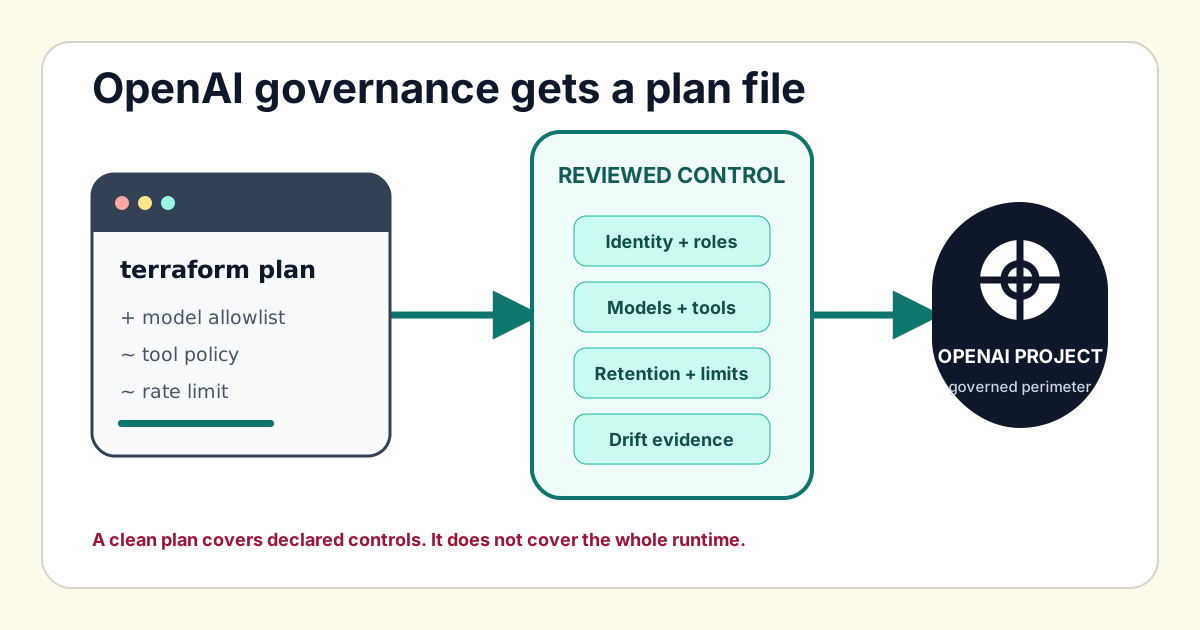
Imagine the next OpenAI model reaches your organization on a Tuesday morning. A product team wants it in production by Friday. Before this release, the critical decisions could collapse into a sequence of console changes: grant a group access, allow the model, enable web search, raise a limit, and hope the screenshots tell the whole story later.
With OpenAI’s official Terraform provider, that rollout can begin as a pull request.
The diff can name the project, role, model policy, hosted tools, retention setting, spend alert, and model-specific rate-limit record. Reviewers can see who is gaining which capability. CI can reject a destructive plan. An approver can tie the apply to a ticket. A later plan can show that somebody changed the dashboard.
That is a serious platform shift. It also creates a tempting misunderstanding.
OpenAI has made a large part of the deterministic perimeter around AI workloads declarative. It has not made inference deterministic, and it has not put the whole governance program into Terraform. The stable v1.0 schema has 22 managed resource types and 38 data sources, but runtime secrets, hard monthly spend caps, some organization-level prerequisites, and runtime behavior still live elsewhere.
The provider’s value is therefore bigger than easier provisioning and narrower than “AI governance as code.” It gives teams a reviewable contract for identity, entitlement, model and tool access, retention, throughput, and alerts. The teams that benefit most will also document where that contract stops.
OpenAI announced the provider on July 29, 2026. The corresponding v1.0.0 GitHub release calls it the first stable version. OpenAI requires Terraform 1.0 or later, while the documented declarative import blocks require Terraform 1.5 or later, according to the provider setup guide.
The scope is substantial. Version-pinned documentation lists 22 resource types and 38 data sources. Those counts describe schema entries, not 60 unrelated platform capabilities. Some resources represent assignments between objects. Some adopt an existing singleton setting. Many data sources are singular and plural views of the same domain.
Still, the surface covers the controls platform teams actually argue about:
Human users need careful wording. The openai_organization_user resource is import-only; declaring it cannot create an arbitrary person in the organization. The provider manages invitations and access around identities, and can adopt an existing organization user, but an identity source still has work to do.
Nor does one least-privilege module prove effective least privilege. OpenAI’s RBAC guide says effective permissions are the union of organization and project roles, both direct and group-derived, and warns that role changes and group sync can take up to 30 minutes to propagate. Access review must inspect every grant path and verify with a non-owner identity; an apply is not evidence of instant revocation.
This changes who participates in access decisions. Repository owners define modules. Security teams write plan policy. Application teams request changes. Reviewers approve them. A protected CI identity applies them. Merge authority becomes part of the AI perimeter.
That layer sits beneath the agent deployment work discussed in OpenAI Presence Turns Agent Deployment Into Release Engineering. Presence packages and promotes an agent. Terraform can define the project, identity, model, tool, retention, and throughput baseline the deployed agent inherits.
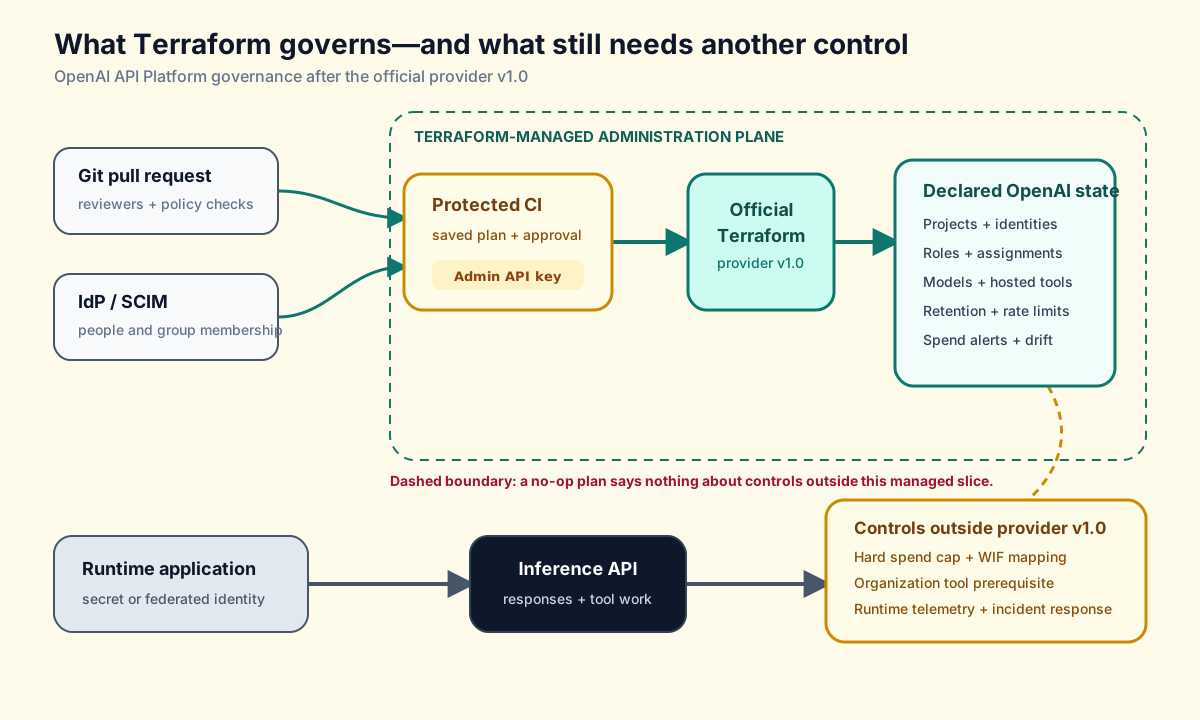
The provider governs the Administration API perimeter. Runtime execution, secrets, and compensating controls remain separate operational lanes.
The provider is explicitly built on the OpenAI Administration API. It governs the conditions under which applications call models. It does not turn a response, image generation, or agent run into a Terraform resource.
That boundary is sensible. Terraform is good at converging declared state. Model output is probabilistic work product. Putting generated answers into state would mix a governance control plane with an inference data plane and create ugly questions about replay, secrets, cost, and drift.
The clean boundary does not mean the perimeter is complete. OpenAI’s documentation establishes what v1.0 manages. The right operational response is a coverage ledger that also records what must be enforced elsewhere.
Cost is the clearest example. Terraform can declare monthly USD email alerts in cents, but OpenAI says spend alerts do not stop API requests. The API Platform separately supports hard organization and project spend limits. Those caps interrupt affected traffic with HTTP 429 responses and scope-specific error codes after tracked spend reaches the limit, although enforcement can lag slightly.
No hard-spend-limit resource appears in the versioned v1.0 resource list. A green plan can therefore prove that a project has an alert while proving nothing about whether traffic will stop at the budget. Until the schema closes that gap, hard caps need an approved dashboard or API workflow and an auditable compensating-control record.
Hosted tools have a similar dependency. The project resource exposes five booleans, but the organization policy has its own modes. A project cannot make every desired denial effective while an organization-level policy enables that tool for all projects. A plan can be internally correct and still depend on a prerequisite outside the provider’s managed surface.
The provider creates a useful separation between eligibility and capacity.
Model permissions can use an allowlist or denylist, including organization-visible fine-tuned snapshots. An allowlist lets a platform team hold a new model back until a pull request explicitly approves it for a project.
Rate limits work differently. OpenAI creates the available rate-limit records. Terraform discovers and updates one of those records; it does not create a fresh record from a model name. OpenAI recommends keeping the chosen rate_limit_id explicit because it identifies a record, not the model itself. The v1.0 rate-limit schema can expose requests per minute, tokens per minute, images per minute, audio megabytes per minute, requests per day, and Batch input tokens per day, depending on the record.
That means model rollout is a two-key operation:
model discovered → allowlist PR → rate-limit record selected → policy checks → canary project → wider rollout
A model can be permitted before its capacity policy is intentionally managed. Conversely, a rate-limit record can exist while the model remains denied. Platform modules should require both decisions and fail review when only one is present.
This is more consequential than the convenience of adding a project. New model access can become a release event with an owner, environments, canaries, explicit throughput, and a rollback path. It also reduces the alias-style ambiguity discussed in OpenAI’s Audio API Retirement Turns Aliases Into Migration Debt: the configuration records both the permitted model identity and the specific capacity record selected for it.
destroy does not mean undoTerraform presents a common lifecycle vocabulary across providers. OpenAI’s remote effects do not fit one tidy meaning.
The official import and reconciliation guide publishes the important differences. Destroying a project archives it, and an archived project cannot be restored. Removing a service account deletes that identity. Removing roles, groups, memberships, and assignments deletes the corresponding managed object or relationship. Removing model permissions deletes the policy configuration. Removing a project rate-limit, hosted-tool, or retention resource only removes it from Terraform state; the remote setting stays in place.
| Resource class | Remote effect | Operational failure | Required guardrail |
|---|---|---|---|
| Project | Archived irreversibly | Permanent loss of the active project boundary | prevent_destroy plus a policy rejection for production |
| Service account and access objects | Identity, object, or assignment is deleted | Workload outage or entitlement loss | Dependency review, staged replacement, and credential inventory |
| Model-permission configuration | The explicit policy configuration is deleted | The resulting access state may differ from the intended baseline | Replacement-before-removal and post-apply verification |
| Rate-limit, tool, and retention settings | Terraform forgets them; remote values remain | Security-sensitive unmanaged drift | Explicit ownership transfer and a follow-up read or import |
This is a hidden type system. One plan verb can mean irreversible archival, identity deletion, policy removal, or abandoned remote configuration. Generic teardown logic is unsafe unless the module knows which class each resource belongs to.
The release history adds a reason to be conservative. The versioned changelog shows a cached and aggregate rate-limit resource arriving in v0.5.0, being deprecated a day later in v0.6.0, and the aggregate resource being removed for v1.0.0. That happened before the stable contract, but it shows how quickly the administration schema evolved.
Pin an intentional compatible range, commit .terraform.lock.hcl, read release notes, and exercise provider upgrades in a test organization. Semantic versioning is a promise about change management, not a substitute for an acceptance test.
OpenAI drew a thoughtful boundary around workload credentials.
The service-account guide says Terraform creates a service-account identity without a default role and without an API key. The identity starts with no project permissions. A custom role and assignment grant only the approved operations.
API-key creation then happens outside Terraform through the Administration API. The complete secret value is returned once and should move directly into an approved secret manager. OpenAI explicitly warns against putting it in configuration, variables, outputs, or state. Key scopes can narrow the assigned role but cannot expand it. Workloads that support workload identity federation can avoid a runtime API key entirely.
That removes a common Terraform-state hazard. It does not remove privileged automation.
The provider itself authenticates with OPENAI_ADMIN_KEY. OpenAI says Admin API keys do not work on ordinary inference endpoints, which limits one misuse path, but the key can still change organization resources. The most valuable credential shifts upstream: from every application secret toward the CI identity that can rewrite access, model policy, retention, and operational limits.
Production controls should reflect that concentration:
At v1.0, the documented provider configuration shows an Admin API key, not workload identity federation or a short-lived OIDC exchange for the provider itself. A federated administrative path is a sensible enterprise demand, but it is a prediction, not a published roadmap.
The distinction is explicit: OpenAI’s workload identity federation guide says Admin API scopes cannot be assigned to workload-identity mappings. Federation is a runtime service-account control, not a substitute for the provider credential.
Provider configuration deserves its own policy check. The v1.0 source accepts a configurable base_url and constructs the client with both that URL and the Admin key. The security inference is straightforward: an untrusted change to base_url could redirect the bearer credential. Production policy should deny non-approved endpoints, gate provider-config diffs, and keep Admin secrets unavailable to speculative plans from untrusted branches.
Saved plans and state also remain sensitive. They can contain identity metadata, alert recipients, organization structure, and sensitive provider fields even though runtime service-account keys stay outside. HashiCorp notes that sensitive redacts display but does not remove values from plan or state. Encrypt the backend, restrict access, audit reads, set retention, and never treat terraform show -json as a safe public artifact.
OpenAI documents terraform plan -detailed-exitcode for reconciliation:
0 = no change
2 = the plan contains changes
1 = Terraform encountered an error
Exit code 2 should open an investigation. It should not automatically trigger apply.
Suppose an incident responder disables remote MCP or lowers a rate limit in the dashboard because a service account appears compromised. The next scheduled plan correctly reports drift. A blind reconciliation loop could restore the pre-incident value and undo the mitigation. OpenAI’s own guide says to determine whether an outside change was intentional before either updating configuration or applying the plan.
The inverse failure is quieter. Once a rate-limit, hosted-tool, or retention resource is removed from state, future plans stop watching that remote setting. Terraform drift detection covers managed resources and fields; it cannot prove the hard cap, workload-identity mapping, organization tool prerequisite, runtime telemetry, or any other unsupported control. “No changes” means the declared slice matches—not that the account is compliant.
This turns drift into an incident and ownership signal. The response needs context:
Policy as code helps at the proposal boundary. HashiCorp documents OPA and Sentinel checks over Terraform runs, while the Open Policy Agent Terraform guide explains evaluation of plan JSON and its limits. Teams can reject broad workload roles, unapproved models, incomplete tool booleans, missing retention, or project destruction before apply.
The durable compliance artifact is a change receipt, not a dashboard screenshot and not the state file alone:
approved pull request
+ saved Terraform plan
+ OPA or Sentinel result
+ apply identity
+ provider and lock-file versions
+ post-apply no-op plan
= reviewable governance change
That extends the principle from OpenAI’s Codex Security CLI Makes Missing Evidence Fail the Build. Governance becomes stronger when missing proof stops the workflow.
Most serious OpenAI organizations already have projects, groups, roles, service accounts, and dashboard settings. A forced rewrite would turn adoption into an outage exercise.
Terraform 1.5 import blocks let teams declare existing objects and adopt them with composite IDs. The safe sequence is intentionally boring: write configuration that matches the remote object, import it, inspect the plan, and require a no-op result before making a policy change.
Data sources are strategically important here. They let Terraform read an object while another system owns its lifecycle. OpenAI explicitly recommends reading a SCIM-managed group as data and leaving membership changes in the identity system. Terraform can then own the OpenAI project-role assignment without becoming a second controller for human identity.
The provider can import a service account, but v1.0 does not expose a service-account data source. Teams need approved project and service-account IDs before adoption. That small gap reinforces a broader point: brownfield migration depends on inventory quality.
Bundle project, least-privilege role, group assignment, model policy, all five tool switches, retention, alerts, and explicit rate-limit records. Do not offer a bare production project as the platform product.
Match remote values, import with known IDs, inspect every proposed change, and require a no-op plan before intentional reconciliation. Preserve evidence of the adoption sequence.
Keep people and SCIM group membership in the identity provider. Read those groups in Terraform, then manage only the OpenAI entitlement and project policy around them.
Raw provider coverage is useful to experts. Most application teams should never assemble 22 resource types directly.
The durable internal product will be an opinionated “governed OpenAI project” module. It will accept an owner, environment, approved models, workload identity, retention class, tool profile, budget signals, and capacity envelope. It will produce a project whose policy is complete enough to review and whose missing external controls are impossible to overlook.
Three predictions follow.
First, hard spend-limit resources are the most obvious near-term schema gap. The platform capability already exists, and alerts plus rate limits sit beside it in v1.0. I expect OpenAI to close that gap, but teams should not build compliance claims on that expectation.
Second, enterprises will push for short-lived or federated provider authentication. OpenAI already promotes federation for runtime service accounts. Concentrating organization-changing authority in a long-lived Admin key will become harder to justify as CI adoption grows.
Third, auditors will prefer compact change receipts over screenshots: approved diff, plan, policy result, apply identity, provider version, and no-op reconciliation. Terraform makes that evidence chain practical.
The uncertainty matters. No substantive independent production-scale review of official v1.0 was available at the research cutoff. OpenAI documents the functional surface well, and the repository is Apache-2.0 open source. Large-organization plan latency, retry behavior, drift fidelity, support quality, and operational failure rates are not independently established. Test those properties before making the provider the only administrative path.
No. It manages organization and project governance through the Administration API. Applications still call OpenAI models through normal runtime APIs. That separation keeps generated output and inference side effects out of Terraform state.
No. Alerts send email when the monthly threshold is reached; traffic continues. Hard organization and project spend limits are separate API Platform controls, and v1.0 does not expose them as managed Terraform resources.
Usually not. Exit code 2 tells you that the declared and remote states differ. During an incident, the remote change may be a valid emergency mitigation. Investigate intent, choose which state should win, and require a no-op follow-up plan.
It can read the group, but OpenAI recommends leaving membership with the identity system that already owns it. Terraform can manage the OpenAI role assignment without competing for the same human-identity lifecycle.
OpenAI’s provider gives platform teams a better unit of governance: a reviewed change with explicit ownership, policy, and reconciliation.
Its strongest design choice is the line it draws. Terraform manages the deterministic administration perimeter while runtime work, credentials, hard caps, and behavioral monitoring keep their own control paths.
That line should stay visible. Teams that treat a green plan as complete governance will gain false confidence. Teams that use it as a precise contract—and keep a ledger for everything outside it—can make OpenAI access far easier to approve, audit, and operate safely.