RufRoot Turned One MCP Port Into an Agent Compromise Domain

RufRoot is the sort of vulnerability that makes a familiar security sentence sound suddenly inadequate: an unauthenticated endpoint allowed remote code execution.
That description is accurate. It is also only the first link in the chain.
In Ruflo versions before 3.16.3, the default Docker Compose deployment published an MCP bridge on port 3001 and MongoDB on port 27017 to every host interface. The bridge accepted tool calls without authentication. One of those calls reached terminal_execute, which ran arbitrary shell commands inside the container. From there, the same process could read provider API keys, invoke agent-swarm tools, reach conversations, and write patterns into persistent agent memory.
The obvious lesson is to authenticate MCP servers. The more useful lesson is that an agent bridge is a concentration point for authority. It may sit between the network and a shell, but also between users and model credentials, tools, logs, orchestration, and learned state. Compromise the bridge and those systems stop being separate assets. They become one compromise domain.
That is why patching alone is not a complete response. Ruflo 3.16.3 closes the disclosed unauthenticated path. It cannot retroactively prove that keys were not copied, conversations were not taken, or future agent behavior was not shaped by a poisoned pattern. For an exposed instance, recovery has two jobs: close the execution path and remove the attacker's influence.
This is the security model MCP builders need now.
The GitHub security advisory marks every Ruflo version below 3.16.3 as affected and 3.16.3 as patched. The current CVE record assigns a CVSS 3.1 score of 10.0 and maps the issue to missing authentication, command injection, and a permissive cross-domain policy.
Repository history adds useful precision. The Web UI, HTTP bridge, and vulnerable default Compose topology appear to have arrived in v3.5.3, although that observation does not replace the broader formal CNA range.
The vulnerable Compose file used the short mappings 3001:3001 and 27017:27017. As Docker documents, omitting a host IP publishes a port on all interfaces by default. Whether the services were reachable from the public internet still depended on the host firewall, cloud security group, VPN, and network segmentation. But the application default did not keep them on loopback.
Once reachable, POST /mcp and POST /mcp/:group accepted MCP tool calls without an identity check. The terminal tool passed attacker-controlled commands to Node's shell execution path. Noma Security, the credited discoverer, reported a one-request reproduction and an eight-step proof of concept against a default AWS EC2 deployment.
The public evidence supports this chain:
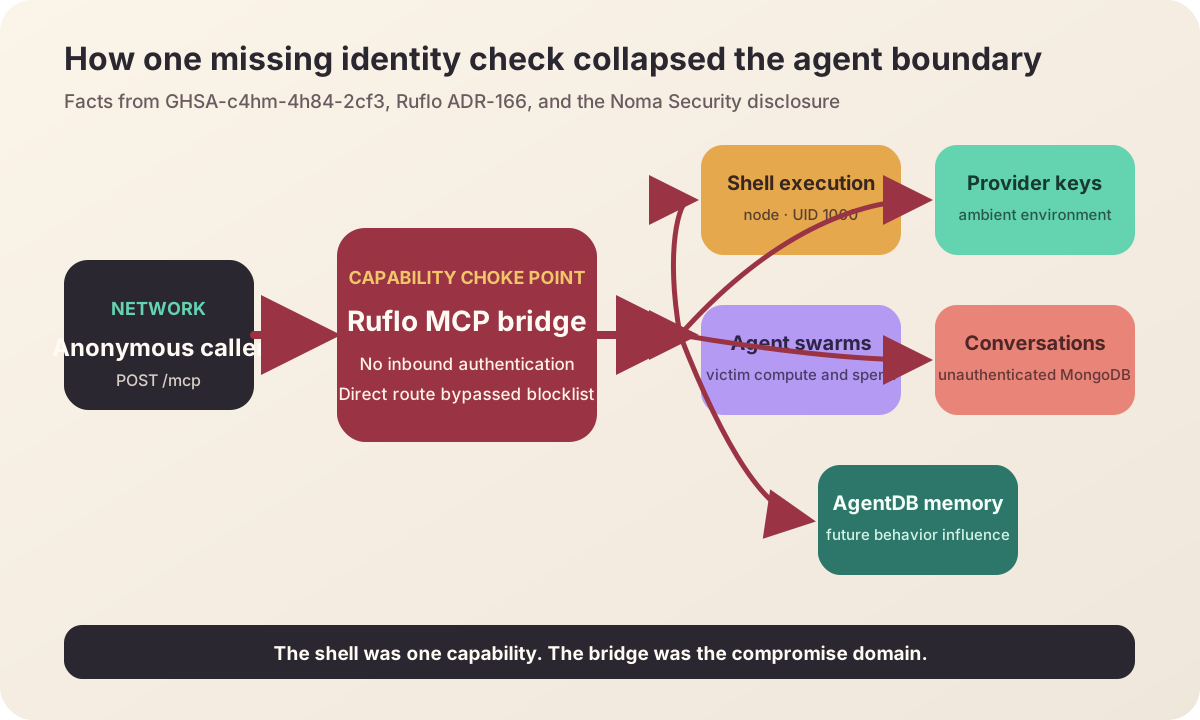
RufRoot mattered because the bridge joined five kinds of authority behind one network decision.
Noma says its PoC enumerated 233 tools, executed a command, read OpenAI, Anthropic, Google, and OpenRouter keys from the process environment, created attacker-controlled swarm activity, wrote an AgentDB pattern, accessed MongoDB conversations, and demonstrated file-based persistence. Ruflo's maintainers documented that they statically verified the substantive disclosure claims, but they did not independently rerun the private PoC.
That distinction matters. The vulnerability and the vulnerable code path are confirmed. There is no public Ruflo-specific exposure count, named victim, or evidence of malicious in-the-wild exploitation as of publication. CISA's July 9 SSVC enrichment said exploitation was none, while also marking the issue automatable with total technical impact. A low EPSS estimate and absence from CISA's KEV catalog are prioritization signals, not an alibi for a network-reachable deployment.
The name RufRoot invites the wrong mental picture. Public evidence does not show a Docker socket mount, a privileged container, a host bind mount, a host-root escalation, or a container escape. The demonstrated command ran as the container's node user, UID 1000.
That was enough.
Unix identity answered one narrow question: what could this process do to the container's operating system? It did not describe the process's authority over the agent system.
The bridge received provider keys in environment variables. Spawned MCP backends inherited the full process environment. The bridge could reach tool dispatch, agent orchestration, memory operations, the conversation database, and the network. A non-root shell inside that process was operationally privileged because the process sat at the intersection of those capabilities.
This leads to the first RohitAI read: agent infrastructure needs an authority graph, not only a Unix privilege model.
Traditional hardening still matters. Run as non-root. Remove writable filesystems. Drop Linux capabilities. Isolate containers. But also ask:
If one service owns every answer, it is a high-privilege service even when id prints UID 1000.
Ruflo already classified terminal_execute as dangerous. The problem was placement.
The blocklist was enforced in the autopilot flow. Direct requests to /mcp and /mcp/:group reached the shared execution machinery without passing through that check. In other words, the product had a safety policy, but only one route had to obey it.
This is more instructive than a simple “forgot authentication” postmortem. Agent platforms accumulate entry points quickly: direct HTTP, grouped MCP, chat UI, CLI, automation, federation, legacy adapters, and internal calls. A policy attached to one experience becomes a bypass as soon as another path reaches the same capability.
Ruflo's 3.16.3 remediation pull request moved the terminal decision into the shared executeTool() path across both bridge variants. That is the correct architectural move. The final dispatcher should make the authorization decision because every route must converge there.
A useful capability check looks conceptually like this:
allow = identity
     + tenant
     + requested tool
     + arguments
     + purpose
     + current policy
     + runtime context
Checking only whether the caller reached an approved UI is weaker. Checking only whether the caller has a server-wide token is also weaker. High-impact tools such as shell execution, file writes, secret access, admin actions, and durable memory writes deserve capability-specific authorization at the sink.
Our recent analysis of the MCP 2026-07-28 specification argued that deleting transport sessions does not delete application state or authorization. RufRoot supplies the concrete failure case. Stateless requests make it even more important that every request carries enough identity and policy context for the gateway and final dispatcher to decide.
Remote code execution usually leads teams toward familiar response steps: patch, rotate secrets, rebuild, inspect persistence, and review logs. RufRoot adds durable agent behavior to the recovery scope.
The vulnerable agentdb_pattern-store path accepted unauthenticated writes into a shared pattern system. Noma's example injected a fake compliance pattern intended to shape future deployment scripts. The vendor advisory now tells previously exposed operators to audit and purge suspicious AgentDB entries because a patched redeploy does not undo poisoning.
This is not best understood as a dirty cache.
A cache is disposable acceleration. Agent memory can be treated as learned guidance: retrieved later, presented as context, and used to influence future actions. A poisoned record is therefore closer to a supply-chain artifact. It can cross time, sessions, and users while looking like normal internal state.
The second RohitAI read is that agent-security patching has two closure criteria:
A version scanner can help prove the first. It cannot prove the second.
That changes the design requirements for memory systems. Every write should carry provenance: principal, tenant, session, source tool, timestamp, policy version, content hash, and ideally the downstream retrievals it influenced. Operators need quarantine, review, snapshots, point-in-time recovery, and post-restore behavior tests. “Delete the suspicious row” is hard advice to follow when a memory store cannot explain who wrote what.
Upgrade to a current Ruflo release at or above 3.16.3, bind locally by default, require authenticated public access, and keep terminal execution disabled unless a documented workflow needs it.
Rotate every provider key available to the bridge, inspect usage and billing, revoke related tokens, and rebuild from trusted artifacts. Valid victim credentials can make attacker traffic look legitimate.
Audit AgentDB patterns and MongoDB, quarantine unexplained writes, verify conversations, and test representative agent behavior after cleanup or restore.
Split bridge, memory, conversation data, and credential brokering into separate identities and network zones. Enforce tool policy at the shared execution sink.
Ruflo responded quickly. The project received the coordinated disclosure on June 30, merged the remediation on July 1, and published 3.16.3 the same day.
The patch changed several security decisions together:
| Control plane | Before 3.16.3 default | 3.16.3 behavior | Residual question |
|---|---|---|---|
| Network bind | Bridge and Mongo ports published on all interfaces | Loopback by default; public bridge startup fails without a token | Loopback still assumes the local machine is a trusted boundary |
| Tool execution | Autopilot-only terminal blocklist | Shared dispatcher denies terminal variants unless explicitly enabled | Enabled terminal use still needs identity, argument, egress, and audit controls |
| Conversation store | MongoDB without authentication | MongoDB starts with auth and requires a root password | Existing named volumes need an explicit authentication migration |
| Container persistence | Writable application filesystem | Read-only root with temporary storage on tmpfs | External state and credentials still need separate protection |
| Regression evidence | Security assumptions spread across code and Compose | Static, runtime, Compose, and federation checks in CI | Production topology still needs independent verification |
The combined design is stronger than adding a token and declaring victory. Loopback shrinks exposure. Fail-closed startup catches dangerous public configuration. Terminal opt-in breaks the primary command path. Mongo authentication protects the conversation store. A read-only root filesystem blocks the demonstrated application-file persistence step. Static and live tests turn those assumptions into build evidence.
But the tagged Compose packaging has a separate, reproducible problem.
RohitAI ran Docker Compose v5.1.0 against the v3.16.3 docker-compose.yml. The file was rejected before interpolation with mapping values are not allowed in this context. The failing line places a required-password expansion containing multiple colons in an unquoted YAML scalar. The same line remains on the repository's current main branch at publication time.
There is a second problem in the documented public override. After locally quoting the password expression so the files could be rendered, Compose retained both the base 127.0.0.1:3001 mapping and the override's 0.0.0.0:3001 mapping. It also retained MongoDB's loopback host mapping even though the override specifies ports: []. That follows Docker's Compose merge rules: sequences are merged, and clearing a base sequence requires the reset mechanism rather than an ordinary empty list.
This does not reopen the disclosed anonymous path in the bridge code. It means the security release's deployment contract is not yet clean enough to accept on faith. Operators should use a vendor-corrected or locally reviewed manifest, render the exact multi-file configuration with docker compose config, and verify live bindings and authentication before rollout.
There are still boundaries to understand.
Public mode uses one static bearer token. That is adequate to block anonymous callers when configured correctly, but it is not a complete remote, multi-user authorization system. It does not inherently give each user an identity, bind a short-lived token to the Ruflo resource, or issue separate scopes for read-only tools, memory writes, and shell execution. The current MCP authorization specification describes the stronger direction: resource-bound tokens and least-privilege scope challenges.
The patch also leaves authentication inactive in default loopback mode and keeps a permissive CORS default there for compatibility. Official MCP security guidance warns that localhost is not a magical trust boundary when malicious local processes, browser content, extensions, DNS rebinding, or other users are in scope. Prefer stdio or restricted IPC for truly local tools, or authenticate HTTP even on loopback when the machine is not a single-user trust domain.
One upgrade trap deserves special attention. Adding MONGO_INITDB_ROOT_USERNAME and MONGO_INITDB_ROOT_PASSWORD secures a fresh MongoDB data directory. The official Mongo image documentation says those initialization variables do not modify a directory that already contains a database. Teams with an existing mongo-data volume need a deliberate user-creation and authentication migration, a backup, and a tested chat-UI reconnection. A new Compose file does not rewrite old state.
Do not begin with a debate about whether anyone probably noticed the service. The public report now gives scanners the default port, route, method, and dangerous tool name. Treat a reachable affected instance as an incident condition.
The ordering matters. Preserve evidence before purging. Rotate credentials before trusting clean-looking provider traffic. Test the negative controls over the wire rather than reading the new configuration and assuming it rendered as intended.
This is where Ruflo's own response offers a good pattern. The project added 12 static checks and 12 runtime checks across both bridge variants, plus CI coverage for Compose and federation defaults. The runtime suite verifies the behaviors that matter: unauthenticated requests fail, authenticated requests succeed, terminal calls stay denied, and public startup without a token exits.
Scanner output is useful for discovery. Negative runtime tests are better closure evidence.
The disclosed Ruflo deployment reportedly exposed 233 tools. Censys's April internet measurement found a much smaller mean capability count across observed MCP services. The exact comparison is not a Ruflo exposure estimate, but it suggests an important risk variable: tool density.
Once authentication failed, tools/list described a large machine-readable capability surface. The attacker did not need to guess whether the service could run commands, create agents, store memory, or touch databases. The catalog turned discovery into enumeration.
Capability count alone is not severity. Two read-only calculators may be safer than one shell. The better risk model combines:
This is the third RohitAI read: an MCP catalog is both a product interface and a map of delegated authority. Security review should score it that way.
The latest protocol helps gateways make better decisions by carrying method and tool names in request headers. I expect production MCP gateways to use those fields for capability-specific policy: ordinary read scopes for search, stronger step-up scopes for writes, and explicit approval for shell, admin, secret, and memory tools. A server-wide bearer will increasingly look like a compatibility layer, not the final design.
First, agent memory will acquire security metadata that databases have long taken for granted. Provenance, tenant boundaries, version history, quarantine, signed or hashed records, and recovery evaluation will move from “nice to have” to baseline. RufRoot makes the reason tangible: durable state can preserve attacker influence after the triggering request is gone.
Second, vulnerability management for agents will split one ticket into four tracks: vulnerable software, credential recovery, durable-state integrity, and behavior validation. Teams will discover that “patched” and “trustworthy again” are different statuses.
Third, deployment manifests will receive more hostile testing. In this incident, docker compose up selected public binds, an unauthenticated database, ambient provider secrets, default-on tool groups, and restart behavior. The manifest was effectively a security API. Defaults and startup failures deserve the same negative tests as the application route.
Fourth, providers will narrow credential blast radius. A bridge backend that never calls Anthropic should not inherit an Anthropic key. Per-backend environment allowlists are a start; short-lived credentials from a broker are better. Valid keys let an attacker blend into normal provider telemetry and spend the victim's money after the original endpoint closes.
None of this requires treating MCP itself as the vulnerability. RufRoot was an implementation and deployment failure around an MCP bridge. But MCP makes the lesson easy to generalize because it standardizes how agents discover and invoke capabilities. As that interface moves into production, its servers must be operated like privileged APIs, not friendly local plugins that happen to speak HTTP.
Yes. The formal affected range is Ruflo below 3.16.3, and the disclosed unauthenticated chain is fixed in 3.16.3. Install a current release that is at least that version. If an affected deployment was reachable, the upgrade is containment; rotate secrets and audit state as separate recovery work.
The public evidence does not show host-root escalation or a container escape. The command ran as node, UID 1000, inside the bridge container. The impact was still critical because that process could reach provider keys, tools, swarms, memory, MongoDB, and the network.
It closes the disclosed default remote exposure and is a strong safer default. It does not protect against every malicious local process, hostile browser context, extension, DNS-rebinding scenario, or untrusted user on the same machine. Prefer restricted local transports or add authentication when loopback is not a trusted single-user boundary.
Not as a complete response. Provider keys may already have been copied. MongoDB uses persistent storage. AgentDB patterns may need review or reset. Existing Mongo named volumes also require an explicit authentication migration because new initialization variables do not retrofit an initialized database.
No public evidence reviewed for this article establishes malicious in-the-wild exploitation, a named victim, or the number of exposed Ruflo instances. The issue is easy to automate and now publicly documented, so absence of public victim evidence should not lower the response priority for a reachable affected service.
RufRoot is a clean example of why agent security cannot stop at the model, the prompt, or the container boundary.
The vulnerable service did not need host root. It already had something more useful: delegated authority across model providers, tools, conversations, swarms, and memory. A policy existed, but one route bypassed it. A patch closed the route, but poisoned state and copied credentials could outlive the vulnerable process.
The durable design rule is simple: put identity and capability policy at the final dispatcher; split high-value services into separate trust domains; minimize ambient credentials; test denial behavior over the wire; and treat persistent agent memory as governed production state.
When an MCP bridge can act for the agent, it is part of the agent's root of trust. Operate it like one.