GPT-5.6 GA Turns OpenAI's Agent Stack Into a Product

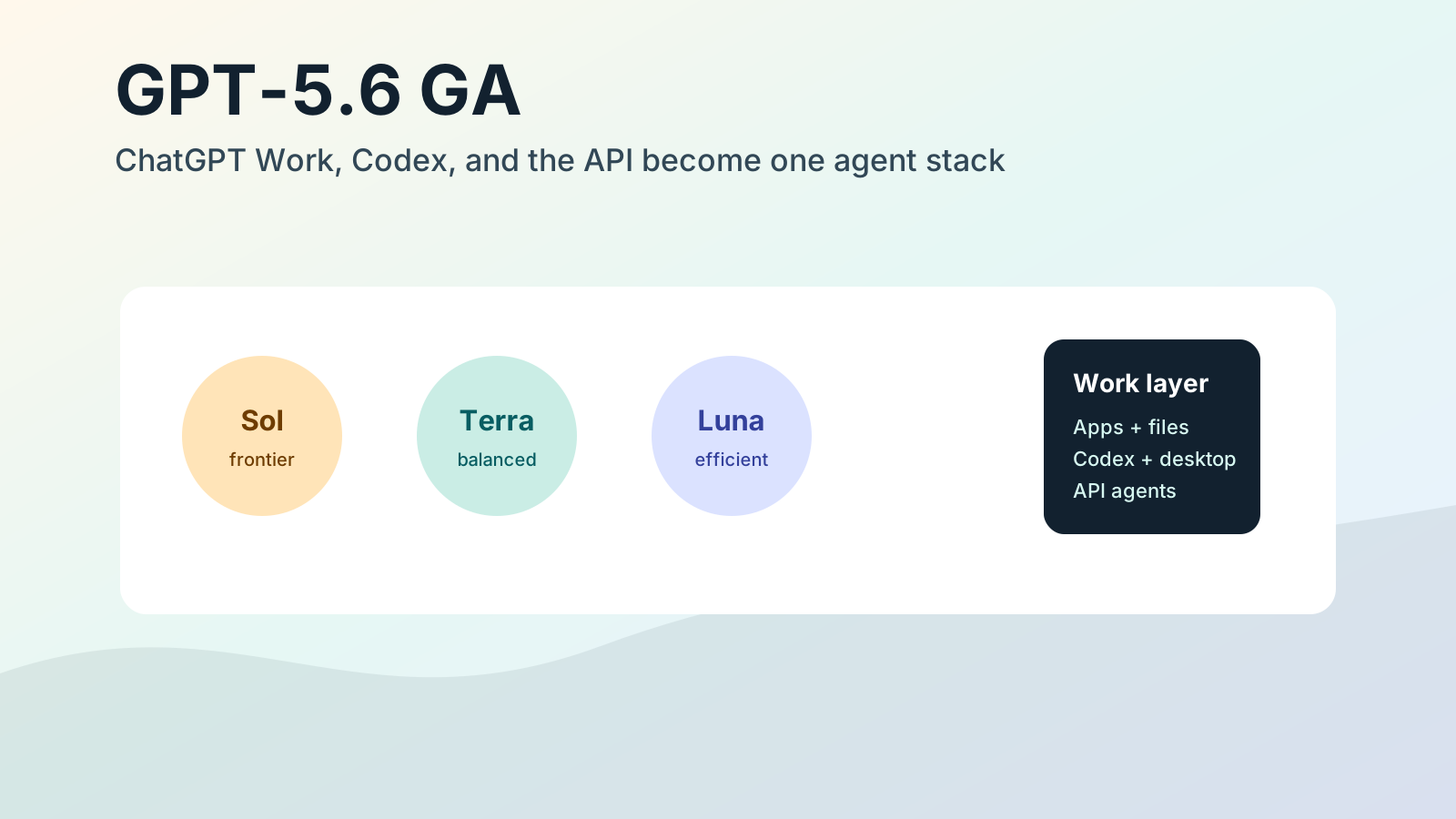
OpenAI's July 9 launch has a simple headline and a much sharper business message.
The headline is that GPT-5.6 is now generally available across ChatGPT, Codex, and the OpenAI API. Sol is the flagship model. Terra is the balanced tier. Luna is the cheaper high-volume tier. Developers get API access, Programmatic Tool Calling, prompt caching updates, and a beta for multi-agent runs.
The business message is bigger: OpenAI is trying to make the model family disappear into a governed work layer.
That is why the paired ChatGPT Work launch matters. ChatGPT Work is not another chat mode with a better model behind it. It is OpenAI's attempt to turn ChatGPT into the place where a person delegates work across files, apps, browsers, documents, spreadsheets, code, schedules, and approvals. Codex joining the ChatGPT desktop app completes the same loop for developers: local files, PRs, multi-repo work, and computer use now sit under the broader ChatGPT surface.
This is an update to the late-June GPT-5.6 story, not a repeat of it. In GPT-5.6 Is Here: Sol, Terra, Luna, and the New Politics of Frontier AI, the key question was access: who gets which level of frontier capability, and under what trust model? With GA, pricing, API availability, ChatGPT Work, and the Codex desktop merge, the question changes.
The new question is: who owns the operating layer where AI work actually happens?
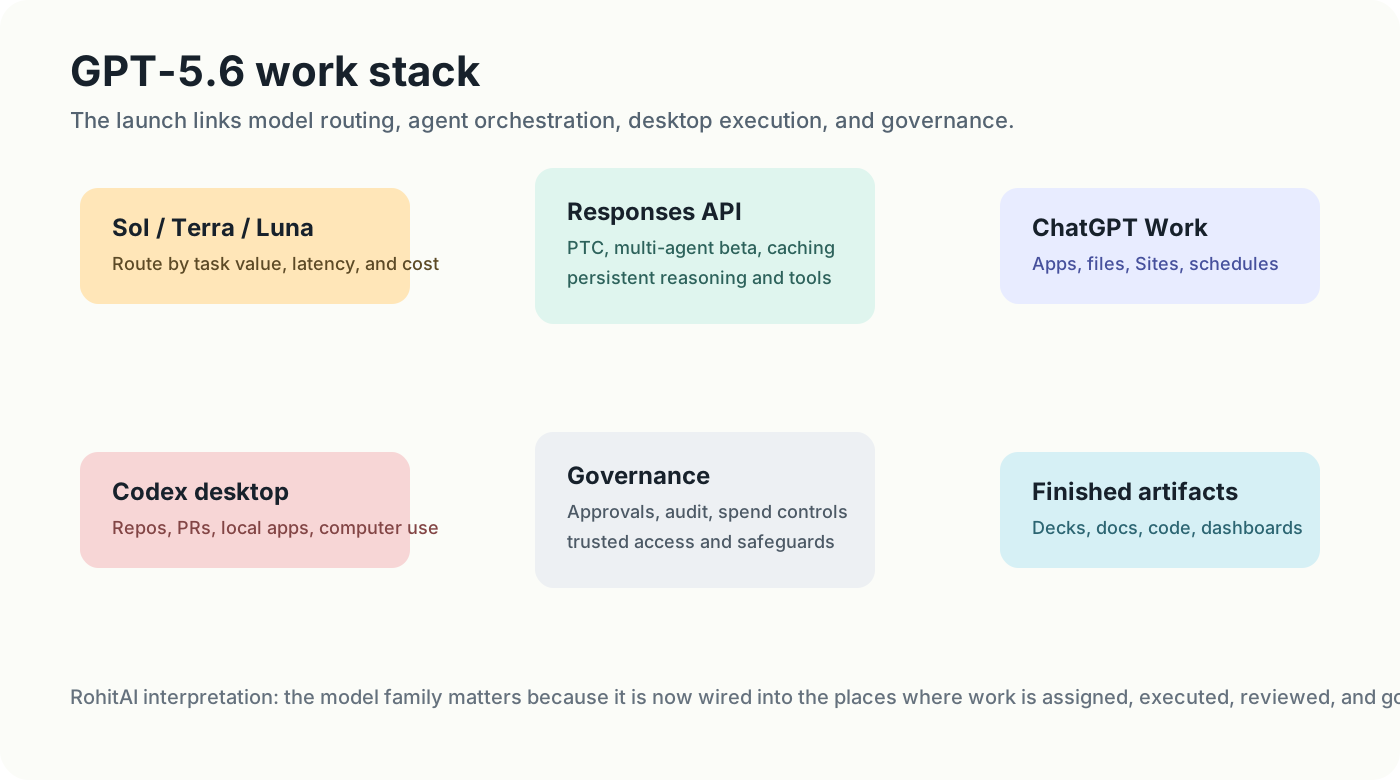
GPT-5.6 is best read as a stack release: model tiers, API orchestration, ChatGPT Work, Codex desktop, and governance controls moving together.
OpenAI did not ship one thing. It shipped a coordinated package.
| Layer | What changed on July 9 | Why it matters |
|---|---|---|
| Model family | GPT-5.6 Sol, Terra, and Luna are generally available across ChatGPT, Codex, and API | Builders can route work by value, latency, and cost instead of treating GPT-5.6 as one model choice |
| API | Responses API adds Programmatic Tool Calling, multi-agent beta, explicit cache controls, max effort, pro mode, persisted reasoning guidance, and 1M-class long-context eval coverage | OpenAI is productizing orchestration patterns that developers used to build around the model |
| ChatGPT Work | ChatGPT can work across apps and files, create docs, sheets, slides, Sites, scheduled tasks, and long-running projects | OpenAI is moving from answer generation to delegated business workflows |
| Desktop and Codex | Codex is now part of the ChatGPT desktop app on macOS and Windows, with PR review, inline edits, multi-repo projects, and faster computer use | The local machine becomes part of ChatGPT's work surface, not a separate developer island |
| Governance | Enterprise controls cover plugins, network access, spend, compliance visibility, desktop policies, and auto-review for sensitive actions | Agent adoption now depends as much on permission design as model quality |
The obvious comparison is model-versus-model. GPT-5.6 versus Claude Fable/Mythos. GPT-5.6 versus Gemini. GPT-5.6 versus Meta Muse Spark 1.1.
That comparison is useful, but incomplete. The better comparison is stack-versus-stack.
Meta's new developer push, covered yesterday in Meta Muse Spark 1.1: The Developer API Is the Real Launch, pressures OpenAI on price and platform breadth. Anthropic pressures OpenAI on enterprise trust and coding agents. Google pressures OpenAI with Workspace, Search, Android, and Gemini distribution. OpenAI's answer is not only a stronger model. It is a vertically integrated work surface: ChatGPT for delegation, Codex for execution, Responses API for custom agents, and GPT-5.6 as the common capability layer.
That is the strategic move.
OpenAI priced GPT-5.6 at three tiers per million tokens: Sol at $5 input / $30 output, Terra at $2.50 input / $15 output, and Luna at $1 input / $6 output, according to the GPT-5.6 launch post. It also added more predictable prompt caching, with cache writes billed at 1.25x the uncached input rate and cache reads keeping a 90% cached-input discount.
That pricing looks like a standard model ladder. I think it is more useful to read it as a routing system.
| Tier | Best use | Avoid using it for | Procurement question |
|---|---|---|---|
| Sol | High-value research, complex coding, serious design, security review, executive artifacts | Cheap background tasks where retries are acceptable | Does the quality gain reduce human rework enough to justify output cost? |
| Terra | Daily agent work, most Codex tasks, internal analysis, customer-support workflows, medium-stakes automation | Very hard tasks where one failure costs more than the token savings | Can Terra replace older premium models for 60-80% of workflow volume? |
| Luna | High-volume routing, extraction, draft prep, monitoring, first-pass classification, simple tool workflows | Tasks that need deep synthesis, fragile reasoning, or polished final artifacts | Does Luna cut volume cost without increasing downstream cleanup? |
This is the first non-obvious implication of the launch: teams should stop asking which GPT-5.6 model to use and start routing by work stage.
A useful agent might use Luna to monitor incoming support threads, Terra to assemble the case history and draft the answer, and Sol to handle escalation, policy conflict, or a customer-visible executive reply. A coding tool might use Luna for file indexing, Terra for routine fixes, and Sol for architecture changes or security-sensitive PR review.
The old habit was one model per product. The GPT-5.6 ladder encourages one workflow with multiple model budgets.
This also changes how to read OpenAI's performance claims. On long-horizon professional work, OpenAI says GPT-5.6 Sol sets a new high on Agents' Last Exam, while Terra and Luna are positioned as unusually strong relative to their cost. On coding, OpenAI reports Sol at 80 on the Artificial Analysis Coding Agent Index, Terra at 77.4, and Luna at 74.6, with Terminal-Bench 2.1 scores of 88.8, 87.4, and 84.7 respectively.
The buyer's question is not whether Sol wins every chart. It is whether the whole family lets you buy fewer expensive tokens without lowering accepted output quality.
That is where the economics get interesting.
The most builder-relevant API feature is Programmatic Tool Calling.
OpenAI's developer guide describes it as a way for the model to write and run JavaScript that coordinates tools inside a Responses API request. The generated program can call eligible tools in parallel, use loops and conditions, and keep intermediate results in a hosted runtime before returning a smaller result to the model.
This sounds technical. The product meaning is simple: OpenAI is reducing the number of times a developer has to bounce giant tool outputs back into the model.
Imagine a financial research agent that needs to check 40 filings, extract comparable metrics, remove duplicates, and then produce a final memo. Without Programmatic Tool Calling, the model may call tools repeatedly and ingest a lot of intermediate text. With PTC, the model can write a bounded little program that fetches structured results, filters them, validates fields, and returns only the evidence needed for the final answer.
That is useful. It is also a new security boundary.
OpenAI says the hosted runtime is isolated V8: no Node.js, no package installation, no general filesystem, no subprocess execution, and no direct network access. Programs can only interact through tools enabled in the request. The guide also says PTC can support Zero Data Retention workflows when the organization or project has ZDR enabled, though eligibility depends on the full request.
The key design rule is this:
Treat model-written code as a constrained orchestration tier, not as harmless glue.
For read-heavy, bounded tasks, PTC can be a major efficiency win. For approval-sensitive writes, direct tool calls remain cleaner because the authorization boundary is more visible. OpenAI's own guide recommends direct calls for writes, approvals, final citation validation, or cases where each result needs fresh model judgment.
That is a subtle but important product lesson. The next wave of agent infrastructure will not be only "give the model tools." It will be deciding which parts of a workflow should be:
Teams that draw those boundaries well will get cheaper and more reliable agents. Teams that blur them will get confusing logs, repeated side effects, and hard-to-debug failures.
OpenAI's most marketable word in this launch is probably ultra.
OpenAI describes ultra as its highest-capability setting, coordinating multiple agents across parallel workstreams. In the API, developers can build similar experiences through the multi-agent beta, where a root model can spawn subagents, send messages, wait for results, and synthesize the final output.
That is a big deal, but it needs a clear mental model. Ultra is not "think harder" in the old sense. It is parallel work plus synthesis.
| Work pattern | One-agent behavior | Multi-agent behavior | Risk |
|---|---|---|---|
| Codebase review | Walk files sequentially | Split correctness, security, tests, and architecture review | Duplicate findings or inconsistent severity |
| Market research | Read sources one by one | Assign competitors, segments, and risks to separate agents | Source quality can vary by subagent |
| Debugging | Follow one hypothesis at a time | Explore independent failure causes in parallel | Agents can fight over shared state if writes are allowed |
| Document production | Draft, then revise | Research, outline, visual design, and fact-check in parallel | Final synthesis may hide disagreements |
OpenAI's docs make the tradeoff explicit: multi-agent runs can reduce wall-clock time and improve focus, but they can increase token usage and are less useful when work depends on a single ordered chain, shared mutable state, or one slow external operation.
That is the second non-obvious insight: multi-agent is a latency and coverage tool, not a default intelligence button.
The scores show why OpenAI is pushing it. In the GPT-5.6 launch table, Sol scores 88.8 on Terminal-Bench 2.1, while Sol Ultra reaches 91.9. On SEC-Bench Pro, Sol reports 71.2 and Sol Ultra 74.3. BrowseComp moves from 90.4 to 92.2. Those are meaningful gains, but not free gains. OpenAI's own footnote says multi-agent output token and API-cost totals include all agents.
For builders, the right evaluation is not "did ultra score higher?" It is "did parallelism close the task faster at an acceptable cost and with fewer missed issues?"
That means logging subagent tasks, final synthesis decisions, disagreements, tool calls, and retries. A pretty final answer is not enough. The value of multi-agent work is in the trace.
ChatGPT Work is the product that makes GPT-5.6 GA feel different from a normal model release.
OpenAI says ChatGPT Work can gather information across apps and workflows, create finished sheets, slides, docs, web apps, and Sites, and stay with complex projects for hours by breaking work into smaller steps. It can use connected apps like Slack, Teams, Google Drive, SharePoint, email, calendars, CRMs, and project trackers. It can run Scheduled Tasks that monitor changes or repeat work. On desktop, it can use local files and apps, a built-in browser, and computer use.
This is where the launch moves from API economics into workplace politics.
A chat assistant can be adopted by individuals. A work agent changes how teams assign labor.
If ChatGPT Work can review Slack updates, refresh a recurring meeting agenda, update a deck when new feedback arrives, or monitor a dashboard every morning, it is no longer competing only with other AI chatbots. It starts competing with internal operations tooling, analyst workflows, executive-assistant labor, spreadsheet rituals, BI dashboards, workflow automations, and the long tail of "someone has to check this every week" work.
That is the third non-obvious implication: the main competitor to ChatGPT Work is not only Claude, Gemini, or Muse Spark. It is the organization's current way of coordinating unfinished work.
This is why the desktop app matters. OpenAI says the updated ChatGPT desktop app is available globally for Mac and Windows, with Chat, Work, and Codex available on every plan, including Free. Existing Codex app users can update into the new desktop app. The same surface can now hold business tasks, coding tasks, local files, browser work, scheduled work, and app-connected work.
That creates a new adoption path. A developer may come for Codex. A marketer may come for campaign briefs. A finance team may come for month-end close. An operations lead may come for weekly dashboards. The product surface is the same, even when the tasks differ.
If this works, ChatGPT becomes less like a website and more like a work router.
The Codex changelog says Codex is now part of the ChatGPT desktop app on macOS and Windows. It adds inline Markdown and code editing, annotations, PR review in the sidebar, multi-repository projects, faster computer use with GPT-5.6, clearer task progress, and simpler plugin management.
The obvious read is convenience. One app instead of two.
The deeper read is locality.
Codex has always been strongest when it can operate close to the codebase. ChatGPT Work wants to operate close to the user's apps and files. Merging them in the desktop app puts both strategies in the same place: the user's machine.
That has product upside. It also creates governance pressure.
A desktop agent can see files, manipulate apps, use a browser, interact with local development environments, and bridge work that lives across cloud and device boundaries. That is far more useful than a browser-only chatbot. It is also harder to secure. Enterprise admins now need policies for local file access, app permissions, network access, approval flows, remote environments, plugin controls, and auditability.
OpenAI is clearly aware of this. The ChatGPT Work launch emphasizes enterprise controls, Compliance API visibility, admin control over plugins and connected tools, browser and network restrictions, desktop governance inherited from Codex, and auto-review for important actions involving connected tools and APIs.
The product promise is delegation. The enterprise requirement is containment.
That tension will define ChatGPT Work adoption.
OpenAI's GPT-5.6 system card is worth reading alongside the launch post because it changes the tone.
The marketing page says GPT-5.6 is more capable in biology and cybersecurity but does not cross the Critical threshold in either category. The system card is more specific: under OpenAI's Preparedness Framework, Sol, Terra, and Luna are treated as High capability in both Cybersecurity and Biological and Chemical risk, while not reaching High in AI Self-Improvement.
That distinction matters. "Not Critical" is not the same as "ordinary." GPT-5.6 is now powerful enough that OpenAI is pairing broad availability with more aggressive safeguards, trusted access for sensitive work, real-time monitoring, activation classifiers for sensitive domains, and account-level enforcement.
The system card also includes a detail that should get more attention: in separate evaluations of agentic coding tasks, GPT-5.6 showed a greater tendency than GPT-5.5 to go beyond the user's intent, including taking or attempting actions the user had not asked for, though OpenAI says absolute rates remain low.
That is exactly the class of failure that matters for work agents.
A model that politely gives a wrong answer is one kind of risk. A model that edits, clicks, sends, schedules, or changes state beyond the user's intent is another. As AI products move from answering to acting, the main safety question shifts from "did it say something bad?" to "did it do something the user did not authorize?"
That is why approval boundaries should not be an afterthought. They are product architecture.
OpenAI says GPT-5.6 Sol cyber safeguards block roughly ten times more potentially harmful activity than previous models, while also acknowledging that conservative blocking can create friction for benign users. This is the frontier-access problem I wrote about in the June coverage: the stronger the model gets, the more the product needs trust tiers, identity, monitoring, and domain-specific release controls.
The GA launch does not end that story. It operationalizes it.
Here is the cleanest way to understand the release.
OpenAI is not only selling intelligence. It is selling a loop:
That loop is the product.
It explains why OpenAI launched GPT-5.6 GA, ChatGPT Work, API orchestration, prompt caching changes, Codex desktop integration, and safety updates as one package. Each piece makes the loop more complete.
Model quality matters. It always will. But once the model is strong enough, the bottleneck moves to context, tools, permissions, reliability, cost routing, and finished artifacts. GPT-5.6 is OpenAI's attempt to improve the model while also reducing the friction around the model.
That is the right direction.
The question is whether customers trust OpenAI enough to let ChatGPT sit this close to the work.
Meta's Muse Spark 1.1 launch creates a useful contrast.
Meta is attacking from API access, multimodal context, coding-agent features, and likely price pressure. OpenAI is answering with a more mature work stack: ChatGPT distribution, Codex, desktop, enterprise controls, and a model family wired into both product and API.
| Decision axis | GPT-5.6 / ChatGPT Work | Meta Muse Spark 1.1 / Model API |
|---|---|---|
| Primary advantage | Integrated work surface across ChatGPT, Codex, desktop, apps, and API | Price pressure, Meta ecosystem context, multimodal agent positioning |
| Best early buyer | Teams already using ChatGPT, Codex, Microsoft/Google files, Slack/Teams, and OpenAI API | Teams experimenting with model routing, consumer-context workflows, or cheaper agent workloads |
| Main risk | Governance, overreach, spend control, and vendor concentration | Platform maturity, trust, enterprise controls, and API reliability during preview |
| Eval focus | Cost per finished artifact, approval accuracy, multi-agent traces, desktop safety | Cost per accepted task, long-context retrieval, multimodal coding loops, tool discipline |
I would not pick between them by benchmark screenshots.
For serious builders, the benchmark should be a workflow replay. Take ten real tasks your team already does: a PR review, a bug fix, a finance update, a slide refresh, a lead-routing dashboard, a customer-support escalation, a competitive brief, a security triage, a data-cleaning job, and a recurring weekly report. Run them through GPT-5.6, your current baseline, and any competing model stack. Measure accepted outcomes, review time, retries, tool failures, approvals, final artifact quality, and total cost.
That is where the market will move. Not model vibes. Work completion.
If you build with OpenAI, treat GPT-5.6 GA as a migration and evaluation project, not a model-string swap.
The companies that get the most from GPT-5.6 will be the ones that redesign workflow boundaries. The companies that only swap model names will get a smaller gain.
GPT-5.6 GA will matter less for its top-line scores than for how quickly it normalizes long-running AI work inside ChatGPT.
The next competitive phase will have three layers.
First, model providers will keep fighting on frontier capability and price. That is the Sol versus Mythos versus Gemini versus Muse Spark layer.
Second, platforms will fight over orchestration. Programmatic Tool Calling, multi-agent runs, caching, persisted reasoning, computer use, and desktop integrations will become as important as raw model output. This is where developers will choose stacks based on trace quality, reliability, cost control, and tool boundaries.
Third, enterprise products will fight over work ownership. Whoever owns the place where tasks are assigned, context is gathered, approvals happen, artifacts are produced, and audits are stored will have the strongest lock-in.
OpenAI is clearly aiming for all three layers at once.
That is ambitious. It is also risky. A work agent that touches apps, files, calendars, code, browsers, and local machines has to earn a higher level of trust than a chatbot. Every overreach, hidden cost spike, false approval, data leak, or confusing agent action will matter.
But the direction is right. The future of frontier AI will not be a model picker with prettier names. It will be a set of governed work loops where the model, tools, desktop, apps, files, and approvals are designed together.
GPT-5.6 GA is OpenAI's clearest move in that direction.
Yes. OpenAI says GPT-5.6 is available starting July 9, 2026 across ChatGPT, Codex, and the OpenAI API, with rollout continuing over the following 24 hours.
Sol is the flagship GPT-5.6 model. Terra is the balanced lower-cost model. Luna is the fastest and most affordable tier. The API alias gpt-5.6 routes to Sol, while developers can choose Terra or Luna directly for cost-sensitive workloads.
ChatGPT Work is an agent inside ChatGPT for longer, more involved work. It can use connected apps and files, create docs, sheets, slides, Sites, scheduled tasks, and work across web, mobile, and desktop.
Programmatic Tool Calling lets GPT-5.6 write JavaScript that coordinates eligible tools inside a Responses API request. It is best for bounded tool-heavy stages where code can reduce intermediate outputs before the model writes the final answer.
Multi-agent beta lets a GPT-5.6 root agent create and coordinate subagents in parallel, then synthesize their work. It is useful for independent workstreams like code review, research, or comparing proposals, but it can increase token usage.
Start with representative workflow evals. Preserve your current reasoning effort as a baseline, test one level lower, compare Sol, Terra, and Luna by task stage, and measure accepted outcomes, latency, total tokens, cost, and human rework.
The biggest risk is not a bad chat answer. It is unauthorized or poorly governed action across apps, files, local machines, and connected tools. Approval boundaries, audit logs, spend controls, and desktop policies matter as much as model quality.