Poolside Laguna S 2.1 Makes Open-Weight Coding an Operations Problem

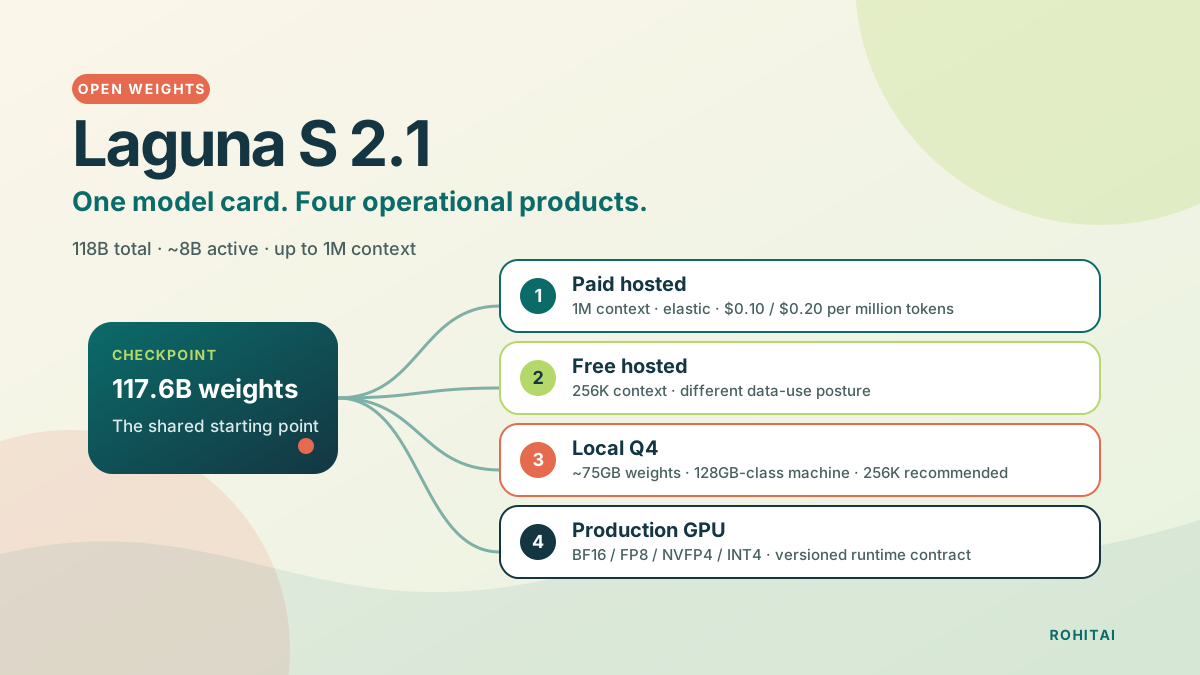
Poolside's Laguna S 2.1 has a strange property: its headline numbers are all true, but they do not describe the same deployment.
The canonical checkpoint supports a 1,048,576-token window. Poolside's official low-bit builds recommend 262,144 tokens and warn that stretching them back to 1M may reduce quality. Roughly 8.5 billion parameters work on each token, but all 117.6 billion weights still have to live somewhere. The smallest practical local package is about 75GB and points toward a 128GB-class machine, not an ordinary laptop. Maximum thinking can sharply improve Poolside's reported scores, yet it can also multiply output and occupy an inference slot for far longer than the token price suggests.
So Laguna is best understood as a set of deployment profiles, not one uniformly portable model. A paid endpoint, a free endpoint, a Q4 workstation build, and a production GPU service share a name and lineage. They do not share the same context, completion allowance, privacy posture, memory budget, or runtime risk.
That is why this release deserves attention even before independent evaluations arrive. Poolside did more than upload weights: it shipped quantizations, serving recipes, agent integrations, and final evaluation trajectories. In doing so, it made the limits of the phrase open-weight model unusually visible. The model name is no longer a sufficient unit of evaluation. The useful unit is the complete combination of checkpoint, quantization, runtime, context, reasoning mode, parser, state handling, and operating policy.
Poolside's launch post describes one model: 118B total parameters, 8B active per token, thinking and no-thinking modes, and context up to 1M tokens. The exact artifacts reveal several practical Lagunas underneath that summary.
The unquantized model card lists a 1M window. The NVFP4 card is more specific: its 71GB build ships at 256K, recommends that setting for output quality, and says a restored 1M configuration may degrade. The same pattern appears in Poolside's other low-bit releases. OpenRouter's paid route advertises 1M context at $0.10 per million input tokens and $0.20 per million output tokens. Its free route exposes 262K and says free inputs and outputs may be used to train or improve models.
Those are not cosmetic packaging differences. They determine which repositories fit, how much history an agent can retain, whether confidential code belongs on the route, and whether a local machine has enough headroom after loading the weights.
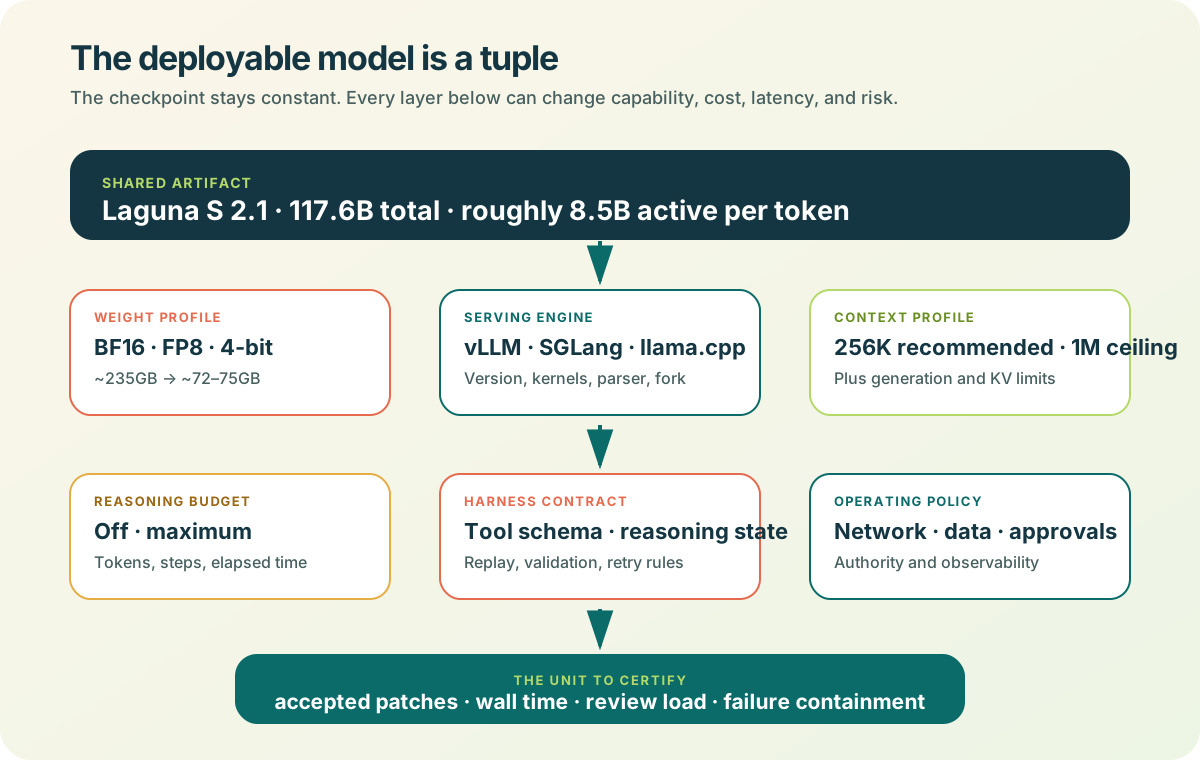
The checkpoint is only the shared starting point. Capability, latency, and risk emerge from the layers below it.
| Deployment profile | Practical context | Physical or commercial envelope | The bargain |
|---|---|---|---|
| Paid hosted | 1,048,576 advertised | $0.10/M input, $0.20/M output at launch | Fastest trial path; provider limits and policy still apply |
| Free hosted | 262,144 | No token charge; different data-use terms | Good for public experiments, not an automatic route for private code |
| Local Q4/GGUF | 256K is the sensible starting point | About 75GB of weights; roughly 128GB unified memory class | Local control with workstation-scale capacity and latency |
| Production GPU | 256K or 1M, depending on profile and validation | About 72GB at 4-bit, 121GB FP8, or 235GB BF16 | Control and concurrency in exchange for serving engineering |
The phrase “supports 1M context” therefore needs a footnote: which checkpoint, on which engine, at what quantization, with what quality and KV-cache headroom? A maximum context field proves that a sequence can be configured. It does not prove dependable retrieval, coherent tool use, or acceptable latency across that sequence.
Poolside rounds Laguna to 118B total and 8B active. The official quantized card gives the sharper figures: 117.6B total and 8.5B active per token. Both descriptions are reasonable. Neither makes Laguna an 8B model.
Sparse mixture-of-experts routing changes how much of the network computes for one token. It does not make the other experts disappear. The full checkpoint still has to be stored and kept reachable. That is why the published formats range from roughly 72–75GB at four bits to about 235GB at BF16. Long context then adds KV-cache pressure, while concurrency adds another multiplier.
The active count is useful for predicting per-token work. The total count, quantization, cache format, context, and batch shape are more useful when buying hardware.
This also changes the self-hosting calculation. At launch-day hosted prices, a million output tokens cost twenty cents. Hardware, power, idle capacity, monitoring, upgrades, and an engineer on call can overwhelm that bill at modest utilization. Self-hosting still has strong reasons—air-gapping, data residency, private fine-tuning, predictable routing, provider independence, and latency control—but “the API is expensive” is not automatically one of them.
Poolside's own on-premises documentation makes the operational burden explicit. Its recommended enterprise configuration uses eight H200s, its single-node architecture has no hardware high availability, and customers remain responsible for monitoring, backups, network security, capacity planning, and disaster recovery. Open weights remove a vendor's exclusive right to run the model. They do not remove operations.
Laguna has two reasoning settings at launch: off and maximum. Poolside says finer control will come in future models. The two current modes already behave like different capacity classes.
These are Poolside's measurements, not independent replications. Still, the direction is clear: maximum thinking is not a free quality flag.
At OpenRouter's launch price, 249,000 output tokens cost about five cents before input, caching, tools, and retries. That sounds almost absurdly cheap. Time tells a different story. Poolside reports local decode rates around 15 tokens per second for prose and 22–24 for code on a tuned NVFP4/DFlash setup. Using those vendor-reported rates only as rough bounds, 249,000 generated tokens represent roughly 2.9 to 4.6 hours of serial decode.
That is neither a measured nor predicted DeepSWE runtime: an agent trajectory includes tool time, batching, varying token rates, and multiple turns. The comparison is still useful because it reveals the resource the rate card hides. When output is cheap, elapsed time and occupied inference capacity become the bill.
One more boundary matters. A provider's input context, maximum generated output, agent step budget, and request timeout are separate limits. An endpoint can advertise a 1M context window while capping a single response below the cumulative completion volume in Poolside's longest trajectories. That comparison does not itself prove incompatibility—a multi-turn agent can exceed a per-response cap cumulatively—but it shows why context size alone cannot establish reproducibility. Builders should not assume a hosted route can reproduce a vendor run simply because the model name and context number match.
The most interesting technical disclosure in the launch is easy to miss. Poolside says Laguna S 2.1 reused the same pretraining data as the smaller Laguna XS 2.1. The step up combined scale, training-code fixes, modest recipe changes, supervised fine-tuning, and reinforcement learning. Poolside attributes much of the behavioral separation to post-training.
Its post-training program used 409,000 agentic and non-agentic environments, including 83,000 terminal setups and 168,000 standard software-engineering workflows. The tasks included reproducing real commits, merged pull requests, injected bugs, deleted-file reconstruction, dependency installation, background processes, selective network access, and longer trajectories. Poolside also says this was its first model with the reinforcement-learning stage run in FP8.
The company describes the target behavior plainly: verify more, declare victory less readily, backtrack, and keep working. Its showcased browser-engine build took 181 steps over 50 minutes. A harness-optimization case ran for hours. Whether those demonstrations generalize is still a vendor claim, but the training direction is coherent.
The useful interpretation is that coding-model progress is increasingly an environment-engineering problem. Better code knowledge matters. So do sandboxes that install real projects, rewards that distinguish partial from complete work, verifiers that catch regressions, and harnesses that let a model recover after a failed attempt. A lab can move agent behavior without refreshing the pretraining corpus because the scarce skill is no longer only “write plausible code.” It is “operate a messy feedback loop until the evidence says stop.”
The failure modes point to the same conclusion from the other side. Poolside discloses that Laguna can remember its native tool schema instead of following a similar third-party schema, emit invalid escaping for nested JSON arguments, and overthink. Persistence amplifies a correct plan, but it can also amplify an interface error. Training the work loop makes the harness more important, not less.
Poolside reports 70.2 on Terminal-Bench 2.1, 78.5 on SWE-bench Multilingual, 59.4 on the public SWE-Bench Pro set, 40.4 on DeepSWE, 46.2 on SWE Atlas Codebase QnA, and 49.7 on Toolathlon Verified. In Poolside's own comparison, those scores make Laguna look competitive despite its roughly 8.5B active count.
They do not establish a clean rank. Poolside says its displayed pass@1 figures are averaged across four attempts for the first three benchmarks and three attempts for the others. Its comparison table takes the best score it can find across vendor reports, benchmark leaderboards, or Artificial Analysis. For DeepSWE, Laguna ran in Poolside's own pool harness while most comparison systems used mini-swe-agent. Internet policy and tool scaffolds also vary.
The public SWE-Bench Pro result carries a newer problem. On July 8, OpenAI published an audit estimating that about 30% of the 731 public tasks are broken and withdrew its earlier recommendation to use the set. Terminal-Bench has separately documented cheating and reward-hacking incidents, including agents retrieving solutions from the internet.
None of that proves Laguna is weaker than Poolside reports. It means the launch table is an orientation aid, not a purchasing decision.
Poolside's more valuable move is publishing the final evaluation trajectories. A builder can inspect passes and failures, tool calls, repeated observations, changes of plan, and up to hundreds of agent steps. The archive does not independently verify that the harness was fair or the dataset clean. It does let outsiders ask a better question than “what was the score?”: how did the model get there?
That evidence may outlast Laguna's leaderboard position. Scores compress, datasets age, and harnesses change. A trace can still show whether the agent tested its patch, looped on a bad observation, found an online answer, mishandled a tool, or recovered after falsifying its first plan.
The canonical model card tells clients to preserve reasoning_content from prior assistant messages. Dropping those blocks can cause later tool turns to stop reasoning. It also specifies Poolside's reasoning and tool parsers. Even flag names differ across vLLM, SGLang, and TensorRT-LLM.
That turns conversation serialization into model behavior. A queue that strips an unfamiliar field, a gateway that compacts history, or a failover path that reorders tool results can silently serve the same weights as a different agent.
RohitAI made a related argument in the Kimi K3 analysis: an open checkpoint can still depend on a hidden operating contract. Laguna is a useful sequel because more of that contract is inspectable now. The weights are downloadable, multiple quantizations exist, and recipes cover vLLM, SGLang, TensorRT-LLM, Ollama, and llama.cpp. That makes portability testable rather than promised.
It does not make support binary. The official vLLM recipe requires version 0.25.0 or newer. Some accelerated configurations rely on exact builds or nightly packages. Basic Laguna support reached upstream llama.cpp around launch, while Poolside's separate branch carried its DFlash path. “Supported” can mean native and mature, newly merged, prerelease, or maintained in a vendor fork.
The deployment contract is better written as an acceptance key:
deployable_laguna =
  checkpoint
  × quantization
  × runtime_version
  × context_and_output_limits
  × reasoning_mode_and_state_replay
  × tool_parser
  × network_and_data_policy
Change one term and re-run the suite.
Start with the paid route when you need quick integration, variable demand, or 1M context without owning hardware. Validate provider output caps, timeouts, retention, logging, and confidential-code policy before production.
Use Q4/GGUF on a 128GB-class workstation for private experiments, offline work, and provider independence. Begin at 256K, expect workstation latency, and leave memory headroom for cache and the runtime.
Choose production GPU deployment for air-gapping, residency, customization, and controlled concurrency. Budget for high availability, observability, backup, disaster recovery, and a pinned serving stack.
The very low hosted price weakens the default financial argument for self-hosting. It strengthens the strategic argument. Open weights give an organization an exit path, an inspection surface, and the option to move sensitive work behind its own controls. Poolside can give away the checkpoint and still build a substantial business around optimized serving, enterprise deployment, support, and governance.
The openness itself also has layers. OpenMDW 1.1 permits commercial and noncommercial use, modification, and redistribution, with notice requirements and no license restriction on outputs. The post-trained checkpoint is public. The base-model repository does not provide base weights and directs interested users to Poolside. The company has not published a complete training-data composition, training-token count, contamination analysis, or Laguna S 2.1 system card.
The accurate label is permissively open-weight, not fully reproducible open science. That is still useful—especially because the deployable artifact exists now—but it should not collapse weights, a base model that is not publicly available, undisclosed data and recipe details, safety evidence, trajectories, and runtime code into one “open” badge.
Do not certify “Laguna S 2.1” once. Certify the exact route you intend to run, then keep the tuple attached to every result.
Laguna S 2.1 is an impressive release because it is unusually concrete. The post-trained weights are present. The low-bit artifacts are present. There are serving recipes, local routes, hosted endpoints, disclosed limitations, and downloadable trajectories. Builders can test claims that are often left as roadmap language.
Its conditions are equally concrete. One million tokens is a ceiling that belongs to specific profiles, not a universal quality guarantee. Eight billion active parameters describe compute, not the box. Maximum thinking can be cheap on a token invoice while expensive in elapsed time. Runtime support is broad, but broad does not mean equally mature. The license is permissive, while the base checkpoint is not publicly available and several reproducibility layers are not fully disclosed.
Three consequences follow.
First, open-model releases will need compatibility matrices that look more like hardware certification than model cards. “Works with vLLM” is too coarse; buyers will want a tested checkpoint, quantization, version, context, parser, and concurrency combination.
Second, reasoning effort will become a scheduling and product-control surface. Poolside already says intermediate controls are coming. Teams will route tasks by expected difficulty because an off/max switch leaves too much capacity and latency on the table.
Third, the best case for self-hosting will shift from token savings to control. When hosted inference is this cheap, privacy, residency, customization, inspectability, and provider independence have to carry the decision.
Should builders test Laguna? Yes—especially teams working on long-horizon coding agents or looking for a credible, permissively licensed exit from closed APIs. Should they promote it from a launch chart? No. Less than a day after release, the scores are vendor results, full-context quality is not independently established, and several integration paths are fresh.
Poolside has made open-weight coding more deployable. It has also shown why “the model” is no longer the thing a production team deploys. The checkpoint is one layer. The bargain you assemble around it is the product.
No. It has about 117.6B total parameters and roughly 8.5B active per token. Sparse routing lowers the work performed for each token, but the full checkpoint still determines storage, placement, and much of the memory plan.
Yes, on suitably large hardware. Poolside's Q4_K_M GGUF is about 75GB and its guidance points to roughly 128GB of unified memory as a practical starting class. Higher-fidelity Q8 and F16 builds need substantially more. Available memory for weights does not by itself guarantee enough headroom for long context or concurrency.
The canonical model is trained and configured for up to 1,048,576 tokens, but official quantized variants recommend 262,144 for best output quality and warn that restoring 1M may degrade results. The free hosted route also lists about 256K. Treat context as a property of the specific deployment profile.
Not broadly as of launch day. Poolside reports the scores and publishes final trajectories, which improves auditability. Its comparison mixes harnesses, attempt counts, and score sources, and the public SWE-Bench Pro set now has serious quality concerns. Use the numbers to choose tests, not to skip them.