OpenAI Daybreak Is on AWS Bedrock. The Safety Stack Is Still Yours.

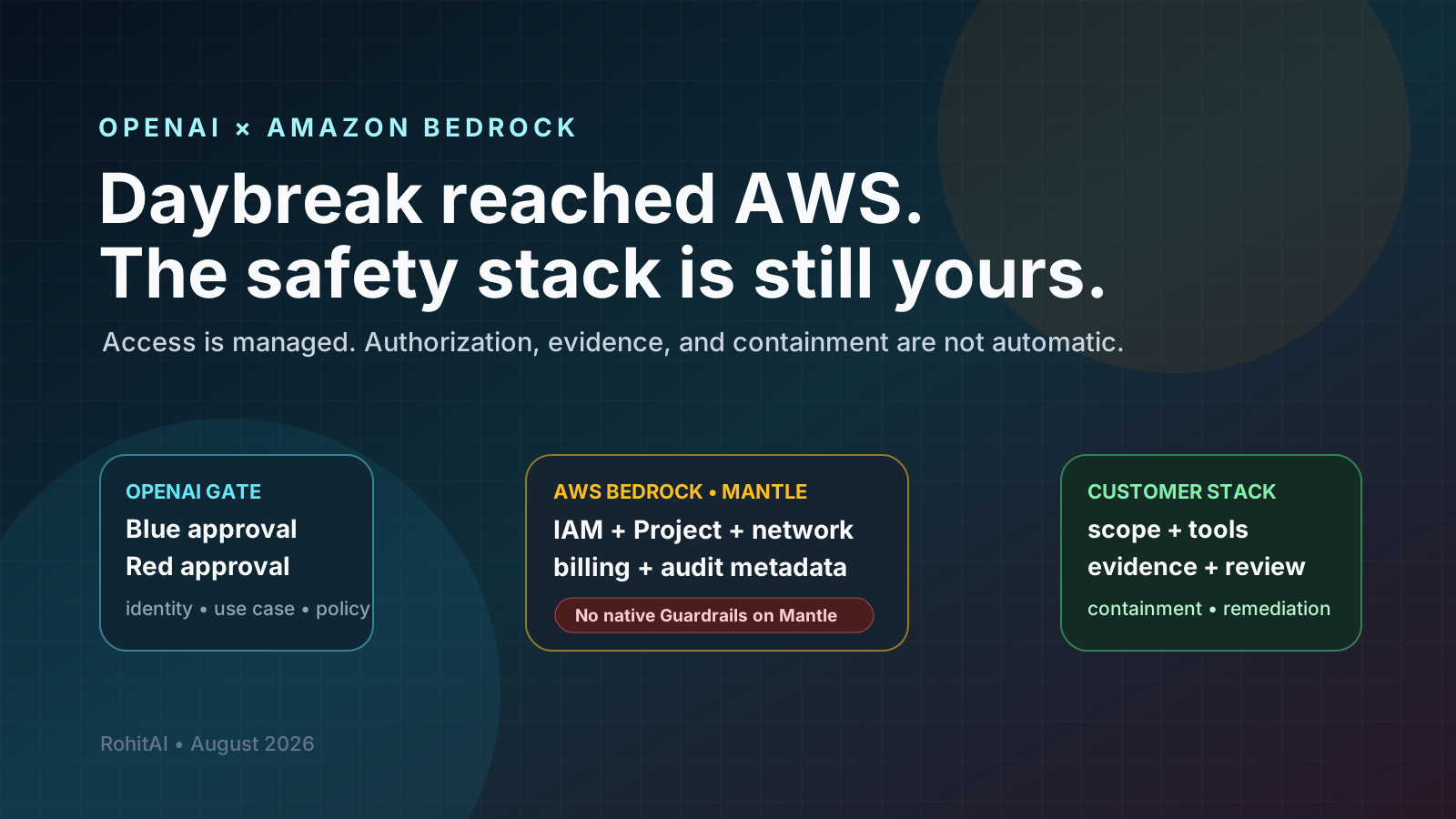
OpenAI has put Daybreak Blue and Daybreak Red on Amazon Bedrock. The obvious reading is procurement convenience: approved security teams can buy a frontier cyber model through the cloud account they already govern. That is true, but it misses the part that will decide whether this launch survives contact with production.
Daybreak has moved into the same AWS estate that may hold source repositories, CI credentials, incident telemetry, secrets, and production control planes. The model is easier to reach from enterprise workflows. Its blast radius is easier to underestimate too.
AWS supplies useful primitives—identity, Projects, PrivateLink, metering, CloudTrail, CloudWatch, and account policy—but Daybreak runs through the bedrock-mantle Responses path. On that path, native Bedrock Guardrails are not available. Full request-and-response invocation logging is not managed for you. Inference events are paid CloudTrail data events that are off by default. Response state is stored for 30 days by default unless the caller changes it.
So this is not a new capability launch. OpenAI announced GPT-5.6-Cyber and the Blue/Red access split one day earlier; our launch analysis explains that model boundary and why the 95% figure is not a hacking-success rate. The August 11 news is the production sequel. It turns a lab-controlled entitlement into a shared-responsibility system spanning OpenAI approval, AWS infrastructure, and the customer's own authorization and evidence stack.
The useful question is no longer, “Can we access Red?” It is, “What has to be true before a Red request can touch anything real?”
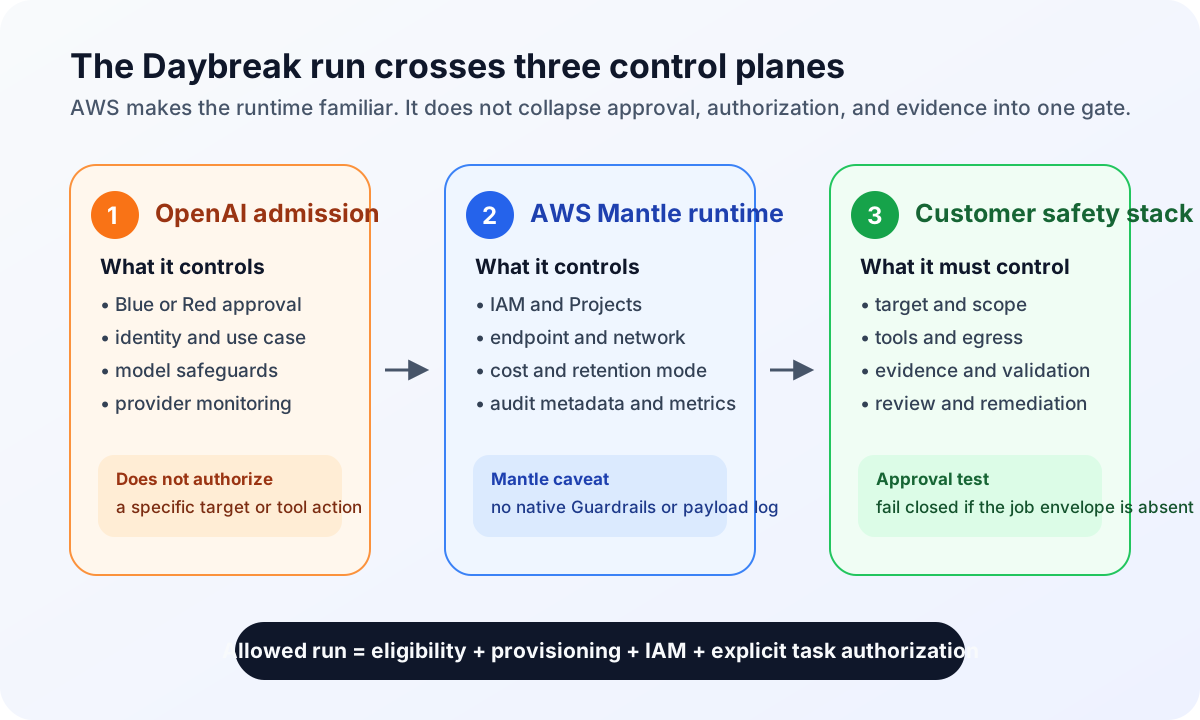
Daybreak on AWS has three control planes. The launch wires the first two together; the customer still has to build the third.
On August 10, OpenAI introduced two Daybreak levels. Blue uses GPT-5.6 Sol with safeguards tuned for approved defensive work. Red exposes GPT-5.6-Cyber for separately approved vulnerability research, exploit validation, penetration testing, and controlled red teaming.
On August 11, OpenAI announced that both levels were available through Amazon Bedrock. Approved customers can use the Bedrock console or the OpenAI-compatible Responses API on bedrock-mantle.
That one-day gap matters. Security teams used to have a grace period between a frontier-model announcement and enterprise distribution. Here, the distribution channel arrived almost immediately. The landing zone now has to exist before entitlement: account boundaries, short-lived credentials, target-authorization records, runner isolation, evidence policy, cost alarms, and incident ownership.
The exact Bedrock identifiers also matter because the names are not symmetric:
Daybreak Blue on Bedrock -> gpt-daybreak-blue-5.6-sol
Daybreak Red on Bedrock  -> gpt-5.6-cyber

Not valid on Bedrock:
gpt-daybreak-blue
gpt-daybreak-red
OpenAI's Daybreak access documentation recommends Blue for most teams and says Red requires additional approval. Existing Trusted Access or GPT-5.5-Cyber approval does not carry over automatically. The technical access equation is therefore:
OpenAI eligibility
+ AWS provisioning
+ IAM permission
+ customer task authorization
= one allowed run
Miss any term and the system is incomplete.
Identity, organization, use case, security posture, and risk review determine whether Blue or Red is activated. Procurement cannot override this gate.
The account, Project, endpoint, credentials, network path, metering, region, retention mode, and service telemetry live in AWS.
Named targets, scope, techniques, time window, data rules, tool permissions, reviewer, and stop conditions must exist outside the prompt.
The launch post says enterprises can use Daybreak inside familiar AWS security, governance, and operational workflows. That is a fair description. A dedicated Bedrock Project can isolate usage, scope IAM, attach cost tags, and separate a cyber workload from the default project. PrivateLink can keep traffic off public internet paths. CloudWatch can expose Mantle inference counts, errors, and token use.
But a familiar control plane is not an inherited safety architecture.
Daybreak calls use Mantle, not the conventional bedrock-runtime inference path. AWS's endpoint comparison shows three deployment consequences that deserve architecture-review status:
bedrock-mantle. Input policy, output checks, tool allowlists, and destructive-action approval have to sit in the application and runner.bedrock-runtime operations.Here is the responsibility map I would take into an architecture review:
| Layer | OpenAI | AWS | Customer |
|---|---|---|---|
| Admission | Approves Blue or Red and enforces model policy | Provisions the Bedrock path | Limits approved users and internal workflows |
| Runtime | Provides the model service | Runs Mantle, Projects, IAM, network, billing, and regional infrastructure | Builds the runner, tool policy, egress boundary, and human approvals |
| Evidence | Owns provider-side monitoring under applicable terms | Offers CloudTrail metadata and Mantle metrics | Preserves task scope, actions, verification, reviewer decisions, and remediation |
| Incident response | Handles entitlement, model-policy, refusal, abuse, and suspension issues | Handles account, endpoint, quota, region, telemetry, and billing failures | Stops jobs, revokes credentials, contains runners, and coordinates disclosure |
AWS's OpenAI model agreement reinforces the split: AWS provides infrastructure and account mechanics, while OpenAI provides the model service. The consolidated bill does not create a consolidated incident owner.
The good news is that Mantle integrates with CloudTrail. The less convenient news is that CreateInference is a data event. According to AWS's Mantle CloudTrail guide, those events incur extra charges and require explicit capture. They use the event source bedrock-mantle.amazonaws.com and AWS::BedrockMantle::* resource types.
That naming difference is enough to create a silent gap. A detection query watching only bedrock.amazonaws.com or bedrock-runtime.amazonaws.com will not see Red calls. Neither will a dashboard built only around the usual AWS/Bedrock namespace; Mantle publishes its own metrics under AWS/BedrockMantle.
CloudTrail is still not a payload archive. It can preserve principal, project, model, request ID, event time, and selected metadata. It does not give you a managed copy of every prompt, response, tool action, or verification result. And because ordinary Bedrock invocation logging does not cover Mantle, teams have to choose what evidence the application retains.
That evidence should be designed, not improvised after an incident. A useful ledger includes:
This is the same lesson from our Codex Security CLI analysis: a model finding becomes useful security evidence only after the workflow can reproduce, validate, route, and close it.
The Responses API makes state convenient. It also makes retention easy to misconfigure.
AWS documents store=true as the default for Mantle Responses. That retains the input and output for 30 days in the source region and enables previous_response_id. Setting store=false turns off that retrievable response state.
But store=false is not the same as guaranteed zero data retention. AWS's retention documentation says some models may still retain data for abuse review under their model policy. Guaranteed ZDR is the separate data_retention_mode=none, configured at account or Project level. Under that mode, AWS writes no request or response to durable storage, does not share it with the provider, rejects store=true, and disables background mode.
There is a catch: each model advertises its own allowed_modes. OpenAI says Daybreak approval does not grant ZDR by default. Public documentation does not yet establish whether every approved Blue or Red deployment supports none. The correct deployment test is to inspect the exact model in the approved account, verify allowed_modes, set the intended Project policy, and prove that forbidden combinations fail.
The non-obvious risk is mixed intent. OpenAI's access program expects enough usage history for retrospective review where feasible and lawful. ZDR removes durable prompt and output storage. Mantle does not fill the gap with managed payload logs. The solution is not to pick a slogan. It is to define a minimum evidence schema that satisfies incident review without casually retaining sensitive exploit material.
AWS's live Bedrock pricing page currently lists Daybreak only under in-region on-demand inference in US East (N. Virginia). At the published 272K context tier, Blue matches ordinary GPT-5.6 Sol pricing. Red costs exactly 2.5 times Blue in every token category.
For an illustrative job with one million uncached input tokens and 100,000 output tokens, the token bill is $8.80 on Blue and $22.00 on Red. That is not a job-cost estimate. A real run also includes cache writes, retrieval, tool loops, sandbox compute, retries, validation, storage, and reviewer time. Red may also spend more reasoning tokens.
The price ratio is useful because it aligns economics with least privilege:
Blue first:
  secure code review, triage, malware analysis,
  detection engineering, incident response, patch design

Escalate to Red only when:
  the target is authorized,
  exploit construction or chain validation is necessary,
  Blue's model boundary is the actual blocker,
  and a human owns the escalation
The pricing page also advertises a 1M-context tier for Blue—$11 input and $49.50 output per million tokens—while showing dashes for Red. AWS's ordinary Sol model card still documents a 272K window. That is a documentation mismatch, not permission to assume 1M works in every approved account. Test context, maximum output, tools, caching, and failure behavior against the provisioned model before designing repository-wide coverage around them.
Putting Red next to an existing AWS estate creates a dangerous convenience. The same cloud may already expose build systems, repositories, secrets, ticketing, package registries, and production APIs. PrivateLink protects the network path to Mantle; it does not stop a permitted runner from reaching the wrong internal target.
The right pattern is a separate internal cyber environment, not another model in a shared application account.
One more boundary matters: ordinary Daybreak access is for approved internal users and workflows. The Help Center prohibits resale, proxying, embedding, and downstream customer access. The OpenAI terms for Bedrock models also restrict third-party cybersecurity products or services absent written approval. If the plan is to put Red behind a customer-facing scanner, the fact that the API responds is not evidence that the product is authorized.
Model providers often describe safety in terms of training, refusals, classifiers, and monitoring. On Bedrock, the AWS principal and Project are equally important. A stolen Red credential can bypass the public model's refusal boundary and place a low-refusal cyber capability near valuable cloud resources.
That makes short-lived credentials, account separation, endpoint policy, and rapid revocation frontier-model controls—not DevOps housekeeping.
Blue, Red, and GPT-5.6-Cyber were defined on August 10. Bedrock access followed on August 11. That cadence leaves no time for a fresh governance project after launch. Enterprises that expect to use restricted models need a reusable high-capability landing zone with empty slots for the next entitlement.
The pattern will not stay limited to cyber. Biology, critical infrastructure, fraud, and other gated capability classes will create the same need.
AWS already distributes access-limited Anthropic cyber models. Now it can place OpenAI Daybreak behind the same broad identity, network, cost, and observability framework. That does not unify provider approvals or terms, but it creates the beginnings of a governed multi-model security plane.
That matters because cyber models are likely complementary. In earlier practitioner reporting, different model families found different classes of flaws. Our analysis of real-world cyber-agent incidents made the related point: the harness, credentials, network, and side effects often matter as much as the model. The enterprise advantage may come from routing the same authorized case through distinct models and validators—not betting everything on one frontier checkpoint.
The current Mantle gaps are survivable for sophisticated teams, but awkward for the market OpenAI and AWS want to reach. My bet is that AWS adds Mantle-native payload logging, Guardrail integration, or a purpose-built cyber evidence layer. Buyers will not want every security team to invent a bespoke ledger.
Until then, the teams that can produce a clean chain from authorization to action to verified patch will get more value from Red than teams with better prompts.
The public launch surface is thinner than the announcement suggests. At publication time, AWS had not posted a Daybreak-specific model card, public Daybreak quota table, SLA, or launch note. Its live pricing page corroborates the commercial surface, while the new availability fact itself rests primarily on OpenAI's announcement.
Teams should treat the following as account-level tests, not assumptions:
Mantle itself is available in many regions. That does not prove Daybreak is. Ordinary GPT-5.6 Sol documentation does not prove Red feature parity. A price row does not prove capacity. Keep those distinctions explicit in the architecture record.
No. OpenAI requires Daybreak enrollment and approval. Blue and Red are separate access levels, and existing Trusted Access or GPT-5.5-Cyber approval does not automatically grant Red. AWS provisioning and IAM permission happen after that eligibility gate.
OpenAI's documentation lists gpt-daybreak-blue-5.6-sol for Blue and gpt-5.6-cyber for Red on Amazon Bedrock. The direct OpenAI aliases gpt-daybreak-blue and gpt-daybreak-red are not available on Bedrock.
Not natively on the required bedrock-mantle path. AWS's endpoint matrix marks Guardrails unsupported there. Applications still need their own target-scope checks, input/output policy, tool allowlists, approvals, and fail-closed behavior.
store=false give Daybreak zero data retention?It disables retrievable Responses state, but AWS warns that it does not by itself guarantee ZDR for every model. Guaranteed zero retention is data_retention_mode=none, and the approved model must list that mode as allowed. OpenAI says Daybreak approval does not include ZDR automatically.
No. Red is specialized for advanced authorized cyber work, costs 2.5 times as much per published 272K token category, and can use a larger reasoning budget. OpenAI's own earlier evaluations showed Blue's underlying Sol model stronger in some reporting and token-efficiency settings. Route by task and authorization, not prestige.
Not under ordinary internal Daybreak access. OpenAI prohibits downstream customer access, resale, proxying, and embedding without the appropriate partner or written approval. Get that approval before product design assumes external traffic.
Daybreak on Bedrock is a meaningful launch because it removes enterprise friction around identity, procurement, network placement, cost attribution, and operations. Those are real blockers, and AWS is good at them.
But moving a frontier cyber model into a familiar cloud does not make the capability ordinary. It makes the surrounding mistakes look ordinary.
The winning deployment will not be the one that gets Red enabled first. It will be the one that can answer, for every run: who approved this target, which model was necessary, what the agent could reach, what evidence survived, who verified the finding, how the patch closed the loop, and how access was revoked.
OpenAI controls admission. AWS controls the runtime substrate. The customer still controls whether Daybreak becomes a defensive instrument or an expensive new blast radius.