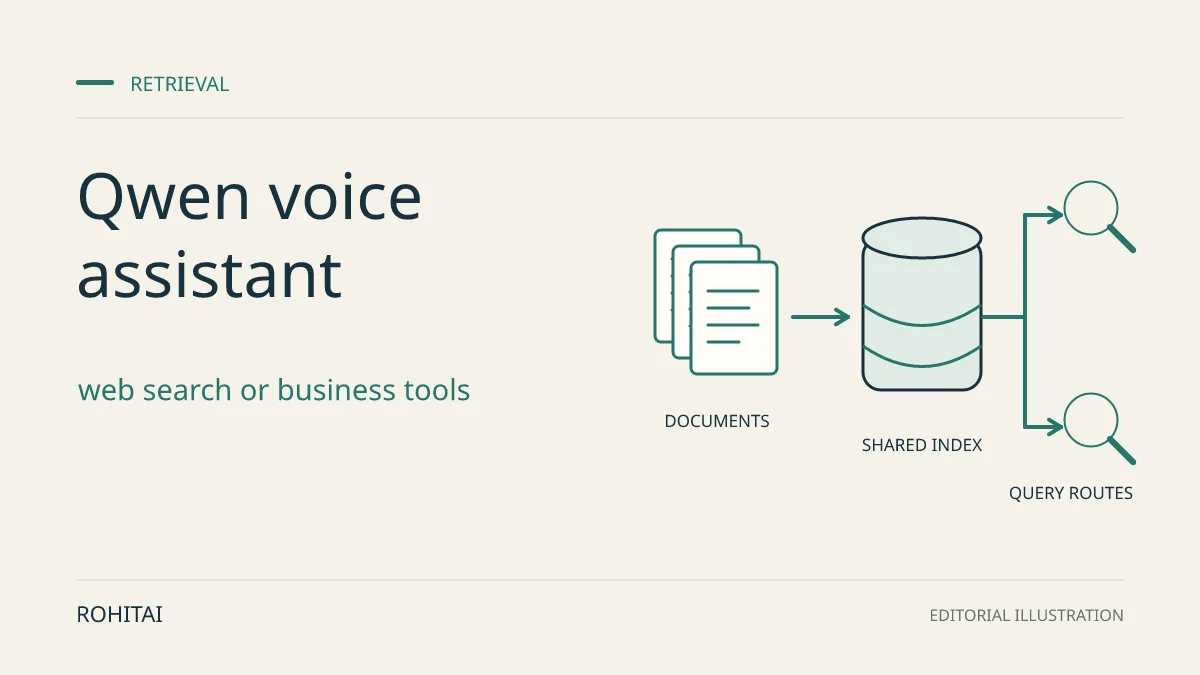
Businesses building a Qwen voice assistant cannot enable its built-in web search and business tools together. Alibaba Cloud documents this restriction in the Qwen-Audio-3.1-Realtime-Flash specification as of October 27, 2026.
That matters if, for example, a customer-service assistant needs to answer current public-information questions and check a private order record. Both may belong in one customer conversation, but combining them requires more application design than enabling two features.
Start with where the answer must come from
Function calling means the model asks your application to run a defined tool. The application executes it, returns the result and requests the model’s next response. Alibaba’s connection guide describes this division of responsibility; it is not a ready-made connection to your booking or order system.
Public information: Consider built-in search when the assistant needs current web information without configured business functions. Search is off by default; enabling it lets the model decide when to search, rather than forcing a fresh lookup for every answer. Returning source links is a separate option in the session settings.
Company records or actions: Use application-defined tools for tasks such as checking an authenticated customer’s order or changing an appointment. These are examples of functions your business would need to supply, not integrations included with the voice model.
Both in one customer journey: The design implication is to evaluate application-managed retrieval through your own tools, or separate workflows for different tasks. These are options to build and validate—not a documented switch that makes built-in search and function calling compatible.
For business tools, the practical recommendation is to enforce the caller’s permitted access, validate the requested details and obtain appropriate confirmation before changing a record. Report success only after the business system confirms it. Those controls belong in the application; understanding a spoken request does not establish authorization.
For related context on whose authority an assistant uses, see RohitAI’s coverage of identity and delegated access for workplace AI agents.
Conversation history is not a permanent customer record
Alibaba’s usage guide puts Flash’s retained audio history at a maximum of 50 turns or 300 cumulative seconds. Earlier history is discarded when either limit is exceeded. The configurable history-turn limit defaults to 20.
The 300 seconds describe audio retained for the model’s context—not a five-minute cutoff for the call. They do not establish a maximum connection duration.
For a booking assistant, a useful design is to keep the agreed date and confirmed booking result in an application record, then supply the necessary facts when needed. Do not rely on speech from early in a conversation remaining available throughout a long interaction or on a later call. This is a design recommendation, not an automatic memory feature.
Budget for retained context, not just new speech
For Qwen-Audio-3.1-Realtime-Flash in Singapore, Alibaba lists the following standard prices as of October 27, 2026. All amounts are US dollars per million tokens; Beijing has a separate rate card.
Content type | Input | Output |
|---|---|---|
Text | $0.23 | $0.70 |
Audio | $0.93 | $1.87 |
For a response containing both speech and text, only audio output is charged at that step. A text-only response uses the text-output rate, according to the model specification.
The less obvious cost is repeated input. Under Alibaba’s conversation billing rules, retained user audio and text are charged again as input on subsequent turns. Instructions incur text-input charges each turn, and earlier model text also becomes billable input. Generated audio is charged once as output, not again as historical audio input.
The practical tradeoff is that retaining more conversation can provide useful context while increasing input charges. Include retained history in a cost estimate instead of counting only newly spoken words. These token rates are not a flat per-minute or all-in call quote; telephony, hosting and any tool or retrieval charges need separate budgeting.
What to establish before committing
Alibaba lists Flash in Singapore and China (Beijing). Confirm account access and limits for the chosen region. Then evaluate the actual caller languages, corrections, tool failures and information that must survive after older audio leaves context.
A public-information assistant can start by evaluating built-in search. A service that reads or changes customer records needs business tools. If the same service needs both, settle how information will reach the assistant—and how important facts will be preserved—before committing to the integration.