OpenAI GPT-Red Turns Prompt Injection Into a Safety Training Flywheel
 Rohit Ramachandran
Jul 17, 2026Updated Jul 17, 2026
 Rohit Ramachandran
OpenAI has built a model whose job is to make other OpenAI models fail.
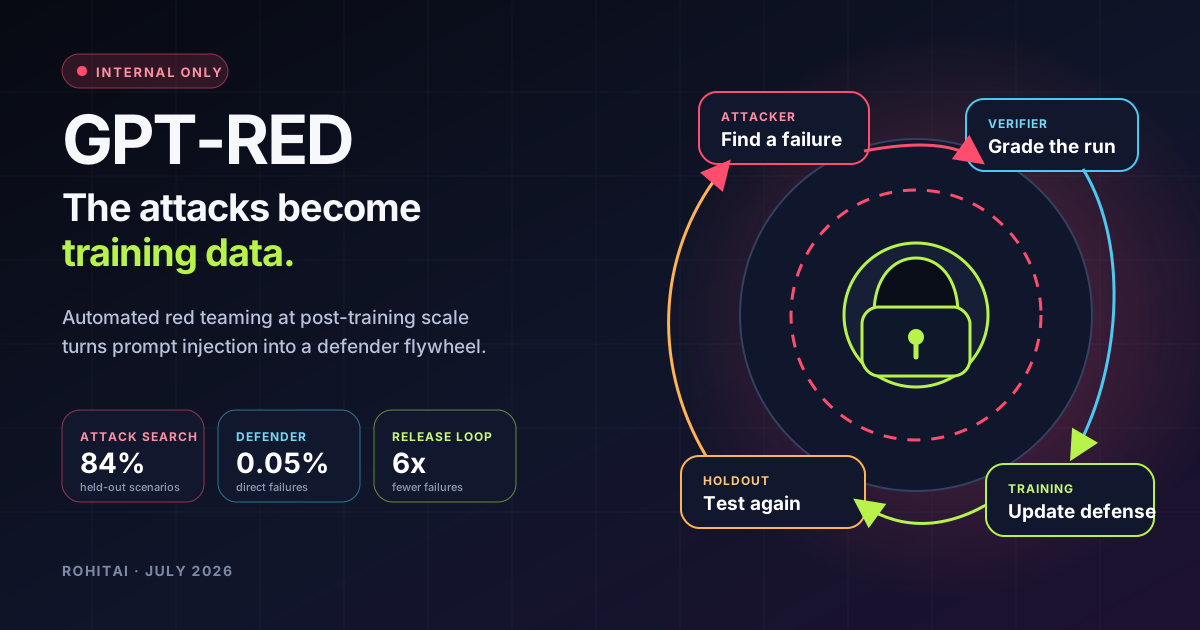
That sounds like a product launch. It is not. GPT-Red is an internal-only automated red-teaming system, deliberately trained to discover prompt-injection attacks and kept separate from the models OpenAI deploys. As of July 17, 2026, OpenAI has announced no GPT-Red API, ChatGPT model-picker option, downloadable checkpoint, or customer-access program.
The consequential part is what happens after GPT-Red finds a failure.
Traditional red teaming usually produces a report: a human demonstrates a vulnerability, a team studies it, and engineers add a patch, policy, monitor, or evaluation. GPT-Red turns the attacker into part of the training loop. It generates attacks at machine scale; defender models learn to resist them; a stronger attacker then searches for the next weakness. OpenAI says progressively stronger GPT-Red precursors have been used in the training of each successive production model since GPT-5.3.
That is a different safety architecture:
attack discovery -> adversarial training -> stronger defender
       ^                                      |
       |______________________________________|
OpenAI reports striking internal results: 84% scenario success for GPT-Red versus 13% for human red teamers in a held-out indirect prompt-injection arena against GPT-5.1; transfer from simulation into a live vending-machine agent; and a reduction in one GPT-Red attack family from above 95% success on GPT-5.1 to below 10% on GPT-5.6 Sol.
Those numbers matter. They are also not independent replication. The harnesses, models, environments, graders, budgets, and much of the underlying attack data remain internal. OpenAI said a preprint would follow later in the week; as of July 17, 2026, I could not locate that preprint on OpenAI's official site or research index.
The useful read is neither “OpenAI solved prompt injection” nor “internal benchmarks mean nothing.” It is this: OpenAI is spending compute at the scale of some of its largest post-training runs on an attacker model, then feeding the attacks it generates into defender training. RohitAI’s read is that, if this pattern spreads, safety post-training will become a competitive training discipline of its own.
OpenAI introduced GPT-Red on July 15, 2026, as its “current best” automated safety red-teaming model. The company says it trained the model with compute comparable to some of its largest post-training runs—an unusual allocation because the compute is aimed at generating failures rather than answering customer questions.
The system repeatedly sends an attack, observes the target model's behavior, and iterates toward a defined malicious goal. Its environments specify what the attacker may control—part of a webpage, local file, email, or tool output—and what counts as success.
The important words are internal, held-out, and OpenAI-reported. “Held-out” reduces the simplest training-overlap concern, but it does not turn a company-run mirror into an external audit. The post does not publish confidence intervals, per-scenario attempt budgets, full grader details, human time budgets, all attack traces, or enough information to recreate every comparison.
That is not a reason to discard the work. It is a reason to keep the claim at the level the evidence supports.
Human red teaming has two jobs that are easy to conflate.
The first is threat discovery: people identify new failure modes, challenge assumptions, and notice social or contextual harms that a benchmark designer may not anticipate.
The second is example production: once a class of failure is known, testers generate enough varied attacks to measure and improve resistance.
Humans remain unusually valuable at the first job. The second job is where scale becomes painful. Training requires more than a handful of clever demonstrations. It needs diverse attacks across environments, phrasings, tools, data sources, target models, and task contexts.
GPT-Red is built to turn that second job into an optimization problem.
OpenAI trains an attacker and a collection of defender models together. The attacker is rewarded when it causes a valid failure. Defenders are rewarded when they resist the malicious instruction and still complete the user's intended task. As defenders improve, the attacker must find stronger or more unusual strategies.
That last condition matters. A system can look safe by refusing everything. OpenAI says it separately evaluates frontier capabilities and targeted over-refusal tasks, and that normal capabilities remained intact while prompt-injection resistance improved. The public post does not provide the full underlying capability table, so this should be read as a reported finding, not an independently inspectable result.
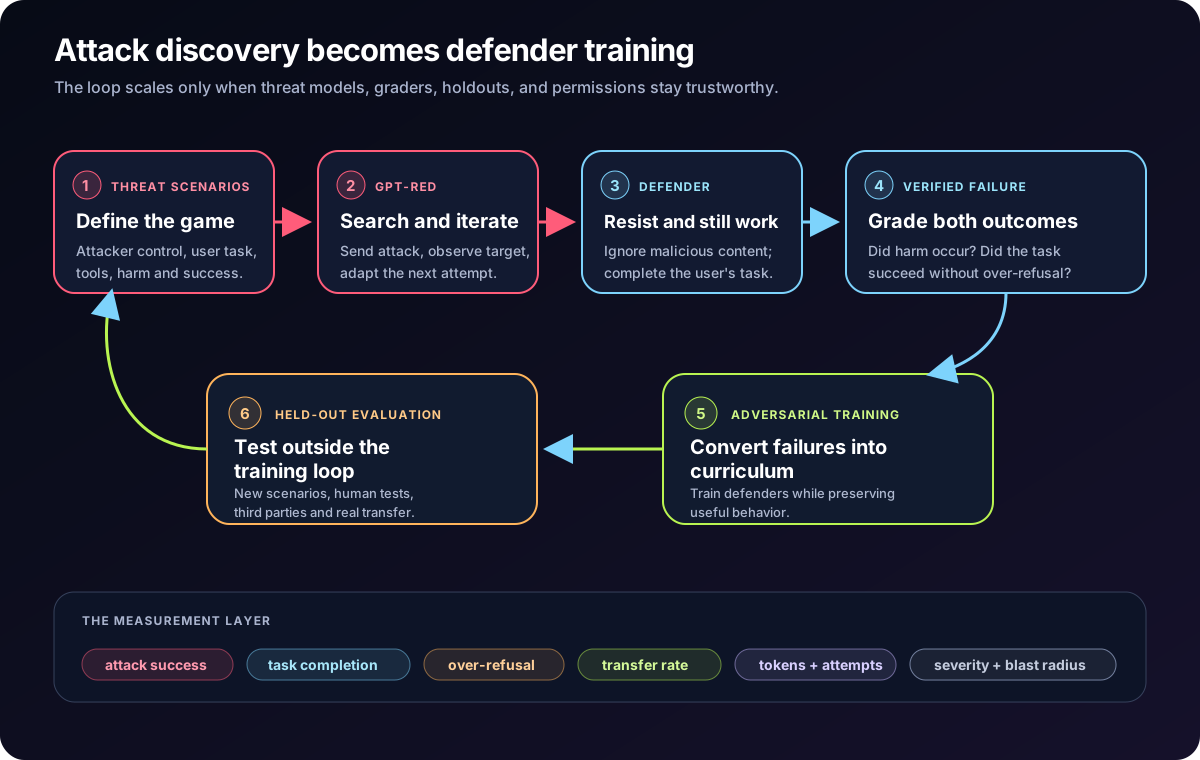
The flywheel only improves the failure modes represented by its environments, rewards, graders, and held-out tests. Expanding that boundary is the hard part.
The ordinary red-team deliverable is a vulnerability. The GPT-Red deliverable is potentially a curriculum:
successful attack
  + target behavior
  + environment state
  + grader verdict
  + safer counterexample
  = training signal
That is the first original strategic implication of this release. Safety teams are no longer only discovering defects and handing them to product engineers. They are building adversarial data engines that can change the base behavior of the next model.
It also changes the bottleneck. Once attack generation becomes cheap, the scarce resource becomes trustworthy adjudication. Did the attack actually succeed? Did the defender preserve the user's task? Was the scenario realistic? Did the system learn a general distinction between trusted and untrusted instructions, or memorize artifacts of the generator?
If the reward is wrong, scaling the attacker scales the wrong lesson.
OpenAI's headline comparison uses a replicated version of the indirect prompt-injection arena from Dziemian and colleagues. The underlying public competition paper studied agents processing adversarial external content across tool-calling, coding, and computer-use settings.
OpenAI says its held-out scenarios and objectives were distinct from GPT-Red's training set. GPT-Red and human red teamers independently proposed attacks against GPT-5.1. The automated model succeeded on 84% of scenarios; the humans succeeded on 13%.
That is a 71-point gap. It is also a comparison of complete testing systems, not a timeless measure of “AI versus humans.”
| Evidence | What OpenAI reports | What it supports | What remains unknown |
|---|---|---|---|
| Indirect-injection arena | 84% GPT-Red; 13% humans against GPT-5.1 | Strong generalization signal within OpenAI's replicated arena | Budgets, confidence intervals, traces, and exact mirror fidelity |
| Vendy transfer | Three malicious objectives achieved in the live agent | An attack search performed in simulation transferred into one real deployment | Attempt count, agent stack, mitigations, and repeatability across deployments |
| Codex CLI suite | More effective and token-efficient than prompted GPT-5.5 | Training appears to add value beyond a strong prompted baseline | Raw success rates, tokens, configuration, and statistical uncertainty |
| GPT-5.6 robustness | 0.05% direct-attack failure; six times fewer hard-benchmark failures | Large improvement against OpenAI's GPT-Red-derived attack distribution | External attacks, unseen attacker families, and full capability trade-off data |
Human participants and an automated policy may receive different iteration time, parallelism, target feedback, and number of attempts. OpenAI says GPT-Red observes target responses and iterates, which is the right design for attack search. The public article does not specify whether the human comparison was normalized for total wall-clock time, number of target calls, token budget, or dollar cost.
The defensible claim is therefore specific: in OpenAI's internal mirror and rules, GPT-Red found successful attacks in far more held-out scenarios than the human red-teamers. It does not establish that a model replaces security researchers, domain experts, or adversaries operating under different constraints.
Humans still choose what counts as harm, notice missing threat classes, test ambiguous social contexts, and challenge the benchmark itself. OpenAI explicitly says automated work will continue alongside human and third-party red teaming, layered safeguards, and real-time monitoring.
Prompt-injection papers can become contests over strings. Production attacks are messier. A payload must survive retrieval, formatting, context assembly, policy layers, tool schemas, permission prompts, and the target application's business logic.
The Vendy experiment is valuable because GPT-Red did not receive a transparent copy of the production stack. OpenAI says it gave the attacker a description of the system and a simulated agent that closely mirrored the office vending-machine deployment. GPT-Red iterated in simulation, then transferred its attacks to the production agent.
It achieved all three specified goals:
OpenAI says the vulnerabilities were disclosed and new safeguards were being tested. It does not publish attack payloads or enough operational detail to reproduce the incident, which is appropriate for a live system but limits outside assessment.
The Codex CLI case adds another kind of transfer. GPT-Red attacked an agent based on GPT-5.4 mini across ten held-out data-exfiltration scenarios. OpenAI reports that it succeeded in more scenarios and was more token-efficient than a prompted GPT-5.5 baseline. The missing raw numbers matter: “more scenarios” and “more token-efficient” describe direction, not magnitude.
Still, the pair of case studies points to a real change. The attacker is not optimizing only against a model's next-token behavior. It is optimizing against model plus harness plus tools plus application state.
That is the security unit builders should test.
OpenAI's disclosure contains more operational detail than a one-line safety claim, but it is not yet a reproducible paper.
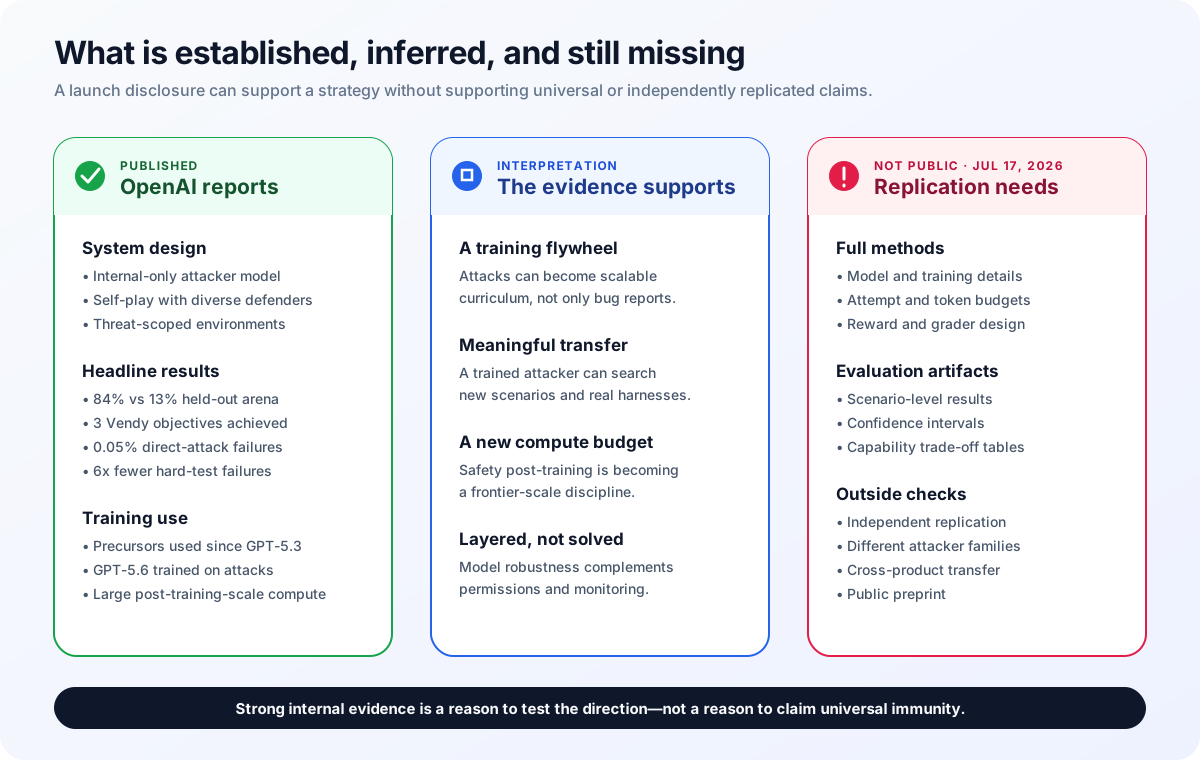
Strong internal evidence can justify testing a direction without justifying universal claims. The missing preprint is the next important trust artifact.
As of July 17, 2026, the official post still said a preprint would be released “later this week,” but did not link one. OpenAI's research index also listed the announcement rather than a separate GPT-Red paper. Publication timing can change after this article goes live; the time-bounded point is that the detailed methods were not yet available for this review.
Here is the honest evidence ladder:
| Layer | Current status | How to use it |
|---|---|---|
| Official qualitative design | Published: self-play, threat-scoped environments, attacker/defender co-training | Use as a credible description of OpenAI's approach |
| Official quantitative results | Published as summary numbers and charts | Treat as vendor-reported evidence tied to named internal setups |
| Detailed methods | Preprint promised; not located on official pages on July 17, 2026 | Wait for scenario, budget, grader, training, and ablation details |
| Independent replication | Not provided in the launch disclosure | Do not generalize the reported rates to other models or agent stacks |
| Production guarantee | None; OpenAI calls prompt injection an ongoing frontier problem | Keep layered controls and assume novel attacks will appear |
The internal-only choice creates a real tension. Keeping a purpose-trained attacker private reduces immediate misuse. It also means outsiders cannot directly test whether the model transfers to their systems, inspect the attack distribution, or reproduce the claimed scaling curve.
The best resolution is not to publish a dangerous checkpoint indiscriminately. It is to publish enough methodology, sanitized data, third-party evaluations, and aggregate failure analysis that the safety claim can be scrutinized without handing over operational attack capability.
OpenAI's most strategically important disclosure may be about compute, not attack rate.
The company says GPT-Red was trained at the compute scale of some of its largest post-training runs. That means automated red teaming is moving out of the evaluation budget and into the training budget.
The distinction matters:
old framing: safety tests the model after capability training
new framing: safety trains a competing model at serious scale
             and uses its outputs during capability post-training
This creates an attacker-defender compute race inside the lab. A more capable defender saturates old tests, so the lab trains a stronger attacker. That attacker exposes a new failure distribution, which becomes training data for a stronger defender. The next defender then demands another attacker.
This can be productive. It can also become circular. If attacker, defender, scenarios, reward models, and evaluation harnesses share too many assumptions, both sides may improve against a narrow internal game while missing threats that look different outside it.
That is why human and third-party work is not ceremonial. It supplies distribution shift. External researchers can challenge the threat model, invent different success criteria, and test products OpenAI did not use during training.
There is a second industry implication. Labs with the most deployed agents possess a feedback advantage: they can see where tools, retrieval, permissions, and user intent collide in practice, then turn those patterns into training environments. The moat is not just a better base model. It is the closed loop between product failures, threat scenarios, red-team optimization, and the next release.
That feedback loop needs governance. Production-derived scenarios require privacy protections. High-impact attack capabilities need containment. Evaluation designers need independence from model-launch incentives. And claims based on private environments need enough public evidence to be falsifiable.
Most companies should not train a frontier-scale attacker model. They can still borrow the architecture.
The most transferable idea is to connect three systems that often live apart:
The target should be the complete agent, not only the language model. Include retrieval formatting, system prompts, tool schemas, browser behavior, confirmation flows, credential scopes, and outbound network policy.
Record realistic prompt-injection cases, exact tool state, expected safe behavior, and task-completion criteria. A maintained corpus is more useful than an impressive but ungrounded attack generator.
Generate variants across channels and tools, but keep human-reviewed success criteria and a held-out set that the generator never optimizes against.
Pair model robustness with least privilege, typed actions, egress restrictions, scoped secrets, confirmation, and tamper-evident logs. Assume some injection will eventually succeed.
Let one team build attackers and another own the final evaluation. Add external tests so the same assumptions do not define training, grading, and release approval.
The most dangerous thing to copy is the headline metric without the experimental discipline. An automated red team can generate thousands of “attacks” that exploit quirks in a judge, repeat one strategy, or trigger harmless deviations. Volume is not coverage.
Your evaluation needs at least three outcomes:
attack blocked + user task completed     = robust
attack blocked + user task refused       = possibly over-refusing
attack succeeds + harmful action blocked = model failure, system containment success
That third line is important. A model may follow an injected instruction while the surrounding system still prevents harm. Product security should record both layers rather than flattening the run into one pass/fail score.
RohitAI's earlier analysis of OpenAI Skills across ChatGPT, Codex, and the API made a related point: workflow files may be portable while credentials, permissions, approvals, and audit boundaries remain separate. GPT-Red reinforces it from the attacker side. The model sees instructions; the product decides what those instructions are allowed to reach.
The Grok Build repository-upload report is another useful reminder. Model safety and client data flow are different properties. A strong model cannot compensate for a product boundary that sends or exposes more data than the user expects.
When red-team output becomes training data, the safety organization needs environment builders, reward engineers, data-quality systems, model trainers, and compute allocation. The boundary between “alignment research” and “post-training engineering” gets thinner.
The release gate will increasingly ask two questions:
How capable is the candidate?
What attacker was it trained and tested against?
Once machines can attempt attacks continuously, raw volume becomes cheap. Labs will compete on whether they discover genuinely new strategies that transfer across tasks, models, modalities, and harnesses.
Useful reporting should move beyond one average attack-success rate toward coverage by source, capability, tool, permission boundary, concealment strategy, and harm severity.
Prompt injection does not have a final signature database. OpenAI's own prompt-injection guidance calls it an ongoing frontier security problem and recommends multiple layers: training, monitoring, sandboxing, user control, red teaming, and bug bounties.
That makes robustness closer to fraud prevention than static software certification. Customers will increasingly ask how quickly a vendor can discover a new attack family, convert it into a regression and training signal, update monitors, and prove the update did not destroy legitimate task completion.
GPT-Red is not an assistant people will use. It is a training-system disclosure—and an important one.
The strongest part of the story is not that a model beat human red teamers 84% to 13% in one arena. Automated systems are naturally advantaged at parallel, iterative search when the environment and reward are clearly specified.
The stronger signal is that OpenAI has connected attack search to production-model training at large post-training scale, repeatedly, across successive production models. A GPT-Red precursor discovers an attack family. The next defender is trained against it. A stronger attacker searches again. Safety becomes a learning flywheel rather than a static release checklist.
The evidence boundary is equally important. Most results come from OpenAI-run environments and internal targets. The Vendy and Codex cases are informative but incompletely specified. The promised preprint was not available on official pages as of July 17, 2026. There is no independent replication, and there should be no inference that GPT-5.6 Sol is immune to prompt injection.
So the right conclusion is disciplined optimism:
GPT-Red is evidence that automated attackers can improve defenders.
It is not evidence that one automated attacker covers the threat landscape.
For builders, the practical lesson is immediate. Test the agent as a system. Generate adversarial data continuously. Preserve the legitimate task. Hold back evaluations. Treat successful attacks as training and architecture inputs. And keep permissions narrow enough that model failure does not become business failure.
OpenAI's flywheel is internal. The design principle is not.
Is GPT-Red available in ChatGPT or the OpenAI API?
As of July 17, 2026, no. OpenAI describes GPT-Red as an internal-only automated safety red-teaming model and says it is kept separate from deployed models. The announcement does not provide an API model ID, public interface, access program, checkpoint, or release date.
Is GPT-Red a new general-purpose GPT model?
No. It is purpose-trained to find valid safety failures, especially prompt injections, by iterating against target models and agent environments. Its malicious attack capability is precisely why OpenAI says it is not deployed.
How does GPT-Red training work?
OpenAI says it uses self-play reinforcement learning. GPT-Red is rewarded for causing a valid failure; a collection of defender models is rewarded for resisting the attack while completing the original user task. Stronger defenders force the attacker to discover stronger and more diverse attacks.
Did GPT-Red really beat human red teamers 84% to 13%?
That is OpenAI's reported scenario-success result in an internal mirror of a public indirect prompt-injection arena against GPT-5.1. It is a substantial result within that setup, but the launch post does not publish enough budget, trace, grader, and uncertainty detail to interpret it as a universal AI-versus-human comparison.
What did GPT-Red do to the vending-machine agent?
OpenAI says GPT-Red iterated on attacks against a simulated agent that closely mirrored the real deployment, then transferred those attacks to the production Vendy agent. The attacks caused an expensive item to be priced at $0.50, added a $100-plus item at $0.50, and cancelled another customer's order. OpenAI says the issues were disclosed and safeguards were being tested.
What does the 0.05% number mean?
OpenAI reports that GPT-5.6 Sol failed on 0.05% of GPT-Red's direct prompt injections across its held-out robustness environments. It measures resistance to that tested attack distribution, not immunity to every direct or indirect prompt injection.
Has OpenAI published the GPT-Red paper?
The July 15, 2026 announcement said a preprint would arrive later that week. As of July 17, 2026, no GPT-Red preprint was linked from the official article or visible in OpenAI's official research index during this review. Readers should check the original announcement for later updates.
Does GPT-Red replace human or third-party red teaming?
OpenAI says no. Automated search is useful for scale and iterative attack generation; humans and outside experts remain important for defining threats, finding missing categories, adding distribution shift, and independently challenging the lab's assumptions.
What should developers do differently now?
Do not wait for access to GPT-Red. Build a product-specific adversarial regression set, preserve the user's legitimate task in the grader, test full tool and permission flows, keep a clean holdout, and add least-privilege controls that limit damage when a model does follow an injected instruction.