NVIDIA Nemotron 3 Embed Makes Retrieval Part of Agent Economics

An AI agent can become expensive before its reasoning model has done anything useful.
A weak query retrieves a plausible but wrong passage. The agent spends tokens inspecting it, reformulates the query, searches again, and carries some of the earlier noise into the next turn. Teams often blame the model at the end of that chain. The first failure happened at the retrieval layer.
That is why NVIDIA's July 16 release of Nemotron 3 Embed matters beyond another embedding leaderboard. The family has an approximately 8B-parameter BF16 quality model, a 1.14B BF16 production model, and a 1.14B NVFP4 checkpoint for accelerated serving. The 8B checkpoint ranked first on the independently maintained RTEB beta leaderboard when this article was checked on July 17, 2026.
The useful thesis is not “NVIDIA won RTEB.” It is this: retrieval is becoming part of the agent's control plane. A better embedder can admit cleaner evidence, reduce repeated searches, shorten reasoning traces, and protect agent memory from plausible junk. In the right workload, paying more at retrieval can make the complete agent cheaper.
There is a catch. NVIDIA's end-to-end cost evidence is vendor-run, RTEB is still beta, and a leaderboard cannot choose your chunking, freshness rules, access controls, hybrid search, or memory policy. This release is a strong reason to test retrieval as a system—not permission to swap a model ID and declare the system fixed.
How to read the evidence
Three layers, three different confidence levels
MTEB's live RTEB rank, benchmark design, zero-shot annotation, and public benchmark-governance notes.
NVIDIA's benchmark tables, agent-cost chart, Blackwell throughput, NIM comparison, and NV Docs tuning result.
Retrieval as context admission control, reindexing as migration, and end-to-end agent economics.
NVIDIA released a family instead of one “best” checkpoint. That is the right shape for retrieval infrastructure because ranking quality, serving throughput, and index storage pull in different directions.
| Checkpoint | Parameters | Native vector | NVIDIA RTEB-16 | Practical role |
|---|---|---|---|---|
Nemotron-3-Embed-8B-BF16 | About 8B | 4,096 dimensions | 78.46 | Quality ceiling for precision-sensitive retrieval |
Nemotron-3-Embed-1B-BF16 | 1.14B | 2,048 dimensions | 72.38 | Production baseline when latency and cost matter |
Nemotron-3-Embed-1B-NVFP4 | 1.14B | 2,048 dimensions | 72.00 | vLLM-focused accelerated serving, especially on Blackwell |
The 8B model card describes a Ministral-3-8B-based causal decoder converted into a bidirectional encoder, then mean-pooled into one vector. Its disclosed training set exceeds 50 million samples.
The 1B BF16 model card describes a less obvious compression path. NVIDIA first made a 3B retriever, pruned it to a 2B intermediate model, distilled it from the 8B teacher, and repeated the pruning-and-distillation process to reach 1.14B. Its disclosed distillation mix contains more than 8.5 million samples. This is not merely the flagship with a few layers removed.
The NVFP4 checkpoint is a post-training-quantized derivative of the 1B BF16 model. NVIDIA quantized weights and activations in linear layers and applied quantization-aware distillation, mainly to recover long-input accuracy. It still outputs a 2,048-value floating-point vector.
The independent MTEB leaderboard ranked the 8B checkpoint first when checked on July 17. That confirms the launch position is not only an NVIDIA graphic. MTEB currently annotates the model as 76% zero-shot on RTEB, which is useful context: this is a strong generalization result, but not a clean “the model never saw related benchmark data” story.
The exact number requires another distinction. NVIDIA's model card reports 78.46 average NDCG@10 over 16 public RTEB tasks. The live RTEB benchmark is broader and changes over time. Do not silently treat the fixed 16-task vendor table, the live rank, and RTEB's public/private design as the same measurement.
RTEB itself remains beta. Its maintainers explain that the benchmark was built around legal, finance, healthcare, code, and multilingual retrieval, using NDCG@10 and a mix of open and private datasets. They also acknowledge that roughly half of the original retrieval datasets were repurposed from QA, which can reward lexical overlap more than genuine semantic understanding.
There is a governance footnote worth knowing. In January 2026, MTEB temporarily removed RTEB's private-score column because Voyage, a collaborator on RTEB, had access to the private data—a structural advantage even though the maintainers alleged no misuse. The private tasks remain available for requested evaluations, but the episode is a reminder that “private benchmark” does not automatically mean “unquestionably neutral benchmark.”
NVIDIA evaluated the models inside a search agent powered by Nemotron 3 Ultra. It varied the embedder and compared retrieval accuracy with estimated downstream agent-token cost across ViDoRe V3, BRIGHT, and BrowseComp-Plus. In NVIDIA's chart, the 8B retriever produced both the highest average retrieval accuracy and the lowest estimated downstream token cost.
That direction is plausible because a retrieval miss compounds:
weak query match
  → irrelevant evidence enters context
  → agent spends tokens judging or explaining it
  → another search and another tool round-trip
  → longer trace with more chances for drift
  → slower, costlier, less reliable completion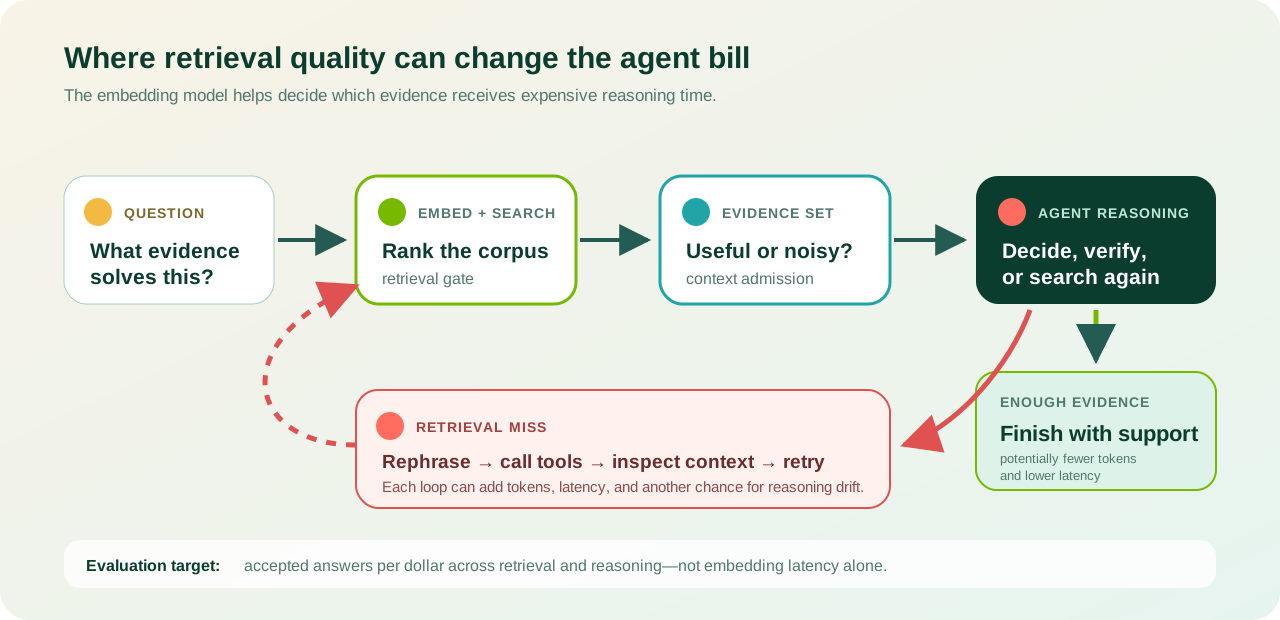
A retriever does more than fetch text. It decides which evidence is allowed to consume the agent's attention.
NVIDIA's earlier agentic retrieval work shows how large that bill can become. One ViDoRe V3 configuration with Claude Opus 4.5 averaged 136.3 seconds per query; NVIDIA calculated roughly 760,000 input tokens and 6,300 output tokens per query. Iterative search can improve difficult retrieval, but autonomy has a bill.
Nemotron 3 Embed points at a complementary strategy: make the first retrieval step better so the agent does not need to be heroic as often. That connects to RohitAI's earlier analysis of the GPT-5.6 agentic credit pool. The route begins before the reasoning-model call. It begins with what evidence enters the task.
The launch chart is not the last word. NVIDIA did not publish raw traces, per-dataset tables, confidence intervals, or an independent replication. The search agent used Nemotron 3 Ultra, and its “dollar” cost was calculated from those token counts using a GPT-5.5 pricing formula—not the actual price of serving Ultra. The 8B model card also names BRIGHT as a seed source for synthetic training data, while BRIGHT contributes to this agent-cost comparison.
Independent research adds a useful warning. A University of Massachusetts study on evaluating retrieval quality in RAG found only a small correlation between conventional query-document relevance labels and downstream RAG performance. Better NDCG is valuable; it is not a substitute for measuring whether the whole agent finishes correctly.
Calling this “RAG plumbing” undersells the role of an embedder in an agent. It is closer to an admission controller: the component that decides which pieces of the outside world cross into scarce reasoning context.
That framing produces four practical consequences.
Teams often try to repair poor evidence with a stronger LLM, a longer prompt, or another verifier. Those can help an agent notice a bad passage. They cannot make a missing passage appear.
The cheapest hallucination is the one prevented upstream. If the correct source arrives early and a deceptive near-match does not, the agent has less ambiguity to resolve. Better embeddings change more than answer relevance; they change the distribution of reasoning problems handed to the model.
LLM routing is comparatively easy: send one request to a small model and another to a large one. Embedding checkpoints create vector spaces. An index built with the 1B model cannot be assumed to accept 8B query vectors: the native dimensions and learned geometry differ. Moving between them usually means re-embedding the corpus or running parallel indexes.
The relationship between 1B BF16 and NVFP4 is therefore operationally important. NVIDIA says the two generally share an embedding space and may be used interchangeably after representative validation. If that holds on your data, precision can change without automatically triggering a full reindex.
Document vectors are often computed once and reused, while reasoning tokens are purchased again on every search turn. On a stable, frequently queried corpus, higher ingestion cost can be amortized while downstream savings repeat.
The correct unit is:
cost per accepted task =
  amortized corpus embedding
  + query embedding and vector search
  + lexical search and reranking
  + agent input/output tokens
  + retries, fallbacks, and human review
That is why a model with higher embedding latency can still win the system-level cost curve.
Agent memory makes the admission decision persistent. A bad web passage wastes one answer. A stale or contradictory “memory” can contaminate many future tasks. Better ranking helps, but it cannot replace write policy, provenance, deduplication, temporal weighting, permission checks, and deletion.
Shared AI memory is becoming a product layer. The retrieval model determines what gets recalled; governance determines what was allowed to become memory in the first place.
The release makes three cost planes easy to confuse.
| Cost plane | Main knob | What Nemotron 3 changes | What it does not change |
|---|---|---|---|
| Embedding compute | Checkpoint size and weight/activation precision | 8B vs 1B; BF16 vs NVFP4; vLLM or NIM serving | The number and precision of values stored in the vector database |
| Vector storage/search | Dimensions, stored-vector type, replicas, and index structure | Native 4,096 or 2,048 dimensions; local checkpoint slicing | The reasoning model's token consumption |
| Agent execution | Evidence quality, search turns, context size, and stop policy | Potentially fewer misses and retries | A guaranteed saving from leaderboard score alone |
At float32, a raw 4,096-dimensional vector is about 16KB; 2,048 dimensions is about 8KB; 1,024 dimensions is about 4KB. Across 100 million chunks, that is roughly 1.6TB, 800GB, or 400GB before index overhead, replicas, metadata, or backups.
The model cards say the 8B checkpoint can be sliced to 2,048 or 1,024 dimensions, while the 1B checkpoints can be sliced to 1,024 or 512. The sliced vector must be L2-normalized again. NVIDIA does not publish a full reduced-dimension quality table, so treat each slice as another model variant to evaluate.
There is also a deployment correction: the current NeMo Retriever Embedding NIM API reference says nvidia/nemotron-3-embed-1b accepts only its native 2,048 dimensions. Requests for 1,024 or 512 return an error. Local slicing capability does not imply that every serving API exposes it.
NVFP4 is a separate knob again. It compresses model weights and linear-layer activations; it does not turn the output into a four-bit vector. NVIDIA's NIM can return float, int8, uint8, binary, or unsigned-binary embeddings, but those output formats have their own accuracy and distance-metric implications. Binary output, for example, requires Hamming distance rather than cosine similarity.
All three cards document a maximum sequence length of 32,768 tokens. NVIDIA's launch chart also reports LongEmbed scores of 88.5 for 8B, 85.0 for 1B BF16, and 84.6 for NVFP4. That is meaningful evidence, not merely a configuration value.
It is still not evidence that a 30,000-token document should become one vector.
The LongEmbed paper describes two synthetic and four real-world tasks with dispersed target information and explicitly says long-context embedding still has substantial room for improvement. Meanwhile, NVIDIA's model-card RTEB, MMTEB, and ViDoRe tables used a 4,096-token sequence length. The 1B training description says its final stage expanded from 1,024 to 4,096 tokens with long-context data.
Mean pooling compresses all token states into one location in vector space. As a passage grows, topics, exceptions, names, and dates compete for that location. Independent work on late chunking starts from the same problem: shorter retrievable units preserve specificity, while long-context encoding can provide surrounding context before pooling.
A 32K window prevents truncation. It does not repeal information dilution.
For code, split around symbols, classes, file boundaries, and call relationships. For policy and legal material, preserve section hierarchy, effective dates, and jurisdiction. For memory, separate durable facts, decisions, preferences, and transient observations. A stronger embedder cannot rescue a corpus designed as arbitrary token windows.
Start here for precision-sensitive support, regulated knowledge, difficult code retrieval, or high-value research. It gives the family its strongest published retrieval result, but it also emits the largest vectors and carries the highest serving cost.
This is the cleanest general deployment starting point. It keeps the 32K interface and multilingual design, supports Transformers, Sentence Transformers, and vLLM, and makes quality-versus-cost comparisons easier.
Use it when accelerated vLLM serving matters, particularly on Blackwell. NVIDIA reports 99%+ BF16 score retention and up to 2x throughput, but those are vendor measurements and the checkpoint is runtime-version-sensitive.
My default order is 1B BF16, then 8B as the quality ceiling, then NVFP4 after the 1B retrieval behavior is understood. That separates three questions: Is this model family good on our data? How much does 8B buy? Can accelerated serving preserve the 1B result on our hardware?
Do not begin by embedding the entire corpus. Build a difficult, labeled slice first. A few hundred carefully selected queries with hard negatives can prevent a very expensive reindexing mistake.
The current docs use similar words for different interfaces. Treat the prompt contract as part of the model artifact.
| Interface | What to send | Retrieval labels |
|---|---|---|
| Transformers or offline vLLM | Prefix strings manually | query: and passage: |
vLLM /v2/embed | Send raw text; saved prompts are applied | input_type: query or document |
vLLM OpenAI-compatible /v1/embeddings | Prefix strings manually | query: and passage: |
NVIDIA NIM /v1/embeddings | Use the endpoint's input type | query or passage |
A missing or mismatched prefix can look like a model regression. Record the endpoint, prefix contract, tokenizer/runtime version, normalization, and vector dimension with every index.
For BF16 local use, the cards currently specify Transformers 5.2.0 or newer and Sentence Transformers 5.4.1 or newer. For NVFP4, NVIDIA tested vLLM 0.25.0 and two upstream containers, warns that vLLM 0.23.x and 0.24.x have known issues, and says other versions have not been explicitly validated. The documented RoPE warning about apply_yarn_scaling is expected; removing the field can break the intended long-context behavior.
All three checkpoints use OpenMDW 1.1, and NVIDIA labels them ready for commercial use. The license grants broad permission to use, modify, and distribute covered model materials, requires license and origin notices when redistributing, and contains a patent/copyright-litigation termination clause. Teams should still review third-party dependencies and their own use with counsel.
This openness matters more for retrieval than it first appears. A company's query-document pairs, failed searches, support escalations, code-review lookups, and memory corrections form a private feedback stream. Teams can mine hard negatives, generate domain queries, tune the 1B checkpoint, and keep the resulting system in their own infrastructure.
NVIDIA's current six-stage fine-tuning recipe covers synthetic data generation, preparation and hard-negative mining, fine-tuning, BEIR-style evaluation, export, and NIM or vLLM deployment. Its default profile is now explicitly wired to nvidia/Nemotron-3-Embed-1B-BF16.
In NVIDIA's NV Docs example, tuning lifted NDCG@10 from 56.7 to 63.3 and Recall@5 from 56.1 to 62.8. The 6.6-point absolute NDCG gain in one domain is slightly larger than the 6.08-point RTEB-16 gap between the untuned 1B and 8B checkpoints. That does not prove tuning always beats scale. It shows why the best production choice may be a tuned 1B model rather than an untuned leaderboard winner.
The adaptation path is not lightweight. NVIDIA's recipe calls for 80GB of GPU memory for fine-tuning, recommends 128GB of system RAM, and estimates about 50GB of disk. Synthetic-data generation also uses hosted LLM calls by default.
“Open” should remain precise. NVIDIA publishes weights, detailed model cards, selected dataset disclosures, and practical tuning and distillation recipes. It does not publish the exact full 50M-plus 8B training mixture, its ratios, or a complete end-to-end reproduction recipe. This is a strong open deployment and adaptation stack, not a perfectly reproducible training artifact.
Version the index as an artifact, not a database side effect. An embedding index without model, dimension, prompt, chunker, and corpus lineage is technical debt wearing a vector-database logo.
First, retriever selection will join model selection in agent architecture reviews. Teams will compare evidence quality, search-turn reduction, and context-token spend as one system.
Second, parallel indexes will become a deliberate premium feature. Some products will use a 1B index for ordinary traffic and an 8B index for high-stakes search. That costs storage and ingestion time, but unlike imaginary per-query routing between incompatible vector spaces, it is technically honest.
Third, precision portability will become a buying criterion. The 1B BF16/NVFP4 shared-space claim points toward a better migration path: validate in BF16, optimize serving later, and avoid a reindex when the evidence says it is safe.
Fourth, retrieval observability will become an agent SLO. Teams will set limits for exact-evidence rate, stale-source rate, unauthorized retrieval, search turns, and downstream tokens—not merely vector-search latency.
Finally, domain tuning will beat leaderboard tourism. The winning deployment may be a tuned 1B model that understands a company's own language, not the untuned 8B model with the highest public score.
Nemotron 3 Embed is a serious open-weight retrieval release. The live RTEB lead earns attention. The 1B variants make deployment credible. The combination of 32K input support, local dimension slicing, vLLM, a production NIM, NVFP4, and a real adaptation recipe gives builders more than a model-card trophy.
Its larger contribution is conceptual.
Agents do not reason over the world. They reason over the context their retrieval systems admit. When that context arrives late, noisy, stale, unauthorized, or incomplete, the agent pays in loops, tokens, latency, and mistakes.
NVIDIA has made the embedding model visible as part of that bill. The sensible response is not a leaderboard victory lap. It is a controlled test on your hardest queries, with the complete system measured from first search to accepted result.
What is NVIDIA Nemotron 3 Embed?
It is a family of open-weight text embedding models for multilingual retrieval, RAG, code search, agent memory, and agentic search. NVIDIA released an approximately 8B BF16 checkpoint plus 1.14B BF16 and NVFP4 checkpoints.
Is Nemotron 3 Embed commercially usable?
NVIDIA says yes. The checkpoints use OpenMDW 1.1. Teams should still review redistribution notices, the litigation-termination clause, third-party components, and their own use case.
Does the 32K context window mean I should embed 32K-token chunks?
No. It means the model can accept input up to that supported length. NVIDIA's principal model-card retrieval tables used 4,096 tokens, and one mean-pooled vector can lose specificity as a passage covers more topics. Test chunk lengths on your corpus.
Can I switch from 1B BF16 to NVFP4 without rebuilding the index?
Possibly. NVIDIA says the checkpoints generally share an embedding space and can be interchangeable, but explicitly recommends validation. Test mixed query/document precision on representative traffic before skipping a reindex.
Can the NIM return 1,024-dimensional Nemotron 3 vectors?
Not in the current API documentation. The local model card supports slicing and re-normalizing the 2,048-dimensional 1B output, but the Nemotron 3 Embed NIM currently accepts only 2,048 dimensions.
Does Nemotron 3 Embed replace a reranker or hybrid search?
Not automatically. Dense retrieval, lexical retrieval, metadata filters, reranking, and agentic query refinement solve different failure modes. Start with clean baselines and add complexity where error analysis justifies it.