Hugging Face Reachy Mini: The Open-Source Robot App Store Moment

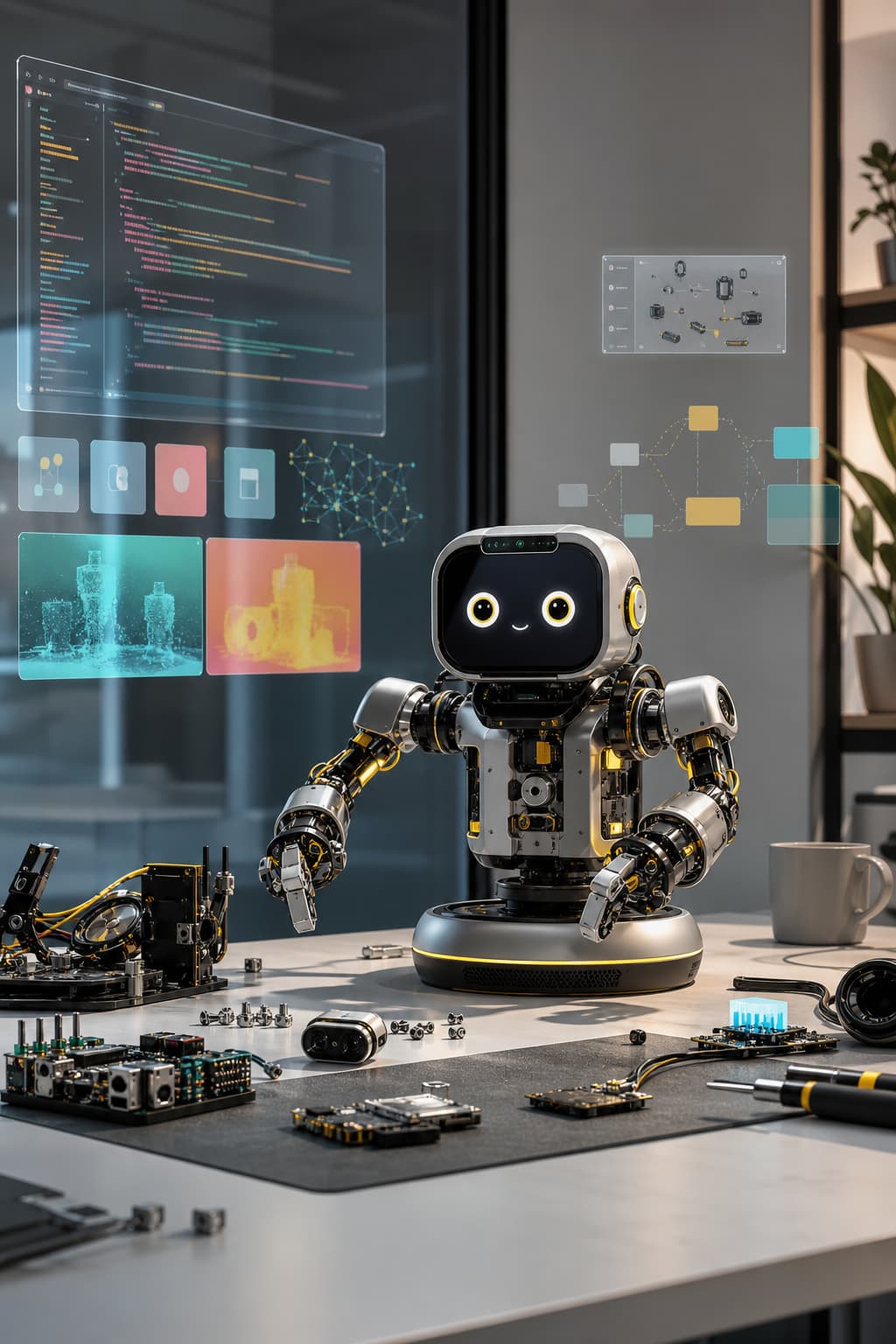
Hugging Face's most important robotics release is easy to underestimate because the hardware looks small, expressive, and almost toy-like.
That is the wrong read.
Reachy Mini is a desktop robot, yes. But the real story is not only the motors, camera, microphones, or price. The real story is that Hugging Face is trying to make robots feel more like software: searchable, forkable, programmable by agents, deployable from the Hub, testable in a simulator, and increasingly useful without sending every interaction to a cloud API.
The release that matters now is the broader Reachy Mini stack: the original open-source robot launch in 2025, the 2026 app-store rollout for nearly 10,000 units, the local speech stack, the media pipeline, MCP tool support, and the NVIDIA/DGX Spark demo path for heavier multimodal agents.
That combination is bigger than one gadget. It is a serious attempt to answer a question robotics has been stuck on for decades:
What if robots were not locked behind robotics expertise?
What if a normal AI builder could describe behavior, fork an app, run it in simulation, then push it to real hardware?
My take: Reachy Mini is not yet the iPhone of robotics. It is too early, too kit-like, and still too rough around setup, networking, security, and reliability. But it might be one of the clearest attempts so far at the robotics equivalent of the early web: open hardware, open code, public examples, community apps, and a low-friction path from idea to running behavior.
The foundation is Reachy Mini, announced by Hugging Face and Pollen Robotics on July 9, 2025. Hugging Face describes it as an expressive open-source robot for human-robot interaction, creative coding, and AI experimentation. It is meant to sit on a desk, be assembled as a kit, and act as a physical endpoint for AI apps.
The official post lists two versions:
| Version | Compute | Connectivity | Power | Sensors and interaction | Official launch price |
|---|---|---|---|---|---|
| Reachy Mini Lite | No onboard compute; compatible with Mac and Linux | No Wi-Fi | Wired | Camera, four microphones, speaker, 6-DoF head movement, body rotation, animated antennas | $399 plus taxes and shipping |
| Reachy Mini Wireless | Raspberry Pi 4 onboard compute | Wi-Fi | Wired and battery | Camera, four microphones, speaker, accelerometer, 6-DoF head movement, body rotation, animated antennas | $499 plus taxes and shipping |
The specs are not humanoid-robot specs. That is the point. Reachy Mini is intentionally small: roughly 28 cm tall, 16 cm wide, and about 1.5 kg. It is not built to fold laundry or unload a dishwasher. It is built to make embodied AI approachable from a desk.
That difference matters because most robotics demos fail the same way: impressive lab videos, expensive hardware, tiny developer ecosystem, difficult setup, and no obvious reason for normal builders to create apps. Hugging Face is attacking the opposite end of the market. Start with affordable hardware, make the software open, use the Hub as distribution, and let AI agents help non-roboticists write behaviors.
The 2026 update is where the story gets much more interesting. In May 2026, Hugging Face announced an agentic robotics app store and toolkit for Reachy Mini. The claim was not just that developers could code apps. It was that a user could describe desired behavior in plain English and have an AI agent write, test, ship, and iterate on the app.
Hugging Face said the community had already shipped more than 200 apps from 150+ creators, with another batch of almost 3,000 robots recently sent to customers and the install base approaching 10,000 units. That is still tiny compared with phones, PCs, or game consoles. But for open-source consumer robotics, it is meaningful scale.
The real launch is the platform
Reachy Mini is hardware, but Hugging Face is packaging it like a software ecosystem: repos, docs, apps, simulation, agents, Spaces, local models, and public examples. That is the part competitors should pay attention to.
Hugging Face has spent years making AI feel communal. Models live on the Hub. Datasets live on the Hub. Demos live in Spaces. Developers can clone, fork, fine-tune, benchmark, and remix.
Robotics has not worked that way.
Robotics is usually split into closed consumer products on one side and expensive research platforms on the other. The closed products are often polished but limited. The research platforms are powerful but expensive, fragile, and hard for non-specialists to use. The average AI developer can download a language model in minutes, but cannot download a working robot environment with the same ease.
Reachy Mini is Hugging Face's attempt to bring robotics into the Hub-native pattern:
model -> repo -> demo -> app -> simulation -> robot behavior
That is a powerful product idea because modern robotics is no longer just mechanical engineering. It is perception, speech, language, tool use, memory, safety, UX, deployment, networking, community distribution, and model choice. Hugging Face already has a natural home for several of those pieces.
The strategic move became clearer after Hugging Face acquired Pollen Robotics in 2025. Pollen already had open-source robotics DNA through Reachy. Hugging Face brought the AI builder community, the Hub, Spaces, inference tooling, model distribution, and the brand trust around open-source AI.
The result is not a robot company bolting on AI. It is an AI platform company trying to pull robotics into its existing software gravity.
The most important Reachy Mini announcement is the app store because app stores create ecosystems.
Hugging Face's version is deliberately not an Apple-style closed store. Apps live as open-source repos on the Hugging Face Hub. They can be searched, forked, installed, changed, and republished. Hugging Face says every app can also run in a browser simulator, which lowers the barrier for people who do not own the robot yet.
That simulator point matters more than it sounds. Hardware scarcity kills robotics communities. If only owners can experiment, the developer pool stays small. If anyone can open a simulator, fork an app, and test a behavior, the software ecosystem can grow faster than hardware shipments.
The examples Hugging Face listed are wonderfully weird in the right way: cooking assistant, language tutor, chess opponent that reacts emotionally, phone-distraction coach, kids' game host, F1 race commentator, coding teacher, home assistant, dance apps, video games, and even OpenClaw interfaces.
Those are not all serious business use cases. They do not need to be. Early platforms often grow through playful utility. The first wave teaches the community what is possible.
| Platform layer | Old robotics pattern | Reachy Mini pattern |
|---|---|---|
| Hardware | Expensive, specialized, lab-heavy | Small desktop kit, relatively affordable |
| Software | Custom code, scattered repos, steep setup | Hub repos, docs, simulator, one-click-ish install path |
| Creation | Robotics engineer writes behavior | AI agent can scaffold behavior from natural language |
| Distribution | Private demo, GitHub link, academic lab release | App catalog on Hugging Face Hub |
| Testing | Need physical robot | Browser simulator plus real hardware |
| Customization | Requires SDK knowledge | Fork app, prompt agent, edit repo |
This is why I keep coming back to the platform framing. Hugging Face is not just shipping a robot. It is trying to make the unit of robotics innovation smaller.
Instead of:
build a robot product
The unit becomes:
build a robot behavior
publish it
let others fork it
That is how you get compounding.
The obvious concern with a desk robot is privacy. It has microphones. It has a camera. It sits near people. It may be used around children, classrooms, or offices. That makes cloud-first design uncomfortable.
Hugging Face's May 27, 2026 local conversation stack is important because it directly addresses this. The post explains how to run a local speech backend for Reachy Mini using a cascaded VAD -> STT -> LLM -> TTS pipeline exposed through a Realtime API-compatible WebSocket.
The recommended stack in that post includes llama.cpp, Gemma 4, Silero VAD, Parakeet-TDT 0.6B v3 STT, and Qwen3-TTS. The larger point is not those exact models. The larger point is that the system is swappable. Local robotics should not depend on one vendor's cloud forever.
This is the right architecture direction. A robot in physical space needs clearer consent boundaries than a chatbot in a tab. If a user wants cloud models, fine. But the device should remain useful without quietly pushing all perception and speech through remote services.
Independent hands-on testing has already surfaced the tension. Jeff Geerling's 2026 Reachy Mini write-up praised the openness and the ability to control or flash the Raspberry Pi-based Wireless model, but also raised concerns about open-by-default APIs, web UI security, cloud connections, and setup roughness. That is useful criticism. Open robotics should not mean insecure robotics.
A serious Reachy Mini deployment should treat privacy and local network security as product requirements, not footnotes.
Robotics becomes interesting when the software can perceive the environment, not just speak a canned answer.
Hugging Face's June 10, 2026 media-stack post explains the audio and video architecture behind Reachy Mini. Both Lite and Wireless can be used locally or remotely, and Hugging Face wants the same code to work in every case.
The camera details are practical: the robot uses a Raspberry Pi Camera 3 Wide with a Sony IMX708 image sensor, 12 MP resolution, autofocus, and support for 1080p at 60 fps streaming. The value is not the camera spec alone. It is that AI apps can run on top of audio and video streams wherever the workload fits: on the robot, on a laptop, or on a GPU-backed Hugging Face Space.
That distributed execution model is the right abstraction for small robots. A tiny desktop robot should not be expected to run every heavy vision model locally. But it should be able to stream data responsibly, let the builder choose the compute target, and keep the app interface consistent.
Think of it as a robotics version of progressive enhancement:
basic behavior on-device
heavier model on laptop
specialized model in a Space
local privacy mode when needed
cloud acceleration when explicitly configured
That flexibility is what makes Reachy Mini more than a novelty.
The June 3, 2026 MCP tools update is one of the most builder-relevant pieces.
Reachy Mini's conversation app can now use tools hosted in public Hugging Face Spaces through MCP. That means a robot can gain abilities like checking weather or searching the web by adding a Space from the Hub rather than editing the local app code. Hugging Face's example shows adding a weather tool with one command and then asking the robot about the weather.
The architecture is simple but important:
Reachy Mini conversation app
        |
profile enables tools
        |
model decides when a tool helps
        |
tool runs locally or in a Space
        |
robot responds with voice and motion
This is where physical AI starts to look like normal agent development. The robot is not just a body. It becomes a tool-using agent with a face, voice, camera, and motion.
For builders, the interesting design question is not "Can the robot call a weather API?" That is trivial. The real question is how tool permissions, profiles, prompts, and user consent should work when the agent is embodied.
A browser agent making a bad API call is annoying. A robot with an always-on camera, local network access, and physical presence needs stricter defaults.
Reachy Mini is not limited to tiny local models. In January 2026, Hugging Face and NVIDIA showed a path where Reachy Mini becomes the physical endpoint for heavier agent systems.
The CES demo used NVIDIA DGX Spark, Nemotron reasoning models, a vision model, text-to-speech, and Reachy Mini hardware or simulation. The blog described local deployment, cloud deployment, and serverless endpoint options. It also noted substantial local storage requirements for the demo models: about 65 GB for the reasoning model and 28 GB for the vision model.
That is useful because it frames Reachy Mini as an endpoint, not the whole brain.
| Compute path | Best for | Tradeoff |
|---|---|---|
| On-robot compute | Simple behaviors, local control, lightweight voice UX | Limited model size and latency headroom |
| Laptop or desktop | Development, local privacy, moderate models | Depends on user hardware and setup skill |
| Local AI box / DGX Spark class | Heavy multimodal demos, private high-end inference | Expensive, power-hungry, enthusiast/enterprise skew |
| Hugging Face Space / cloud GPU | Specialized apps, shared demos, fast iteration | Needs network, consent, cost, and privacy boundaries |
This layered approach is probably how practical robotics will ship for the next few years. The robot handles embodiment and sensors. External compute handles heavier reasoning and perception. The product challenge is making that feel understandable rather than fragile.
Reachy Mini should not be compared only against humanoid robots. That makes it look weak in the wrong ways. It is better compared against developer platforms, educational robots, social robots, and simulation-first agent environments.
| Category | Example | What it optimizes for | Where Reachy Mini is different |
|---|---|---|---|
| Humanoid robotics | Figure, Tesla Optimus, Agility Digit | Physical labor, mobility, manipulation | Reachy Mini is not a labor robot; it is a desk-scale AI app platform |
| Research robots | Reachy 2, Franka-style arms, lab platforms | Advanced manipulation and research | Reachy Mini is cheaper, smaller, and more approachable |
| Educational robots | LEGO, micro:bit kits, classroom robots | STEM learning and classroom control | Reachy Mini adds modern AI, Hub distribution, voice, vision, and agent workflows |
| Social robots | Jibo-style products, companion devices | Personality and home interaction | Reachy Mini is more open and hackable, less appliance-like |
| Software agents | Browser agents, coding agents, local assistants | Digital tasks and tool use | Reachy Mini gives agents a body, camera, microphones, and physical presence |
The best mental model is this:
Reachy Mini is a Raspberry Pi-era robotics dev kit rebuilt for the LLM agent era.
That is not a small thing.
If you are an AI builder, the most interesting Reachy Mini projects are not "make it chat." Chat is table stakes. The interesting projects combine perception, tools, memory, and physical expression.
Good early use cases:
Bad early use cases:
That is not pessimism. It is the right level of respect for embodied systems.
Reachy Mini is exciting precisely because it is early. But early means rough edges.
The official launch post itself says the robot is in an early development phase and is shared as-is to gather feedback. Hands-on reports have noted setup issues, networking quirks, inconsistent app behavior across environments, and security concerns around local APIs. The hardware is a kit, not a sealed consumer appliance. The app ecosystem is new. Many apps will be experiments.
That is fine for builders. It is less fine for people expecting a polished home robot.
The other caveat is that open-source robotics still has supply-chain and support friction. A software project can scale by pushing commits. A robot has parts, shipping, customs, repairs, replacements, and manufacturing bottlenecks. Hugging Face can make the code forkable, but it cannot make physical logistics disappear.
The final caveat is safety. A small desktop robot is much safer than a full-size mobile manipulator, but microphones, cameras, local APIs, and cloud tools still create risk. Open platforms need good defaults because most users will not read every doc before running the fun demo.
My verdict
Reachy Mini is not a finished consumer robot category. It is a credible developer wedge into open-source robotics. The impressive part is not that it can talk or move. The impressive part is that Hugging Face is building the surrounding loop: apps, agents, simulation, local voice, MCP tools, media streams, and community distribution.
The bigger implication is that robotics may finally get its open-source flywheel.
Open-source software improves because people can inspect, run, change, and share it. Robotics has always had a harder time because hardware creates friction. Reachy Mini reduces that friction by keeping the robot small, making it relatively affordable, exposing the code, supporting simulation, and putting apps where developers already live.
If the platform works, the most interesting apps probably will not come from Hugging Face. They will come from teachers, hackers, parents, researchers, accessibility builders, office tinkerers, and small companies with specific needs.
That is the app-store lesson, but in a healthier open form.
The robot itself may or may not become a mass-market device. The architecture is the more durable idea:
open hardware
open software
agent-written behaviors
simulator-first development
Hub-native distribution
local-first privacy options
cloud tools when useful
community app ecosystem
That is a serious blueprint.
No. It is a small desktop robot designed for human-robot interaction, creative coding, education, and AI experimentation. It has expressive head/body movement, camera, microphones, speaker, and animated antennas, but it is not a walking or manipulation-focused humanoid.
Hugging Face's launch post lists Reachy Mini Lite at $399 and Reachy Mini Wireless at $499, plus taxes and shipping. Availability, regional costs, and shipping details can change, so check the official purchase page before buying.
Yes, Hugging Face published a local conversation path using a VAD -> STT -> LLM -> TTS cascade. The local setup requires more technical work and depends on your hardware, but it is important for privacy-sensitive use.
It is an open app ecosystem where Reachy Mini apps live as repositories on the Hugging Face Hub. Apps can be searched, forked, installed, tested in a browser simulator, and adapted with help from AI coding agents.
MCP lets the conversation app use external tools hosted in Hugging Face Spaces. That turns the robot from a closed local app into a tool-using agent that can gain new abilities, while still needing careful permission and security design.
Not in the polished-appliance sense. It is better understood as an early open-source robotics platform for builders, educators, hobbyists, and researchers who are comfortable with kits, setup, debugging, and fast-moving software.