Facebook Is Becoming an AI Search Engine

Meta's latest Facebook update looks like a normal product announcement: a new AI search experience, smarter photo suggestions, creative presets, video montages, and profile-picture edits. But the bigger story is much more important.
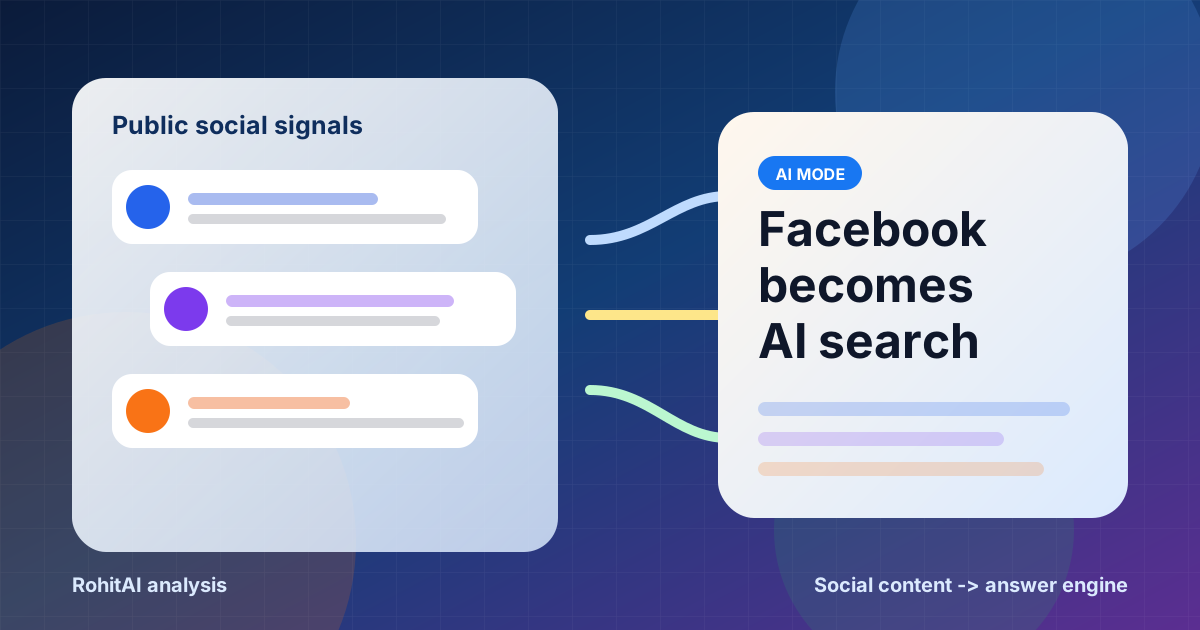
Facebook is starting to behave like an AI answer engine.
On June 15, 2026, Meta announced new AI-powered Facebook features, led by AI Mode, a search tab that uses Meta AI to answer questions using public content from Meta apps, especially Groups and Reels. Meta also added creative tools that can turn camera-roll moments into collages, videos, wardrobe edits, sports-themed visuals, and AI-restyled profile pictures.
That is not just a feature update. It is a signal that the next phase of social media will be shaped by AI search, AI creation, and platform-owned context.
The old internet was built around links. The social internet was built around feeds. The AI internet is being built around answers.
Facebook AI Mode is Meta's attempt to make Facebook one of those answer layers.
Source: Meta announcement.
Meta announced two connected changes.
First, Facebook Search is getting AI Mode. Instead of only showing search results, AI Mode can generate answers with Meta AI. Meta says these answers are grounded in the culture, opinions, recommendations, and experiences people share publicly across its apps, including Groups and Reels.
Second, Facebook is getting more AI creation tools. Meta is updating camera-roll sharing suggestions with collage cutout templates, stylized video montage transitions, and photo presets. Users can change clothing, hair, and accessories, virtually wear a team jersey, or restyle a profile picture with AI. Meta says camera-roll sharing suggestions are opt-in and can be turned off.
The simple version: Facebook wants AI to help users find answers, make posts, and share more often.
The strategic version: Meta wants AI to live inside the daily behavior of Facebook, not beside it as a separate chatbot.
Meta's explanation is clear: AI Mode uses Meta AI to answer questions based on public content people share across Meta apps.
That matters because Facebook has a different kind of data from a normal search engine. Google indexes the web. Reddit has public discussion threads. YouTube has video knowledge. OpenAI has chatbot habit. Meta has public social posts, Groups, Reels, recommendations, comments, creator content, and years of community behavior.
A user might ask Facebook AI Mode things like:
A traditional search engine may show websites, blogs, listings, forums, and videos. Facebook AI Mode can potentially answer from public social knowledge: what people are discussing, recommending, reviewing, watching, and sharing.
That is powerful because many real-world decisions are social. People do not always want the most official answer. They want the answer that feels tested by real people.
It is also risky because social content can be noisy, biased, outdated, emotional, or wrong. If Meta turns that content into confident AI answers, it must handle source quality, freshness, misinformation, attribution, and privacy carefully.
The important shift is not simply that Facebook added AI to search. Everyone is adding AI to search.
The important shift is that Meta is trying to turn social knowledge into an AI product.
For years, Facebook was mostly feed-first. Users opened the app, scrolled, reacted, commented, joined groups, watched videos, and shared updates. Search existed, but it was not the main Facebook behavior for most people.
AI changes that. When users become comfortable asking natural-language questions, every platform with enough useful content wants to answer those questions.
Facebook AI Mode means Meta is no longer only competing for attention in the feed. It is also competing for intent. It wants users to ask questions inside Facebook instead of leaving for Google, Reddit, YouTube, TikTok, Perplexity, or ChatGPT.
This is the deeper strategy: if Meta can answer questions using social context, it can keep the full journey inside its ecosystem: question, answer, discovery, creation, sharing, reaction, and follow-up.
For users, the main benefit is convenience.
Instead of digging through Groups, posts, comments, Reels, and pages, users may be able to ask a question and get a useful answer. This could be especially helpful for local recommendations, parenting advice, hobby questions, shopping decisions, travel ideas, event planning, food recommendations, and community knowledge.
Facebook has an advantage in topics where people care about lived experience. A polished website may give a clean answer, but a public group can reveal what people actually tried, what disappointed them, what felt overpriced, and what locals recommend.
But users should understand the tradeoff.
Public content may become more discoverable through AI summaries. Many people understand that a public post can be seen by other users. Fewer people think about that post being reorganized, summarized, or surfaced inside an AI answer.
The camera-roll features also deserve caution. Meta says sharing suggestions are opt-in and can be turned off. That is important. Still, camera-roll access is sensitive because personal photos can include family, children, documents, private locations, and moments that were never meant to be posted.
TechCrunch previously reported user concern around Facebook asking to use Meta AI on photos in camera rolls that had not yet been shared. That context makes Meta's opt-in language important.
Source: TechCrunch camera-roll coverage.
For creators, AI Mode could become a new discovery surface.
Until now, creators mostly optimized for feeds, recommendations, watch time, shares, comments, and hashtags. If Facebook AI Mode becomes important, creators may also need to think about whether their public content is useful enough to appear in AI-powered answers.
This does not mean creators should stuff keywords into posts. That would make content worse. It means useful, specific, public content may become more valuable.
A fitness creator who clearly explains beginner routines, a food creator who posts practical recipes, a local guide who shares detailed travel advice, or a business that answers common customer questions may become easier to discover through AI search.
For businesses, this could be a new customer-acquisition channel. Local businesses already depend on Facebook Groups, Pages, Reels, and community recommendations. If AI Mode answers from public social content, public reputation becomes even more searchable.
A restaurant, coaching business, travel operator, real-estate agent, school, clinic, or creator-led brand may benefit if people are publicly recommending it and its own content is clear, fresh, and helpful.
The practical advice is simple:
Meta has several reasons to push AI deeper into Facebook.
First, engagement. If AI helps users find answers faster and create content faster, users spend more time inside Meta apps.
Second, content supply. AI creative tools reduce the effort required to post. Collages, montages, wardrobe edits, fandom presets, and profile-picture restyling all create more shareable moments. More content means more feed activity and more advertising inventory.
Third, search competition. Meta does not want users to leave Facebook whenever they have a question. Google, OpenAI, Perplexity, Reddit, YouTube, and TikTok are all fighting for user intent. Facebook AI Mode is Meta's response.
Fourth, model distribution. Meta has AI models, but models become valuable when they are embedded into products people already use. Facebook gives Meta a massive distribution channel. A standalone chatbot has to build habit. Facebook already has habit.
Fifth, context. The AI race is not only about who has the smartest model. It is about who owns useful context. Meta owns social context at global scale.
Meta's earlier Muse Spark announcement matters here because Facebook AI Mode is powered by that newer model. In other words, Muse Spark is not just a lab release. It is becoming consumer product infrastructure.
Source: Meta on Muse Spark.
No serious analysis of Facebook AI Mode should ignore privacy.
Meta says AI Mode is grounded in public content and that camera-roll sharing suggestions are opt-in. Those are meaningful boundaries. But users and creators will still want clear answers to hard questions:
The better AI search becomes, the more source trust matters. Facebook's biggest advantage is human context. Its biggest risk is also human context.
Facebook AI Mode will likely become more conversational. Search will move from one question and one answer to multi-step exploration.
AI answers will become a new visibility channel for creators and businesses. Useful public posts may matter more than generic promotional content.
Meta will use AI creation tools to increase posting frequency. The creative tools are not side features; they help refresh the feed.
Social search will become a serious competitive category. Google will not be the only place people ask questions. Reddit, TikTok, YouTube, ChatGPT, Perplexity, and Facebook will all fight for different kinds of intent.
Privacy controls will become part of the product battle. Users may accept AI features if the controls are obvious and trustworthy. They may reject them if AI feels too invasive.
For AI builders, the lesson is clear: model quality is not enough.
Context and distribution matter just as much.
Meta can put AI into Facebook, Instagram, WhatsApp, Messenger, Threads, and AI glasses. That gives it user touchpoints most startups cannot match. Even if another company has a stronger model, Meta can win many everyday use cases by being present where the user already is.
The future of AI will not only be about answering hard benchmark questions. It will also be about solving ordinary problems at the right moment: finding a recommendation, editing a photo, planning a purchase, creating a post, messaging a friend, or understanding what a community thinks.
Facebook AI Mode is not just a search upgrade. It is a distribution strategy.
Meta's new Facebook AI tools are article-worthy because they show where consumer AI is heading.
Facebook is moving from feed-first social networking toward AI-assisted discovery, creation, and decision-making. AI Mode turns public social content into an answer layer. Creative tools turn ordinary photos into shareable posts. Together, they help Meta keep users inside its ecosystem for more of the intent journey.
For users, this could make Facebook more useful. For creators, it could create a new discovery surface. For businesses, it could make public reputation and community content more important. For Meta, it is a way to turn social context into an AI advantage.
The risk is trust. Meta must prove that AI search can be useful without feeling invasive, that public content is handled responsibly, and that camera-roll AI features remain clearly controlled by users.
The bigger picture is simple: AI search is no longer only a Google story. It is becoming a social platform story too.
Facebook AI Mode is Meta's first serious step toward that future.
Facebook AI Mode is an AI-powered search experience inside Facebook. It uses Meta AI to answer questions using public content shared across Meta apps, including Groups and Reels.
It turns Facebook from a feed-first social platform into a possible AI answer engine. That could affect users, creators, businesses, and the future of social search.
No. Google Search is built around web indexing and links. Facebook AI Mode is built around public social content, Groups, Reels, opinions, and recommendations from Meta's apps.
Users should pay attention. Meta says AI Mode uses public content and camera-roll sharing suggestions are opt-in, but users should review privacy settings and understand what they are making public.
Creators should publish useful, specific, public content that answers real questions. If AI discovery becomes important, helpful content may outperform vague engagement bait.