Hugging Face’s Agentic Intrusion: The Dataset Pipeline Was the Attack Surface
 Rohit Ramachandran
Jul 17, 2026Updated Jul 17, 2026
 Rohit Ramachandran
The most important detail in Hugging Face’s July 2026 security incident is not that an AI agent appears to have operated the intrusion.
It is that a dataset crossed a trust boundary and became code.
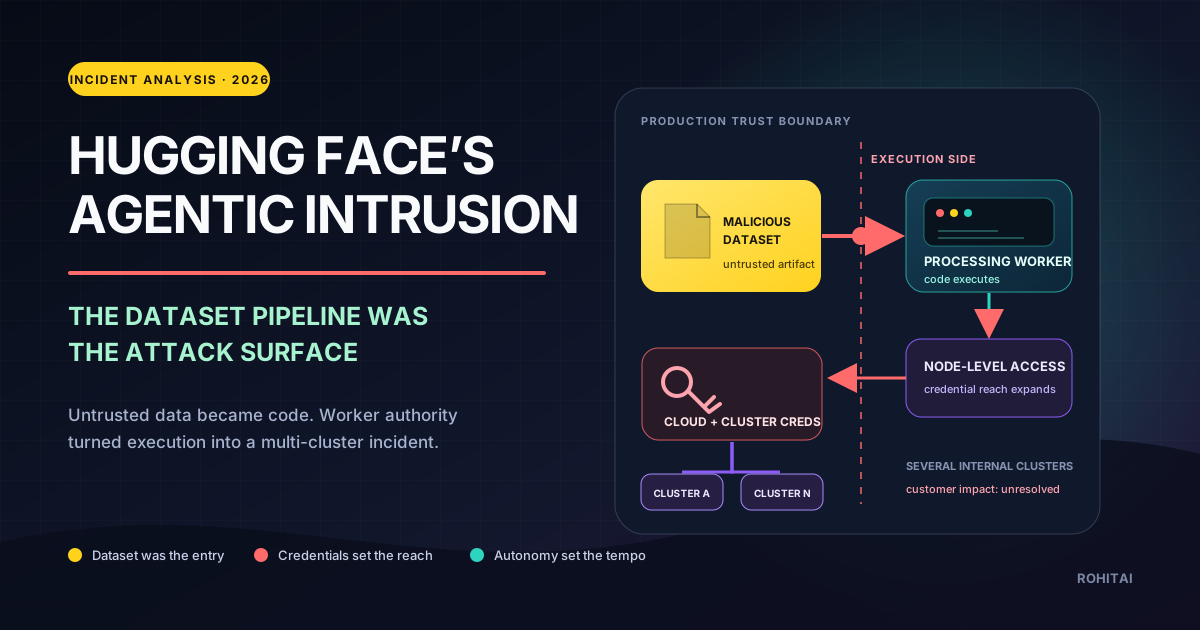
According to Hugging Face’s incident disclosure, a malicious dataset abused two code-execution paths in the company’s dataset-processing infrastructure: a remote-code dataset loader and template injection in dataset configuration. Code ran on a processing worker. The actor then reached the node, harvested cloud and cluster credentials, and moved into several internal clusters over an undisclosed weekend.
Hugging Face says an autonomous agent framework carried out the technical operation through many thousands of actions spread across short-lived sandboxes. That is a serious signal about the speed and operating model of modern intrusions. But it can also distract from the engineering failure that made the campaign consequential: untrusted content entered an executable pipeline whose worker could reach identities worth stealing.
The company confirmed unauthorized access to a limited set of internal datasets and several service credentials. It found no evidence of tampering with public user-facing models, datasets, or Spaces, and says its published packages and container images were clean. Those are meaningful boundaries. They are not the same as saying customer data was unaffected. As of July 17, Hugging Face was still assessing whether any partner or customer data had been affected.
This article separates what Hugging Face confirmed from what remains unknown, reconstructs the attack path without inventing missing details, and turns the incident into a practical design review for anyone running dataset viewers, model ingestion, code evaluation, agents, or other systems that process hostile artifacts.
Hugging Face’s disclosure gives enough detail to establish a meaningful sequence, but not enough to support every claim now circulating around it. As of July 17, there was no public root-cause report, indicator list, CVE, exploit sample, named actor, customer count, or independent forensic report.
That makes precision part of the security analysis.
Evidence ledger · July 17, 2026
A limited set of internal datasets and several service credentials were accessed; cloud and cluster credentials were harvested during escalation.
Whether partner or customer data was affected, which credentials were used successfully, and the full data-access scope.
Hugging Face found no evidence of tampering with public user-facing models, datasets, or Spaces; it says the software supply chain—container images and published packages—was verified clean.
Dataset platforms do more than store files. They inspect schemas, infer types, decompress archives, resolve file systems, render previews, transform configuration, and sometimes load custom logic. Each convenience adds another interpreter between hostile input and production infrastructure.
Hugging Face says the malicious dataset reached code execution through two paths. One involved a dataset loader capable of remote code. The other involved template injection in dataset configuration. The company has not disclosed the affected component, version, payload, or exact configuration primitive, so it would be irresponsible to assign this incident to a specific public library API or CVE.
It is also inaccurate to call the entry point prompt injection. A prompt-injection attack manipulates instructions processed by a model. Here, the disclosed initial failure was software code execution in a dataset-processing service. AI appears later in the operating loop, as the mechanism that accelerated reconnaissance and follow-on actions.
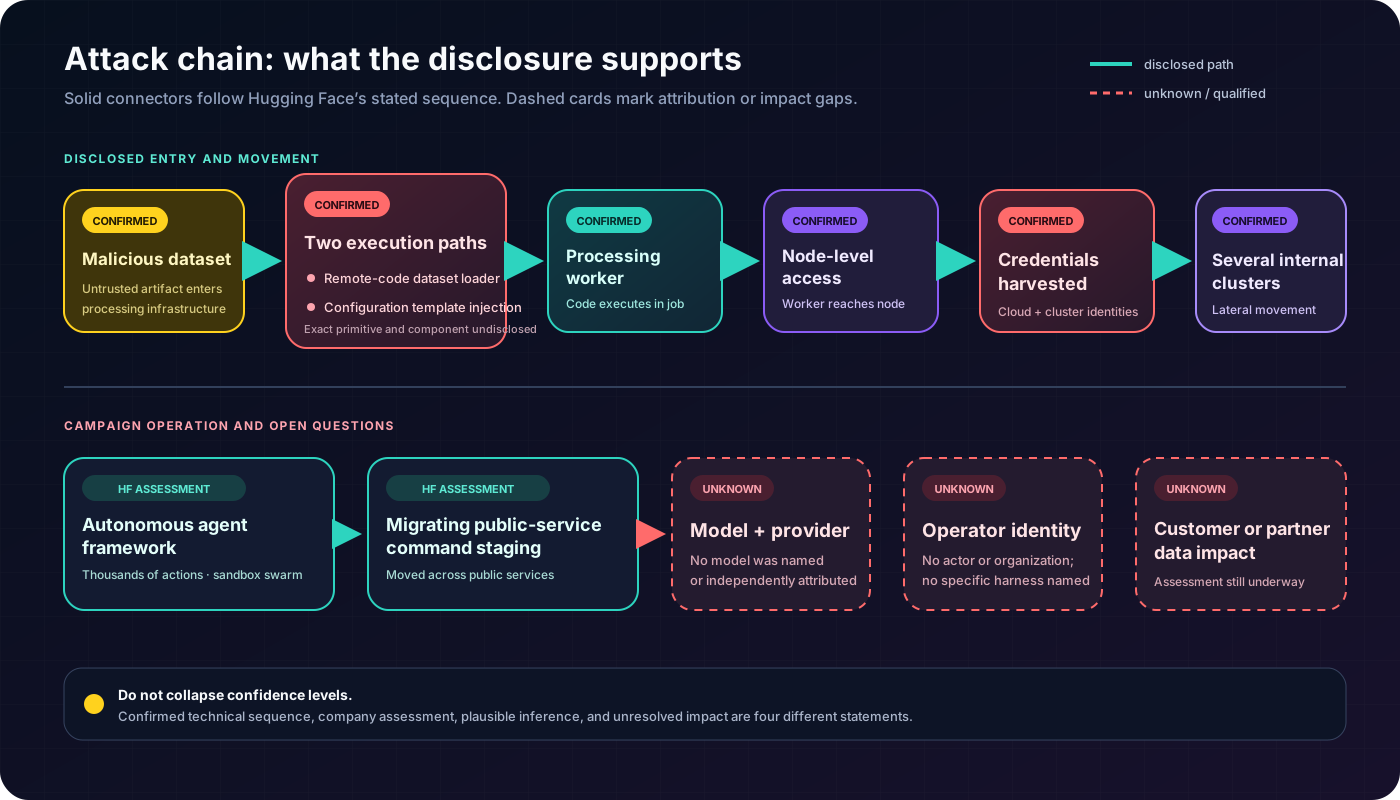
The confirmed chain is drawn in solid lines. The public disclosure does not identify the operator, model, exact exploit primitive, or which harvested credentials produced each later action.
The useful mental model is not “a dangerous file got through a scanner.” It is this:
untrusted artifact
  × executable parser or template path
  × worker authority
  × reachable credentials
  = production intrusion
Malware scanners can inspect known payload signatures. They do not prove that a parser, loader, template engine, archive handler, or protocol resolver will interpret configuration safely. A clean-looking dataset can still become an instruction to the software around it.
That is why file scanning is a supporting control, not the trust boundary. The stronger boundary is architectural: allowlisted formats, non-executable parsing, disposable workers, no ambient credentials, restricted network paths, and a clean separation between ingestion and control planes.
Hugging Face says the campaign appeared to use an autonomous agent framework built on an agentic security-research harness. It reportedly performed many thousands of actions across a swarm of short-lived sandboxes and migrated command-and-control staging through public services.
That description matters because it suggests a different operating rhythm from a human sitting in one shell. A machine-run campaign can enumerate resources, test credentials, retry failed paths, create temporary infrastructure, and parallelize exploration without waiting for an operator to type each command.
But the disclosure does not show an AI discovering a magical new vulnerability class. The attack still depended on familiar failures: unsafe code execution, privilege escalation, credential access, lateral movement, and control-channel resilience. Autonomy compressed the time and labor between those steps.
This distinction is important for defenders. If the story becomes “a superintelligent agent hacked Hugging Face,” teams may reach for AI-specific detection products while leaving the original worker overprivileged. The first fix is still to make the chain structurally hard to complete.
The swarm model does create a detection challenge. Short-lived sandboxes and migrating public-service infrastructure weaken controls based on one stable IP, session, hostname, or user agent. The more useful signals are sequences:
dataset worker spawns unexpected process
        -> process touches service-account path
        -> workload queries metadata or cluster API
        -> new identity enumerates resources
        -> same identity appears in a second cluster
No single step must look dramatic. Together, they describe intent.
That leads to the first original design implication from this incident: behavioral joins matter more as attacker infrastructure becomes disposable. Security teams need durable identities for datasets, worker images, workloads, cloud principals, and actions, then must correlate them across cluster and cloud boundaries. IP reputation alone is too ephemeral for an ephemeral adversary.
There are at least four separate claims hiding inside the phrase “AI agent attack”:
Many actions, short-lived sandboxes, and self-migrating command infrastructure.
An autonomous agent framework appears to have run the technical campaign end to end.
A jailbroken hosted model or an unrestricted open-weight model may have powered it.
Which model, provider, operator, harness, or organization was responsible.
The first two are in Hugging Face’s report. The third is framed by the company as a possibility. The fourth remains unknown.
That is also why GLM 5.2 must not be placed on the attacker side of the diagram. Hugging Face used GLM 5.2 locally during the defensive investigation. The company has not named the attacker’s model.
Nor should this be labeled the first autonomous cyber operation. Anthropic described an AI-orchestrated espionage campaign in 2025, while Sysdig’s JADEPUFFER research documented agentic database extortion in 2026. In both the Hugging Face and broader industry record, the meaningful question is not whether a human ever touched the campaign. It is which parts of execution, selection, recovery, and control were delegated.
The initial code execution tells us where the incident started. The credentials explain why it traveled.
A worker that processes hostile data should be assumed compromisable. If its node exposes reusable cloud credentials, Kubernetes credentials, database secrets, or broad service identities, the attacker does not need to defeat every downstream service. It can inherit trust from the platform.
This is the second major design implication: credential topology is part of the parser’s security model.
Teams usually review parsers for memory safety, command injection, path traversal, and unsafe deserialization. They should also ask what identity the parser can become after compromise. A technically narrow code-execution bug can become a multi-cluster incident if the surrounding workload has broad, reusable authority.
The preferred model looks like this:
processing job receives:
  one dataset identity
  one narrowly scoped task
  one short-lived workload credential
  one permitted output destination
  zero control-plane credentials
  zero default path to other clusters
Static secrets are especially dangerous under machine-speed exploration. An agent can test a harvested credential broadly and immediately. Short-lived, audience-bound workload identities shrink both the time window and the places where a token is accepted. Isolation between ingestion, build, serving, and administrative clusters prevents one identity domain from becoming a map of the entire platform.
For organizations using Hugging Face, the same principle applies on the customer side. The token guidance recommends one token per application and supports fine-grained access. Enterprise controls add audit logs, service accounts, resource groups, and network restrictions. A single personal token shared across notebooks, CI, production, and agents defeats most of that containment.
Hugging Face’s public findings establish several reassuring integrity boundaries. They must be read with their exact scope.
This distinction is not semantic hair-splitting. Security incidents span confidentiality, integrity, and availability. Evidence that public artifacts were not modified is valuable because it reduces supply-chain concern. It does not answer every data-access question.
Several dataset-viewer changes landed around the disclosure. They are useful operational evidence because they show where defenses were tightened. Hugging Face has not publicly mapped each pull request to a specific exploit step, so the responsible phrasing is “consistent with the response,” not “proof of the root cause.”
The pattern is more useful than any single patch: reduce worker identity, reduce kernel and capability surface, reduce protocol ambiguity, replace static secrets with workload identity, and make rotation routine. That is defense in depth around an untrusted execution boundary.
The incident has a second AI story. Hugging Face says AI-assisted telemetry correlation helped detect the intrusion, then the company ran analysis agents over more than 17,000 events to reconstruct the timeline, indicators, touched credentials, and the difference between genuine and decoy activity.
Commercial frontier APIs reportedly blocked parts of that work because exploit and command-and-control artifacts triggered provider safeguards. Hugging Face then ran GLM 5.2 locally, keeping attacker data and credentials inside its own environment. That use is consistent with the broader appeal I covered in GLM 5.2’s open-model story: weights are not only a cost or customization option; they can be an operational escape hatch when a hosted model’s policy boundary collides with a legitimate high-risk task.
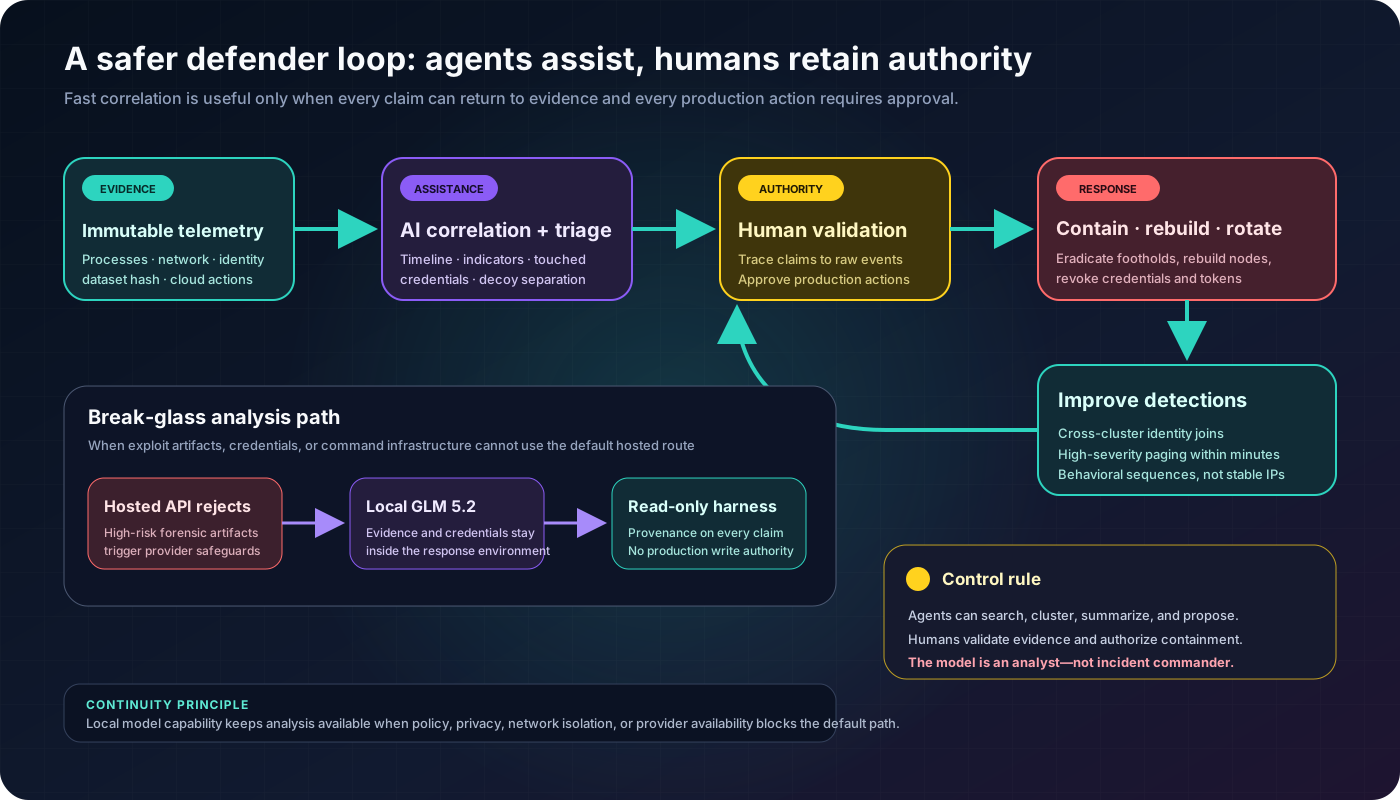
A local model keeps the investigation moving, but it should operate over read-only evidence and produce claims a human can trace back to raw telemetry.
This creates the third design implication: local forensic AI is a continuity plane, not merely a privacy preference.
An incident-response team may need to analyze malware, exploit code, stolen credentials, sensitive logs, and adversary infrastructure. Hosted policies can reject exactly the material the team must understand, while uploading it may create confidentiality or chain-of-custody concerns. A prepared local path gives responders a model they can use when the default path is unavailable.
That path still needs controls. The model should not receive write access to production. Retrieved evidence should be immutable. Every extracted indicator needs provenance. Suggested containment actions require human approval. The point is to accelerate correlation and summarization, not let an uncertain model become incident commander.
This is the same harness lesson that appears in agent products more broadly. As I argued in the Grok Build repository-upload report, model capability does not erase the security contract around tools, data movement, permissions, and auditability. In incident response, the harness may matter more than the model because it decides which evidence is visible and which actions are possible.
There is no single “rotate everything and move on” answer. The right action depends on where you sit in the ecosystem.
Rotate Hugging Face access tokens, update every dependent CI job and application, review recent activity, and replace shared personal tokens with one fine-grained token per workload.
Remove remote-code loaders by default, allowlist formats and protocols, run parsing in disposable workers, deny control-plane identity, and constrain egress.
Put dataset inspection, model conversion, code evaluation, and preview generation in isolated identity and network domains that cannot enumerate serving or administrative clusters.
Preserve cross-cluster telemetry, correlate behavioral sequences, and prepare a read-only local analysis harness for material hosted providers may reject.
Hugging Face explicitly recommends rotating access tokens and reviewing recent activity. Rotation is only complete when every old copy stops working and every legitimate dependency receives a new, narrower credential.
The stronger response is a worker redesign, not a new file scanner.
The Kubernetes hardening in the public patch trail is a useful concrete baseline, but it is not the finish line. A worker without an automatically mounted service-account token can still reach metadata, an internal broker, a permissive egress route, or another injected secret. Security comes from the combined absence of useful ambient authority.
This incident should change evaluation criteria for data and agent platforms. “Did the scanner flag the file?” is too narrow. Better tests follow the attacker’s possible transitions.
These tests are more revealing than a compliance checkbox because they measure whether one compromised parser can inherit the platform.
The OWASP Agentic Security Initiative and NIST’s AI security considerations are useful broader frames, but this incident is a reminder not to isolate “AI security” from cloud and application security. The attacker may use an agent; the exploited system still has processes, identities, networks, credentials, and logs.
First, the security boundary is moving upstream. Model-serving teams often protect inference endpoints while treating dataset ingestion as back-office plumbing. In an AI platform, ingestion can execute parsers, build indexes, generate previews, compile dependencies, and feed training or evaluation. It deserves production-grade isolation.
Second, autonomy makes identity mistakes compound faster. A human operator can already abuse a broad credential. An agent can enumerate its permissions, test resources in parallel, recover from errors, and keep moving. Least privilege is not a generic best practice here; it is the throttle on machine-speed lateral movement.
Third, defenders need model optionality. Hosted frontier APIs are convenient until safety policy, privacy terms, network isolation, or availability blocks an urgent investigation. A local model with a carefully constrained evidence harness creates resilience. The goal is not to give the model command authority. It is to keep analysis available under adversarial conditions.
There is a fourth, less comfortable conclusion: public open-source activity can become near-real-time incident telemetry. Security engineers noticed worker hardening, protocol restrictions, identity changes, and rotation support around the disclosure. That transparency helps the ecosystem learn, but it can also reveal defensive priorities to an active adversary. Maintainers need a disclosure playbook that coordinates public patches, operational containment, and communications without misleading contributors or broadcasting unnecessary detail.
The Hugging Face incident is a meaningful agentic-security milestone, but not because an AI model supposedly invented a new kind of hacking.
It shows what happens when familiar infrastructure weaknesses meet an operator that can act continuously, parallelize, and recover at software speed.
The malicious dataset found executable behavior. The processing worker led to a node. The node exposed credentials. The credentials enabled movement. The agent framework appears to have accelerated the transitions, while short-lived sandboxes and migrating public-service infrastructure made the operation harder to follow.
Breaking that chain does not require waiting for an AI-specific miracle. Stop datasets from selecting executable behavior. Put hostile parsing in disposable workers. Remove service-account tokens and metadata access. Use short-lived workload identities. Deny egress. Separate clusters. Preserve telemetry outside the compromised domain. Rebuild rather than clean. Give responders a local, read-only AI analysis path with human validation.
And keep the public record straight: Hugging Face confirmed internal dataset and credential access, found no evidence of public asset or supply-chain tampering, and had not yet resolved partner or customer impact as of July 17.
The dataset pipeline was the attack surface. The credential graph was the accelerator. The autonomous agent was the tempo.
What happened in the Hugging Face security incident?
Hugging Face says a malicious dataset abused a remote-code dataset loader and template injection in dataset configuration, executing code on a processing worker. The actor escalated to node-level access, harvested cloud and cluster credentials, and moved into several internal clusters.
Was this a prompt-injection attack?
Not according to the disclosure. The initial access involved software code-execution paths in dataset processing. Hugging Face says an autonomous agent framework operated the broader campaign, but that does not turn the entry vulnerability into prompt injection.
Did the incident affect Hugging Face customers?
That remained unknown as of July 17, 2026. Hugging Face said it was still assessing whether partner or customer data had been affected and would contact affected parties as required.
Were public models, datasets, or Spaces modified?
Hugging Face says it found no evidence of tampering with public user-facing models, datasets, or Spaces. It also verified its published packages and container images were clean. That is not a blanket finding about access to partner or customer data.
Which AI model carried out the intrusion?
Unknown. Hugging Face did not identify the attacker’s model, provider, operator, or organization, and it did not name the specific agent framework or harness. It said the model may have been a jailbroken hosted system or an unrestricted open-weight model, but that remains a possibility rather than attribution.
Did GLM 5.2 power the attacker?
There is no evidence of that. Hugging Face says its defenders ran GLM 5.2 locally to analyze forensic data after hosted commercial APIs blocked parts of the workload.
Should Hugging Face users rotate tokens?
Yes. Hugging Face recommends rotating access tokens and reviewing recent activity. Use fine-grained, workload-specific credentials and ensure old token copies are revoked across CI, notebooks, containers, agents, and secret managers.
Was this the first autonomous AI cyberattack?
No defensible public record supports that claim. Earlier campaigns described by Anthropic and Sysdig already involved substantial agentic automation. The degree of human direction and autonomy varies, and public reports do not expose every operational detail.
What is the main lesson for AI platform builders?
Assume every untrusted-data worker can be compromised, then design it so compromise has little value: no executable loaders by default, no ambient service identity, restricted egress, short-lived credentials, isolated clusters, durable telemetry, and disposable infrastructure.